Kirjojen hintavertailu. Mukana 12 390 323 kirjaa ja 12 kauppaa.

Kirjahaku

Etsi kirjoja tekijän nimen, kirjan nimen tai ISBN:n perusteella.

1000 tulosta hakusanalla Stan Rimbas

El Baston de Abuelito

El Baston de Abuelito

Stan Kubica; James a. Perez

Barrow Court Books
2017
nidottu
Ellie est nerviosa de conocer a su Abuelito por la primera vez. Pap y Papi le dicen que la va a querer su Abuelito, pero Ellie no est segura, especialmente cuando hablan de subir a la cima del Monte Atlas. Pero Ellie se lleva una gran sorpresa, en la forma del bast n del Abuelito.
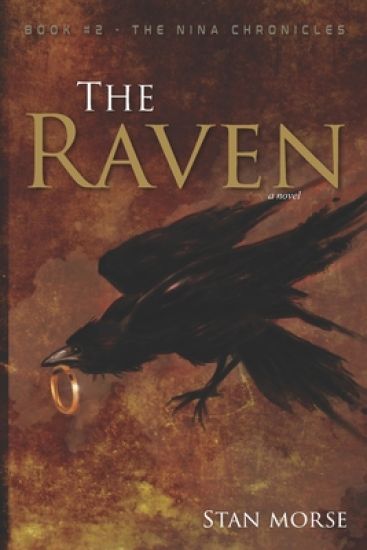
The Raven

The Raven

Stan Morse

R. R. Bowker
2020
nidottu
Nina will soon come to appreciate the Raven's unsolicited attention, as her extraordinary abilities begin to emerge far sooner than anyone thought possible. With the stakes taking a quantum leap, the Order's ruling council will now move to protect their privileged lives, placing Nina and those close to her in great danger.The second novel in The Nina Chronicles: a speculation about human evolution.
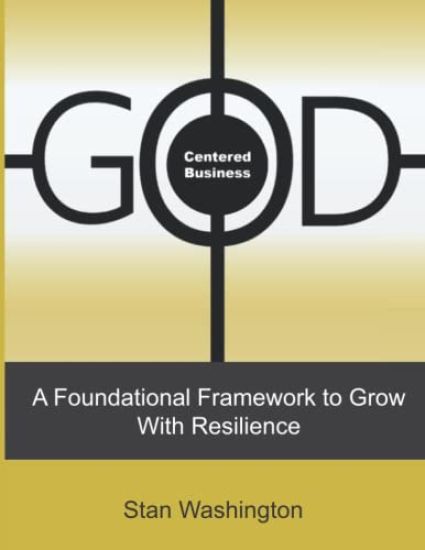
GOD Centered Business

GOD Centered Business

Stan Washington

Honor Services Inc
2021
pokkari
Why are you trying to be like other people when God made you special and unique for HIS purpose?Success looks very different to GOD. When HE calls you into business HE wants to make you succeed, but HE needs to do it HIS way. This framework teaches you how to achieve that success. The GOD-Centered Business: A Foundational Framework to Grow with Resilience emphasizes the true purpose of your business, namely to serve the LORD by serving others. You will go step-by-step to grow the foundations of a successful business. It starts with your leadership and the best example is CHRIST. Grow from HIM by using the 36-day journal to spend personal quiet time with the LORD. .Many books speak about starting a business, but what's next? Use this book to learn business development principles to identify and build GOD's vision, create expert content marketing, develop a peaceful sales model and implement outstanding customer service.Are you ready to enjoy a thriving business and a balanced lifestyle that is based on abundant relationships? Fulfil your purpose by being yourself through this framework and grow with resilience.
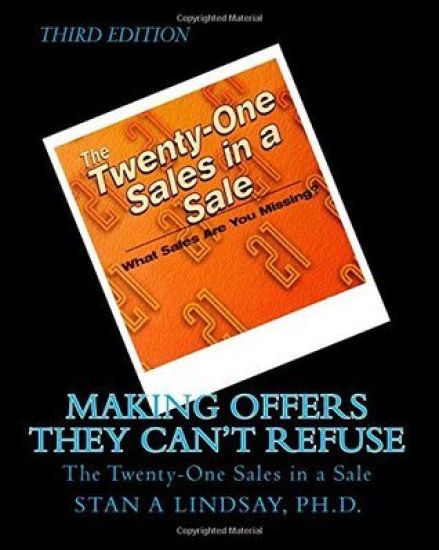
Making Offers They Can't Refuse: The Twenty-One Sales in a Sale
Making Offers They Can't Refuse presents an Integrated Marketing Communication approach, centering on a thorough business proposal approach. Presenting Personal Selling as an honorable, ethical, and successful profession, this book teaches you to be totally thorough in the presentation of your case, using the art of persuasion as developed by some of history's greatest geniuses--Plato, Aristotle, and Jesus--and modern-day theorists Kenneth Burke and Stephen Toulmin. By identifying every necessary persuasive step in a direct Personal Selling situation, you are encouraged to be thorough. Personal Selling is the most thorough form of marketing communication. Using Personal Sales as the skeleton upon which to introduce other forms of Integrated Marketing Communication IMC] in this book, various comments will apply the principles learned in each of the twenty-one sales in a sale to the field of IMC. IMC is an approach that recognizes that all types of Marketing Communication used by a business or organization should be coordinated, in order to produce the most effective marketing results. Clearly, the more coordinated the Marketing Communication messages delivered by a business or organization, the more cost-effective and results-effective the overall marketing message will be. Among the types of Marketing Communication included in IMC are: -Advertising (traditionally, the primary mass media form), -Public Relations (often, the attempt to receive mass media coverage without fees), -Personal Sales (the central skeletal approach of this book), -Promotions (providing opportunities, incentives, and stimuli for "trying" the product now), -Packaging (the messages sent by the way the product is packaged), -Sponsorships (reputation enhancement provided by sponsoring events, etc.), -Direct Marketing (through catalogs, infomercials, telemarketing, internet, etc.), -Online Marketing (through the internet).-Mobile Marketing (through cellphones and similar devices), and-Diffusion of Innovations (through word of mouth).Making Offers They Can't Refuse shows you how to integrate all of these forms of marketing communication to make the most effective marketing effort.
Argumentor

Argumentor

Stan A. Lindsay Ph. D.

Say Press
2015
nidottu
This book begins by defining argumentation--not as emotional assertions or in other negative senses--but as a logical, rational approach to making good decisions based upon sound reasoning. The author relies on the contributions of Aristotle (plus Aristotle's teacher, Plato, and Plato's teacher, Socrates) rather than attempting to "reinvent the wheel" of argumentation. Aristotle's perspective on dialectic and rhetoric constitutes the ground on which rhetoricians in the ancient Roman world, and rhetorical theoreticians of the Twentieth and Twenty-first Centuries have built. Contemporary scholars such as Kenneth Burke, Stephen Toulmin, and Chaim Perelman have refined Aristotle's wheel, and hence, improved upon it, but students of argumentation are well-advised to return, first of all, to the invention of the wheel-to examine its construction, to see how the basic structures operate in the argumentation process. Students of argumentation may, then, consider the refinements that have been made over the years. Using insights introduced by Socrates, Plato, and Aristotle and, later, fine-tuned by Stephen Toulmin, the book introduces deductive reasoning with its syllogism, rhetorical syllogism (the enthymeme), and Toulmin's six-part expansion of deductive reasoning. Inductive reasoning, with its reliance on examples and statistics is also introduced. Although argumentation is defined by Lindsay as primarily the logical proof presented by Aristotle (logos, as opposed to ethos and pathos), Lindsay extends Aristotle's concept of ethos to demonstrate the concept's reliance on the syllogism (logos), as well. Lindsay lists the eight primary characteristics of argumentation: 1. It is good; it allows rational individuals to reach rational conclusions, to make rational decisions. 2. It consists of offering proofs, not simply assertions. 3. It is the use of logic, as opposed to the use of emotion. 4. It is most successful when the participants do not feel an ego-centric need to win, but instead seek to find the most reasonable position on issues. 5. It may be used to test and maintain either an absolute truth or a probable truth. 6. It, at least, seeks to establish probable, possible, or plausible truth. 7. It is aimed primarily at producing faith/pistis, rather than absolute knowledge. 8. It uses proofs that consist only of logos, not ethos or pathos. To Aristotle's three contexts of rhetorical argumentation (judicial/legal, deliberative/political, and epideictic/cultural), Lindsay adds a fourth: arguments concerning all-time truth. Lindsay ultimately offers a thorough demonstration of how the multiple principles of argumentation are used to demonstrate that a problem exists, what caused the problem, what types of solutions to the problem are suitable, and how a complete proposal argument is put together.
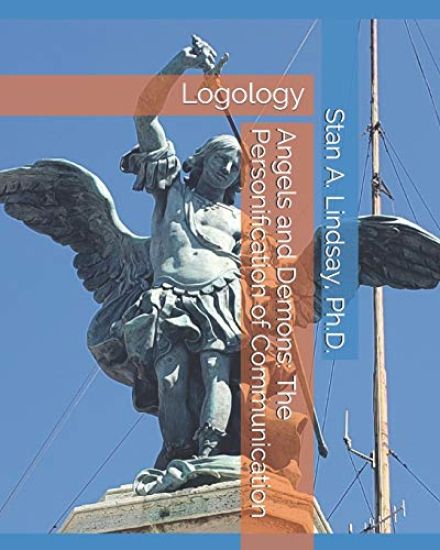
Angels and Demons: The Personification of Communication: Logology
Angels and Demons: The Personification of Communication offers a solid, scholarly presentation of angelology and demonology from early Jewish and Christian sources from the Hellenistic period. It demonstrates the existence of a new category of fallen angel stories: Sinless Fallen Angels. It demonstrates that the New Testament (along with Rabbinic Judaism) generally rejects the three most common views of the Fallen Angel story, from the Hellenistic and Persian periods. Finally, it expands on G. F. Moore's formula: "God's will is made known or effectuated in the world not only through personal agents (ANGELS), but directly by his WORD or by his SPIRIT" (emphases Lindsay's). Applying to Moore's formula the "logological" views of Communication scholar Kenneth Burke, the book argues that angels and demons are presented in early Jewish and Christian sources as the personification of communication. Pop culture perpetrates several myths regarding angels and demons that are alien to the literature of the Old or New Testament and early Rabbinic period. This book, however, pertains only to the angelology in that literature. Here are corrections some of the myths:1.Lucifer is NOT the devil, Satan, or even a Fallen Angel or demon. Mentioned only in Isaiah, Lucifer (meaning "Shining One") is a nickname for the King of Babylon, who thinks he is god-like, but will die like any other man.2.Satan is not an "evil god" who is at war with the Good God.3.The fallen angel stories you have heard do not occur anywhere in the Bible.4.Demons, such as the ones in the Exorcist with Linda Blair, or even in the Rite with Anthony Hopkins, are incorrectly portrayed, according the literature of the Old and New Testaments and early Rabbinic period. There is no levitation, no spinning heads, etc. in demon possession stories in the New Testament.5.Demons, according to the Apostle Paul, do not even exist as actual entities; they are nothing: the equivalent of Idols or False Gods.6.Angels have no capacity for having sex or for reproduction.Dr. Stan A. Lindsay has served on the faculties of Iowa Christian College, Indiana University, Purdue University, Loyola University Chicago, and Florida State University, for which schools he has taught Classical Greek, Classical and Mishnaic Hebrew, Biblical Studies, Burkean Studies, and Rhetorical Studies. He holds an M.A. in Hebrew, and worked on multiple Ph.D. programs in Hebrew, Comparative Literature, Biblical Studies, and Rhetoric, before completing the Ph.D. in Rhetoric at Purdue University. He is an internationally renowned specialist in the communication theory of Kenneth Burke. In light of these credentials, Dr. Lindsay provides a unique perspective for viewing the Judeo-Christian cultural, logological, rhetorical, and communicative aspect of angelology. Other books that Dr. Lindsay has published are: Implicit Rhetoric: Kenneth Burke's Extension of Aristotle's Concept of Entelechy (University Press of America, 1998), The Twenty-One Sales in a Sale (Oasis Press/PSI Research, 1998), Revelation: The Human Drama (Lehigh University Press, 2001), A Concise Kenneth Burke Concordance (Say Press, 2004), The Seven C's of Stress: A Burkean Approach (Say Press, 2004), Psychotic Entelechy: The Dangers of "Spiritual Gifts" Theology (University Press of America, 2006), Persuasion, Proposals, and Public Speaking 2nd ed. (Say Press, 2009), Disneology: Religious Rhetoric at Walt Disney World (Say Press, 2010), The Essence of Rhetoric in Disney Music (Say Press, 2010), Basic Public Relations Documents: Implicit Rhetoric in Action (Say Press, 2010), The Expanded Kenneth Burke Concordance (Say Press, 2014), ArguMentor (Say Press, 2015), Making Offers They Can't Refuse: The Twenty-One Sales in a Sale 3rd ed. (Say Press, 2015), and The Logic of Christianity: A Syllogistic Chain (Say Press, 2018).