The 1979 publication of Susan Gubar and Sandra M. Gilbert’s ground-breaking study The Madwoman in the Attic marked a founding moment in feminist literary history as much as feminist literary theory. In their extensive study of nineteenth-century women’s writing, Gubar and Gilbert offer radical re-readings of Jane Austen, the Brontës, Emily Dickinson, George Eliot and Mary Shelley tracing a distinctive female literary tradition and female literary aesthetic. Gubar and Gilbert raise questions about canonisation that continue to resonate today, and model the revolutionary importance of re-reading influential texts that may seem all too familiar
The 1979 publication of Susan Gubar and Sandra M. Gilbert’s ground-breaking study The Madwoman in the Attic marked a founding moment in feminist literary history as much as feminist literary theory. In their extensive study of nineteenth-century women’s writing, Gubar and Gilbert offer radical re-readings of Jane Austen, the Brontës, Emily Dickinson, George Eliot and Mary Shelley tracing a distinctive female literary tradition and female literary aesthetic. Gubar and Gilbert raise questions about canonisation that continue to resonate today, and model the revolutionary importance of re-reading influential texts that may seem all too familiar
This work has been selected by scholars as being culturally important, and is part of the knowledge base of civilization as we know it. This work was reproduced from the original artifact, and remains as true to the original work as possible. Therefore, you will see the original copyright references, library stamps (as most of these works have been housed in our most important libraries around the world), and other notations in the work.This work is in the public domain in the United States of America, and possibly other nations. Within the United States, you may freely copy and distribute this work, as no entity (individual or corporate) has a copyright on the body of the work.As a reproduction of a historical artifact, this work may contain missing or blurred pages, poor pictures, errant marks, etc. Scholars believe, and we concur, that this work is important enough to be preserved, reproduced, and made generally available to the public. We appreciate your support of the preservation process, and thank you for being an important part of keeping this knowledge alive and relevant.
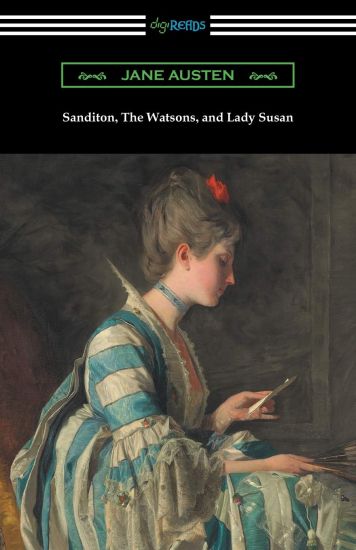
Collected together here are three of Jane Austen's posthumously published works; "Sanditon," "The Watsons," and "Lady Susan." These fragmentary tales show Austen experimenting with different literary styles and parodying the popular novels of her day. In "Sanditon," Austen uses the premise of an idyllic and modern seaside town to examine its inhabitants and their various social circles with her trademark sharp social observations and wit. "The Watsons" is the story of Mr. Watson, a widowed clergyman, and his two sons and four daughters. The heroine of the tale is the spirited daughter Emma, who finds her marriage prospects lessened by both her poverty and, ironically, her sense of refinement. "Lady Susan," the most complete of the three, is an epistolary novel which focuses on the story of its title character, a beautiful, but petty and unscrupulous woman. Lady Susan engages in constant flirtations and manipulations while she searches for rich husbands for herself and her young daughter. Also included here is a cancelled chapter of "Persuasion" and the short essay "Plan of a Novel" in which Austen sets out her capacity as a novelist and what makes up the ideal novel. This edition is printed on premium acid-free paper.
Susan Bogert Warner (July 11, 1819 - March 17, 1885), was an American evangelical writer of religious fiction, children's fiction, and theological works.Pen name, Elizabeth Wetherell.Born in New York City, she wrote, under the name of "Elizabeth Wetherell", thirty novels, many of which went into multiple editions. However, her first novel, The Wide, Wide World (1850), was the most popular. It was translated into several other languages, including French, German, and Dutch. Other than Uncle Tom's Cabin, it was perhaps the most widely circulated story of American authorship. Other works include Queechy (1852), The Law and the Testimony, (1853), The Hills of the Shatemuc, (1856), The Old Helmet (1863), and Melbourne House (1864). In the nineteenth century, critics admired the depictions of rural American life in her early novels. American reviewers also praised Warner's Christian and moral teachings, while London reviewers tended not to favor her didacticism. Early twentieth-century critics classified Warner's work as "sentimental" and thus lacking in literary value. In the later twentieth century, feminist critics rediscovered The Wide, Wide World, discussing it as a quintessential domestic novel and focusing on analyzing its portrayal of gender dynamics. Some of her works were written jointly with her younger sister Anna Bartlett Warner, who sometimes wrote under the pseudonym "Amy Lothrop". The Warner sisters also wrote famous children's Christian songs. Susan wrote "Jesus Bids Us Shine" while Anna was author of the first verse of the well-known children's song "Jesus Loves Me", which she wrote at Susan's request. Both sisters became devout Christians in the late 1830s. After their conversion, they became confirmed members of the Mercer Street Presbyterian church, although in later life, Warner became drawn into Methodist circles. The sisters also held Bible studies for the West Point cadets. When they were on military duty, the cadets would sing "Jesus Loves Me." The popularity of the song was so great that upon Warner's death, she was buried in the West Point Cemetery. Warner could trace her lineage back to the Puritans on both sides. Her father was Henry Warner, a New York City lawyer originally from New England, and her mother was Anna Bartlett, from a wealthy, fashionable family in New York's Hudson Square. When Warner was a young child, her mother died, and her father's sister Fanny came to live with the Warners. Although Henry Warner had been a successful lawyer, he lost most of his fortune in the Panic of 1837 and in subsequent lawsuits and poor investments. The family had to leave their mansion at St. Mark's Place in New York and move to an old Revolutionary War-era farmhouse on Constitution Island, near West Point, NY. In 1849, seeing little change in their family's financial situation, Susan and Anna started writing to earn income. Susan Warner died in Highland Falls, New York and is buried in the West Point Cemetery.
Susan Bogert Warner (July 11, 1819 - March 17, 1885), was an American evangelical writer of religious fiction, children's fiction, and theological works.Pen name, Elizabeth Wetherell. Born in New York City, she wrote, under the name of "Elizabeth Wetherell", thirty novels, many of which went into multiple editions. However, her first novel, The Wide, Wide World (1850), was the most popular. It was translated into several other languages, including French, German, and Dutch. Other than Uncle Tom's Cabin, it was perhaps the most widely circulated story of American authorship. Other works include Queechy (1852), The Law and the Testimony, (1853), The Hills of the Shatemuc, (1856), The Old Helmet (1863), and Melbourne House (1864). In the nineteenth century, critics admired the depictions of rural American life in her early novels. American reviewers also praised Warner's Christian and moral teachings, while London reviewers tended not to favor her didacticism. Early twentieth-century critics classified Warner's work as "sentimental" and thus lacking in literary value. In the later twentieth century, feminist critics rediscovered The Wide, Wide World, discussing it as a quintessential domestic novel and focusing on analyzing its portrayal of gender dynamics. Some of her works were written jointly with her younger sister Anna Bartlett Warner, who sometimes wrote under the pseudonym "Amy Lothrop". The Warner sisters also wrote famous children's Christian songs. Susan wrote "Jesus Bids Us Shine" while Anna was author of the first verse of the well-known children's song "Jesus Loves Me", which she wrote at Susan's request. Both sisters became devout Christians in the late 1830s. After their conversion, they became confirmed members of the Mercer Street Presbyterian church, although in later life, Warner became drawn into Methodist circles. The sisters also held Bible studies for the West Point cadets. When they were on military duty, the cadets would sing "Jesus Loves Me." The popularity of the song was so great that upon Warner's death, she was buried in the West Point Cemetery. Warner could trace her lineage back to the Puritans on both sides. Her father was Henry Warner, a New York City lawyer originally from New England, and her mother was Anna Bartlett, from a wealthy, fashionable family in New York's Hudson Square. When Warner was a young child, her mother died, and her father's sister Fanny came to live with the Warners. Although Henry Warner had been a successful lawyer, he lost most of his fortune in the Panic of 1837 and in subsequent lawsuits and poor investments. The family had to leave their mansion at St. Mark's Place in New York and move to an old Revolutionary War-era farmhouse on Constitution Island, near West Point, NY. In 1849, seeing little change in their family's financial situation, Susan and Anna started writing to earn income. Susan Warner died in Highland Falls, New York and is buried in the West Point Cemetery.
Poets and writers Susan Howe and Alexis Pauline Gumbs read each other’s work and discuss reading and being read as an act of intimacy Published on the occasion of Adam Pendleton: Who Is Queen? at the Museum of Modern Art, New York, the book series Who Is Queen? adapts conversations between pairs of notable writers, theorists, philosophers and musicians into contrapuntal texts intertwined with archival photographs and additional writings. Alexis Pauline Gumbs (born 1982) is the author of several books, most recently Undrowned: Black Feminist Lessons from Marine Mammals (2020), and the cofounder of the Mobile Homecoming Trust, an "intergenerational experiential living library of Black LBGTQ brilliance." Susan Howe’s (born 1937) most recent poetry collection was Concordance, published in 2020 along with a reissue of Spontaneous Particulars (2014), a prose meditation on her research in rare book collections. Her selected essays, collected in The Quarry, were published in 2015, and a poetry collection, Debths (2017), won Canada’s Griffin Award for Poetry in 2018.
Over her career Susan Sherratt has questioned our basic assumptions in many areas of the later prehistory of the Mediterranean and Europe, deploying a canny eye for detail, but never losing sight of the big picture. Her collected works include contributions on the relationship between Homeric epic and archaeology; the economy of ceramics, metals and other materials; the status of the ‘Sea Peoples’ and other ethnic terminologies; routes and different forms of interaction; and the history of museums/collecting (especially relating to Sir Arthur Evans). The editors of ?T?????? (Athyrmata) have brought together a cast of thirty-two scholars from nine different countries who have contributed these twenty-six papers to mark Sue’s 65th birthday – a collection that seeks to reflect both her broad range of interests and her ever-questioning approach to uncovering the realities of life in Europe and the Mediterranean in later prehistory.