Kirjojen hintavertailu. Mukana 11 244 527 kirjaa ja 12 kauppaa.

Kirjahaku

Etsi kirjoja tekijän nimen, kirjan nimen tai ISBN:n perusteella.

1000 tulosta hakusanalla THOMAS LECHFORD

The Papers of Thomas Jefferson, Retirement Series, Volume 17

The Papers of Thomas Jefferson, Retirement Series, Volume 17

Thomas Jefferson

PRINCETON UNIVERSITY PRESS
2021
sidottu
A definitive scholarly edition of the retirement papers of Thomas JeffersonThe 612 documents in this volume include Jefferson’s notes on his early career, one of the lengthiest documents of his retirement. Often misleadingly called his autobiography, the text describes Jefferson’s experience as an American revolutionary, a legislator shaping and revising Virginia’s laws, and a United States diplomat in France as its own revolution neared.Jefferson sits for a portrait by Thomas Sully commissioned for West Point. He takes the unusual step of allowing his recommendation of a book by John Taylor to be published, insuring a wide circulation of Jefferson’s views on the proper balance between state and federal powers. In a private letter he asserts that the federal judiciary is amassing overarching power, “ever acting, with noiseless foot, & unalarming advance, gaining ground step by step, and holding what it gains.” Jefferson receives a description of an African American commemoration of the nation’s 1807 ban on the importation of slaves.Jefferson advises that the opening of the University of Virginia is not imminent even as he oversees its construction and defends the high cost, stating as his goal, “to do, not what was to perish with ourselves, but what would remain, be respected and preserved thro’ other ages.”
Thomas Kyd

Thomas Kyd

Brian Vickers

PRINCETON UNIVERSITY PRESS
2024
sidottu
A groundbreaking new account of the author of The Spanish Tragedy that establishes him as a major Elizabethan dramatistThomas Kyd (1558–1594) was a highly regarded dramatist and the author of The Spanish Tragedy, the first revenge tragedy and the most influential Elizabethan play. In this first full study of his life and works, Brian Vickers discusses Kyd’s accepted canon as well as three additional plays Vickers has newly identified as having been written by Kyd—exciting discoveries that establish him as a major dramatist.Thomas Dekker, a fellow Elizabethan dramatist, referred to “industrious Kyd,” which suggests a greater output than the three plays traditionally attributed to him—The Spanish Tragedy, Soliman and Perseda, and Cornelia. Kyd worked between 1585 and 1594, when the plague led to the anonymous publication of many plays because of the breakup of several London theatre companies. Researching this corpus, Vickers has identified Kyd’s authorship of three more plays: Arden of Faversham, the first domestic tragedy, King Leir and his three daughters, a tragicomedy that provided Shakespeare with his main source, and Fair Em, a love comedy. These attributions are based on two forms of evidence: unique similarities of plot between Kyd’s acknowledged and newly attributed plays and many unique phrases shared by all six plays as identified by modern software.Discussing all the plays in detail and placing them in biographical and historical context, Thomas Kyd offers a major reassessment of an underappreciated Elizabethan playwright.
The Papers of Thomas Jefferson, Retirement Series, Volume 18

The Papers of Thomas Jefferson, Retirement Series, Volume 18

Thomas Jefferson

PRINCETON UNIVERSITY PRESS
2022
sidottu
A new definitive volume of the retirement papers of Thomas JeffersonThis volume’s 627 documents feature a vast assortment of topics. Jefferson writes of his dread of “a doting old age.” He inserts an anonymous note in the Richmond Enquirer denying that he has endorsed a candidate for the next presidential election, and he publishes two letters in that newspaper under his own name to refute a Federalist claim that he once benefited by overcharging the United States Treasury. Jefferson does not reply to unsolicited letters seeking his opinion on constitutional matters, judicial review, and a call for universal white male suffrage in Virginia. Fearing that it would set a dangerous precedent, he declines appointment as patron of a new society “for the civilisation of the Indians.” Jefferson is also asked to comment on proposed improvements to stoves, lighthouses, telescopes, and navigable balloons. Citing his advanced age and stiffened wrist, he avoids detailed replies and allows his complaint to John Adams about the volume of incoming correspondence to be leaked to the press in hopes that strangers will stop deluging them both with letters. Jefferson approves of the growth of Unitarianism and predicts that “there is not a young man now living in the US. who will not die an Unitarian.”
The Papers of Thomas Jefferson, Volume 46

The Papers of Thomas Jefferson, Volume 46

Thomas Jefferson

PRINCETON UNIVERSITY PRESS
2022
sidottu
A definitive scholarly edition of the correspondence and papers of Thomas JeffersonCongress adjourns early in March, and Jefferson goes home to Monticello for a month. After his return to Washington, he corresponds with territorial governors concerning appointments to legislative councils. He peruses information about Native American tribes, Spanish and French colonial settlements, and the geography of the Louisiana Territory. He seeks the consent of Spanish authorities to a U.S. exploration along the Red River while asserting privately that Spain “has met our advances with jealousy, secret malice, and ill faith.” A new law extends civil authority over foreign warships in U.S. harbors, and he considers using it also to constrain privateers. Federalist opponents bring up “antient slanders” to question his past private and official actions. His personal finances are increasingly reliant on bank loans. He starts a search for a new farm manager at Monticello. Meriwether Lewis and William Clark write from Fort Mandan in April before setting out up the Missouri River. Jefferson will not receive their reports until mid-July. In the Mediterranean, William Eaton coordinates the capture of the port of Derna and Tobias Lear negotiates terms of peace with Pasha Yusuf Qaramanli to end the conflict with Tripoli. News of those events will not reach the United States until September.
The Papers of Thomas Jefferson, Retirement Series, Volume 19

The Papers of Thomas Jefferson, Retirement Series, Volume 19

Thomas Jefferson

PRINCETON UNIVERSITY PRESS
2023
sidottu
A definitive new volume of the retirement papers of Thomas JeffersonThis volume’s 601 documents show Jefferson dealing with various challenges. He is injured in a fall at Monticello, and his arm is still in a sling months later when he narrowly escapes drowning during a solitary horseback ride. Jefferson obtains temporary financial relief by transferring a $20,000 debt from the Bank of the United States to the College of William and Mary.Aided by a review of expenditures by the University of Virginia that uncovers no serious discrepancies, Jefferson and the Board of Visitors obtain a further $60,000 loan that permits construction to begin on the Rotunda.Jefferson drafts but apparently does not send John Adams a revealing letter on religion. He exchanges long letters discussing the Supreme Court with Justice William Johnson, and he writes to friends about France’s 1823 invasion of Spain. Jefferson also helps prepare a list of recommended books for the Albemarle Library Society.In November 1822, Jefferson’s grandson Francis Eppes marries Mary Elizabeth Randolph. He gives the newlyweds his mansion at Poplar Forest and visits it for the last time the following May. In a letter to James Monroe, Jefferson writes and then cancels “my race is near it’s term, and not nearer, I assure you, than I wish.”
The Papers of Thomas Jefferson, Volume 47

The Papers of Thomas Jefferson, Volume 47

Thomas Jefferson

PRINCETON UNIVERSITY PRESS
2023
sidottu
A definitive scholarly edition of the correspondence and papers of Thomas JeffersonJefferson continues his pattern of returning home to Monticello for the summer months. He makes a brief visit to Poplar Forest in Bedford County to plan the development of that property. James Hubbard, a young enslaved worker at Monticello, escapes but is captured in Fairfax County. Another slave who has fled, James Hemings, rejects efforts to persuade him to return and disappears. Receiving news of the end of the conflict with Tripoli, Jefferson states that although it is “a small war in fact, it is big in principle.” He devotes much of his attention to relations with Spain. He considers alliance with Great Britain to force a resolution with Spain, then chooses instead to negotiate with France for the purchase of Florida and settlement of matters in dispute with Spain. He drafts bills to organize the militia by age and create a naval militia. Specimens sent by Lewis and Clark arrive. Jefferson calculates that the United States has recently acquired cessions of well over 9 million acres of land from Native Americans. He meets with visiting Creek leaders. Answering a query, Jefferson states that Patrick Henry was “the greatest orator that ever lived” but “avaritious & rotten hearted.”
The Papers of Thomas Jefferson, Retirement Series, Volume 20

The Papers of Thomas Jefferson, Retirement Series, Volume 20

Thomas Jefferson

PRINCETON UNIVERSITY PRESS
2024
sidottu
A definitive new volume of the retirement papers of Thomas JeffersonDuring the period covered by the 575 documents in this volume, Jefferson advises President James Monroe on what later becomes known as the “Monroe Doctrine.” He also approves of the Greek independence movement in correspondence with the scholar and political leader Adamantios Coray.Jefferson says that the “most dangerous blot” on the U.S. Constitution is the provision under which a vote by the states in the House of Representatives decides elections not settled by the Electoral College. With his allies in Virginia’s General Assembly, he succeeds in converting the University of Virginia’s loans from the state Literary Fund into an outright grant and obtains an additional $50,000 for books and scientific instruments. He seeks advice on regulating and equipping the institution, helps to obtain its architectural capitals, and designs its gymnasia.Jefferson describes coffee as “the favorite beverage of the civilised world” and advises a namesake child to “Adore God. reverence and cherish your parents. love your neighbor as yourself; and your country more than life. be just. be true. murmur not at the ways of Providence, and the life into which you have entered will be the passage to one of eternal and ineffable bliss.”
Thomas Paine Collected Writings, Volume 2

Thomas Paine Collected Writings, Volume 2

Thomas Paine

PRINCETON UNIVERSITY PRESS
2026
sidottu
A comprehensive scholarly edition of the writings and correspondence of Thomas Paine Thomas Paine: Collected Writings is the first major new edition of Paine’s works, bringing together all his writings in six breathtaking volumes that dramatically revise our previous understanding of his activities as a writer and his importance as a democratic theorist in the age of revolutions. It includes about 180 new letters and some two hundred works newly attributed to Paine, with twenty-nine works previously regarded as Paine’s being deattributed. Drawing on pioneering computerized text analysis that makes possible for the first time attributions of anonymous and pseudonymous texts, this collection includes in volumes 5–6 newly identified pamphlets and newspaper and journal contributions, and suggests that Paine was extremely active as a Grub Street oppositional Whig writer in the decade prior to the American Revolution. Many writings from the period of his residence in France (1792–1802) and his subsequent return to the United States are also restored to his published output. Paine emerges as a much more consistent and serious democratic theorist than is often assumed, whose contribution to revolutionary debates in America, Britain, and France were unparalleled in its time. This volume spans the years 1782 to 1793, a period in which Paine explored the theoretical foundations of the ideas and institutions he championed in Common Sense. The book includes the Letter to the Abbé Raynal, Dissertations on Government, Prospects on the Rubicon, and Rights of Man. It also reprints “Liberty Tree,” “The Death of General Wolfe,” and other poems, with commentary by the editors providing invaluable historical context.
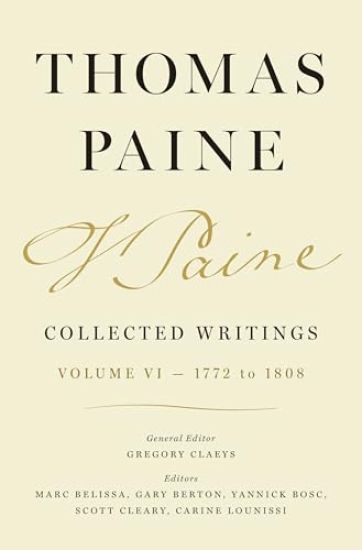
Thomas Paine Collected Writings, Volume 6

Thomas Paine Collected Writings, Volume 6

Thomas Paine

PRINCETON UNIVERSITY PRESS
2026
sidottu
A comprehensive scholarly edition of the writings and correspondence of Thomas Paine Thomas Paine: Collected Writings is the first major new edition of Paine’s works, bringing together all his writings in six breathtaking volumes that dramatically revise our previous understanding of his activities as a writer and his importance as a democratic theorist in the age of revolutions. It includes about 180 new letters and some two hundred works newly attributed to Paine, with twenty-nine works previously regarded as Paine’s being deattributed. Drawing on pioneering computerized text analysis that makes possible for the first time attributions of anonymous and pseudonymous texts, this collection includes in volumes 5–6 newly identified pamphlets and newspaper and journal contributions, and suggests that Paine was extremely active as a Grub Street oppositional Whig writer in the decade prior to the American Revolution. Many writings from the period of his residence in France (1792–1802) and his subsequent return to the United States are also restored to his published output. Paine emerges as a much more consistent and serious democratic theorist than is often assumed, whose contribution to revolutionary debates in America, Britain, and France were unparalleled in its time. The supplementary writings presented in this volume span the years 1772 to 1808, a time of political maturation for Paine as he engaged with a host of issues and causes in America, Britain, and France. Often written anonymously or under known or new aliases, these pieces suggest a very different narrative of his activities and development during this period. Commentary by the editors provides invaluable historical context.
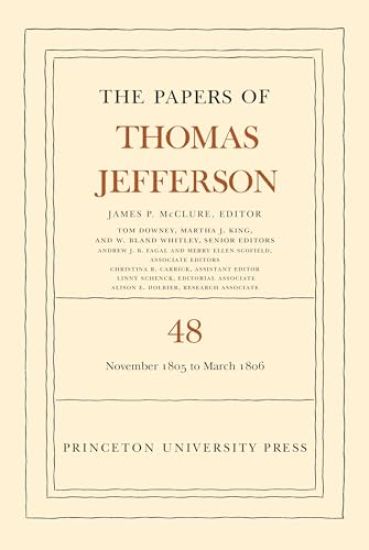
The Papers of Thomas Jefferson, Volume 48

The Papers of Thomas Jefferson, Volume 48

Thomas Jefferson

PRINCETON UNIVERSITY PRESS
2025
sidottu
A definitive scholarly edition of the correspondence and papers of Thomas JeffersonJefferson sends his annual message to Congress. He submits the peace treaty with Tripoli, but ratification takes months as the Senate asks for supporting documentation and Congress considers the request of Ahmad Qaramanli for compensation. The president desires action to make Spain negotiate outstanding issues and urges defensive preparations in the event of armed conflict. Congress appropriates $2 million for the purchase of Florida and approves the appointment of James Bowdoin and John Armstrong as commissioners to negotiate. New restrictive measures by Great Britain that threaten to choke off American trade with the West Indies spark memorials by merchants in seaport cities. After Congress passes an act outlawing trade with Haiti for a year, Timothy Pickering decries the administration’s “spaniel servility” to France. Representatives of the Cherokee, Potawatomi, Sac, Fox, Osage, Missouri, Kansas, Otoe, Iowa, Pawnee, and Sioux nations come to Washington. South American revolutionary Francisco de Miranda travels in the United States, secretly collecting men and materials for a projected uprising in Venezuela. Tunisian envoy Sulayman Melmelli is in Washington. Jefferson’s daughter Martha Randolph and her family make an extended visit to the capital, during which his newest grandchild, James Madison Randolph, is born in the President’s House.
The Papers of Thomas Jefferson, Retirement Series, Volume 21

The Papers of Thomas Jefferson, Retirement Series, Volume 21

Thomas Jefferson

PRINCETON UNIVERSITY PRESS
2025
sidottu
A definitive new volume of the retirement papers of Thomas JeffersonThe 533 documents in this volume include revealing material on Jefferson’s health. He is limited to a liquid diet for weeks due to an abscess under his jaw. Although daily horseback rides take him “3. or 4. to 8. or 10. miles without fatigue,” he cannot walk “further than my garden.” He has lost only one tooth due to age and is glad not to need “teeth of porcelain.”Due to debility, Jefferson’s only serious occupation is the effort to open the University of Virginia. Francis W. Gilmer travels to Great Britain to recruit professors and buy “a library and apparatus.” Jefferson is determined to hire only faculty of “the first grade of science.” The Rotunda is still unfinished but fit for use “until funds may occur to compleat it.”Jefferson predicts that a plan to send freed African Americans to Africa will fail. He observes that “barbarism” is in decline and “will in time I trust disappear from the earth.” To another correspondent he defends “the principles which have guided my public life,” but adds that, when altered circumstances make changes of principle beneficial, “then let such changes take place, and the means yield to the end.”
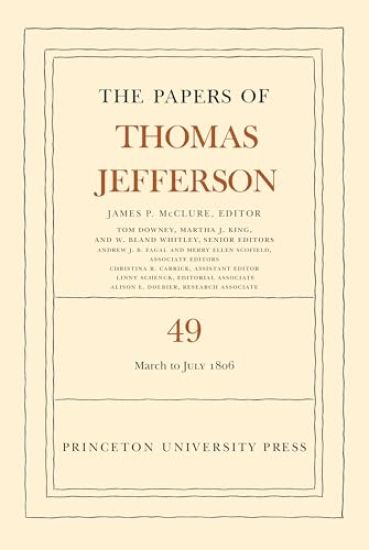
The Papers of Thomas Jefferson, Volume 49

The Papers of Thomas Jefferson, Volume 49

Thomas Jefferson

PRINCETON UNIVERSITY PRESS
2026
sidottu
A definitive scholarly edition of the correspondence and papers of Thomas JeffersonThe Senate confirms John Armstrong and James Bowdoin as commissioners to negotiate with Spain and James Monroe and William Pinkney to do the same with Great Britain. In speeches in the House of Representatives, John Randolph attacks the administration’s measures and declares that the president has lost the confidence of the cabinet. Jefferson shrugs this off, maintaining that Randolph can pull away only a few Republicans. In the approaches to New York harbor, a shot from a British warship causes the death of an American mariner. Jefferson issues a proclamation that calls for the apprehension of Henry Whitby, the captain of the warship, and bars his ship and others with it from American ports and waters. Congress passes an act to limit the navy to 925 seamen, capping the number of ships and raising Jefferson’s concerns in light of a potential war with Tunis. He plans to use gunboats and militia to protect Orleans Territory in the event of conflict with Spain. Aaron Burr calls on him and hints that he could do “much harm.” Jefferson’s mentor George Wythe dies by poisoning, leaving Jefferson his books. Jefferson plans and begins to lay out the large garden for vegetables at Monticello.
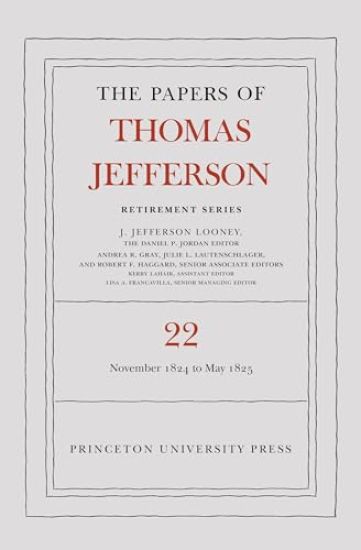
The Papers of Thomas Jefferson, Retirement Series, Volume 22

The Papers of Thomas Jefferson, Retirement Series, Volume 22

Thomas Jefferson

PRINCETON UNIVERSITY PRESS
2026
sidottu
A definitive new volume of the retirement papers of Thomas JeffersonThe 586 documents in this volume begin with Lafayette’s celebrated American tour, during which he spends eleven days at Monticello early in November 1825 and discusses the institution of slavery with Jefferson. During a slightly later visit accompanied by Daniel Webster, George Ticknor describes Jefferson as “very active, lively, and happy,” and “entirely absorbed” with plans for the University of Virginia.Francis W. Gilmer returns, having successfully recruited five European professors for the new school. Two teachers already in America complete the founding faculty. Although Jefferson is “almost in despair” that the law chair remains unfilled, the University of Virginia finally opens its doors on 7 March 1825. Fearing that a plan to move the College of William and Mary to Richmond would draw students and resources away from the university, Jefferson’s allies defeat the proposal. Jefferson drafts a bill to dismantle the college, but it is ultimately not submitted. Potential university students, professors, and hotel keepers seek information and advice.Jefferson congratulates John Adams on the election of his son to the presidency but commiserates with him that aging has left them both “alone amidst a new generation whom we know not, and who know not us.”
Thomas Hooker, 1586-1647

Thomas Hooker, 1586-1647

Frank Shuffelton

Princeton University Press
2015
pokkari
Examining the relationship between Hooker's activities and his writings, Frank Shuffelton considers his role in the crises of early New England politics and religion. The author analyzes Hooker's works and shows that as preacher and pastor, theologian and architect of the Puritan religious community, Thomas Hooker voiced concerns that remained important throughout American history. The analysis of Hooker's career is especially valuable for the information it provides concerning his close involvement with the major issues of the day: the conflict between Roger Williams and the Bay Colony; the antinomian controversy; the political and religious striving of the Massachusetts Bay Colony; and the forming of a truly American community. The author distinguishes several phases in Hooker's activities that correspond to his cultural and geographical milieu at different times. He discusses Hooker's education, first pastoral experience, and career. Originally published in 1977. The Princeton Legacy Library uses the latest print-on-demand technology to again make available previously out-of-print books from the distinguished backlist of Princeton University Press. These editions preserve the original texts of these important books while presenting them in durable paperback and hardcover editions. The goal of the Princeton Legacy Library is to vastly increase access to the rich scholarly heritage found in the thousands of books published by Princeton University Press since its founding in 1905.
Thomas Chatterton's Art

Thomas Chatterton's Art

Donald S. Taylor

Princeton University Press
2015
pokkari
Thomas Chatterton's fabrications--or "forgeries"--of historical poems ostensibly written from the thirteenth through the fifteenth centuries have attracted a great deal of attention and discussion of their authenticity since the eighteenth century. Nevertheless, his works have never before been the subject of a sustained serious and critical investigation that focused on his artistic achievement rather than on the legend and myth surrounding his melodramatic life. Donald Taylor's study provides a thorough analysis of Chatterton's poems and to place them in the context of the poetic and literary traditions that influenced him. Setting his analyses within the contexts of "historic," heroic, satiric, pastoral, and descriptive modes, the author considers each of Chatterton's major works as solutions to the literary problems the poet set for himself, thus tracing the literary history of Chatterton's artistic development as a sequence of subjects and literary modes explored. As Professor Taylor amply demonstrates, Thomas Chatterton's brief career embodies important features of the literary transition from the Augustans to the Romantics and, contrary to traditional assumptions, shows that the historical worlds Chatterton imagined have close ties to the century and sensibility against which he is assumed to have rebelled. Originally published in 1979. The Princeton Legacy Library uses the latest print-on-demand technology to again make available previously out-of-print books from the distinguished backlist of Princeton University Press. These editions preserve the original texts of these important books while presenting them in durable paperback and hardcover editions. The goal of the Princeton Legacy Library is to vastly increase access to the rich scholarly heritage found in the thousands of books published by Princeton University Press since its founding in 1905.
Thomas Jefferson's Paris

Thomas Jefferson's Paris

Howard C. Rice

Princeton University Press
2015
pokkari
This handsomely illustrated picture book provides a remarkable glimpse of the Paris Jefferson knew--Paris on the eve of the French Revolution. The houses, gardens, bookshops, and landmarks of the time are brought to life through commentary and drawings, paintings, and maps. Originally published in 1976. The Princeton Legacy Library uses the latest print-on-demand technology to again make available previously out-of-print books from the distinguished backlist of Princeton University Press. These editions preserve the original texts of these important books while presenting them in durable paperback and hardcover editions. The goal of the Princeton Legacy Library is to vastly increase access to the rich scholarly heritage found in the thousands of books published by Princeton University Press since its founding in 1905.
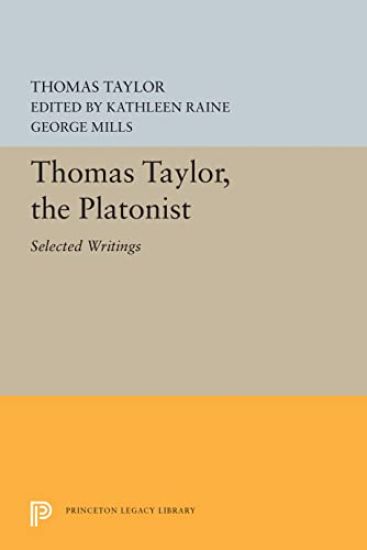
Thomas Taylor, the Platonist

Thomas Taylor, the Platonist

Thomas Taylor

Princeton University Press
2019
pokkari
This volume makes available to the modern reader selected writings of Thomas Taylor, the eighteenth-century English Platonist. TO Taylor we are indebted for the first full translation into English of Plato and Aristotle. Platonism, as Taylor saw it, was an informing principle, transmitted through a "golden chain of philosophers," a doctrine received by Socrates and Plato from the Orphic and Pythagorean past and transmitted to the future. It emerged again and again, enriched in the School of Alexandria, in Renaissance art, in the works of Spenser, Shelley, Yeats. Kathleen Raine is well known as a poet. GEorge Mills Harper is Professor of English, University of Florida. Bollingen Series LXXXVIII.Originally published in 1969.The Princeton Legacy Library uses the latest print-on-demand technology to again make available previously out-of-print books from the distinguished backlist of Princeton University Press. These editions preserve the original texts of these important books while presenting them in durable paperback and hardcover editions. The goal of the Princeton Legacy Library is to vastly increase access to the rich scholarly heritage found in the thousands of books published by Princeton University Press since its founding in 1905.
Thomas Sheridan of Smock-Alley

Thomas Sheridan of Smock-Alley

Esther K. Sheldon

Princeton University Press
2015
pokkari
This account of Thomas Sheridan's career as theater manager has been based on biographies written by his contemporaries, on 18th-century newspapers and pamphlets, and on letters written to and by Sheridan. The author also gives us much new information about Sheridan's relations with David Garrick. In an appendix, the author has included a Smock-Alley Calendar, giving a daily record of performances and casts. Most of the material in the Calendar has not been collected before and should be invaluable to theater historians. Originally published in 1967. The Princeton Legacy Library uses the latest print-on-demand technology to again make available previously out-of-print books from the distinguished backlist of Princeton University Press. These editions preserve the original texts of these important books while presenting them in durable paperback and hardcover editions. The goal of the Princeton Legacy Library is to vastly increase access to the rich scholarly heritage found in the thousands of books published by Princeton University Press since its founding in 1905.
Thomas Hooker, 1586-1647

Thomas Hooker, 1586-1647

Frank Shuffelton

Princeton University Press
2016
sidottu
Examining the relationship between Hooker's activities and his writings, Frank Shuffelton considers his role in the crises of early New England politics and religion. The author analyzes Hooker's works and shows that as preacher and pastor, theologian and architect of the Puritan religious community, Thomas Hooker voiced concerns that remained important throughout American history. The analysis of Hooker's career is especially valuable for the information it provides concerning his close involvement with the major issues of the day: the conflict between Roger Williams and the Bay Colony; the antinomian controversy; the political and religious striving of the Massachusetts Bay Colony; and the forming of a truly American community. The author distinguishes several phases in Hooker's activities that correspond to his cultural and geographical milieu at different times. He discusses Hooker's education, first pastoral experience, and career. Originally published in 1977. The Princeton Legacy Library uses the latest print-on-demand technology to again make available previously out-of-print books from the distinguished backlist of Princeton University Press. These editions preserve the original texts of these important books while presenting them in durable paperback and hardcover editions. The goal of the Princeton Legacy Library is to vastly increase access to the rich scholarly heritage found in the thousands of books published by Princeton University Press since its founding in 1905.