Kirjojen hintavertailu. Mukana 11 241 044 kirjaa ja 12 kauppaa.

Kirjahaku

Etsi kirjoja tekijän nimen, kirjan nimen tai ISBN:n perusteella.

1000 tulosta hakusanalla Theodor Boder

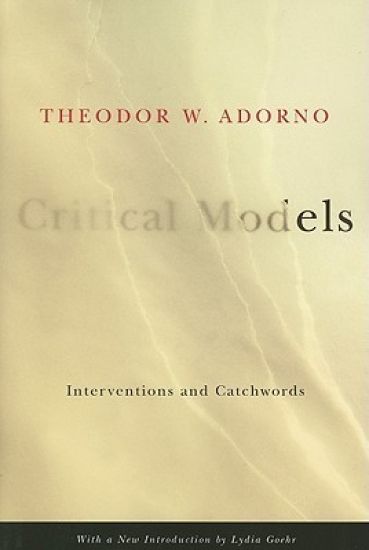
Critical Models

Critical Models

Theodor W. Adorno

Columbia University Press
2005
sidottu
Critical Models combines into a single volume two of Adorno's most important postwar works - Interventions: Nine Critical Models (1963) and Catchwords: Critical Models II (1969). Written after his return to Germany in 1949, the articles, essays, and radio talks included in this volume speak to the pressing political, cultural, and philosophical concerns of the postwar era. The pieces in Critical Models reflect the intellectually provocative as well as the practical Adorno as he addresses such issues as the dangers of ideological conformity, the fragility of democracy, educational reform, the influence of television and radio, and the aftermath of fascism. This new edition includes an introduction by Lydia Goehr, a renowned scholar in philosophy, aesthetic theory, and musicology. Goehr illuminates Adorno's ideas as well as the intellectual, historical, and critical contexts that shaped his postwar thinking.
Critical Models

Critical Models

Theodor W. Adorno

Columbia University Press
2005
pokkari
Critical Models combines into a single volume two of Adorno's most important postwar works - Interventions: Nine Critical Models (1963) and Catchwords: Critical Models II (1969). Written after his return to Germany in 1949, the articles, essays, and radio talks included in this volume speak to the pressing political, cultural, and philosophical concerns of the postwar era. The pieces in Critical Models reflect the intellectually provocative as well as the practical Adorno as he addresses such issues as the dangers of ideological conformity, the fragility of democracy, educational reform, the influence of television and radio, and the aftermath of fascism. This new edition includes an introduction by Lydia Goehr, a renowned scholar in philosophy, aesthetic theory, and musicology. Goehr illuminates Adorno's ideas as well as the intellectual, historical, and critical contexts that shaped his postwar thinking.
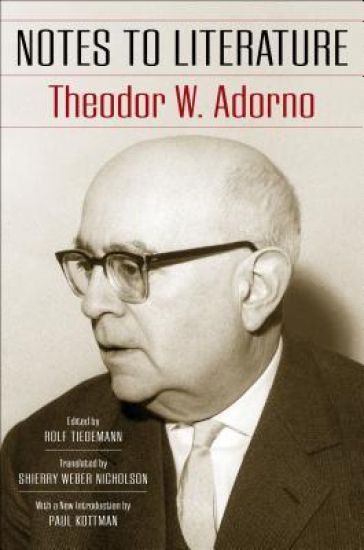
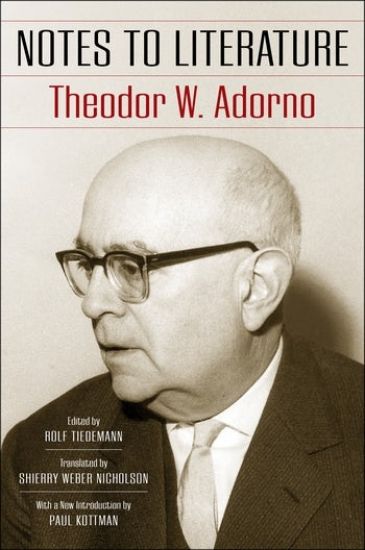
Notes to Literature

Notes to Literature

Theodor W. Adorno

Columbia University Press
2019
sidottu
Notes to Literature is a collection of the great social theorist Theodor W. Adorno’s essays on such writers as Mann, Bloch, Hölderlin, Siegfried Kracauer, Goethe, Benjamin, and Stefan George. It also includes his reflections on a variety of subjects, such as literary titles, the physical qualities of books, political commitment in literature, the light-hearted and the serious in art, and the use of foreign words in writing. This edition presents this classic work in full in a single volume, with a new introduction by Paul Kottman.
Notes to Literature

Notes to Literature

Theodor W. Adorno

Columbia University Press
2019
pokkari
Notes to Literature is a collection of the great social theorist Theodor W. Adorno’s essays on such writers as Mann, Bloch, Hölderlin, Siegfried Kracauer, Goethe, Benjamin, and Stefan George. It also includes his reflections on a variety of subjects, such as literary titles, the physical qualities of books, political commitment in literature, the light-hearted and the serious in art, and the use of foreign words in writing. This edition presents this classic work in full in a single volume, with a new introduction by Paul Kottman.
Hegel

Hegel

Theodor W. Adorno

MIT Press
1994
pokkari
This short masterwork in twentieth-century philosophy provides both a major reinterpretation of Hegel and insight into the evolution of Adorno's critical theory. The first study focuses on the relationship of reason, the individual, and society in Hegel, defending him against the criticism that he was merely an apologist for bourgeois society. The second study examines the experiential content of Hegel's idealism, considering the notion of experience in relation to immediacy, empirical reality, science, and society. The third study, "Skoteinos," is an unusual and fascinating essay in which Adorno lays out his thoughts on understanding Hegel. In his reflections, which spring from his experience teaching at the Goethe University in Frankfurt, questions of textual and philosophical interpretation are intertwined. Rescuing the truth value of Hegel's work is a recurring theme of the critical theory of the Frankfurt School, and nowhere is this goal pursued with more insight than in these three studies. The core problem Adorno sets for himself is how to read Hegel in a way that comprehends both the work and its historical context, thereby allowing conclusions to be drawn that may seem on the surface to be exactly opposed to what Hegel wrote but that are, nevertheless, valid as the present truth of the work. It is the elaboration of this method of interpretation, a negative dialectic, that was Adorno's underlying goal. Adorno's efforts to salvage the contemporaneity of Hegel's thought form part of his response to the increasingly tight net of social control in the aftermath of World War II. In this, his work is related to the very different attempts to undermine reified thinking undertaken by the various French theorists. The continued development of what Adorno called "the administered world" has only increased the relevance of his efforts.