Kirjojen hintavertailu. Mukana 11 342 296 kirjaa ja 12 kauppaa.

Kirjahaku

Etsi kirjoja tekijän nimen, kirjan nimen tai ISBN:n perusteella.

1000 tulosta hakusanalla Timothy Dolan

The Strategist's Handbook

The Strategist's Handbook

Timothy Galpin

Oxford University Press
2023
nidottu
Strategy, an ancient pursuit, has evolved through the centuries and in today's business environment applies to all organizations, across all sectors and geographies. The Strategist's Handbook is a collection of the best materials, insights, tools, and templates that comprise the core Strategy course taught in the undergraduate, MBA, Executive MBA, and Post-graduate Diploma programs at the Saïd Business School, University of Oxford. Each of the best practices, pitfalls to avoid, tools and templates presented in this book has been field-tested and refined for over three decades while working with for profit, not-for-profit, and government organizations, across multiple industries around the globe to help them develop and implement their strategies. The guidance and tools can be applied in small, mid-sized, and large organizations; their application just needs to be scaled accordingly. While this is a practical “how to” book, the tools and approaches presented are based on a solid foundation of well-established theory and extensive research that is also highlighted within each chapter. The contents can benefit those new to “strategy” as well as seasoned strategy professionals, current and aspiring senior managers, middle- and front-line managers, functional experts, and strategy consultants.
Good as Usual

Good as Usual

Timothy Williamson

Oxford University Press
2025
sidottu
Good as Usual argues that contemporary discussion on the nature of norms and values goes wrong by treating them as exceptional and mysterious, since they do not fit popular philosophical assumptions about metaphysics, epistemology, and the philosophy of language. Timothy Williamson shows that, once we throw out those preconceived and outdated ideas, we can understand moral and evaluative features of reality as similar to its other features, and capable of being known and described in similar ways. The result is a new and anti-reductionist form of moral and evaluative realism and cognitivism. Williamson applies the same approach to practical reasoning about what to do, criticizing the subjectivist assumptions of standard decision theory, showing how the desires as well as the beliefs on which we act can amount to knowledge, and how connections between the justification of belief and the justification of action can benefit epistemology. Light is cast on the nature of rationality by a sharp distinction between rational beliefs and rational believers. Subtle logical fallacies about permissibility, obligation, and reasons are shown to have confused our normative thinking. This volume brings together and expands all of the author's work on normativity and value; it can be understood as the application to practical philosophy of the approach to theoretical philosophy developed in earlier work.
Administrative Law

Administrative Law

Timothy Endicott

Oxford University Press
2021
nidottu
Exceptionally clear and incisive, Administrative Law is the essential guide to understanding this challenging area of the law. The author uses a variety of learning features to make complex points accessible and also to encourage reflection and debate. Chapters start with a 'look for' section which outlines the key ideas in each chapter, pop quizzes appear throughout, and each chapter is wrapped up with a 'take home message', critical questions, and a list of further reading. Digital formats and resources The fifth edition is available for students and institutions to purchase in a variety of formats, and is supported by online resources. - The e-book offers a mobile experience and convenient access along with functionality tools, navigation features and links that offer extra learning support: www.oxfordtextbooks.co.uk/ebooks - The online resources include notes on key cases and legislation, guidance on answering the questions in the text, and a guide for lecturers on possible ways of approaching the material in the book.
Beyond our Dreaming

Beyond our Dreaming

Timothy Dudley-Smith

Oxford University Press
2012
muu
Timothy Dudley-Smith is one of the foremost hymn-writers of the Anglican Church, with work represented in over 250 hymnals throughout the English-speaking world. Beyond our Dreaming is his eighth collection, and includes 36 hymn texts written between 2008 and 2011, and spanning seasons and services throughout the church's year. With textual notes and suggestions of suitable hymn tunes, the collection will be of interest to all who seek to invigoratehymn-singing and church worship in the Anglican Church.
Human Freedom, Christian Righteousness

Human Freedom, Christian Righteousness

Timothy J. Wengert

Oxford University Press Inc
1998
sidottu
This book argues that Philip Melanchthon, conventionally pictured as hopelessly caught in the middle between Erasmus and Luther, and more "Erasmian" than a Lutheran theologian should have been, was, at least theologically, not Erasmian at all, but in fact sharply anti-Erasmus. Wengert draws largely on Melanchthon's Scholia on the Epistle of Paul to the Colossians as well as on a range of other contemporary sources to address a number of important questions, including the complicated and elusive relationship between humanism and the Reformation and the issues of proper biblical interpretation of free will, of divine and human righteousness, and of political order.
The Age of Mass Migration

The Age of Mass Migration

Timothy J. Hatton; Jeffrey G. Williamson

Oxford University Press Inc
1998
sidottu
About 55 million Europeans migrated to the New World between 1850 and 1914, landing in North and South America and in Australia. This movement, which marked a profound and permanent shift in global population and economic activity, is described in vivid detail by Timothy J. Hatton and Jeffrey G. Williamson, and the causes and effects relative to this great relocation are soundly analysed. The Age of Mass Migration offers a thorough treatment of a period of vital development in the economic history of the modern world and, moreover, devotes much objective consideration to certain economic questions that still baffle us today: Why does a nation's emigration rate typically rise with early industrialization? How do immigrants choose their destinations? Are international labour markets segmented? Do immigrants truly "rob" jobs from locals? What impact do immigrants have on wage rates and living standards in the host country? In addressing these issues, and many of others, this book takes a new and comprehensive view of mass migration. Although somewhat controversial in terms of method--it assigns to a social phenomenon an economic explanation and interpretation-- The Age of Mass Migration will be useful to all students of migration, historical or contemporary, and to anyone interested in international economic activities.
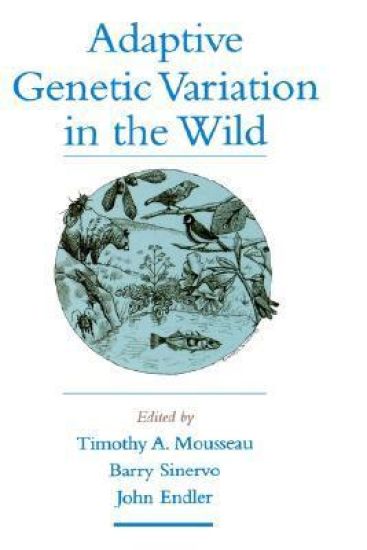
Adaptive Genetic Variation in the Wild

Adaptive Genetic Variation in the Wild

Timothy A. Mousseau; Barry Sinervo; John A. Endler

Oxford University Press Inc
2000
sidottu
Two of the great mysteries of biology yet to be explored concern the distribution and abundance of genetic variation in natural populations and the genetic architecture of complex traits. These are tied together by their relationship to natural selection and evolutionary history, and some of the keys to disclosing these secrets lie in the study of wild organisms in their natural environments. This book, featuring a superb selection of papers from leading authors, summarizes the state of current understanding about the extent of genetic variation within wild populations and the ways to monitor such variation. It proposes the idea that a fundamental objective of evolutionary ecology is necessary to predict organism, population, community, and ecosystem response to environmental change. In fact, the overall theme of the papers centers around the expression of genetic variation and how it is shaped by the action of natural selection in the natural environment. Patterns of adaptation in the past and the genetic basis of traits likely to be under selection in a dynamically changing environment is discussed along with a wide variety of techniques to test for genetic variation and its consequences, ranging from classical demography to the use of molecular markers. This book is perfect for professionals and graduate students in genetics, biology, ecology, conservation biology, and evolution.
Persons and Causes

Persons and Causes

Timothy O'Connor

Oxford University Press Inc
2000
sidottu
This provocative book refurbishes the traditional account of freedom of will as reasons-guided 'agent' causation, situating its account within a general metaphysics. O'Connor's discussion of the general concept of causation and of ontological reductionism v. emergence will specially interest metaphysicians and philosophers of mind.
Ethics and Governance

Ethics and Governance

Timothy L. Fort

Oxford University Press Inc
2001
sidottu
This book argues that ethical business behavior can be enhanced by taking fuller account of human nature, particularly with respect to the need for creating relatively small communities within the corporation. Timothy Fort discusses this premise in relation to the three predominant theories of business ethics--stakeholder, virtue, and contract. Drawing heavily from philosophy, he analyzes traditional business ethics and legal theory. Overall, his work provides a good example of how to integrate normative and empirical studies in business ethics, a task that often receives substantial discussion in academic journals.
Caring for Patients at the End of Life

Caring for Patients at the End of Life

Timothy Quill

Oxford University Press Inc
2001
nidottu
In "Caring for Patients at the End of Life: Facing an Uncertain Future Together", the author uses his wide range of clinical experience caring for severely ill patients and their families to illustrate the challenges and potential of end-of-life care. Section one utilizes the near death experiences of two patients to explore values underlying medical humanism, and then presents the case of "Diane" to explore the fundamental clinical commitments of partnership and non-abandonment. Section two explores, illustrates, and provides practical guidance for clinicians, patients, and families about critical communication issues including delivering bad news, discussing palliative care, and exploring the wish to die. In section three, difficult ethical and policy challenges inherent in hospice work, including the rule of double effect, terminal sedation, and physician-assisted suicide, are explored using a mix of real cases and an analysis of underlying clinical, ethical, and policy issues. In a final chapter, the author discusses the tragic death of his brother which occurred as this book was being completed, and how his family made the most emotionally challenging decisions of their lives.
Radical Interpretation and Indeterminacy

Radical Interpretation and Indeterminacy

Timothy McCarthy

Oxford University Press Inc
2002
sidottu
McCarthy develops a theory of Radical Interpertation - The project of characterizing from scratch the language and attituteds of an agent or population - and applies the theory to the problems of indeterminacy of interperation first descrided in the writings of Quine. The major theme in McCarthy's study is that a relatively modest set of interpertive principles, properly applied, can serve to resolve the major indeterminacies of interperation. Its most substantive contribution is in proposing a solution to problems of indeterminacy that remain unsloved in the literature.
Persons and Causes

Persons and Causes

Timothy O'Connor

Oxford University Press Inc
2002
nidottu
What happens when someone acts? We suppose that we are often morally responsible for what we do, that our creations merit credit, and the unfolding of our relationships with others find their ultimate source within us -- in the choices we have freely made. But how is such freedom of choice possible? What are the springs of free will? In this carefully-argued and provocative study, O'Connor systematically develops an account of human agency intended to shed light on these basic questions. Central to his account is the traditional concept of 'agent' of 'personal' causation, a concept that has been largely abandoned in contemporary discussions of free will. O'Connor critically assesses the previous account of this notion by Thomas Reid, Richard Taylor, and Roderick Chisholm, before reformulating it in relation to more general discussions of contemporary causation. He then provides an original account of how reasons can explain actions whose causes are their agents. He concludes by arguing at length that the freedom of will his account describes is consistent with an understanding of human beings as being fully rooted in the natural world. O'Connor also criticizes several alternative accounts of free will and offers fresh arguments bearing on several related topics, including: the incompatibility of freedom and determinism, Frankfurt's challenge to the link between freedom and moral responsibility, the nature of event causation, contrastive explanation, and the concept of emergence. This book will interest not only theorists of action and free will, but also philosophers of mind and general metaphysicians.
Three Faces of Desire

Three Faces of Desire

Timothy Schroeder

Oxford University Press Inc
2004
sidottu
Desires lead to actions, influence feelings, and determine what counts as a reward. Recent empirical evidence shows that these three aspects of desire stem from a common biological origin. Informed by contemporary science as much as by the philosophical tradition, Three Faces of Desire reveals this common foundation and builds a striking new philosophical theory of desire that puts desire's neglected face-reward-at its core. Schroeder delves into the way that actions and feelings are produced in the brain, arguing that a distinctive system is responsible for promoting action, on the one hand, and causing feelings of pleasure and displeasure, on the other. This system, the brain's reward system, is the causal origin of both action and feeling, and is the key to understanding the nature of desire.
Discourse on Civility and Barbarity

Discourse on Civility and Barbarity

Timothy Fitzgerald

Oxford University Press Inc
2007
sidottu
In recent years scholars have begun to question the usefulness of the category of ''religion'' to describe a distinctive form of human experience and behavior. In his last book, The Ideology of Religious Studies (OUP 2000), Timothy Fitzgerald argued that ''religion'' was not a private area of human existence that could be separated from the public realm and that the study of religion as such was thus impossibility. In this new book he examines a wide range of English language texts to show how religion became transformed from a very specific category indigenous to Christian culture into a universalist claim about human nature and society. These claims, he shows, are implied by and frequently explicit in theories and methods of comparative religion. But they are also tacitly reproduced throughout the humanities in the relatively indiscriminate use of ''religion'' as an a priori valid cross-cultural analytical concept, for example in historiography, sociology, and social anthropology. Fitzgerald seeks to link the argument about religion to the parallel formation of the ''non-religious'' and such dichotomies as church-state, sacred-profane, ecclesiastical-civil, spiritual-temporal, supernatural-natural, and irrational-rational. Part of his argument is that the category ''religion'' has a different logic compared to the category ''sacred,'' but the two have been consistently confused by major writers, including Durkheim and Eliade. Fitzgerald contends that ''religion'' imagined as a private belief in the supernatural was a necessary conceptual space for the simultaneous imagining of ''secular'' practices and institutions such as politics, economics, and the Nation State. The invention of ''religion'' as a universal type of experience, practice, and institution was partly the result of sacralizing new concepts of exchange, ownership, and labor practices, applying ''scientific'' rationality to human behavior, administering the colonies and classifying native institutions. In contrast, shows Fitzgerald, the sacred-profane dichotomy has a different logic of use.
The Rule of Empires

The Rule of Empires

Timothy Parsons

Oxford University Press Inc
2010
sidottu
In The Rule of Empires, Timothy Parsons gives a sweeping account of the evolution of empire from its origins in ancient Rome to its most recent twentieth-century embodiment. He explains what constitutes an empire and offers suggestions about what empires of the past can tell us about our own historical moment. Parsons uses imperial examples that stretch from ancient Rome, to Britain's "new" imperialism in Kenya, to the Third Reich to parse the features common to all empires, their evolutions and self-justifying myths, and the reasons for their inevitable decline. Parsons argues that far from confirming some sort of Darwinian hierarchy of advanced and primitive societies, conquests were simply the products of a temporary advantage in military technology, wealth, and political will. Beneath the self-justifying rhetoric of benevolent paternalism and cultural superiority lay economic exploitation and the desire for power. Yet imperial ambitions still appear viable in the twenty-first century, Parsons shows, because their defenders and detractors alike employ abstract and romanticized perspectives that fail to grasp the historical reality of subjugation. Writing from the perspective of the common subject rather than that of the imperial conquerors, Parsons offers a historically grounded cautionary tale rich with accounts of subjugated peoples throwing off the yoke of empire time and time again. In providing an accurate picture of what it is like to live as a subject, The Rule of Empires lays bare the rationalizations of imperial conquerors and their apologists and exposes the true limits of hard power.
Religion in America

Religion in America

Timothy Beal

Oxford University Press Inc
2008
nidottu
It's hard to think of a single aspect of American culture, past or present, in which religion has not played a major role. The roles religion plays, moreover, become more bewilderingly complex and diverse every day. For all those who want--whether out of curiosity, necessity, or civic duty--a vivid picture and fuller understanding of the current reality of religion in America, this Very Short Introduction is the go-to book they need. Timothy Beal describes many aspects of religion in contemporary America that are typically ignored in other books on the subject, including religion in popular culture and counter-cultural groups; the growing phenomenon of "hybrid" religious identities, both individual and collective; the expanding numbers of new religious movements, or NRMs, in America; and interesting examples of "outsider religion," such as Paradise Gardens in Georgia and the People Love People House of God in Ohio. He also offers an engaging overview of the history of religion in America, from Native American traditions to the present day. Beal sees three major forces shaping the present and future of religion in America: first, unprecedented religious diversity, which will continue to grow in the decades to come; second, the information revolution and the emergence of a new network society; and third, the rise of consumer culture. Taken together, these forces offer the potential to create a new American pluralism that would enrich society in unimaginable ways, but they also threaten the great ideal of e pluribus unum. With visual aids that help readers navigate America's diverse religious landscape, this informative, thoughtful, and provocative book is a must-read in the emerging public conversation concerning religion in America. ABOUT THE SERIES: The Very Short Introductions series from Oxford University Press contains hundreds of titles in almost every subject area. These pocket-sized books are the perfect way to get ahead in a new subject quickly. Our expert authors combine facts, analysis, perspective, new ideas, and enthusiasm to make interesting and challenging topics highly readable.
Major Issues in Cognitive Aging

Major Issues in Cognitive Aging

Timothy Salthouse

Oxford University Press Inc
2010
sidottu
In recent years the field of cognitive aging has flourished and expanded into many different disciplines. It is probably, therefore, inevitable that some of the research has become very narrow, primarily focused on "counting and classifying the wrinkles of aged behavior," rather than addressing more broad, general, and important questions. Timothy Salthouse's main goal in this book is to try to identify some of the major phenomena in the field of cognitive aging, and discuss issues relevant to the investigation and interpretation of them. He does not attempt to provide a comprehensive survey of the research literature on aging and cognition because many excellent reviews are available in edited handbooks. His principal aim is rather to stimulate readers to think about the big questions in cognitive aging research, and how they might best be answered.
Integrative Pediatrics

Integrative Pediatrics

Timothy Culbert; Karen Olness

Oxford University Press Inc
2009
sidottu
There is ample evidence that children and adolescents in large numbers are actively using integrative (complementary and alternative) therapies. Various studies now indicate that over 50% of pediatricians surveyed would refer a patient for integrative therapy, and they would welcome more natural therapies for children provided they were safe and effective. However, there has been little training for pediatricians in this area. Integrative Pediatrics addresses these issues and provides guidelines for pediatricians, parents, and general audiences in a balanced, evidence-based manner. In this volume in the Weil Integrative Medicine Library series, the authors describe a rational and evidence-based approach to the integrative therapy of childhood disorders and well-child care, integrating the principles of alternative and complementary therapies into the principles and practice of conventional pediatrics. The authors examine what works and what doesn't and offer practical guidelines for physicians to incorporate integrative medicine into their practice and how to advise patients and their parents on reasonable and effective therapies. The text also covers areas of controversy and identifies areas of uncertainty where future research is needed. Chapters also cite the best available evidence for both safety and efficacy of all therapies discussed. The series editor is Andrew Weil, MD, Professor and Director of the Program of Integrative Medicine at the University of Arizon. Dr. Weil's program was the first academic program in the US and he is the major name in integrative medicine in the US, and well-known around the world. His program's stated goal is "to combine the best ideas and practices of conventional and alternative medicine into cost effective treatments without embracing alternative practices uncritically."
Philosophical Dialogues

Philosophical Dialogues

Timothy Smiley

Oxford University Press
1995
sidottu
Many of the greatest philosophers have used the form of the dialogue to expound their arguments, yet the vehicle itself has been inadequately studied. The three essays in this volume examine the reasons why particular philosophers have chosen to use the dialogue as a tool to interact between the philosophical content and the literary form.