

Kirjahaku
Etsi kirjoja tekijän nimen, kirjan nimen tai ISBN:n perusteella.
1000 tulosta hakusanalla "Integration"

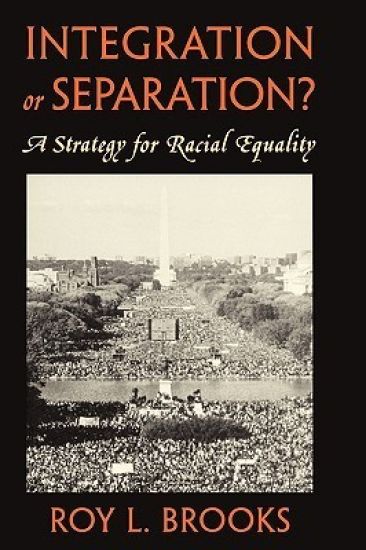
Integrated in principle, segregated in fact: is this the legacy of fifty years of "progress" in American racial policy? Is there hope for much better? Roy L. Brooks, a distinguished professor of law and a writer on matters of race and civil rights, says with frank clarity what few will admit--integration hasn't worked and possibly never will. Equally, he casts doubt on the solution that many African-Americans and mainstream whites have advocated: total separation of the races. This book presents Brooks's strategy for a middle way between the increasingly unworkable extremes of integration and separation.Limited separation, the approach Brooks proposes, shifts the focus of civil rights policy from the group to the individual. Defined as cultural and economic integration within African-American society, this policy would promote separate schooling, housing, and business enterprises where needed to bolster the self-sufficiency of the community, without trammeling the racial interests of individuals inside or outside of the group, and without endangering the idea of a shared Americanness. But all the while Brooks envisions African-American public schools, businesses, and communities redesigned to serve the enlightened self-interest of the individual. Unwilling to give up entirely on racial integration, he argues that limited separation may indeed lead to improved race relations and, ultimately, to healthy integration.This book appears at a crucial time, as Republicans dismantle past civil rights policies and Democrats search for new ones. With its alternative strategy and useful policy ideas for bringing individual African-Americans into mainstream society as first-class citizens, Integration or Separation? should influence debate and policymaking across the spectra of race, class, and political persuasion.
Integration of One-forms on P-adic Analytic Spaces
Vladimir G. Berkovich
Princeton University Press
2006
pokkari
Among the many differences between classical and p-adic objects, those related to differential equations occupy a special place. For example, a closed p-adic analytic one-form defined on a simply-connected domain does not necessarily have a primitive in the class of analytic functions. In the early 1980s, Robert Coleman discovered a way to construct primitives of analytic one-forms on certain smooth p-adic analytic curves in a bigger class of functions. Since then, there have been several attempts to generalize his ideas to smooth p-adic analytic spaces of higher dimension, but the spaces considered were invariably associated with algebraic varieties. This book aims to show that every smooth p-adic analytic space is provided with a sheaf of functions that includes all analytic ones and satisfies a uniqueness property. It also contains local primitives of all closed one-forms with coefficients in the sheaf that, in the case considered by Coleman, coincide with those he constructed. In consequence, one constructs a parallel transport of local solutions of a unipotent differential equation and an integral of a closed one-form along a path so that both depend nontrivially on the homotopy class of the path. Both the author's previous results on geometric properties of smooth p-adic analytic spaces and the theory of isocrystals are further developed in this book, which is aimed at graduate students and mathematicians working in the areas of non-Archimedean analytic geometry, number theory, and algebraic geometry.
The integration of children with special needs into mainstream schools demands a reorganisation of staff and support levels both in schools and in the advisory services. Integration and the Support Service, illustrated with examples from a detailed case study of one Local Education Authority, shows how support services can most effectively be matched to needs and how new strategies for integration can be developed.

The integration of new immigrants is one of the most important issues in Europe, yet not enough is known about the lives of migrants. This book draws on several years of ethnographic research with African migrants in Ireland, many of whom are former asylum seekers. Against the widespread assumptions that integration has been handled well in Ireland and that racism is not a major problem, this book shows that migrants are themselves shaping integration in their everyday lives in the face of enormous challenges. The book, now available in paperback, will appeal to scholars and students interested in migration and ethnicity and to a general reading public interested in the stories of integration in Ireland. The book is situated within current anthropological theory and makes an important contribution, both theoretically and empirically, to understandings of the everyday and a site of possibility and critique.
By providing common vocabularies and taxonomies, patterns enable software developers and architects to share important architectural, design, and implementation discoveries they make while solving commonly recurring technical challenges. Now you can take advantage of Microsoft’s extensive systems integration experience?and expedite the development of your own solutions?by examining and applying the integration patterns described in this guide. You get expert guidance and recommendations for using new and established platform-independent architecture and design patterns, as well as implementation patterns that apply specifically to Microsoft® BizTalk® Server 2004, Host Integration Server 2004, and the Microsoft .NET Framework. Understand how to use individual patterns for specific technical scenarios, as well as how to combine patterns to build more complex systems. All PATTERNS & PRACTICES guides are reviewed and approved by Microsoft engineering teams, consultants, partners, and customers?delivering accurate, real-world information that’s been technically validated and tested. Key Book Benefits: Proven—based on field experience Authoritative—offers the best advice available Accurate—technically validated and tested Actionable—provides the steps to success Relevant—addresses real-world problems based on customer scenarios

Integration is a key challenge facing modern society today. Integration and Resistance offers a new theoretical perspective for considering integration. By focusing on international immigrants and their organisations from a wider perspective the author demonstrates that the threat to social integration does not lie with the immigrants themselves but with global capital and the state. By analysis of data collected in Spain and Portugal the book breaks new ground in providing information on processes occurring in intermediate-capitalist countries that share some aspects of economic development, social and migration features with Northern Europe and America whilst also sharing other features such as the economic dependence of more impoverished countries.

Integration in the Library Organization
Christine E Thompson
Routledge Member of the Taylor and Francis Group
2000
sidottu
Bring technical and public services together to create a more user-friendly library!Written for public and technical services librarians, this vital book examines the changes in the profession that have contributed to the integration of the two services. It explores the responsibilities of public and technical services, the effect of dualism on libraries and the profession, and management concerns in this overlapping environment. With case studies and insightful predictions for the future, Integration in the Library Organization discusses the changes in the profession that have contributed to the integration of the two services. This book fills a gap in the available information about team management and the blurring of public/technical services lines in libraries. Integration in the Library Organization shows you how to create an environment of full staff cooperation within your library and provides examples of ways that other libraries have accomplished this. Here you'll discover management techniques to use in such an overlapping environment. Integration in the Library Organization discusses: the false dualism of technical services vs. public services working as partners in a team-based environment tailoring library positions to match individual skills outsourcing in Hawaii satellite cataloging operations and nonprint backlogs . . . and much more!Integration in the Library Organization will provide you with the insight you need to help your library balance and integrate technical and public services and improve the capability of your library to offer patrons quality services and large amounts of information.

Integration in the Library Organization
Christine E Thompson
Routledge Member of the Taylor and Francis Group
2000
nidottu
Bring technical and public services together to create a more user-friendly library!Written for public and technical services librarians, this vital book examines the changes in the profession that have contributed to the integration of the two services. It explores the responsibilities of public and technical services, the effect of dualism on libraries and the profession, and management concerns in this overlapping environment. With case studies and insightful predictions for the future, Integration in the Library Organization discusses the changes in the profession that have contributed to the integration of the two services. This book fills a gap in the available information about team management and the blurring of public/technical services lines in libraries. Integration in the Library Organization shows you how to create an environment of full staff cooperation within your library and provides examples of ways that other libraries have accomplished this. Here you'll discover management techniques to use in such an overlapping environment. Integration in the Library Organization discusses: the false dualism of technical services vs. public services working as partners in a team-based environment tailoring library positions to match individual skills outsourcing in Hawaii satellite cataloging operations and nonprint backlogs . . . and much more!Integration in the Library Organization will provide you with the insight you need to help your library balance and integrate technical and public services and improve the capability of your library to offer patrons quality services and large amounts of information.

Integration of Technology into the Classroom
D Lamont Johnson; Cleborne D Maddux; Leping Liu
CRC Press Inc
2001
sidottu
This is Volume 16, number 2 of Computers in Schools and uses case studies and research to focus on the integration of computing and Information Technology into the classroom. The case studies illustrate successful experiences of teachers harnessing the power of technology to enrich and enhance teaching and learning experiences in the classroom.

Integration of Technology into the Classroom
D Lamont Johnson; Cleborne D Maddux; Leping Liu
Haworth Press Inc
2001
nidottu
This is Volume 16, number 2 of Computers in Schools and uses case studies and research to focus on the integration of computing and Information Technology into the classroom. The case studies illustrate successful experiences of teachers harnessing the power of technology to enrich and enhance teaching and learning experiences in the classroom.

Integration of Renewable Energy Systems
Andy Walker; Jennifer Scheib; Craig Turchi; Robi Robichaud; Gregg Tomberlin; Kari Burman; Michael Hillesheim; Ben Kroposki; Ming Qu
American Society of Mechanical Engineers,U.S.
2016
sidottu
Energy efficiency measures are generally less expensive than a renewable energy (RE) system to provide the same amount of energy saved. The Energy Information Administration reports that, on average, a dollar spent on efficiency saves $2 off the cost of a renewable energy system to provide the same amount of energy [IEA, 2011]. But as the saying goes “you can’t save yourself rich” and having installed sophisticated controls and efficient systems, we need some source of energy to power them. On-site renewable energy systems offer several advantages, especially when operated in concert with a larger utility system. The main reasons to consider RE is cost-effectiveness, but other reasons are as diverse as: reduction of atmospheric emissions; compliance with regulations requiring RE; enhanced reliability through redundant energy supply; abate risks related to fuel availability and cost, or risk of fuel-spills during delivery; score points in a sustainability rating; or as a mitigation measure in a larger environmental-permitting process.Renewable energy technologies used on buildings include daylighting; solar photovoltaics; solar water heating; solar ventilation air preheating; passive solar heating and cooling load avoidance; wind power; biomass heat (or cogeneration as discussed in Chapter 8); anaerobic digestion of waste; and geothermal heat. Ground source heat pumps are also often considered, in-part, RE systems. Daylighting and the envelope measures (passive heating and cooling) are often considered efficiency measures, but daylighting is a direct and obvious use of solar energy in buildings, and photovoltaics (PV), Solar Water Heating and Solar Ventilation Air preheating are technologies to consider on any building project. We even consider an example of hydroelectric power on the water supply to a building.We cover the operating principle of each type of system, list components and provide schematic diagram of how components are assembled into systems; provide information for cost estimate and life cycle cost calculation, describe how system size may be optimized to minimize life cycle cost, and we stress the importance of operations and maintenance (O&M) over a long performance period. Significant emphasis is placed on integration of RE into the conventional utility system, at both the site level and from the perspective of the larger utility system, so that savings due to the RE may be realized without compromising the reliability of the system. Case studies are presented to exemplify application of each technology.

Integration of Theory and Applications in Applied Mechanics
Springer
1990
sidottu
The Department of Applied Mechanics of the Royal Institution of Engineers in the Netherlands (Koninklijk Instituut van Ingenieurs) organised on April 2-4, 1990 the first National Applied Mechanics Congress about the theme: "Integration of Theory and Applications in Applied Mechanics" The idea behind this initiative was to bring together the Applied Mechanics communities in The Netherlands and Belgium and to create an environment in which new developments in the field could be discussed and in which connections to other disciplines could be established. Among an extensive list of possible subjects the following were selected as congress topics: - non-linear material behaviour, - chaos, - mechatronics, - liquid-solid interactions, - mathematics and applied mechanics, - integration of Applied Mechanics and other disciplines. Applied Mechanics comprises both solid mechanics and fluid mechanics. These can be subdivided further into: rheology, plasticity, theory of plates and shells, theory of elasticity, multibody dynamics, dynamics of continuous media, stability of the elastic equilibrium, etc. Applied Mechanics is of tremendous practical significance and it proves its value almost daily in applications such as the calculation of the strength and stiffness of constructions, like e. g.
Combines existing (and different) ecosystem theories into an integral pattern, which shows that systems ecology can offer a full theoretical pattern. This may be of importance for development of ecology, ecosystem theory and environmental science.
Integration of Natural Language and Vision Processing
Springer
1995
sidottu
Although there has been much progress in developing theories, models and systems in the areas of Natural Language Processing (NLP) and Vision Processing (VP) there has heretofore been little progress on integrating these subareas of Artificial Intelligence (AI). This book contains a set of edited papers addressing computational models and systems for the integration of NLP and VP. The papers focus on site descriptions such as that of the large Japanese $500 million Real World Computing (RWC) project, on historical philosophical issues, on systems which have been built and which integrate the processing of visual scenes together with language about them, and on spatial relations which appear to be the key to integration. The U.S.A., Japan and the EU are well reflected, showing up the fact that integration is a truly international issue. There is no doubt that all of this will be necessary for the InformationSuperHighways of the future.
Integration of Natural Language and Vision Processing
Springer
1995
sidottu
Although there has been much progress in developing theories, models and systems in the areas of natural language processing (NLP) and vision processing (VP), there has hitherto been little progress in integrating these two subareas of artificial intelligence. The papers in Integration of Natural Language and Vision Processing focus on site descriptions, such as the work at Apple Computer, California, and the DFKI, Saarbrücken, on historical surveys and philosophical issues, on systems that have been built, enabling communication through text, speech, sound, touch, video, graphics and icons, and on the automatic presentation of information, whether it be in the form of instruction manuals, statistical data or visualisation of language. There is also a review of Mark Maybury's book Intelligent Multimedia Interfaces. Audience: Vital reading for all interested in the SuperInformationHighways of the future.
Integration of Natural Language and Vision Processing
Springer
1996
sidottu
Although there has been much progress in developing theories, models and systems in the areas of Natural Language Processing (NLP) and Vision Processing (VP), there has heretofore been little progress on integrating these two subareas of Artificial Intelligence (AI). This book contains a set of edited papers addressing theoretical issues and the grounding of representations in NLP and VP from philosophical and psychological points of view. The papers focus on site descriptions such as the reasoning work on space at Leeds, UK, the systems work of the ILS (Illinois, U.S.A.) and philosophical work on grounding at Torino, Italy, on Schank's earlier work on pragmatics and meaning incorporated into hypermedia teaching systems, Wilks' visions on metaphor, on experimental data for how people fuse language and vision and theories and computational models, mainly connectionist, for tackling Searle's Chinese Room Problem and Harnad's Symbol Grounding Problem. The Irish Room is introduced as a mechanism through which integration solves the Chinese Room. The U.S.A., China and the EU are well reflected, showing the fact that integration is a truly international issue. There is no doubt that all of this will be necessary for the SuperInformationHighways of the future.
Integration of Natural Language and Vision Processing
Springer
1996
sidottu
Although there has been much progress in developing theories, models and systems in the areas of Natural Language Processing (NLP) and Vision Processing (VP) there has up to now been little progress on integrating these two subareas of Artificial Intelligence (AI). This book contains a set of edited papers on recent advances in the theories, computational models and systems of the integration of NLP and VP. The volume includes original work of notable researchers: Alex Waibel outlines multimodal interfaces including studies in speech, gesture and points; eye-gaze, lip motion and facial expression; hand writing, face recognition, face tracking and sound localization in a connectionist framework. Antony Cohen and John Gooday use spatial relations to describe visual languages. Naoguki Okada considers intentions of agents in visual environments. In addition to these studies, the volume includes many recent advances from North America, Europe and Asia demonstrating the fact that integration of Natural Language Processing and Vision is truly an international challenge.
The book integrates for the first time existing ecosystem theories and is therefore able to present a full ecological and theoretical pattern. It shows that we are able to understand ecosystems and their reactions, provided that we use all basic systems ecology for different aspects of ecosystem properties. The first edition of this book was published in 1992. This second edition contains the many recently published and presented contributions on ecosystem theories, which show even more strongly that an integration of the existing ecosystem theories is needed and also possible.