This book analyses the role power sharing, social movements, economic regeneration, urban space, memorialisation and symbols play in transforming divided societies into shared peaceful ones. It explains why some projects are counterproductive while others assist peace-building.
Volume VIII of Acta Historiae Neerlandicae again presents studies on the history of the Low Countries which it is hoped will be of interest to foreign scholars. The intention has been to deal with a fairly long period, and many differing aspects, of the subject. So institutional, political, economic, social and cultural history all receive a fair share of attention, and together the studies cover a considerable number of centuries. It is, however, striking to note how even this restricted number of studies reflects prevailing viewpoints among today's Low Countries' historians. Clearly there is considerable stress on economic and social questions. Traditional studies such as those of former Belgian historians on medieval history, or those of the Dutch on the seventeenth century, are now giving way to works that are problem directed. Power structures, the position of the bourgeoisie, reactions of the intelli gentsia and theologians to societal problems, have now more attraction for scholars than the glories of late medieval wealth in Flanders or Holland's Golden Age. Terms such as Guerilla warfare, Struggle, Depression, typify today's critical approach to society in general.
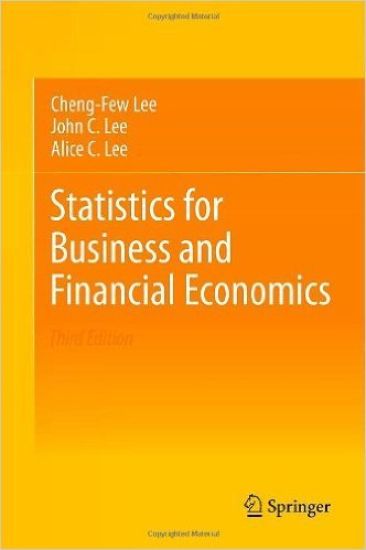
NewsProfessor Cheng-Few Lee ranks #1 based on his publications in the 26 core finance journals, and #163 based on publications in the 7 leading finance journals (Source: Most Prolific Authors in the Finance Literature: 1959-2008 by Jean L Heck and Philip L Cooley (Saint Joseph's University and Trinity University).This is an extensively revised edition of a popular statistics textbook for business and economics students. The first edition has been adopted by universities and colleges worldwide, including New York University, Carnegie Mellon University and UCLA.Designed for upper-level undergraduates, MBA and other graduate students, this book closely integrates various statistical techniques with concepts from business, economics and finance and clearly demonstrates the power of statistical methods in the real world of business. While maintaining the essence of the first edition, the new edition places more emphasis on finance, economics and accounting concepts with updated sample data. Students will find this book very accessible with its straightforward language, ample cases, examples, illustrations and real-life applications. The book is also useful for financial analysts and portfolio managers.
Futures and Options are concerned with the valuation of derivatives and their application to hedging and speculating investments. This book contains 22 chapters and is divided into five parts. Part I contains an overview including a general introduction as well as an introduction to futures, options, swaps, and valuation theories. Part II: Forwards and Futures discusses futures valuation, the futures market, hedging strategies, and various types of futures. Part III: Option Theories and Applications includes both the basic and advanced valuation of options and option strategies in addition to index and currency options. Part IV: Advanced Analyses of Options takes a look at higher level strategies used to quantitatively approach the analysis of options. Part V: Special Topics of Options and Futures covers the applications of more obscure and alternative methods in derivatives as well as the derivation of the Black-Scholes Option Pricing Model.This book applies an active interdisciplinary approach to presenting the material; in other words, three projects involving the use of real-world financial data on derivative, in addition to homework assignments, are made available for students in this book.
Futures and Options are concerned with the valuation of derivatives and their application to hedging and speculating investments. This book contains 22 chapters and is divided into five parts. Part I contains an overview including a general introduction as well as an introduction to futures, options, swaps, and valuation theories. Part II: Forwards and Futures discusses futures valuation, the futures market, hedging strategies, and various types of futures. Part III: Option Theories and Applications includes both the basic and advanced valuation of options and option strategies in addition to index and currency options. Part IV: Advanced Analyses of Options takes a look at higher level strategies used to quantitatively approach the analysis of options. Part V: Special Topics of Options and Futures covers the applications of more obscure and alternative methods in derivatives as well as the derivation of the Black-Scholes Option Pricing Model.This book applies an active interdisciplinary approach to presenting the material; in other words, three projects involving the use of real-world financial data on derivative, in addition to homework assignments, are made available for students in this book.
Statistics for Business and Financial Economics, 3rd edition is the definitive Business Statistics book to use Finance, Economics, and Accounting data throughout the entire book. Therefore, this book gives students an understanding of how to apply the methodology of statistics to real world situations. In particular, this book shows how descriptive statistics, probability, statistical distributions, statistical inference, regression methods, and statistical decision theory can be used to analyze individual stock price, stock index, stock rate of return, market rate of return, and decision making. In addition, this book also shows how time-series analysis and the statistical decision theory method can be used to analyze accounting and financial data. In this fully-revised edition, the real world examples have been reconfigured and sections have been edited for better understanding of the topics. On the Springer page for the book, the solution manual, test bank and powerpoints are available for download.
Current scientific evidence suggests that free radicals— unstable by-products produced by normal human metabolic processes—damage the body, resulting in chronic health disorders and degenerative changes associated with aging. Nutritional products on the market today promise antioxidants can reduce—possibly even reverse—damage caused by these free radicals. If true, that would mean less chronic disease and premature aging, at the very least. But are antioxidants indeed the new Fountain of Youth? Media reports extol antioxidants as the solution to disease and aging, and some studies do seem to back up those reports. Yet the studies that have been completed are far from conclusive, and taking antioxidant supplements can be dangerous. This book explores current thinking, analyzes studies, and answers the questions: What are antioxidants? What do they do? Is there any real benefit to taking them as supplements? Are there real dangers for me? Media report preliminary and conflicting scientific studies on antioxidants, notwithstanding the fact that the final analysis about their effectiveness and safety is incomplete. The result is increasing sales of dietary supplements and so-called functional foods or nutraceuticals that are not regulated, nor proven, and a possible public safety crisis from hypersupplementation. Milbury and Richer bring us up to date, sharing nuances and emerging news regarding antioxidants—and their dangers. Understanding the Antioxidant Controversy is an educated consumers' and health professionals' guide to this controversial topic.
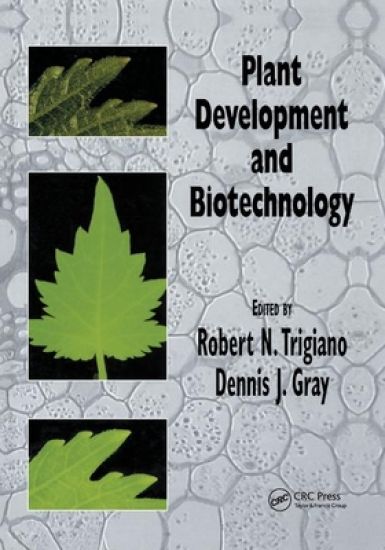
Biotechnology revolutionized traditional plant breeding programs. This rapid change produced new discussions on techniques and opportunities for commerce, as well as a fear of the unknown. Plant Development and Biotechnology addresses the major issues of the field, with chapters on broad topics written by specialists. The book applies an informal style that addresses the major aspects of development and biotechnology with minimal references, without sacrificing information or accuracy. Divided into five primary parts, this volume explores how the field emerged from its early theoretical base to the technical discipline of today. It also covers progress being made with genetically engineered plants, providing a snapshot of the field's controversial present. Part III discusses methods for preparing media, creating solutions and dilutions, and accomplishing sterile culture work. It investigates common methods for visualizing and documenting studies, and quantifying responses of tissue culture in research. Part IV delivers the essential foundation of plant tissue culture, introducing the three types of commonly used culture regeneration systems. Part V integrates propagation techniques with other methodologies for the modification and manipulation of germplasm. Part VI concludes with special sections. Subjects include in vitro plant pathology, recent research into genetic and phenotypic variation, the mechanics of commercial plant production, and the importance of clean cultures and problems associated with maintaining in vitro cultures. The final chapter analyzes entrepreneurship in the field and outlines the do's and don'ts to consider when launching an enterprise.
Research and Information Guides in Business, Industry, and Economic Institutions series will bridge the gap between classical forms of literature and new alternative formats. Each guide will be devoted to an industry, a profession, a managerial process, or a field of study. This guide to information resources on the American Stock Exchange is not intended to be a detailed history of the Amex. It does cover the literature of the Exchange from 1900 through 1993. Research methodology included searching of major cataloging systems, reviewing of print and electronic indexes, and summarizing of publications in the American Stock Exchange library. All publications identified were read and summarized.
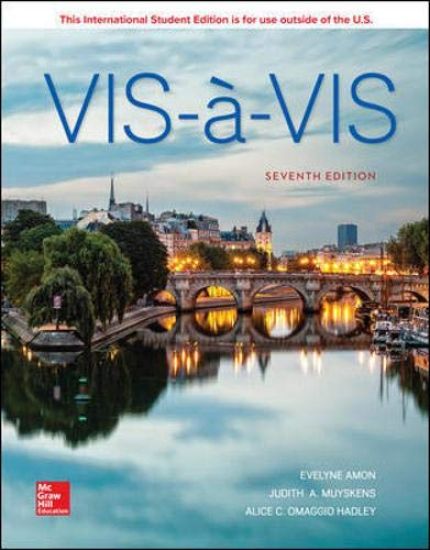
Vis-à-vis engages students with its unique integration of contemporary culture and communicative building blocks, providing tools to build a solid foundation in introductory French. Building communicative competence with Vis-à-visOne of the major challenges of the introductory language course is to give each student ample exposure to the language and sufficient opportunity to practice speaking, both in and out of the classroom. On our Connect platform, students have full access to the eBook, online Workbook/Laboratory Manual activities, LearnSmart, and all accompanying audio and video resources. In Vis-à-vis, the following resources work together to promote communicative competence:Interactive vocabulary presentations (Paroles) include audio recordings, allowing students to listen, record, and practice new vocabulary outside of class.Interactive activities for vocabulary and grammar, many of which are auto-graded, give students the opportunity to complete their assignments and come to class better prepared to participate in paired and group activities.Prononcez bien! activities include a recording feature and provide students with opportunities for discrete-word and contextualized practice that help students develop confidence in their speaking abilities.Recordings of lively mini-dialogues featuring the blog characters give students a spirited introduction to the new grammatical structure in context.Seventeen Grammaire interactive tutorials, each with a brief practice quiz, focus on structures that students typically struggle with, such as passé compose vs. imparfait. LearnSmart modules for vocabulary and grammar: This powerful adaptive tool helps students pinpoint their weaknesses and gives them an individualized study program based on their results. Audio prompts for vocabulary and grammar help students strengthen both their listening and writing skills. Building cultural competence with Vis-à-visThe program's meaningful and extensive exploration of the rich culture of France and the Francophone world is fully supported throughout the program.Each four-chapter segment of Vis-à-vis focuses on a new French or Francophone character and region. The personal online journal entries in Le blog de... the related Reportage, and the Bienvenue readings that precede Chapter 1 and follow Chapters 4, 8, 12, and 16, expose students to contemporary language and the vast diversity of life and culture in France, Canada, Tunisia, and beyond. Le videoblog de...and the stunning Bienvenue video segments feature the bloggers and give students a window into the sights and sounds of eight different French-speaking regions/countries including France, Martinique, and Tahiti. Each video is accompanied by comprehension and cross-cultural comparison activities that encourage students to make connections between their culture and those of the French-speaking world.A brand-new feature has been added below the Reportage, entitled Le Micro-trottoir. Le micro-trottoir provides students a chance to see everyday language in action through recorded “man-on-the-street" interviews featuring a diverse group of people.
Vis-à-vis engages students with its unique integration of contemporary culture and communicative building blocks, providing tools to build a solid foundation in introductory French. Building communicative competence with Vis-à-visOne of the major challenges of the introductory language course is to give each student ample exposure to the language and sufficient opportunity to practice speaking, both in and out of the classroom. On our Connect platform, students have full access to the eBook, online Workbook/Laboratory Manual activities, LearnSmart, and all accompanying audio and video resources. In Vis-à-vis, the following resources work together to promote communicative competence:• Interactive vocabulary presentations (Paroles) include audio recordings, allowing students to listen, record, and practice new vocabulary outside of class.• Interactive activities for vocabulary and grammar, many of which are auto-graded, give students the opportunity to complete their assignments and come to class better prepared to participate in paired and group activities.• Prononcez bien! activities include a recording feature and provide students with opportunities for discrete-word and contextualized practice that help students develop confidence in their speaking abilities.• Recordings of lively mini-dialogues featuring the blog characters give students a spirited introduction to the new grammatical structure in context.• Seventeen Grammaire interactive tutorials, each with a brief practice quiz, focus on structures that students typically struggle with, such as passé compose vs. imparfait. • LearnSmart modules for vocabulary and grammar: This powerful adaptive tool helps students pinpoint their weaknesses and gives them an individualized study program based on their results. Audio prompts for vocabulary and grammar help students strengthen both their listening and writing skills. Building cultural competence with Vis-à-visThe program’s meaningful and extensive exploration of the rich culture of France and the Francophone world is fully supported throughout the program.• Each four-chapter segment of Vis-à-vis focuses on a new French or Francophone character and region. The personal online journal entries in Le blog de…, the related Reportage, and the Bienvenue readings that precede Chapter 1 and follow Chapters 4, 8, 12, and 16, expose students to contemporary language and the vast diversity of life and culture in France, Canada, Tunisia, and beyond. • Le videoblog de… and the stunning Bienvenue video segments feature the bloggers and give students a window into the sights and sounds of eight different French-speaking regions/countries including France, Martinique, and Tahiti. Each video is accompanied by comprehension and cross-cultural comparison activities that encourage students to make connections between their culture and those of the French-speaking world.• A brand-new feature has been added below the Reportage, entitled Le Micro-trottoir. Le micro-trottoir provides students a chance to see everyday language in action through recorded “man-on-the-street" interviews featuring a diverse group of people.
Security Analysis, Portfolio Management, and Financial Derivatives integrates the many topics of modern investment analysis. It provides a balanced presentation of theories, institutions, markets, academic research, and practical applications, and presents both basic concepts and advanced principles. Topic coverage is especially broad: in analyzing securities, the authors look at stocks and bonds, options, futures, foreign exchange, and international securities. The discussion of financial derivatives includes detailed analyses of options, futures, option pricing models, and hedging strategies. A unique chapter on market indices teaches students the basics of index information, calculation, and usage and illustrates the important roles that these indices play in model formation, performance evaluation, investment strategy, and hedging techniques. Complete sections on program trading, portfolio insurance, duration and bond immunization, performance measurements, and the timing of stock selection provide real-world applications of investment theory. In addition, special topics, including equity risk premia, simultaneous-equation approach for security valuation, and Itô's calculus, are also included for advanced students and researchers.
These topical modules were developed and tested by the ChemLinks Coalition and the Modular Chemistry Consortium as part of the National Science Foundation's Systematic Change Initiative in Chemistry. The teaching approach that these modules reflect represents a significant pedagogical improvement over methods that rely on traditional lectures and verification laboratories.ChemConnections modules cover a broad range of chemical topics and supply research-based, classroom-tested, active learning strategies that guide students through the scientific process.