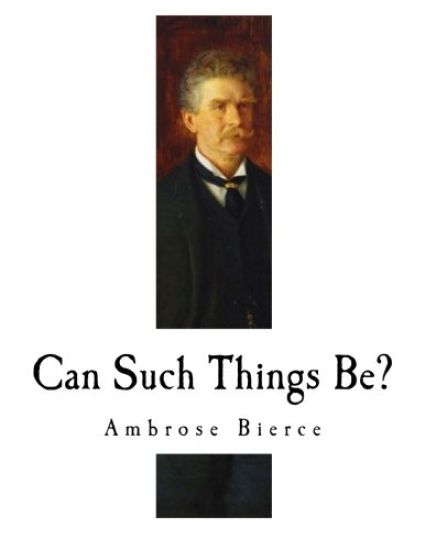
Can Such Things Be? By Ambrose Bierce. Ambrose Gwinnett Bierce was an American Civil War soldier, wit, and writer. Bierce's book The Devil's Dictionary was named as one of "The 100 Greatest Masterpieces of American Literature" by the American Revolution Bicentennial Administration. His story An Occurrence at Owl Creek Bridge has been described as "one of the most famous and frequently anthologized stories in American literature"; and his book Tales of Soldiers and Civilians (also published as In the Midst of Life) was named by the Grolier Club as one of the 100 most influential American books printed before 1900. A prolific and versatile writer, Bierce was regarded as one of the most influential journalists in the United States, and as a pioneering writer of realist fiction. For his horror writing, Michael Dirda ranked him alongside Edgar Allan Poe and H.P. Lovecraft. His war stories influenced Stephen Crane, Ernest Hemingway, and others, and he was considered an influential and feared literary critic. In recent decades Bierce has gained wider respect as a fabulist and for his poetry.
An Occurrence at Owl Creek Bridge by Ambrose Bierce. Peyton Farquhar, a plantation owner in his mid-thirties, is being prepared for execution by hanging from an Alabama railroad bridge during the American Civil War. Six military men and a company of infantrymen are present, guarding the bridge and carrying out the sentence. Farquhar thinks of his wife and children and is then distracted by a noise that, to him, sounds like an unbearably loud clanging; it is actually the ticking of his watch. He considers the possibility of jumping off the bridge and swimming to safety if he can free his tied hands, but the soldiers drop him from the bridge before he can act on the idea. In a flashback, Farquhar and his wife are relaxing at home one evening when a soldier rides up to the gate. Farquhar, a supporter of the Confederacy, learns from him that Union troops have seized the Owl Creek railroad bridge and repaired it. The soldier suggests that Farquhar might be able to burn the bridge down if he can slip past its guards. He then leaves, but doubles back after nightfall to return north the way he came. The soldier is actually a disguised Union scout who has lured Farquhar into a trap, as any civilian caught interfering with the railroads will be hanged.
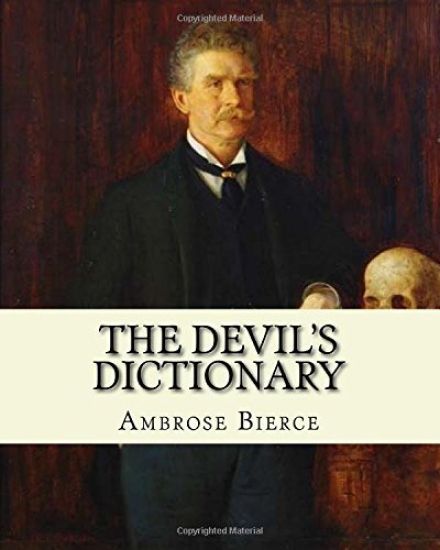
The Devil's Dictionary is a satirical dictionary written by American Civil War soldier, wit, and writer Ambrose Bierce consisting of common words followed by humorous and satirical definitions. The lexicon was written over three decades as a series of installments for magazines and newspapers. Bierce's witty definitions were imitated and plagiarized for years before he gathered them into books, first as The Cynic's Word Book in 1906 and then in a more complete version as The Devil's Dictionary in 1911. Initial reception of the book versions was mixed. In the decades following, however, the stature of The Devil's Dictionary grew. It has been widely quoted, frequently translated, and often imitated, earning a global reputation. In the 1970s, The Devil's Dictionary was named as one of "The 100 Greatest Masterpieces of American Literature" by the American Revolution Bicentennial Administration. It has been called "howlingly funny", and Wall Street Journal columnist Jason Zweig wrote that The Devil's Dictionary is "probably the most brilliant work of satire written in America. And maybe one of the greatest in all of world literature." Ambrose Gwinnett Bierce (June 24, 1842 - circa 1914) was an American short story writer, journalist, poet, and Civil War veteran.Bierce's book The Devil's Dictionary was named as one of "The 100 Greatest Masterpieces of American Literature" by the American Revolution Bicentennial Administration. His story An Occurrence at Owl Creek Bridge has been described as "one of the most famous and frequently anthologized stories in American literature";and his book Tales of Soldiers and Civilians (also published as In the Midst of Life) was named by the Grolier Club as one of the 100 most influential American books printed before 1900. A prolific and versatile writer, Bierce was regarded as one of the most influential journalists in the United States, and as a pioneering writer of realist fiction. For his horror writing, Michael Dirda ranked him alongside Edgar Allan Poe and H.P. Lovecraft. His war stories influenced Stephen Crane, Ernest Hemingway, and others, and he was considered an influential and feared literary critic. In recent decades Bierce has gained wider respect as a fabulist and for his poetry.In December 1913, Bierce traveled to Chihuahua, Mexico, to gain first-hand experience of the Mexican Revolution. He disappeared, and was rumored to be traveling with rebel troops. He was never seen again. Early life: Bierce was born in a log cabin at Horse Cave Creek in Meigs County, Ohio, on June 24, 1842, to Marcus Aurelius Bierce (1799-1876) and Laura Sherwood Bierce. He was of entirely English ancestry, all of which came to North America between 1620 and 1640 as part of the Great Puritan Migration. He often wrote critically of both "Puritan values" and people who "made a fuss" about genealogy. He was the tenth of thirteen children, whose father gave all names beginning with the letter "A" in order of birth, the Bierce siblings were Abigail, Amelia, Ann, Addison, Aurelius, Augustus, Almeda, Andrew, Albert, and Ambrose. His mother was a descendant of William Bradford.His parents were a poor but literary couple who instilled in him a deep love for books and writing.Bierce grew up in Kosciusko County, Indiana, attending high school at the county seat, Warsaw.He left home at 15 to become a printer's devil at a small abolitionist Ohio newspaper, the Northern Indiana..................
Ambrose Bierce never owned a horse, a carriage, or a car; he was a renter who never owned his own home. He was a man on the move, a man who traveled light: and in the end he rode, with all of his possessions, on a rented horse into the Mexican desert to join Pancho Villa -- never to return. Can Such Things Be? Once William Randolph Hearst -- Bierce's employer, who was bragging about his own endless collections of statuary, art, books, tapestries, and, of course real estate like Hearst Castle -- once William Randolph Hearst asked Bierce what he collected. Bierce responded, smugly: "I collect words. And ideas. Like you, I also store them. But in the reservoir of my mind. I can take them out and display them at a moment's notice. Eminently portable, Mr. Hearst. And I don't find it necessary to show them all at the same time." Such things can be................... Ambrose Gwinnett Bierce (June 24, 1842 - circa 1914) was an American short story writer, journalist, poet, and Civil War veteran. Bierce's book The Devil's Dictionary was named as one of "The 100 Greatest Masterpieces of American Literature" by the American Revolution Bicentennial Administration. His story An Occurrence at Owl Creek Bridge has been described as "one of the most famous and frequently anthologized stories in American literature"; and his book Tales of Soldiers and Civilians (also published as In the Midst of Life) was named by the Grolier Club as one of the 100 most influential American books printed before 1900. A prolific and versatile writer, Bierce was regarded as one of the most influential journalists in the United States, and as a pioneering writer of realist fiction. For his horror writing, Michael Dirda ranked him alongside Edgar Allan Poe and H.P. Lovecraft. His war stories influenced Stephen Crane, Ernest Hemingway, and others, and he was considered an influential and feared literary critic. In recent decades Bierce has gained wider respect as a fabulist and for his poetry. In December 1913, Bierce traveled to Chihuahua, Mexico, to gain first-hand experience of the Mexican Revolution. He disappeared, and was rumored to be traveling with rebel troops. He was never seen again. Early life: Bierce was born in a log cabin at Horse Cave Creek in Meigs County, Ohio, on June 24, 1842, to Marcus Aurelius Bierce (1799-1876) and Laura Sherwood Bierce. He was of entirely English ancestry, all of which came to North America between 1620 and 1640 as part of the Great Puritan Migration.He often wrote critically of both "Puritan values" and people who "made a fuss" about genealogy.He was the tenth of thirteen children, whose father gave all names beginning with the letter "A" in order of birth, the Bierce siblings were Abigail, Amelia, Ann, Addison, Aurelius, Augustus, Almeda, Andrew, Albert, and Ambrose. His mother was a descendant of William Bradford. His parents were a poor but literary couple who instilled in him a deep love for books and writing. Bierce grew up in Kosciusko County, Indiana, attending high school at the county seat, Warsaw. He left home at 15 to become a printer's devil at a small abolitionist Ohio newspaper, the Northern Indianan.......................
Ambrose Gwinnett Bierce (June 24, 1842 - circa 1914) was an American short story writer, journalist, poet, and Civil War veteran. Bierce's book The Devil's Dictionary was named as one of "The 100 Greatest Masterpieces of American Literature" by the American Revolution Bicentennial Administration. His story An Occurrence at Owl Creek Bridge has been described as "one of the most famous and frequently anthologized stories in American literature"; and his book Tales of Soldiers and Civilians (also published as In the Midst of Life) was named by the Grolier Club as one of the 100 most influential American books printed before 1900. A prolific and versatile writer, Bierce was regarded as one of the most influential journalists in the United States, and as a pioneering writer of realist fiction. For his horror writing, Michael Dirda ranked him alongside Edgar Allan Poe and H.P. Lovecraft. His war stories influenced Stephen Crane, Ernest Hemingway, and others, and he was considered an influential and feared literary critic. In recent decades Bierce has gained wider respect as a fabulist and for his poetry. In December 1913, Bierce traveled to Chihuahua, Mexico, to gain first-hand experience of the Mexican Revolution. He disappeared, and was rumored to be traveling with rebel troops. He was never seen again. Early life: Bierce was born in a log cabin at Horse Cave Creek in Meigs County, Ohio, on June 24, 1842, to Marcus Aurelius Bierce (1799-1876) and Laura Sherwood Bierce. He was of entirely English ancestry, all of which came to North America between 1620 and 1640 as part of the Great Puritan Migration.He often wrote critically of both "Puritan values" and people who "made a fuss" about genealogy.He was the tenth of thirteen children, whose father gave all names beginning with the letter "A" in order of birth, the Bierce siblings were Abigail, Amelia, Ann, Addison, Aurelius, Augustus, Almeda, Andrew, Albert, and Ambrose. His mother was a descendant of William Bradford. His parents were a poor but literary couple who instilled in him a deep love for books and writing. Bierce grew up in Kosciusko County, Indiana, attending high school at the county seat, Warsaw. He left home at 15 to become a printer's devil at a small abolitionist Ohio newspaper, the Northern Indianan.