Kirjojen hintavertailu. Mukana 11 342 296 kirjaa ja 12 kauppaa.

Kirjahaku

Etsi kirjoja tekijän nimen, kirjan nimen tai ISBN:n perusteella.

1000 tulosta hakusanalla Ambrose Edson

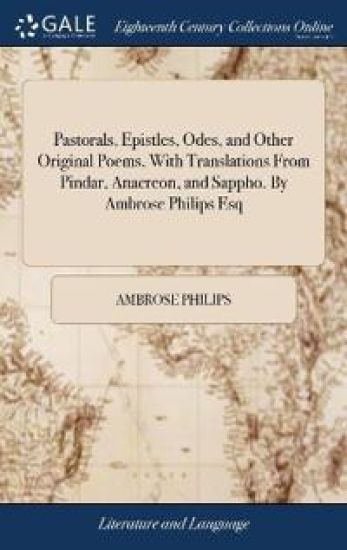
Pastorals, Epistles, Odes, and Other Original Poems, With Translations From Pindar, Anacreon, and Sappho. By Ambrose Philips Esq
The 18th century was a wealth of knowledge, exploration and rapidly growing technology and expanding record-keeping made possible by advances in the printing press. In its determination to preserve the century of revolution, Gale initiated a revolution of its own: digitization of epic proportions to preserve these invaluable works in the largest archive of its kind. Now for the first time these high-quality digital copies of original 18th century manuscripts are available in print, making them highly accessible to libraries, undergraduate students, and independent scholars.Western literary study flows out of eighteenth-century works by Alexander Pope, Daniel Defoe, Henry Fielding, Frances Burney, Denis Diderot, Johann Gottfried Herder, Johann Wolfgang von Goethe, and others. Experience the birth of the modern novel, or compare the development of language using dictionaries and grammar discourses. ++++The below data was compiled from various identification fields in the bibliographic record of this title. This data is provided as an additional tool in helping to insure edition identification: ++++British LibraryT043760London: printed for J. and R. Tonson and S. Draper, 1748. 8],147, 1]p.; 12

Tales of Soldiers and Civilians -The Collected Works of Ambrose Bierce Vol. II
Bierce edited the twelve volumes of The Collected Works of Ambrose Bierce, which were published from 1909 to 1912. The seventh volume consists solely of The Devil's Dictionary. Bierce has been criticized by his contemporaries and later scholars for deliberately pursuing improbability and for his penchant toward ""trick endings."" In his later stories, apparently under the influence of Maupassant, Bierce ""dedicated himself to shocking the audience,"" as if his purpose was ""to attack the reader's smug intellectual security."" Bierce's bias towards Naturalism has also been noted: ""The biting, deriding quality of his satire, unbalanced by any compassion for his targets, was often taken as petty meanness, showing contempt for humanity and an intolerance to the point of merciless cruelty."" Stephen Crane was of the minority of Bierce's contemporaries who valued Bierce's experimental short stories. Get Your Copy Now.
The Collected Short Stories of Ambrose Bierce
American journalist and satirist Ambrose Bierce is one of the most famous and fascinating figures in all of American literature. He led an adventurous and eventful life, beginning with his birth in a log cabin, to his time as a Civil War soldier, followed by his career as an author and journalist, to finally his mysterious disappearance during the Mexican Revolution at age 71. Bierce is perhaps best known for his short stories about the American Civil War, which influenced authors such as Ernest Hemingway and Stephen Crane. He was also an accomplished horror story writer, whose work inspired the tales of H. P. Lovecraft. Bierce's gift for story-telling is exemplified by his famous "An Occurrence at Owl Creek Bridge", which is the story of Peyton Farquhar, a Confederate sympathizer condemned to die by hanging upon the Owl Creek Bridge. It is one of the most anthologized of American short stories and showcases his cutting wit and talent for irony and surprise. This story, along with numerous others, is collected in this representative edition of "The Collected Short Stories of Ambrose Bierce". This edition is printed on premium acid-free paper.
Ambrose Bierce's The Devil's Dictionary

Ambrose Bierce's The Devil's Dictionary

Ambrose Bierce

Createspace Independent Publishing Platform
2009
nidottu
The Devil's Dictionary did not reappear in Bierce's next column ("Prattle," in the magazine The Argonaut, of which he had become an editor in March 1877). Nevertheless, he used the idea of comic definitions in his columns dated November 17, 1877, and September 14, 1878. It was in early 1881 that Bierce first used the title, The Devil's Dictionary, while editor-in-chief of another weekly San Francisco magazine, Wasp. The "dictionary" proved popular, and during his time in this post (1881-86) he included 88 installments, each of 15-20 new definitions. In 1887 Bierce became an editor in The Examiner and featured "The Cynic's Dictionary," which was to be the last of his "dictionary" columns until they reappeared in 1904, when they continued erratically before finishing in July 1906. A number of the definitions are accompanied by satiric verses, many of which are signed with comic pseudonyms such as Salder Bupp and Orm Pludge; the most frequently appearing "contributor" is "that learned and ingenious cleric, Father Gassalasca Jape, S.J., whose lines bear his initials". What had started as a newspaper serialization was first reproduced in book form in 1906 under the dubious title Cynic's Word Book. Published by Doubleday, Page and Company, this contained definitions of 500 words in the first half of the alphabet (A-L). A further 500 words (M-Z) were published in 1911 in Volume 7 of The Collected Works of Ambrose Bierce, this time under the name of The Devil's Dictionary. This was a name much preferred by Bierce and he claimed the earlier 'more reverent' title had been forced upon him by the religious scruples of his previous employer. (wikipedia)