This book covers the history of the early diesel classes 21 and 29, which were constructed by the North British Locomotive Company in the early 1960s for the Scottish region of British Railway. Both classes were not very successful and were all withdrawn within ten years of entering service.
This book provides an in-depth history of the Metropolitan-Vickers diesel-electric Type 2 locomotives, more frequently known collectively as the Co-Bo's due to their unusual wheel arrangement. Twenty locomotives were constructed during the late-1950s for use on the London Midland Region of British Railways. The fleet was fraught with difficulties from the start, most notably due to problems with their Crossley engines, this necessitating the need for extensive rehabilitation work during the early-1960s. Matters barely improved and the option to completely re-engine the locomotives with English Electric units was debated at length, but a downturn in traffic levels ultimately resulted in their demise by the end of 1968 prior to any further major rebuilding work being carried out. Significant quantities of new archive and personal sighting information, supported by over 180 photographs and diagrams, have been brought together to allow dramatic new insights into this enigmatic class of locomotives, including the whole debate surrounding potential re-engining, their works histories, the extended periods in storage, together with in-depth reviews of the various detail differences and liveries.
The 'Claytons' were originally conceived as the British Railways "standard" Type 1 diesel-electric locomotive, superseding other Type 1 classes delivered as part of the 'Pilot Scheme' fleet. The early classes suffered from poor driver visibility, and the plan from 1962 was for subsequent trip-freight and local yard shunting locomotives to be centre-cab machines with low bonnets to dramatically improve visibility. To this extent the Claytons were highly successful and popular with operating crews. However, the largely untested high-speed, flat Paxman engines proved to be highly problematical, resulting in deliveries being curtailed after 117 locomotives. Further requirements for Type 1 locomotives after 1965 were met by reverting to one of the original 'Pilot' designs! Deteriorating traffic levels ultimately led to the Claytons being withdrawn from BR service by December 1971. Considerable amounts of archive material have been unearthed to enable the issues surrounding the rise and fall of the 'Standard Type 1' locomotives to be fully explored. Further sources provide insights into the effort and money expended on the Claytons in a desperate attempt to improve their reliability. Individual locomotive record cards, together with personal sighting information, allow histories of each class member to be developed including allocations, works visits, liveries and disposal details. Supported by over 280 photographs and diagrams, dramatic new insights into this troubled class have been assembled for both historians and modellers alike.
In 1957 the Western Region of BR identified a need for 400 Type 1 diesel locomotives for short-haul freight duties but it was 1964 before the first was introduced. General-purpose Type 1s were being delivered elsewhere but WR management regarded these as too expensive for their requirements. After completion of design work on the Western' locomotives, Swindon turned to creating a cheap no-frills' Type 1\. At 65% of the cost of the Bo-Bo alternative, the Swindon 0-6-0 represented a better fit' for the trip-freight niche. Since 1957 the privatised road-haulage industry had decimated BR's wagon-load sector; whilst the 1962 Transport Act released BR from its financially-debilitating public-service obligations, the damage had been done, and the 1963 Beeching Plan focused on closing unprofitable routes and associated services. By 1963 the original requirement for 400 Type 1s had been massively reduced. Fifty-six locomotives were constructed in 1964/65\. Continuing traffic losses resulted in the whole class becoming redundant by 1969\. Fortuitously, a demand for high-powered diesels on the larger industrial railway systems saw the bulk of the locomotives finding useful employment for a further twenty years. This book covers the life of these locomotives on British Railways; a companion volume will provide an extensive appraisal of "Their Life in Industry" for the forty-eight locomotives which made the successful transition after withdrawal from BR
Presents the findings of a three-year ASTD/U.S. Department of Labor nationwide study on how to develop a skilled workforce capable of meeting today's business requirements. Explains how to implement training programs that develop the new basic skills workers will need.
Are you troubled by hearing voices or seeing visions that others do not? Do you believe that other people are trying to harm you or control you? Do you feel that something odd is going on that you can’t explain or that things are happening around you with a special meaning? Do you worry that other people can read your mind or that thoughts are being put in your head?Think You’re Crazy? Think Again provides an effective step-by-step aid to understanding your problems, making positive changes and promoting recovery. Written by experts in the field, this book will help you to:understand how your problems developed and what keeps them goinguse questionnaires and monitoring sheets to identify and track changes in the links between your experiences, how you make sense of these and how you feel and behavelearn how to change thoughts, feelings and behaviour for the betterpractice skills between sessions using worksheetsBased on clinically proven techniques and filled with examples of how cognitive therapy can help people with distressing psychotic experiences, Think You’re Crazy? Think Again will be a valuable resource for people with psychosis.
Are you troubled by hearing voices or seeing visions that others do not? Do you believe that other people are trying to harm you or control you? Do you feel that something odd is going on that you can’t explain or that things are happening around you with a special meaning? Do you worry that other people can read your mind or that thoughts are being put in your head?Think You’re Crazy? Think Again provides an effective step-by-step aid to understanding your problems, making positive changes and promoting recovery. Written by experts in the field, this book will help you to:understand how your problems developed and what keeps them goinguse questionnaires and monitoring sheets to identify and track changes in the links between your experiences, how you make sense of these and how you feel and behavelearn how to change thoughts, feelings and behaviour for the betterpractice skills between sessions using worksheetsBased on clinically proven techniques and filled with examples of how cognitive therapy can help people with distressing psychotic experiences, Think You’re Crazy? Think Again will be a valuable resource for people with psychosis.
Some have called him a slave, minister, a family man, murderer, and a revolutionary. Nat Turner is the controversial figure who rose from the ashes of obscurity to leaving and indelible impression of religious rigor and bloodshed on the very fabric of America; and quite possibly the world. Here is the story of a slave who was one of body but not of the mind and the spirit. Nat Turner, a slave himself, who would lead (60) other slaves to commit the unthinkable.the murder of (55) white women and children during the slave revolt at Southampton, Virginia in 1831. Even after his eventual capture and subsequent execution, Nat Turner stood by his actions and convictions because he believed that he was an instrument of God, and if it required the killing of white women and children to bring America into the light that its own hands were purged in the blood of the African slave; so be it In this book I plan to chronicle who the real Nat Turner was.a slave, minister, and finally, an African American hero. I will utilize scholarly books from noted authors who proved that many of us have been mis-educated about Nat Turner. Patrick Henry who history scholars call one of the Founding Fathers once said "Give me liberty or give me death". Nat Turner attempted to take liberty by force for the freedom of all African American slaves, and in the end welcomed death with open arms.
Colleges fiercely defend America's deeply stratified higher education system, arguing that the most exclusive schools reward the brightest kids who have worked hard to get there. But it doesn't actually work this way. As the recent college-admissions bribery scandal demonstrates, social inequalities and colleges' pursuit of wealth and prestige stack the deck in favour of the children of privilege. For education scholar and critic Anthony P. Carnevale, it's clear that colleges are not the places of aspiration and equal opportunity they claim to be.
This is a book that is long overdue.In the juvenile justice system, we've developed systems of adjudication and rehabilitation; in clinical psychology, we focus on treatment protocols and healing strategies. Nevertheless, both structures have run on parallel tracks, seldom intersecting despite their common mission of helping juveniles transition into successful, responsible, joyful adults. Until now.In Parental Patrol, Detective Montanari provides a framework for understanding and avoiding, the damaging developmental path that often leads young people to behaviors that result their involvement in both the juvenile justice and mental health systems. For the concerned parent, that path is described--with the insight and proficiency of an experienced police officer and the sensitivity and compassion of an effective therapist--through twenty aspects of learning that must be mastered if positive, problem-free emotional growth and development are to occur.The usefulness of Montanari's work goes well beyond being a guidebook for parents. It would also be relevant and appropriate as a training tool for police and therapists seeking to bridge the gap between their professions, providing context and common ground to inform the important work that they do. -Nicholas A. Duva, Ph.D. Parental Patrol is a police officer's guide to the millions of frustrated parents who are struggling with adolescent rebels.Veteran police detective Anthony P. Montanari offers a unique perspective into policing children and has spent close to twenty years investigating juvenile matters. Through trial and error he has suggested twenty specific fundamentals that parents must teach their children, illustrated in what he calls a learning icosagon. Deprivation of these cornerstones of life may result in behavioral issues in children. Identifying which deficiencies within a learning icosagon helps to determine which children are at risk and allows police to use situational profiling as a tool merely by anticipating potential at-risk youth.
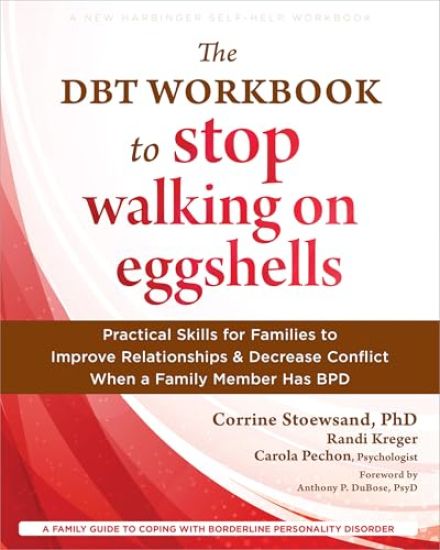
Millions of people suffer from borderline personality disorder (BPD), and countless more live with the effects of loving, caring about, or caring for someone with BPD. The best-selling book, Stop Walking on Eggshells, has helped nearly a million people survive and thrive in relationships with BPD sufferers. This workbook-written specifically for families-takes Eggshells to the next level by empowering readers with skills from dialectical behavior therapy (DBT) to help them connect with empathy, minimize conflict, and take the space they need to thrive.Evidence-based dialectical behavior therapy (DBT) skills for surviving and thriving when a family member has BPD.If you have a family member who struggles with borderline personality disorder (BPD), you're probably familiar with the concept of walking on eggshells. Your loved one may experience intense emotions that are difficult to predict, leaving you feeling stressed, drained, and on edge. So, how can you support your loved one while also taking care of and protecting yourself?From a leading DBT expert and the author of Stop Walking on Eggshells-which has helped nearly a million people successfully navigate their relationships with BPD sufferers-this workbook harnesses the power of DBT, the gold standard for treating BPD. You'll learn to better understand and empathize with your loved one's internal experiences and symptoms, and discover strategies to help you manage your own emotions and stay calm in stressful or upsetting situations. You'll also discover tools for improving communication, tips for boosting self-compassion, and skills for setting healthy boundaries with your loved one. If you're ready to stop walking on eggshells and start minimizing conflict, connecting with empathy, and making sure your own needs are met, this workbook can help you get started-step by step.
Eric Oakes and Anthony P. Acampora tap into their many years of experience in the mental health and addiction-recovery industry. They provide powerful insights on overcoming adversity by providing numerous strategies from a clinical and faith-based perspective. This conversational platform puts into focus the hearts of two seasoned professionals who see things differently but are willing to listen and collaborate for the mutual goal of helping people find hope in seemingly hopeless situations.