Kirjojen hintavertailu. Mukana 12 377 671 kirjaa ja 12 kauppaa.

Kirjahaku

Etsi kirjoja tekijän nimen, kirjan nimen tai ISBN:n perusteella.

1000 tulosta hakusanalla Barbara J. Keys

Treating Children with Sexually Abusive Behavior Problems

Treating Children with Sexually Abusive Behavior Problems

Barbara J Christopherson; Jan Ellen Burton; Lucinda A Rasmussen; Steven C Huke; Julie Bradshaw

Routledge Member of the Taylor and Francis Group
1998
sidottu
Treating Children with Sexually Abusive Behavior Problems: Guidelines for Child and Parent Intervention is a unique, pioneering venture in the area of sexual abuse. Unlike most books on sexual abuse, which focus on children as victims, this integrated treatment approach suggests ways to develop parallel treatment strategies for both parents and children who display harmful sexual behavior.In many ways a first in its field, Treating Children with Sexually Abusvie Behavior Problems gives you the tools to orchestrate your own treatment and intervention techniques, specifically for those children under age 12 who display sexually harmful or unlawful behavior. You’ll find in this useful volume a one-of-a-kind approach to linking together individual, group, and family treatment into one integrated, comprehensive program that treats both perpetrator and victim in tandem. Effective applied techniques are presented to teach:accountability of the offending party concern for others/empathy social competence the establishment of appropriate boundaries healthy sexuality coping with prior trauma safety and supervisionTreating Children with Sexually Abusive Behavior Problems is intended for professionals in child sexual abuse; graduate and undergraduate students in psychology, social work, marriage and family therapy, and psychiatry; juvenile court workers; child welfare case workers; teachers; attorneys; and judges. It will also serve to better inform the victim, family, and general public. If you’re concerned about the spread of sexually abusive behavior in children, you’ll want to become informed and armed with the practical and useful guidelines found in this innovative approach to a prevalent social problem.
Treating Children with Sexually Abusive Behavior Problems

Treating Children with Sexually Abusive Behavior Problems

Barbara J Christopherson; Jan Ellen Burton; Lucinda A Rasmussen; Steven C Huke; Julie Bradshaw

Routledge Member of the Taylor and Francis Group
1998
nidottu
Treating Children with Sexually Abusive Behavior Problems: Guidelines for Child and Parent Intervention is a unique, pioneering venture in the area of sexual abuse. Unlike most books on sexual abuse, which focus on children as victims, this integrated treatment approach suggests ways to develop parallel treatment strategies for both parents and children who display harmful sexual behavior.In many ways a first in its field, Treating Children with Sexually Abusvie Behavior Problems gives you the tools to orchestrate your own treatment and intervention techniques, specifically for those children under age 12 who display sexually harmful or unlawful behavior. You’ll find in this useful volume a one-of-a-kind approach to linking together individual, group, and family treatment into one integrated, comprehensive program that treats both perpetrator and victim in tandem. Effective applied techniques are presented to teach:accountability of the offending party concern for others/empathy social competence the establishment of appropriate boundaries healthy sexuality coping with prior trauma safety and supervisionTreating Children with Sexually Abusive Behavior Problems is intended for professionals in child sexual abuse; graduate and undergraduate students in psychology, social work, marriage and family therapy, and psychiatry; juvenile court workers; child welfare case workers; teachers; attorneys; and judges. It will also serve to better inform the victim, family, and general public. If you’re concerned about the spread of sexually abusive behavior in children, you’ll want to become informed and armed with the practical and useful guidelines found in this innovative approach to a prevalent social problem.
The Overcomer`s Anointing – God`s Plan to Use Your Darkest Hour as Your Greatest Spiritual Weapon

The Overcomer`s Anointing – God`s Plan to Use Your Darkest Hour as Your Greatest Spiritual Weapon

Barbara J. Yoder; Chuck Pierce

Chosen Books, a division of Baker Publishing Group
2009
nidottu
Because God is light, many Spirit-filled Christians overlook the fact that believers go through times of dark spiritual battle. Yet throughout the Bible and church history, we see God bringing his light into the darkest places in order to transform them. Pastor Barbara Yoder wants believers to know that God still breaks through today, often in the darkest and seemingly most hopeless times. Through careful study of Scripture and from the cutting edge of her own experience, Yoder shows readers God's faithfulness during the darkest spiritual hours. Offering hope and purpose, Yoder Shows believers how God uses those dark times of the soul to forge something new--something only darkness can shape and only God's light can expose. Readers will come away encouraged to see how often God waits until the final moments to bring forth victory for those obedient to His will.
The Breaker Anointing – How God Breaks Open the Way to Victory

The Breaker Anointing – How God Breaks Open the Way to Victory

Barbara J. Yoder; James Goll; Chuck Pierce

Chosen Books, a division of Baker Publishing Group
2017
nidottu
Landmark Text Now Revised and Expanded for a New GenerationWe all face hard times and obstacles in life--whether physically, emotionally, spiritually, financially, creatively, or relationally. Yet we have a God who is with us and for us. A God who, as Micah 2:13 says, is a "Breaker" who goes before us.Now revised and expanded, this new edition of Barbara Yoder's best-selling book will help you discover that the same God who led Moses and broke open the way for his people is leading the church today--and he will break open any way or route he has ordained for us to go through. Yet he does not do it alone. You are part of the breakthrough. Every believer filled with the Spirit has access to God's breaker anointing. We can move forward, therefore, with faith, confidence, and bold, courageous action. He is waiting for us to step out and change our lives, cities, and nations. God the Breaker goes before us--and where he goes, nothing can hold us back.
A Culture of Fact

A Culture of Fact

Barbara J. Shapiro

Cornell University Press
2003
pokkari
Barbara J. Shapiro traces the surprising genesis of the "fact," a modern concept that, she convincingly demonstrates, originated not in natural science but in legal discourse. She follows the concept's evolution and diffusion across a variety of disciplines in early modern England, examining how the emerging "culture of fact" shaped the epistemological assumptions of each intellectual enterprise.Drawing on an astonishing breadth of research, Shapiro probes the fact's changing identity from an alleged human action to a proven natural or human happening. The crucial first step in this transition occurred in the sixteenth century when English common law established a definition of fact which relied on eyewitnesses and testimony. The concept widened to cover natural as well as human events as a result of developments in news reportage and travel writing. Only then, Shapiro discovers, did scientific philosophy adopt the category "fact." With Francis Bacon advocating more stringent criteria, the witness became a vital component in scientific observation and experimentation. Shapiro also recounts how England's preoccupation with the fact influenced historiography, religion, and literature—which saw the creation of a fact-oriented fictional genre, the novel.
Canada's Governors General, 1847-1878

Canada's Governors General, 1847-1878

Barbara J. Messamore

University of Toronto Press
2006
sidottu
Oft-ignored in the study of Canadian history or dismissed as a vestige of colonial status, the governor general's office provides essential historical insight into Canada's constitutional evolution. In the nineteenth century, as today, individual governors general exercised considerable scope in interpreting their approach to the office. The era 1847-1878 witnessed profound changes in Canada's relationship with Britain, and in this new book, Barbara J. Messamore explores the nature of these changes through an examination of the role of the governor general.Guided by outmoded instructions and constitutional conventions that were not yet firmly established, the governors general of the time - Lord Elgin, Sir Edmund Head, Lord Monck, Lord Lisgar, and Lord Dufferin - all wrestled with the implications of colonial self government. The imprecision of the viceregal role made the character of the appointee especially important and biographical details are thus essential to an understanding of how the new experiment of colonial self-government was put into practice. Messamore's book marries constitutional history and biography, providing illumination on some of the key figures of nineteenth-century Canadian politics.
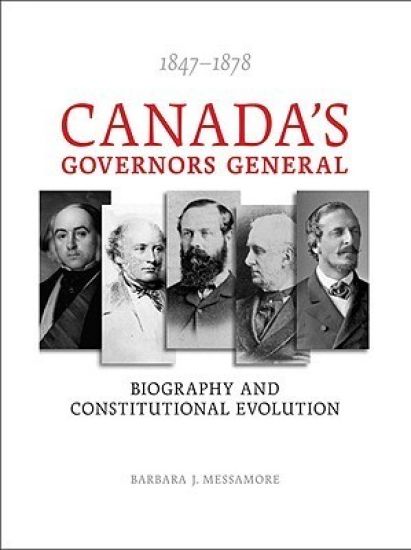
Canada's Governors General, 1847-1878

Canada's Governors General, 1847-1878

Barbara J. Messamore

University of Toronto Press
2006
pokkari
Oft-ignored in the study of Canadian history or dismissed as a vestige of colonial status, the governor general's office provides essential historical insight into Canada's constitutional evolution. In the nineteenth century, as today, individual governors general exercised considerable scope in interpreting their approach to the office. The era 1847-1878 witnessed profound changes in Canada's relationship with Britain, and in this new book, Barbara J. Messamore explores the nature of these changes through an examination of the role of the governor general.Guided by outmoded instructions and constitutional conventions that were not yet firmly established, the governors general of the time - Lord Elgin, Sir Edmund Head, Lord Monck, Lord Lisgar, and Lord Dufferin - all wrestled with the implications of colonial self government. The imprecision of the viceregal role made the character of the appointee especially important and biographical details are thus essential to an understanding of how the new experiment of colonial self-government was put into practice. Messamore's book marries constitutional history and biography, providing illumination on some of the key figures of nineteenth-century Canadian politics.
Biophysical Agents

Biophysical Agents

Barbara J. Behrens

F.A. Davis Company
2020
nidottu
Written specifically for PTAs! Develop the clinical decision-making skills you need to be a successful PTA. This easy-to-follow approach helps you learn how to successfully relate thermal, mechanical, and electrical biophysical agents to specific therapeutic goals while understanding all the physiologic ramifications. Drawing from the APTA's Guide to Physical Therapist Practice, this text will enable you to make the connection between a physical agent and the appropriate treatment interventions as part of a comprehensive, successful physical therapy treatment program.Five Stars. "Great book easy to understand." - Dania L., Online ReviewerExcellent resource. "Very informative book for PTA students. Lots of useful charts and easy to follow." - Stephen W., Online Reviewer
Political Communication and Political Culture in England, 1558-1688
This book surveys the channels through which political ideas and knowledge were conveyed to the English people from the beginning of the reign of Elizabeth I to the Revolution of 1688. Shapiro argues that an assessment of English political culture requires an examination of all means by which this culture was expressed and communicated. While the discussion focuses primarily on genres such as the sermon, newsbook, poetry, and drama, it also considers the role of events and institutions. Shapiro is the first to explore and elucidate the entire web of communication in early modern English political life.
Transforming Critical Thinking

Transforming Critical Thinking

Barbara J.Thayer- Bacon

Teachers' College Press
2000
nidottu
Barbara J. Thayer-Bacon presents a groundbreaking reconceptualization of critical thinking theory. Drawing on pragmatic, feminist, and postmodern philosophies, this richly detailed volume presents an overview of the history of critical thinking and identifies its major theorists. Thayer-Bacon critiques how critical thinking is conceptualized and applied in classrooms and offers a newly delineated platform for how women and feminist theorists, as well as men, can engage in what she calls "constructive thinking." Her proposals are not only timely, they are also original. This book is a vital addition to the discourse and debates about critical thinking theory.
Music and Soulmaking

Music and Soulmaking

Barbara J. Crowe

Scarecrow Press
2004
sidottu
This resource explores fascinating new avenues in music therapy. The author discusses connections between music therapy and theorizes that every little nuance found in nature is part of a dynamic system in motion. She also shows how everything is inter-related and addresses how music is able to touch people in a deep and consequentially healing way. This complex interaction results in what the author terms "Soulmaking", or the ability of music to heal what makes us vital, whole, alive, and balanced. Crowe draws upon her 25 years of experience as a music therapist to flesh out her theory of soulmaking, providing concrete examples of the effect music can have on a wide range of patients with diseases as varied as Alzheimer's and Down's Syndrome. She also addresses the four facets of human functioning: mind, body, emotion, and spirit and shows how music can touch them all.
Marty Robbins

Marty Robbins

Barbara J. Pruett

Scarecrow Press
2007
nidottu
From his first performance in the late 1940s until his early death in 1982, Marty Robbins established himself as one of the most popular and successful singer/songwriters in the latter half of the 20th century. On the country charts, he racked up 15 #1 hits, including the crossover smashes El Paso and A White Sport Coat (and a Pink Carnation). A beloved entertainer, Robbins received honors from every major music association. El Paso became the first Grammy ever awarded to a Country song, while My Woman My Woman My Wife received the 1970 Grammy for Best Country Song. In 1969 Robbins was named artist of the decade by the Academy of Country Music. He was inducted into the Nashville Songwriters Hall of Fame in 1975 and the Country Music Hall of Fame in 1982. In addition to his success as a singer/songwriter, Robbins loved car racing. In the early 1970s he joined the NASCAR circuit and raced the rest of his life. In Marty Robbins: Fast Cars and Country Music, author Barbara J. Pruett provides an exhaustive overview of Robbins' life and career. Nearly half of the book is a chronological listing (starting in 1948) of more than 2,000 magazine and newspaper articles and other sources of information about Robbins. Another section provides a basic discography of his hundreds of recordings, including both albums and singles released in his lifetime and after. The book also features a list of all of the songs he copyrighted, stories about his stock car racing activities, several previously unpublished photographs, and interviews with those who knew and worked with him—and even an extensive interview with Robbins himself. As a tribute to a great entertainer, this volume will be of interest not only to entertainment writers and researchers, but also to Marty Robbins fans worldwide.
On Exhibit

On Exhibit

Barbara J. Black

University of Virginia Press
2000
sidottu
Why did the Victorians collect with such a vengeance and exhibit in museums? Focusing on this key 19th-century enterprise, Barbara J. Black seeks to illuminate British culture of the period by examining the cultural power that this collecting and exhibiting possessed. Through its museums, she argues, Victorian London constructed itself as a world city. Using the tools of cultural criticism, social history and literary analysis, the author roots Victorian museum culture in key political events and cultural forces: British imperialism, exploration and tourism; advances in science and changing attitudes about knowledge; the commitment to improved public taste through mass education; the growth of middle-class dominance and the resulting bourgeois fetishism and commodity culture; and the democratization of luxury engendered by the French and industrial revolutions. She covers a wide range of genres - from poetry to museum guidebooks to the triple-decker novel -and treats three London museums as case studies: Sir John Soane's house-museum, the Natural History Museum, and the exemplary South Kensington. While the work provides an analysis of Victorian society, it also reminds us how modern the Victorians were - how, in crucial ways, our culture derives from the Victorian era. Forging connections among museums, urbanism and modernity, it provokes the reader to examine cultural imperialism and the costs and advantages of cultural consensus.
Facilitating For Growth

Facilitating For Growth

Barbara J. Fleischer

Liturgical Press
1993
pokkari
Great small-group facilitators are not born with their abilities; they develop them. This book will help facilitators in their task of enabling members to participate fully in their group. The content and exercises of each chapter present practical information and methods to help facilitators deepen their knowledge of their role and hone their skills in group facilitation.The first eight chapters cover various aspects of facilitation: the role of the facilitator; getting started; communication basics - expressive skills and listening skills; integrating our diversity; tuning into group life; and group transitions. Each chapter begins with warm-up exercises consisting of questions and assignments designed to help readers draw from their own experience as they work with the written material presented in each chapter.The rest of the book outlines eight flexibly formatted, ninety-minute workshop (or individual) sessions corresponding to the eight topics introduced previously. Includes exercises for practicing and assessing skills acquired in each session.
Was Blind, but Now I See

Was Blind, but Now I See

Barbara J. Flagg

New York University Press
1997
sidottu
Race does not speak to most white people. Rather, whites tend to associate race with people of color and to equate whiteness with racelessness. As Barbara J. Flagg demonstrates in this important book, this "transparency" phenomenon—the invisibility of whiteness to white people—profoundly affects the ways in whites make decisions: they rely on criteria perceived by the decision maker as race-neutral but which in fact reflect white, race-specific norms. Flagg here identifies this transparently white decision making as a form of institutional racism that contributes significantly, though unobtrusively, to the maintenance of white supremacy. Bringing the discussion to bear on the arena of law, Flagg analyzes key areas of race discrimination law and makes the case for reforms that would bring legal doctrine into greater harmony with the recognition of institutional racism in general and the transparency phenomenon in particular. She concludes with an exploration of the meaning of whiteness in a pluralist culture, paving the way for a positive, nonracist conception of whiteness as a distinct racial identity. An informed and substantive call for doctrinal reform, Was Blind But Now I See is the most expansive treatment yet of the relationship between whiteness and law.
Households on the Mimbres Horizon, Volume 82

Households on the Mimbres Horizon, Volume 82

Barbara J. Roth

University of Arizona Press
2023
nidottu
Pithouse sites represent the basic form of occupation in the Mimbres Mogollon region of southwestern New Mexico from AD 200 to the late 900s. This study presents the results of excavations of one such site, called La Gila Encantada. Little is known about the variability present at pithouse sites away from the major Mimbres and Gila River Valleys. Nonriverine occupations have been understudied until now. This book describes subsistence and settlement practices and compares the results with recent research conducted at the larger villages in the Mimbres River Valley. Despite basic similarities in material culture, households at La Gila Encantada appear to have followed different trajectories than those along the rivers. Examining these differences, archaeologist Barbara J. Roth provides insights into some of the reasons why they existed and shows that the variability present in pithouse occupations over the years was tied to multiple factors, including environmental differences, economic practices, and the social composition of groups occupying the sites. With chapters assessing ceramic data, chipped and groundstone analysis, shell and mineral jewelry, and regional context, this look at the past offers relevant insights into current issues in Southwest archaeology, including identity, interaction, and household organization.
Bending Archaeology toward Social Justice

Bending Archaeology toward Social Justice

Barbara J. Little

THE UNIVERSITY OF ALABAMA PRESS
2023
sidottu
In this time of Black Lives Matter, the demands of NAGPRA, and climate crises, the field of American archaeology needs a radical transformation. It has been largely a white, male, privileged domain that replicates an entrenched patriarchal, colonial, and capitalist system. In Bending Archaeology toward Social Justice, Barbara J. Little explores the concepts and actions required for such a change, looking to peace studies, anthropology, sociology, social justice activism, and the achievements of community-based archaeology for helpful approaches in keeping with the UN Sustainable Development Goals. She introduces an analytic model that uses the strengths of archaeology to destabilize violence and build peace. As Little explains, the Diachronic Transformational Action model and the peace/violence triad of interconnected personal, cultural, and structural domains of power can help disrupt the injustice of all forms of violence. Diachronic connects the past to the present to understand how power worked in the past and works now. Transformational influences power now by disrupting the stability of the violence triad. Action refers to collaborative work to diagnose power relations and transform toward social justice. Using this framework, Little confronts the country’s founding and myth of liberty and justice for all, as well as the American Dream. She also examines whiteness, antiracism, privilege, and intergenerational trauma, and offers white archaeologists concepts to grapple with their own racialized identities and to consider how to relinquish white supremacy. Archaeological case studies examine cultural violence and violent direct actions against women, Indigenous peoples, African Americans, and Japanese Americans, while archaeologies of poverty, precarity, and labor are used to show how archaeologists have helped expose the roots of these injustices. Because climate justice is integral to social justice, Little showcases insights that archaeology can bring to bear on the climate crisis and how lessons from the past can inform direct actions today. Finally, Little invites archaeologists to embrace inquiry and imagination so that they can both imagine and achieve the positive peace of social justice.
Bending Archaeology toward Social Justice

Bending Archaeology toward Social Justice

Barbara J. Little

THE UNIVERSITY OF ALABAMA PRESS
2023
nidottu
In this time of Black Lives Matter, the demands of NAGPRA, and climate crises, the field of American archaeology needs a radical transformation. It has been largely a white, male, privileged domain that replicates an entrenched patriarchal, colonial, and capitalist system. In Bending Archaeology toward Social Justice, Barbara J. Little explores the concepts and actions required for such a change, looking to peace studies, anthropology, sociology, social justice activism, and the achievements of community-based archaeology for helpful approaches in keeping with the UN Sustainable Development Goals. She introduces an analytic model that uses the strengths of archaeology to destabilize violence and build peace. As Little explains, the Diachronic Transformational Action model and the peace/violence triad of interconnected personal, cultural, and structural domains of power can help disrupt the injustice of all forms of violence. Diachronic connects the past to the present to understand how power worked in the past and works now. Transformational influences power now by disrupting the stability of the violence triad. Action refers to collaborative work to diagnose power relations and transform toward social justice. Using this framework, Little confronts the country’s founding and myth of liberty and justice for all, as well as the American Dream. She also examines whiteness, antiracism, privilege, and intergenerational trauma, and offers white archaeologists concepts to grapple with their own racialized identities and to consider how to relinquish white supremacy. Archaeological case studies examine cultural violence and violent direct actions against women, Indigenous peoples, African Americans, and Japanese Americans, while archaeologies of poverty, precarity, and labor are used to show how archaeologists have helped expose the roots of these injustices. Because climate justice is integral to social justice, Little showcases insights that archaeology can bring to bear on the climate crisis and how lessons from the past can inform direct actions today. Finally, Little invites archaeologists to embrace inquiry and imagination so that they can both imagine and achieve the positive peace of social justice.
Relational "(e)Pistemologies"

Relational "(e)Pistemologies"

Barbara J. Thayer-Bacon

Peter Lang Publishing Inc
2003
nidottu
Relational (e)pistemologies redefines epistemology in a non-transcendent manner and reclaims the traditional epistemological concerns of standards and criteria for warranting arguments and determining truth and falsity. These concerns must be reclaimed in order to make them visible and accountable as well as pragmatically useful on socially constructed grounds - not transcendental grounds. Thayer-Bacon's book offers analysis and critique as well as redescription. She presents a pragmatist social feminist view, a relational perspective of knowing embedded within a discussion of many other relational views - personal, social and holistic, ecological, and scientific - which emphasize connections. Thayer-Bacon describes each of these forms of relationality, and she points to key scholars whose work highlights a certain relational form. She concludes with a discussion of the educational implications relational (e)pistemological theories have for education.
Japan's Imperial Diplomacy

Japan's Imperial Diplomacy

Barbara J. Brooks

University of Hawai'i Press
2000
nidottu
In November 1937, Ishii Itaro, head of the Japanese Foreign Ministry's Bureau of Asiatic Affairs, reflected bitterly on the decline of the Ministry's influence in China and his own long and debilitating struggle to guide China policy. Ishii was the most notable member of a group of middle-level diplomats who, having served in China, strongly advocated that Japan must adopt policies in harmony with China's rising nationalism and national interests. This volume profiles this distinct strain of ""China service diplomat"", while providing a comprehensive look at the institutional history and internal dynamics of the Japanese foreign ministry and its handling of China affairs in the years leading up to and through World War II. Moving from an examination of a wide range of primary sources, including the archives of the Japanese Foreign Ministry, memoirs, diaries and speeches, the author offers integrated interpretations of Japanese imperialism, diplomacy, and the bureaucratic restructuring of the 1930s that was fundamental to Japan's version of fascism and the move toward war.