Kirjojen hintavertailu. Mukana 11 244 527 kirjaa ja 12 kauppaa.

Kirjahaku

Etsi kirjoja tekijän nimen, kirjan nimen tai ISBN:n perusteella.

1000 tulosta hakusanalla Barbara M Cook

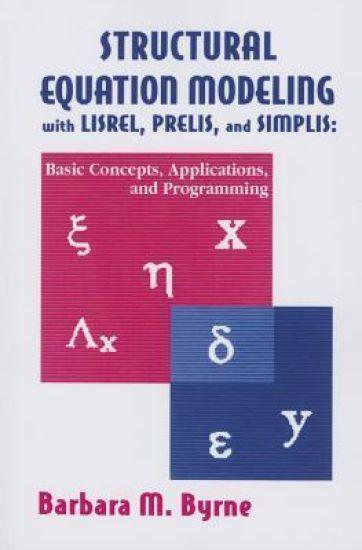
Structural Equation Modeling With Lisrel, Prelis, and Simplis
This book illustrates the ease with which various features of LISREL 8 and PRELIS 2 can be implemented in addressing research questions that lend themselves to SEM. Its purpose is threefold: (a) to present a nonmathmatical introduction to basic concepts associated with SEM, (b) to demonstrate basic applications of SEM using both the DOS and Windows versions of LISREL 8, as well as both the LISREL and SIMPLIS lexicons, and (c) to highlight particular features of the LISREL 8 and PRELIS 2 progams that address important caveats related to SEM analyses.This book is intended neither as a text on the topic of SEM, nor as a comprehensive review of the many statistical funcitons available in the LISREL 8 and PRELIS 2 programs. Rather, the intent is to provide a practical guide to SEM using the LISREL approach. As such, the reader is "walked through" a diversity of SEM applications that include both factor analytic and full latent variable models, as well as a variety of data management procedures.
Structural Equation Modeling With AMOS

Structural Equation Modeling With AMOS

Barbara M. Byrne

Routledge
2016
sidottu
This bestselling text provides a practical guide to structural equation modeling (SEM) using the Amos Graphical approach. Using clear, everyday language, the text is ideal for those with little to no exposure to either SEM or Amos. The author reviews SEM applications based on actual data taken from her own research. Each chapter "walks" readers through the steps involved (specification, estimation, evaluation, and post hoc modification) in testing a variety of SEM models. Accompanying each application is: an explanation of the issues addressed and a schematic presentation of hypothesized model structure; Amos input and output with interpretations; use of the Amos toolbar icons and pull-down menus; and data upon which the model application was based, together with updated references pertinent to the SEM model tested.Thoroughly updated throughout, the new edition features: All new screen shots featuring Amos Version 23. Descriptions and illustrations of Amos’ new Tables View format which enables the specification of a structural model in spreadsheet form. Key concepts and/or techniques that introduce each chapter. Alternative approaches to model analyses when enabled by Amos thereby allowing users to determine the method best suited to their data. Provides analysis of the same model based on continuous and categorical data (Ch. 5) thereby enabling readers to observe two ways of specifying and testing the same model as well as compare results. All applications based on the Amos graphical mode interface accompanied by more "how to" coverage of graphical techniques unique to Amos. More explanation of key procedures and analyses that address questions posed by readers All application data files are available at www.routledge.com/9781138797031.The two introductory chapters in Section 1 review the fundamental concepts of SEM methodology and a general overview of the Amos program. Section 2 provides single-group analyses applications including two first-order confirmatory factor analytic (CFA) models, one second-order CFA model, and one full latent variable model. Section 3 presents multiple-group analyses applications with two rooted in the analysis of covariance structures and one in the analysis of mean and covariance structures. Two models that are increasingly popular with SEM practitioners, construct validity and testing change over time using the latent growth curve, are presented in Section 4. The book concludes with a review of the use of bootstrapping to address non-normal data and a review of missing (or incomplete) data in Section 5. An ideal supplement for graduate level courses in psychology, education, business, and social and health sciences that cover the fundamentals of SEM with a focus on Amos, this practical text continues to be a favorite of both researchers and practitioners. A prerequisite of basic statistics through regression analysis is recommended but no exposure to either SEM or Amos is required.
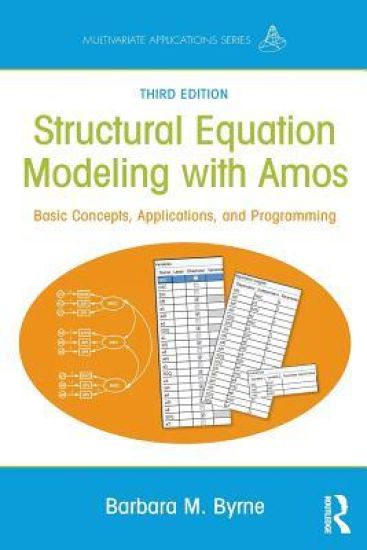
Structural Equation Modeling With AMOS

Structural Equation Modeling With AMOS

Barbara M. Byrne

Routledge
2016
nidottu
This bestselling text provides a practical guide to structural equation modeling (SEM) using the Amos Graphical approach. Using clear, everyday language, the text is ideal for those with little to no exposure to either SEM or Amos. The author reviews SEM applications based on actual data taken from her own research. Each chapter "walks" readers through the steps involved (specification, estimation, evaluation, and post hoc modification) in testing a variety of SEM models. Accompanying each application is: an explanation of the issues addressed and a schematic presentation of hypothesized model structure; Amos input and output with interpretations; use of the Amos toolbar icons and pull-down menus; and data upon which the model application was based, together with updated references pertinent to the SEM model tested.Thoroughly updated throughout, the new edition features: All new screen shots featuring Amos Version 23. Descriptions and illustrations of Amos’ new Tables View format which enables the specification of a structural model in spreadsheet form. Key concepts and/or techniques that introduce each chapter. Alternative approaches to model analyses when enabled by Amos thereby allowing users to determine the method best suited to their data. Provides analysis of the same model based on continuous and categorical data (Ch. 5) thereby enabling readers to observe two ways of specifying and testing the same model as well as compare results. All applications based on the Amos graphical mode interface accompanied by more "how to" coverage of graphical techniques unique to Amos. More explanation of key procedures and analyses that address questions posed by readers All application data files are available at www.routledge.com/9781138797031.The two introductory chapters in Section 1 review the fundamental concepts of SEM methodology and a general overview of the Amos program. Section 2 provides single-group analyses applications including two first-order confirmatory factor analytic (CFA) models, one second-order CFA model, and one full latent variable model. Section 3 presents multiple-group analyses applications with two rooted in the analysis of covariance structures and one in the analysis of mean and covariance structures. Two models that are increasingly popular with SEM practitioners, construct validity and testing change over time using the latent growth curve, are presented in Section 4. The book concludes with a review of the use of bootstrapping to address non-normal data and a review of missing (or incomplete) data in Section 5. An ideal supplement for graduate level courses in psychology, education, business, and social and health sciences that cover the fundamentals of SEM with a focus on Amos, this practical text continues to be a favorite of both researchers and practitioners. A prerequisite of basic statistics through regression analysis is recommended but no exposure to either SEM or Amos is required.
A History of English (RLE: English Language)

A History of English (RLE: English Language)

Barbara M. H. Strang

Routledge
2015
sidottu
A History of English, first published in 1970, is a book for beginners in linguistic history. This title examines the changes in English language speech and writing over a period of almost 2000 years, whilst also exploring more recent changes within the author’s living memory. This title aims to raise countless issues for enquiry and discussion, and its purpose is to serve as a springboard for language history learning rather than a textbook.
A History of English (RLE: English Language)

A History of English (RLE: English Language)

Barbara M. H. Strang

Routledge
2017
nidottu
A History of English, first published in 1970, is a book for beginners in linguistic history. This title examines the changes in English language speech and writing over a period of almost 2000 years, whilst also exploring more recent changes within the author’s living memory. This title aims to raise countless issues for enquiry and discussion, and its purpose is to serve as a springboard for language history learning rather than a textbook.
Strange Scriptures That Perplex the Western Mind

Strange Scriptures That Perplex the Western Mind

Barbara M. Bowen

Literary Licensing, LLC
2013
sidottu
""Strange Scriptures That Perplex The Western Mind"" is a book written by Barbara M. Bowen that explores various religious texts and practices from around the world that may seem unusual or perplexing to those from a Western background. The book delves into the beliefs and customs of various religions, including Hinduism, Buddhism, Taoism, and more, examining the ways in which these traditions can challenge Western assumptions and ways of thinking. Bowen draws on her own experiences and research to provide insight into the meanings and significance of these strange scriptures, offering readers a new perspective on the diversity of religious beliefs and practices around the world. Through her engaging and accessible writing style, Bowen encourages readers to consider new ways of understanding and appreciating the complexity of the human experience.This is a new release of the original 1944 edition.This scarce antiquarian book is a facsimile reprint of the old original and may contain some imperfections such as library marks and notations. Because we believe this work is culturally important, we have made it available as part of our commitment for protecting, preserving, and promoting the world's literature in affordable, high quality, modern editions, that are true to their original work.
Making Tobacco Bright

Making Tobacco Bright

Barbara M. Hahn

Johns Hopkins University Press
2012
sidottu
In her sweeping history of the American tobacco industry, Barbara Hahn traces the emergence of the tobacco plant's many varietal types, arguing that they are products not of nature but of economic relations and continued and intense market regulation. Hahn focuses her study on the most popular of these varieties, Bright Flue-Cured Tobacco. First grown in the inland Piedmont along the Virginia-North Carolina border, Bright Tobacco now grows all over the world, primarily because of its unique-and easily replicated-cultivation and curing methods. Hahn traces the evolution of technologies in a variety of regulatory and cultural environments to reconstruct how Bright Tobacco became, and remains to this day, a leading commodity in the global tobacco industry. This study asks not what effect tobacco had on the world market, but how that market shaped tobacco into types that served specific purposes and became distinguishable from one another more by technologies of production than genetics. In so doing, it explores the intersection of crossbreeding, tobacco-raising technology, changing popular demand, attempts at regulation, and sheer marketing ingenuity during the heyday of the American tobacco industry. Combining economic theory with the history of technology, Making Tobacco Bright revises several narratives in American history, from colonial staple-crop agriculture to the origins of the tobacco industry to the rise of identity politics in the twentieth century.
Making Tobacco Bright

Making Tobacco Bright

Barbara M. Hahn

Johns Hopkins University Press
2018
pokkari
How did Bright Flue-Cured Tobacco come to dominate the industry?In her sweeping history of the American tobacco industry, Barbara Hahn traces the emergence of the tobacco plant’s many varietal types, arguing that they are products not of nature but of economic relations and continued and intense market regulation. Hahn focuses her study on the most popular of these varieties, Bright Flue-Cured Tobacco. First grown in the inland Piedmont along the Virginia–North Carolina border, Bright Tobacco now grows all over the world, primarily because of its unique—and easily replicated—cultivation and curing methods. Hahn traces the evolution of technologies in a variety of regulatory and cultural environments to reconstruct how Bright Tobacco became, and remains to this day, a leading commodity in the global tobacco industry. This study asks not what effect tobacco had on the world market, but how that market shaped tobacco into types that served specific purposes and became distinguishable from one another more by technologies of production than genetics. In so doing, it explores the intersection of crossbreeding, tobacco-raising technology, changing popular demand, attempts at regulation, and sheer marketing ingenuity during the heyday of the American tobacco industry. Combining economic theory with the history of technology, Making Tobacco Bright revises several narratives in American history, from colonial staple-crop agriculture to the origins of the tobacco industry to the rise of identity politics in the twentieth century.
Famous Horses

Famous Horses

Barbara M. Linde

Gareth Stevens Publishing
2011
sidottu
Some of the most famous animals in history have been horses. From George Washington's trusty Arabian, Magnolia, to the fictional stallion Black Beauty, horses have played an important part in historical events, books, television shows, and movies for many years. Readers will discover important facts about some of the world's most important and beloved horses. Photographs of the horses and their owners help illustrate these amazing and beautiful animals.
Horses in History

Horses in History

Barbara M. Linde

Gareth Stevens Publishing
2011
nidottu
Did you know that horses have been around for 55 million years? Of course, they have changed their appearance a lot over the centuries. People have used horses for many different things, from plowing fields to fighting in battles. Readers will learn about the way horses adapted to the changes in their environment over millions of years. They will also explore the special relationship between horses and humans in the United States and throughout the world.
The Life Cycle of an Opossum

The Life Cycle of an Opossum

Barbara M. Linde

Gareth Stevens Publishing
2011
nidottu
Why does a baby opossum live in its mother's pouch? When can an opossum live on its own? Why are humans a danger to opossums? From inside the mother's pouch to life outside the den, this is an engaging exploration of America's only wild marsupial. Fun facts and vivid photographs teach readers about every stage of an opossum's life.
Appaloosas

Appaloosas

Barbara M. Linde

Gareth Stevens Publishing
2012
nidottu
Appaloosas, with their mottled skin and spotted coats, are one of the most recognizable horse breeds. Though spotted horses have been around since ancient times, it was Native Americans who made the breed an admired one in North America. In this book, horse enthusiasts will learn about the various characteristics of the Appaloosa. Readers will delight in the colorful photographs of Appaloosas throughout history and learn how this breed nearly disappeared.
Arabian Horses

Arabian Horses

Barbara M. Linde

Gareth Stevens Publishing
2012
sidottu
The Arabian horse is known for its beauty. With its tail held high, it seems proud of its appearance. These horses hold a special place in the history of the Middle East. They were bred carefully for swiftness and endurance in a hot desert environment. Many years later, others discovered the value of the Arabian horse. Even George Washington had a prized Arabian. In this book, vivid photos and fun facts highlight the most admired features of this beloved breed.