

Kirjahaku
Etsi kirjoja tekijän nimen, kirjan nimen tai ISBN:n perusteella.
1000 tulosta hakusanalla Basil Bernstein


From a game of hide and seek, the Cardinal draws reflections on prayer and the spiritual life. Few readers will fail to gain encouragement and help from the wisdom in these pages.
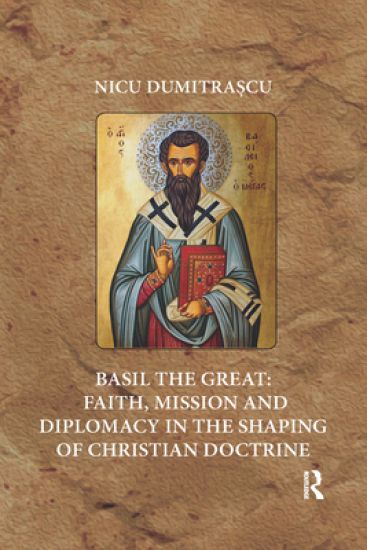
Basil the Great: Faith, Mission and Diplomacy in the Shaping of Christian Doctrine
Nicu Dumitra?cu
Routledge
2020
nidottu
Regarded as one of the three hierarchs or pillars of orthodoxy along with Gregory of Nazianzus and John Chrysostom, Basil is a key figure in the formative process of Christianity in the fourth century. While his role in establishing Trinitarian terminology, as well as his function in shaping monasticism, his social thought and even his contribution to the evolution of liturgical forms have been the focus of research for many years, there are few studies which centre on his political thought. Basil played a major role in the political and religious life between Cappadocia and Armenia and was a key figure in the tumultuous relationship between Church and State in Late Antiquity. He was a great religious leader and a gifted diplomat, and developed a ’special relationship’ with Emperor Valens and other high imperial officials.

Renowned biographer Michael Holroyd had always assumed that his own family was perfectly English, or at least perfectly ordinary. But an investigation into the Holroyd past--guided by old photograph albums, crumbling documents, and his parents' wildly divergent accounts of their lives--gradually yields clues to a constellation of startling events and eccentric characters: a slow decline from English nobility on one side, a dramatic Scandinavian ancestry on the other. Fires, suicides, bankruptcies, divorces, unconsummated longings, and the rumor of an Indian tea fortune permeate this wry, candid memoir, "part multiple biography, part autobiography, but principally an oblique investigation of the biographer's art" (New York Times Book Review). " A] perfect example of a memoir that entrances me."--Katherine A. Powers, Boston Sunday Globe " O]ne of the few biographers] who can convey what makes ordinary as well as extraordinary mortals live in our minds."--Los Angeles Times

Basil of Caesarea is thought of most often as an opponent of heresy and a pioneer of monastic life in the eastern church. In this new biographical study, however, controversy is no longer seen as the central preoccupation of his life nor are his ascetic initiatives viewed as separable from his pastoral concern for all Christians. Basil's letters, sermons, and theological treatises, together with the testimonies of his relatives and friends, reveal a man beset by doubt. He demanded loyalty, but gave it also, and made it a central feature of his church. In Rousseau's portrait, Basil's understanding of human nature emerges as his major legacy.
Basil Valentine's Triumphal Chariot Of Antimony
Basilus Valentinus
Kessinger Publishing
2007
sidottu
Basil, The Schoolboy Or The Heir Of Arundel (1854)
Edward Monro
KESSINGER PUBLISHING, LLC
2008
sidottu
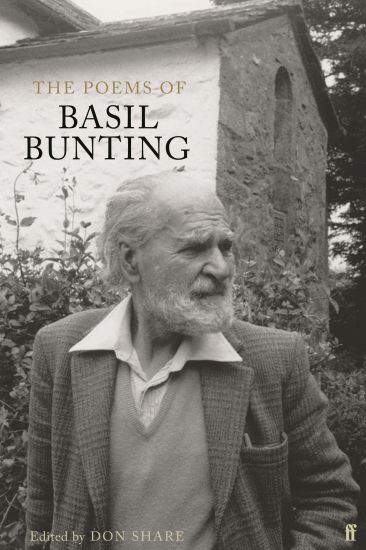
Basil Bunting's work was published haphazardly throughout most of his life, and in many cases he did not oversee publication. This is the first critical edition of the complete poems, and offers an accurate text with variants from all printed sources. Don Share annotates Bunting's often complex and allusive verse, with much illuminating quotation from his prose writings, interviews and correspondence. He also examines Bunting's use of sources (including Persian literature and classical mythology), and explores the Northumbrian roots of Bunting's poetic vocabulary and use of dialect.
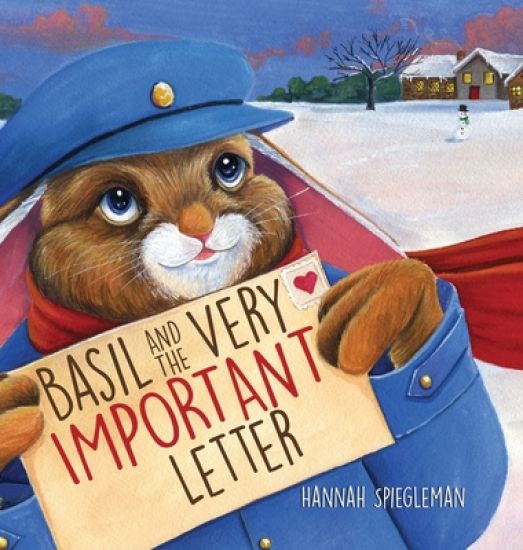
"Work was done for the day. Every letter and parcel had been delivered, and Basil the postman was looking forward to warming himself by the fire with a cup of peppermint tea. That's when he saw it ... one missed letter "Basil is a hardworking postman who knows that every letter is important, and every letter must be delivered before sundown. When he finds a missed letter on his desk at the end of the day, he knows he absolutely MUST deliver it before dark. With the letter and his trusty pocket watch in hand, Basil dashes off into the snow. Along the way, he meets many of his friends and maybe, just maybe, gets a very special surprise.
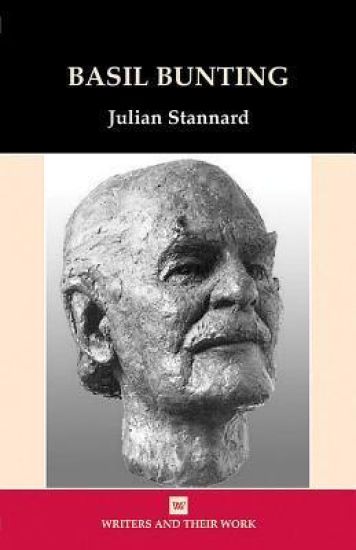
Basil Bunting (1900-1985) was an extraordinary if sometimes neglected poet. His late-flowering masterpiece Briggflatts (1965) jettisoned him into the pantheon of twentieth century greats and reminded his audience that the legacies of international modernism had not been entirely buried. Bunting showed that Anglo-American modernism was not incompatible with native traditions and Briggflatts is a powerful evocation of Northumbria, the poet’s cherished place of origin. Such dynamic regionalism struck a powerful note in the 1960s, his poetry proving an inspiration to younger poets. Bunting became a talismanic figure, his charismatic readings helping to galvanise the British Poetry Revival. Briggflatts rescued Bunting from literary neglect and prompted readers to return to his earlier writings which are also examined here.
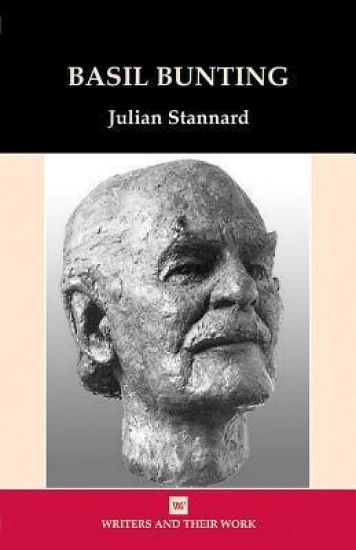
Basil Bunting (1900-1985) was an extraordinary if sometimes neglected poet. His late-flowering masterpiece Briggflatts (1965) jettisoned him into the pantheon of twentieth century greats and reminded his audience that the legacies of international modernism had not been entirely buried. Bunting showed that Anglo-American modernism was not incompatible with native traditions and Briggflatts is a powerful evocation of Northumbria, the poet’s cherished place of origin. Such dynamic regionalism struck a powerful note in the 1960s, his poetry proving an inspiration to younger poets. Bunting became a talismanic figure, his charismatic readings helping to galvanise the British Poetry Revival. Briggflatts rescued Bunting from literary neglect and prompted readers to return to his earlier writings which are also examined here.
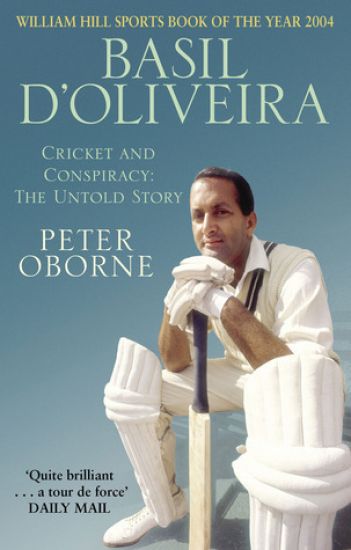
There have been innumerable biographies of cricketers. Peter Oborne's outstanding biography of Basil D'Oliveira is something else. It brings together sport, politics and race. It is the story of how a black South African defied incredible odds and came to play cricket for England, of how a single man escaped from apartheid and came to fulfil his prodigious sporting potential. It is a story of the conquest of racial prejudice, both in South Africa and in the heart of the English sporting establishment. The story comes to its climax in the so-called D'Oliveira Affair of 1968, when John Vorster, the South African Prime Minister, banned the touring MCC side because of the inclusion of a black man. This episode marked the start of the twenty-year sporting isolation of South Africa that ended only with the collapse of apartheid itself.
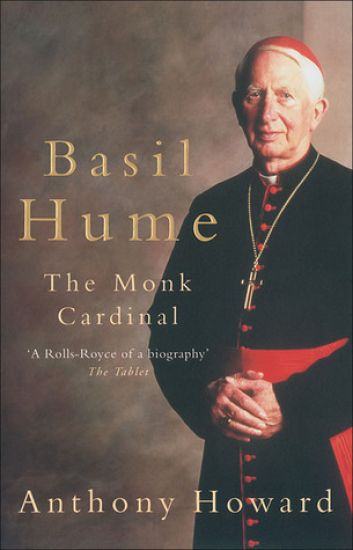
Following Cardinal Basil Hume's death on 17 June 1999, The Times concluded his obituary with a remarkable accolade: 'Few churchman in this century, inside or outside the Catholic Church, have died more deeply loved.'Basil Hume served as Cardinal Archbishop of Westminster for twenty-three years and his holiness and wisdom made him an extraordinary leader. In this enthralling biography, Anthony Howard, who has had unique access to Cardinal Hume's private papers and the people who knew him best, traces his life, from his Newcastle upbringing through to his schooling at Ampleforth and his reign at Westminster, including his long and ultimately successful fight on behalf of the Maguire Seven and the Guildford Four.
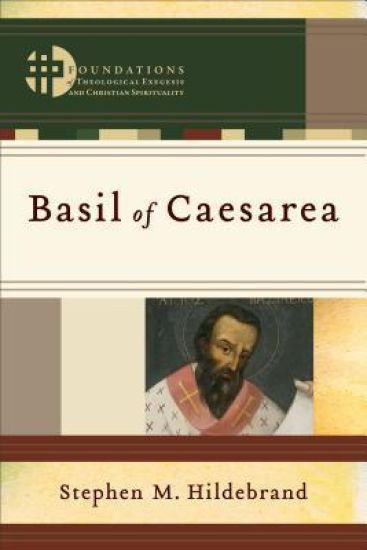
This introduction to the thought of Basil of Caesarea surveys his theological, spiritual, and monastic writings, showing the importance of his work for contemporary theology and spirituality. It brings together various aspects of Basil's thought into a single whole and explores his uniqueness and creativity as a theologian. The volume engages specialized scholarship on Basil but makes his thought accessible to a wider audience. It is the third volume in the Foundations of Theological Exegesis and Christian Spirituality series, which critically recovers patristic exegesis and interpretation for contemporary theology and spirituality.
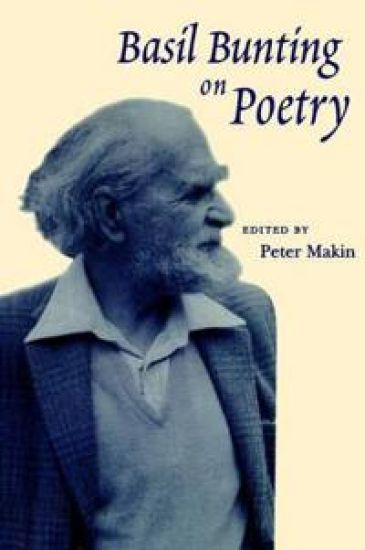
Basil Bunting on Poetry
Johns Hopkins University Press
2003
pokkari
"All you can usually say about a poem or a picture is, 'Look at it, listen to it.' Whether you listen to a piece of music or a poem, or look at a picture or a jug or a piece of sculpture, what matters about it is not what it has in common with others of its kind, but what is singularly its own."-Basil Bunting A close poetic ally of Ezra Pound and Louis Zukofsky, the British poet Basil Bunting is best known for his use of specific musical form in poetry. Several of his works, including his long poem Briggflatts, are in the form of the sonata. Although his language is plain, unvarnished English, his influences and models extend to Classical, Persian, and Japanese verse. Basil Bunting on Poetry collects two series of lectures that Bunting delivered in 1968 and 1974. Tracing the development of an English poetry governed by families of stress-groups from Beowulf down to Wyatt, Wordsworth, Whitman, Pound, and Zukofsky, the lectures focus on writing and hearing poetry rather than on literary-historical concerns. Throughout, editor Peter Makin expands upon and annotates the lectures with additional comments drawn from Bunting's writings.
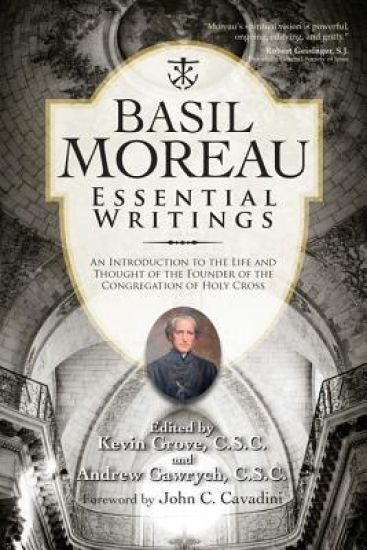
Basil Moreau
Christian Classics Inc
2014
nidottu
This definitive introduction to the life and vision of Blessed Basil Moreau, C.S.C., is the first book to gather together the essential spiritual, pastoral, and educational writings of the nineteenth-century French priest who founded the Congregation of Holy Cross, which is the religious order that founded the University of Notre Dame in 1842.