First Published in 1999. This is volume III of 10 from the international library of psychology, looking at physiological psychology and focuses on the neural basis of thought. The papers contained in this book may, from the point of view of empiricism, be regarded as an attempt to advance another step along the path of the Peirce-James-Bergson tradition. It aims at presenting the neurological aspect of a theory of knowledge which was published eleven years ago under the title Elements in Thought and Emotion.
The material in The Zen of Bookkeeping and Accounting: Accounting for New College Students and Other Learners is based on a simple framework for teaching and learning bookkeeping and accounting using activities related to the elements of a Simple Combined Chart of Accounting and Trial Balance created by Dr. Pettigrew.To help organize the thoughts of readers, Dr. Pettigrew, a CPA and successful university professor, uses a three-books concept and the Simple Combined Chart of Accounting and Trial Balance to demonstrate day-to-day bookkeeping and accounting activities. Accountants and bookkeepers use a systematic step-by-step set of activities to keep, update and report on the three main books of an organization: (1) Journal book to record transactions, (2) General Ledger to post the recorded journal entries, and (3) Financial Reports comprising the balance sheet, income statement, statement of retained earnings, and statement of cash flows to summarize and report on the balances in the general ledger. A simple description of what bookkeeping and accounting is about, and how bookkeeping and accounting activities are performed in real-world situations is presented, using a fictitious organization, Smallz Bizniz LLC.The material in The Zen of Bookkeeping and Accounting: Accounting for New College Students and Other Learners focuses on financial accounting: Accounting for the sources and uses of valuable resources, values shown in dollars, in a business organization.The definition used for this simplified book is in terms of the activities involved in the accounting process: Accounting is both a process and a means of summarizing and reporting of financial transactions and activities of a business for a specific period. The process involves identifying and recording financial transactions in journals and posting them to related accounting ledgers; the accounting ledgers are then summarized, classified, and reported in financial statements such as the balance sheet, income statement, statement of changes in owner's equity, and cash flows statement to be used by users for decision-making purposes. In other words, accounting is a systematic step-by-step set of activities taken by the accountant to (1) identify, analyze, and record financial transactions, (2) record the transactions in the journal using a chart of accounts, (3) post the journal entries to the general ledger, (4) prepare a trial balance of the general ledger accounts, (5) make adjustments at the end of accounting periods, and (6) summarize and report on the activities of the firm. Dr. Pettigrew hopes you enjoy reading and learning from The Zen of Bookkeeping and Accounting: Accounting for New College Students and Other Learners, and realize that you too can learn bookkeeping and accounting, and wishes you all the best for a successful career in business and accounting.
Section 13 of the Academy's Basic and Clinical Science Course™ (BCSC®) covers the science of refractive surgery and patient evaluation. It also examines specific procedures in refractive surgery and their potential complications, refractive surgery in ocular and systemic disease, and accommodative and nonaccommodative treatment of presbyopia. In addition, the book includes information on lens implants.Section 13 features a chapter focusing on small-incision lenticule extraction (SMILE), reviews advances in intraocular lens technology, and covers intraocular refractive surgery.Deepen your understanding with 15 videos that demonstrate refractive surgical techniques, including the FDA-approved SMILE procedure. Both print and eBook users have access to the videos.Upon completion of Section 13, readers should be able to:Explain the steps—including medical and social history, ocular examination, and ancillary testing—in evaluating whether a patient is an appropriate candidate for refractive surgery.For surface ablation procedures, describe patient selection, epithelial removal, refractive outcomes, and complications.For laser in situ keratomileusis (LASIK), describe patient selection, surgical techniques, outcomes, and complications.
What if I told you the secrets of easily and effortlessly teaching your new puppy to be a well mannered and obedient family member? I bet you're a bit like me, I used to become frustrated because I didn't know how to avoid all the known bad behaviors a puppy might form into habits, or how to make a puppy feel comfortable in a new environment. Imagine how great you and your puppy's life will be when you use evidence-based scientific principles to keep all those unwanted behaviors from ever happening. Are you frustrated with your puppy pulling on leash, chewing on the wrong things, nipping at you, not having any impulse control and all sorts of other bad behaviors? The number one problem today is that most pet parents don't know the industry secrets that most professional dog trainers don't want you to know. Because these behaviors are simple to cut off and keep from ever happening. Finding and Training Your Service Dog never allows any of these problem behaviors that your puppyis known to develop to ever start.Some of the techniques to do this are Auto Attention and Impulse Control, the Mother and Father of all behaviors. This book will teach you why Teaching Smart Not Hard/Modern Dog Training is the way to go. Take advantage of expert knowledge and advice to solve and keep known problems like: ChewingBarkingHouse TrainingPulling on leashResource guardingDiggingNippingSeparation Anxiety The First three months at home, starting from day one, are perhaps the most important time in your puppy's life. This Pet Dog Bible is the most comprehensive evidence-based instruction manual on the subject of puppies. Full practical and easy to follow step by step instructions on how to avoid bad behaviors and teach the good ones. This book will give you industry secrets professional dog trainers don't want you to knowby teaching you how to easily train your puppy in the basic and intermediate levels of behaviors. This book will give you the confidence to teach over 14 behaviors that every dog should know. Imagine how proud you will be when you and your puppy crush the Canine Good Citizen test Learn HowTo: Evaluate a dog from a breeder or a rescueHow to choose a good breeder or fostered dog rescueTeach puppy its name, gaining automatic attention Stop Resource GuardingStop pup from pulling by teaching loose leash walkingEffortless House Training/Putting elimination on cueMake your dog a chew toy fanatic-teaches what they should chew onSetup your dogs' living areasBite InhibitionSocializing your new puppyHow your puppy will developWhat vaccines and when your puppy will need themHow to read a dog food label to get the best nutritious puppy foodImpulse Control Taught via the Default Behavior and the ReleaseHow to teach your pup to have Automatic Attention on youCalming SignalsHow to deal with Separation Anxiety, stairs, and boredomHow to teach your puppy to love her crateLess Stressful Vet VisitsDesensitizing your dog to unusual stimuliTeach your pup how to target so she can ring some bells when she wants to go outHow to politely greet other animals and humansSoft Mouth RetrievalThe proper way to use a clicker and treats-for initial teaching onlyHow to maintain a taught behavior by making it so much fun it becomes nearly self-rewardingA Force free, Positive Reinforcement, clicker training programI bet you're a bit like me and want to use the least amount of effort to achieve your training goals in a fraction of the time. In other words we want to Teach Smart Not Hard.
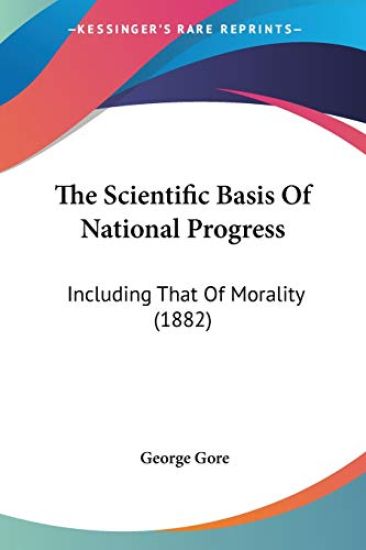
The Scientific Basis of National Progress - Including That of Morality is an unchanged, high-quality reprint of the original edition of 1882. Hansebooks is editor of the literature on different topic areas such as research and science, travel and expeditions, cooking and nutrition, medicine, and other genres. As a publisher we focus on the preservation of historical literature. Many works of historical writers and scientists are available today as antiques only. Hansebooks newly publishes these books and contributes to the preservation of literature which has become rare and historical knowledge for the future.
Fitch explores the relationship between the mind and the body, arguing that mental and moral processes are ultimately rooted in physical processes. This book is a compelling contribution to the philosophy of mind that will be of interest to scholars and students in a range of disciplines.This work has been selected by scholars as being culturally important, and is part of the knowledge base of civilization as we know it.This work is in the "public domain in the United States of America, and possibly other nations. Within the United States, you may freely copy and distribute this work, as no entity (individual or corporate) has a copyright on the body of the work.Scholars believe, and we concur, that this work is important enough to be preserved, reproduced, and made generally available to the public. We appreciate your support of the preservation process, and thank you for being an important part of keeping this knowledge alive and relevant.
Fitch explores the relationship between the mind and the body, arguing that mental and moral processes are ultimately rooted in physical processes. This book is a compelling contribution to the philosophy of mind that will be of interest to scholars and students in a range of disciplines.This work has been selected by scholars as being culturally important, and is part of the knowledge base of civilization as we know it.This work is in the "public domain in the United States of America, and possibly other nations. Within the United States, you may freely copy and distribute this work, as no entity (individual or corporate) has a copyright on the body of the work.Scholars believe, and we concur, that this work is important enough to be preserved, reproduced, and made generally available to the public. We appreciate your support of the preservation process, and thank you for being an important part of keeping this knowledge alive and relevant.