Kirjojen hintavertailu. Mukana 11 244 527 kirjaa ja 12 kauppaa.

Kirjahaku

Etsi kirjoja tekijän nimen, kirjan nimen tai ISBN:n perusteella.

1000 tulosta hakusanalla Benjamin Martin

Horologia Nova; or, the new art of Dialling in Theory and Practice. In Which is Demonstrated, That all the Variety in This Science Consists in the Construction of Three Dials Only
The 18th century was a wealth of knowledge, exploration and rapidly growing technology and expanding record-keeping made possible by advances in the printing press. In its determination to preserve the century of revolution, Gale initiated a revolution of its own: digitization of epic proportions to preserve these invaluable works in the largest archive of its kind. Now for the first time these high-quality digital copies of original 18th century manuscripts are available in print, making them highly accessible to libraries, undergraduate students, and independent scholars.Medical theory and practice of the 1700s developed rapidly, as is evidenced by the extensive collection, which includes descriptions of diseases, their conditions, and treatments. Books on science and technology, agriculture, military technology, natural philosophy, even cookbooks, are all contained here.++++The below data was compiled from various identification fields in the bibliographic record of this title. This data is provided as an additional tool in helping to insure edition identification: ++++Cambridge University LibraryT166401London: printed for, and sold by the author, in Fleet-Street, no. 171. and by the booksellers in town and country, 1770. 4],15, 1]p., plate; 4

Optical Essays, Containing, I. A Practical Description of the Several Sorts of Single, Solar, and Compound Microscopes; ... II. The Nature of Vision in Insects Demonstrated by Microscopic Observations
The 18th century was a wealth of knowledge, exploration and rapidly growing technology and expanding record-keeping made possible by advances in the printing press. In its determination to preserve the century of revolution, Gale initiated a revolution of its own: digitization of epic proportions to preserve these invaluable works in the largest archive of its kind. Now for the first time these high-quality digital copies of original 18th century manuscripts are available in print, making them highly accessible to libraries, undergraduate students, and independent scholars.Medical theory and practice of the 1700s developed rapidly, as is evidenced by the extensive collection, which includes descriptions of diseases, their conditions, and treatments. Books on science and technology, agriculture, military technology, natural philosophy, even cookbooks, are all contained here.++++The below data was compiled from various identification fields in the bibliographic record of this title. This data is provided as an additional tool in helping to insure edition identification: ++++British LibraryT010172With a 5-page catalogue of Martin's books and instruments at the end.London: printed for, and sold by the author, 1761?]. 2], ii,50,5, 1]p., plate; 8
The wandering pilgrim

The wandering pilgrim

Benjamin Martin

Hansebooks
2017
pokkari
The wandering pilgrim - Hymns and spiritual songs is an unchanged, high-quality reprint of the original edition of 1868. Hansebooks is editor of the literature on different topic areas such as research and science, travel and expeditions, cooking and nutrition, medicine, and other genres. As a publisher we focus on the preservation of historical literature. Many works of historical writers and scientists are available today as antiques only. Hansebooks newly publishes these books and contributes to the preservation of literature which has become rare and historical knowledge for the future.
Roger Martin Du Gard and Maumort

Roger Martin Du Gard and Maumort

Benjamin Franklin Martin

Northern Illinois University Press
2017
sidottu
In the late 1930s and early 1940s, Roger Martin du Gard was one of the most famous writers in the Western world. He won the Nobel Prize for Literature in 1937, and his works, especially Les Thibault, a multivolume novel, were translated into English and read widely. Today, this close friend of André Gide, Albert Camus, and André Malraux is almost unknown, largely because he left unfinished the long project he began in the 1940s, Lieutenant Colonel de Maumort. Initially, the novel is an account of the French experience during World War II and the German occupation as seen through the eyes of a retired army officer. Yet, through Maumort's series of recollections, it becomes a morality tale that questions the values of late nineteenth- and early twentieth-century European civilization. A fragmentary version of the novel was published in 1983, twenty-five years after its author's death, and an English translation appeared in 1999. Even incomplete, it is a work of haunting brilliance. In this groundbreaking study, Benjamin Franklin Martin recovers the life and times of Roger Martin du Gard and those closest to him. He describes the genius of Martin du Gard's literature and the causes of his decline by analyzing thousands of pages from journals and correspondence. To the outside world, the writer and his family were staid representatives of the French bourgeoisie. Behind this veil of secrecy, however, they were passionate and combative, tearing each other apart through words and deeds in clashes over life, love, and faith. Martin interweaves their accounts with the expert narration that distinguishes all of his books, creating a blend of intellectual history, family drama, and biography that will appeal to scholars, students, and general readers alike.
Roger Martin Du Gard and Maumort

Roger Martin Du Gard and Maumort

Benjamin Franklin Martin

Northern Illinois University Press
2020
pokkari
In the late 1930s and early 1940s, Roger Martin du Gard was one of the most famous writers in the Western world. He won the Nobel Prize for Literature in 1937, and his works, especially Les Thibault, a multivolume novel, were translated into English and read widely. Today, this close friend of André Gide, Albert Camus, and André Malraux is almost unknown, largely because he left unfinished the long project he began in the 1940s, Lieutenant Colonel de Maumort. Initially, the novel is an account of the French experience during World War II and the German occupation as seen through the eyes of a retired army officer. Yet, through Maumort's series of recollections, it becomes a morality tale that questions the values of late nineteenth- and early twentieth-century European civilization. A fragmentary version of the novel was published in 1983, twenty-five years after its author's death, and an English translation appeared in 1999. Even incomplete, it is a work of haunting brilliance. In this groundbreaking study, Benjamin Franklin Martin recovers the life and times of Roger Martin du Gard and those closest to him. He describes the genius of Martin du Gard's literature and the causes of his decline by analyzing thousands of pages from journals and correspondence. To the outside world, the writer and his family were staid representatives of the French bourgeoisie. Behind this veil of secrecy, however, they were passionate and combative, tearing each other apart through words and deeds in clashes over life, love, and faith. Martin interweaves their accounts with the expert narration that distinguishes all of his books, creating a blend of intellectual history, family drama, and biography that will appeal to scholars, students, and general readers alike.
Life After The Field

Life After The Field

Benjamin L Martin

Martin Etiquettes LLC
2021
pokkari
Would you be surprised if I told you most athletes deal with many issues of depression and anxiety after retirement? If you're a former athlete you can probably relate. What if I told you that changing some habits and mindsets can put you right in that same space of living to your full potential? In some cases you will discover a new level of motivation and accomplishment than ever before. What this book attempts to do is explain the mental struggles you may be going through as a retiring athlete. It provides clarity by offering solutions based on skills and habits you can apply directly from sports to your life now. I pull directly from my own battles with depression, anxiety and frustration to share a guide to battling through these obstacles. Post retirement depression isn't a topic that is discussed in the world of athletics but as I've discovered is a relevant and mutual sentiment. If you can relate to being aimlessly lost, frequently anxious and unsatisfied with life after your sports career ends, this is the book for you. Take a few moments to dive into this book and get help with understanding your mental state, repositioning your interests and discovering a new side of yourself you may have never knew existed.
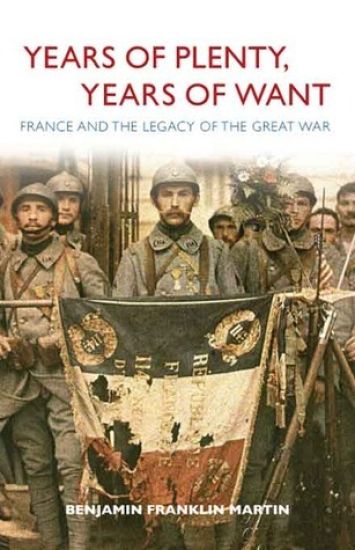
Years of Plenty, Years of Want

Years of Plenty, Years of Want

Benjamin Franklin Martin

Northern Illinois University Press
2013
sidottu
The Great War that engulfed Europe between 1914 and 1918 was a catastrophe for France. French soil was the site of most of the fighting on the Western Front. French dead were more than 1.3 million, the permanently disabled another 1.1 million, overwhelmingly men in their twenties and thirties. The decade and a half before the war had been years of plenty, a time of increasing prosperity and confidence remembered as the Belle Epoque or the good old days. The two decades that followed its end were years of want, loss, misery, and fear. In 1914, France went to war convinced of victory. In 1939, France went to war dreading defeat. To explain the burden of winning the Great War and embracing the collapse that followed, Benjamin Martin examines the national mood and daily life of France in July 1914 and August 1939, the months that preceded the two world wars. He presents two titans: Georges Clemenceau, defiant and steadfast, who rallied a dejected nation in 1918, and Edouard Daladier,hesitant and irresolute, who espoused appeasement in 1938 though comprehending its implications. He explores novels by a constellation of celebrated French writers who treated the Great War and its social impact, from Colette to Irène Némirovsky, from François Mauriac to Antoine de Saint-Exupéry. And he devotes special attention to Roger Martin du Gard, the1937 Nobel Laureate, whose roman-fleuve The Thibaults is an unrivaled depiction of social unraveling and disillusionment. For many in France, the legacy of the Great War was the vow to avoid any future war no matter what the cost. They cowered behind the Maginot Line, the fortifications along the eastern border designed to halt any future German invasion. Others knew that cost would be too great and defended the "Descartes Line": liberty and truth, the declared values of French civilization. In his distinctive and vividly compelling prose, Martin recounts this struggle for the soul of France.