Kirjojen hintavertailu. Mukana 12 083 983 kirjaa ja 12 kauppaa.

Kirjahaku

Etsi kirjoja tekijän nimen, kirjan nimen tai ISBN:n perusteella.

1000 tulosta hakusanalla Berlie Doherty

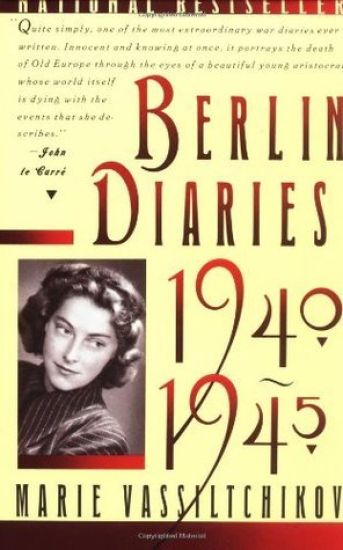
Berlin Diaries, 1940-1945

Berlin Diaries, 1940-1945

Marie Vassiltchikov

VINTAGE
1988
nidottu
The secret diaries of a twenty-three-year-old White Russian princess who worked in the German Foreign Office from 1940 to 1944 and then as a nurse, these pages give us a unique picture of wartime life in that sector of German society from which the 20th of July Plot -- the conspiracy to kill Hitler -- was born. "A skillful weaving of history, memoir, and autobiography...full of colorful characters...When she began writing in 1940, Missie, as she was called, was...concerned mainly with beaux and parties....By 1945 she has no more illusions. She has foraged for food....She has smelled the decaying flesh of corpses buried in the bombed ruins of Berlin and Vienna and lost some of her best friends." -- Washington Post Book World"Neither a set of reflections flor a philippic, but a record ...The best eyewitness account we possess of the bombing of Berlin."-- Gordon A. Craig, The New York Times Book Review"A rare opportunity to see the Second World War from an unusual perspective: the view from Berlin and Vienna, not Washington or London. [The author] has a sharp eye and a witty tongue." -- Cleveland Plain Dealer"A vivid insider's view of Nazi Germany." -- Vanity Fair"One of the most remarkable documents to come out of the war, and nothing will ever quite match its calm and grace in utterly hideous circumstances."-- John Kenneth Galbraith

Berlin in the Cold War, 1948-1990
This volume consists of a book and downloadable resources containing a facsimile collection of diplomatic documents covering British reactions to critical developments regarding Berlin, its quadripartite administration, and role in the Cold War during the crises of 1948-49, 1959-61 and 1988-90. These events were each set within very different international contexts, but four interrelated themes are nevertheless common to each of the three chapters of the volume: the British Government’s insistence, in conjunction with the Americans and the French, on upholding and safeguarding the rights of the four occupying powers in Berlin; British concerns with broader matters of military security in Western Europe as a whole and Germany in particular; the interaction of the four occupying powers with one another; and the questions raised by demographic change, especially population movements from east to west. All of the documents dealing with the events of 1989-90 fall within the UK’s 30-year rule and are therefore not yet in the public domain.
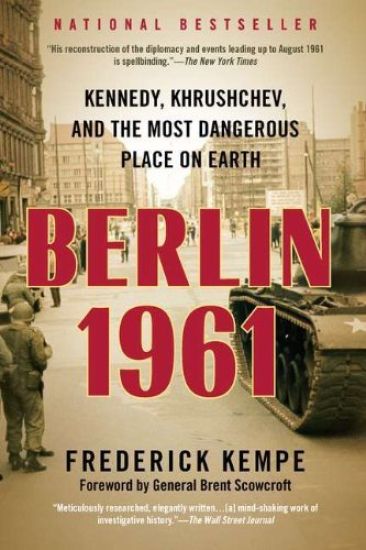
Berlin 1961: Kennedy, Khrushchev, and the Most Dangerous Place on Earth
In June 1961, Nikita Khrushchev called Berlin "the most dangerous place on earth." He knew what he was talking about. Much has been written about the Cuban Missile Crisis a year later, but the Berlin Crisis of 1961 was more decisive in shaping the Cold War-and more perilous. It was in that hot summer that the Berlin Wall was constructed, which would divide the world for another twenty-eight years. Then two months later, and for the first time in history, American and Soviet fighting men and tanks stood arrayed against each other, only yards apart. One mistake, one nervous soldier, one overzealous commander-and the tripwire would be sprung for a war that could go nuclear in a heartbeat.On one side was a young, untested U.S. president still reeling from the Bay of Pigs disaster and a humiliating summit meeting that left him grasping for ways to respond. It would add up to be one of the worst first-year foreign policy performances of any modern president. On the other side, a Soviet premier hemmed in by the Chinese, East Germans, and hardliners in his own government. With an all-important Party Congress approaching, he knew Berlin meant the difference not only for the Kremlin's hold on its empire-but for his own hold on the Kremlin.Neither man really understood the other, both tried cynically to manipulate events. And so, week by week, they crept closer to the brink.Based on a wealth of new documents and interviews, filled with fresh-sometimes startling-insights, written with immediacy and drama, Berlin 1961 is an extraordinary look at key events of the twentieth century, with powerful applications to these early years of the twenty-first.Includes photographs
Berlin

Berlin

David Large

Basic Books
2001
pokkari
In the political history of the past century, no city has played a more prominent-though often disastrous-role than Berlin. At the same time, Berlin has also been a dynamic centre of artistic and intellectual innovation. If Paris was the "Capital of the Nineteenth Century," Berlin was to become the signature city for the next hundred years. Once a symbol of modernity, in the Thirties it became associated with injustice and the abuse of power. After 1945, it became the iconic City of the Cold War. Since the fall of the Wall, Berlin has again come to represent humanity's aspirations for a new beginning, tempered by caution deriving from the traumas of the recent past. David Clay Large's definitive history of Berlin is framed by the two German unifications of 1871 and 1990. Between these two events several themes run like a thread through the city's history: a persistent inferiority complex a distrust among many ordinary Germans, and the national leadership of the "unloved city's" electric atmosphere, fast tempo, and tradition of unruliness its status as a magnet for immigrants, artists, intellectuals, and the young the opening up of social, economic, and ethnic divisions as sharp as the one created by the Wall.
Bernie's Short Stories (Under a 1000 words)
My book of Bernie's Short Stories (under a 1000 words) is a collection of stories compiled from my writings with South Canterbury Writers. Each month we have a competition. We are given a title. It surprises us that we manage to create stories out of some of the more controversial topics. The stories are voted on. All good fun, and not to be taken seriously.With my love of books, reading, and history, many of the stories in this collection are set in the past and some are contempory. There is the story of 'AUNT BEE.' Did her plan work? Or why did 'MR SNOUT' start running and was never seen again? And yes 'Miracles' can happen. Or who was the mystery man on 'THE LIST'? And the 'F WORD' can have many meanings. These stories have the answers along with another thirty-five tales. An easy entertaining read.
Bernie Sanders Paper Doll Collectible Campaign Edition
No matter which side of the political fence you're on, you can believe in these Bernie Sanders paper dolls Currently campaigning for the Democratic party's 2016 presidential nomination, the Vermont Senator will be ready for any debate in 15 entertaining costumes, including a folk singer, basketball player, track team captain, and more. Includes a detailed Sanders biography.
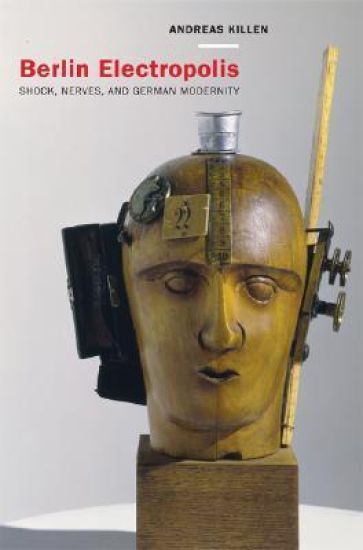
Berlin Electropolis

Berlin Electropolis

Andreas Killen

University of California Press
2006
sidottu
Berlin Electropolis ties the German discourse on nervousness in the late nineteenth and early twentieth centuries to Berlin's transformation into a capital of the second industrial revolution. Focusing on three key groups--railway personnel, soldiers, and telephone operators--Andreas Killen traces the emergence in the 1880s and then later decline of the belief that modernity caused nervous illness. During this period, Killen explains, Berlin became arguably the most advanced metropolis in Europe. A host of changes, many associated with breakthroughs in technologies of transportation, communication, and leisure, combined to radically alter the shape and tempo of everyday life in Berlin. The resulting consciousness of accelerated social change and the shocks and afflictions that accompanied it found their consummate expression in the discourse about nervousness. Wonderfully researched and clearly written, this book offers a wealth of new insights into the nature of the modern metropolis, the psychological aftermath of World War I, and the operations of the German welfare state. Killen also explores cultural attitudes toward electricity, the evolution of psychiatric thought and practice, and the status of women workers in Germany's rapidly industrializing economy. Ultimately, he argues that the backlash against the welfare state that occurred during the late Weimar Republic brought about the final decoupling of modernity and nervous illness.
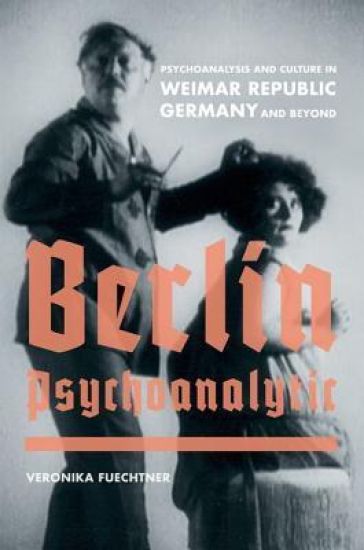
Berlin Psychoanalytic

Berlin Psychoanalytic

Veronika Fuechtner

University of California Press
2011
sidottu
One hundred years after the Berlin Psychoanalytic Institute was established, this book recovers the cultural and intellectual history connected to this vibrant organization and places it alongside the London Bloomsbury group, the Paris Surrealist circle, and the Viennese fin-de-siecle as a crucial chapter in the history of modernism. Taking us from World War I Berlin to the Third Reich and beyond to 1940s Palestine and 1950s New York - and to the influential work of the Frankfurt School - Veronika Fuechtner traces the network of artists and psychoanalysts that began in Germany and continued in exile. Connecting movements, forms, and themes such as Dada, multi-perspectivity, and the urban experience with the theory and practice of psychoanalysis, she illuminates themes distinctive to the Berlin psychoanalytic context such as war trauma, masculinity and femininity, race and anti-Semitism, and the cultural avant-garde. In particular, she explores the lives and works of Alfred Doblin, Max Eitingon, Georg Groddeck, Karen Horney, Richard Huelsenbeck, Count Hermann von Keyserling, Ernst Simmel, and Arnold Zweig.
Berlin Alexanderplatz

Berlin Alexanderplatz

Peter Jelavich

University of California Press
2009
pokkari
This fascinating exploration of a work that was the epitome of German literary modernism illuminates in chilling detail the death of the Weimar Republic's left-leaning culture of innovation and experimentation. Peter Jelavich examines Alfred Doblin's "Berlin Alexanderplatz" (1929), a novel that questioned the autonomy and coherence of the human personality in the modern metropolis, and traces the radical discrepancies that came with its adaptation into a radio play (1930) and a film (1931). Jelavich explains these discrepancies by examining not only the varying demands of genre and technology but also the political and economic contexts of the media - in particular, the censorship practices in German radio and film.His analysis culminates in a richly textured discussion of the complex factors that led to the demise of Weimar culture, as Nazi intimidation and the economic strains of the Depression induced producers to depoliticize their works. Jelavich's book becomes a cautionary tale about how fear of outspoken right-wing politicians can curtail and eliminate the arts as a critical counterforce to politics - all in the name of entertainment.
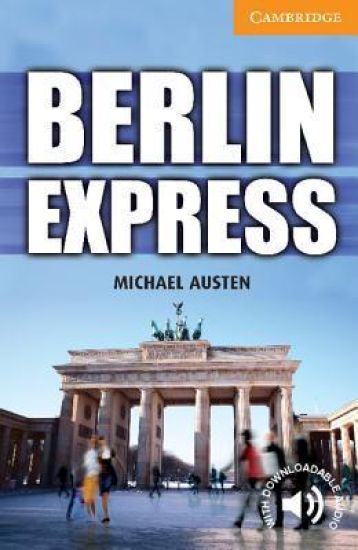
Berlin Express Level 4 Intermediate

Berlin Express Level 4 Intermediate

Michael Austen

Cambridge University Press
2010
pokkari
Award-winning original fiction for learners of English. At seven levels, from Starter to Advanced, this impressive selection of carefully graded readers offers exciting reading for every student's capabilities. Hiro, a 20-year-old Japanese student, sits next to an old man on a train to Berlin. By mistake they exchange phones and read each other's text messages. Hiro believes that the man's messages show that he is going to Berlin to kill someone. Hiro's first day in the city is a race against time as he tries to warn people of an assassination plot. But is the plot real or does it exist only in Hiro's imagination? Paperback-only version. Also available as a pack with 2 Audio CDs with complete text recordings from the book.
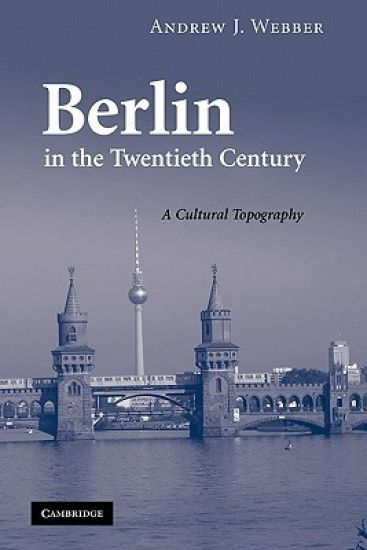
Berlin in the Twentieth Century

Berlin in the Twentieth Century

Andrew J. Webber

Cambridge University Press
2011
pokkari
Berlin has been the focal scene of some of the most dramatic and formative events of the twentieth century. Through periods of decadence, fascism, war, partition and reunification, it has seen both extraordinary constraint and creativity. Andrew Webber explores the cultural topography of Berlin and considers the city as key capital of the twentieth century, reflecting its history, its traumas and its achievements. He shows how its spaces and buildings participate in the drama by analysing how they are represented in literature and film. Taking his methodology from Walter Benjamin, Webber presents bold readings of works synonymous with Berlin, with authors from Bertolt Brecht and Franz Kafka to Christa Wolf, and directors from Walther Ruttmann to Rainer Werner Fassbinder and Wim Wenders. Across this range of material, twentieth-century Berlin is seen to be as ambivalent as it is fascinating.
Berlin - Washington, 1800–2000

Berlin - Washington, 1800–2000

Cambridge University Press
2005
sidottu
This collection examines the urban spaces of Berlin and Washington and provides a comparative cultural history of two eminent nation-states in the modern era. Each of the cities has assumed, at times, a mythical quality and they have been seen as collective symbols, with ambitions and contradictions that mirror the nation-states they represent. Such issues such stand in the centre of this volume. The authors ask what these two capitals have meant for the nation and explore the relations between architecture, political ideas, and social reality. Topics range from Thomas Jefferson's ideas about the new capital of the United States to the creation of the Holocaust memorial in Berlin, from nineteenth-century visitors to small-town Washington to the protesters of the 1968 student movement in West Berlin. This lively collection of essays speaks to audiences as diverse as historians, urban sociologists, architects and readers interested in cultural studies.
Berlin in the Twentieth Century

Berlin in the Twentieth Century

Andrew J. Webber

Cambridge University Press
2008
sidottu
Berlin has been the focal scene of some of the most dramatic and formative events of the twentieth century. Through periods of decadence, fascism, war, partition and reunification, it has seen both extraordinary constraint and creativity. Andrew Webber explores the cultural topography of Berlin and considers the city as key capital of the twentieth century, reflecting its history, its traumas and its achievements. He shows how its spaces and buildings participate in the drama by analysing how they are represented in literature and film. Taking his methodology from Walter Benjamin, Webber presents bold readings of works synonymous with Berlin, with authors from Bertolt Brecht and Franz Kafka to Christa Wolf, and directors from Walther Ruttmann to Rainer Werner Fassbinder and Wim Wenders. Across this range of material, twentieth-century Berlin is seen to be as ambivalent as it is fascinating.
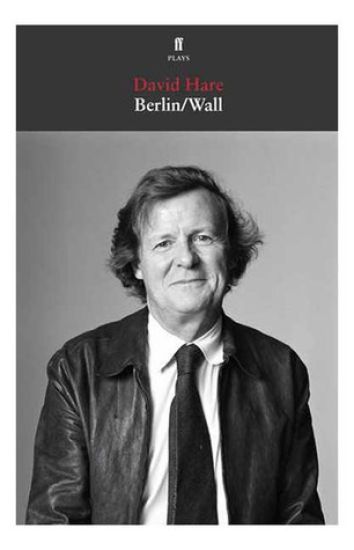
Berlin/Wall

Berlin/Wall

David Hare

Faber Faber
2009
pokkari
Berlin/WallIn two contrasted readings for the stage, David Hare visits a place where a famous wall has come down; then another where a wall is going up.BerlinFor his whole adult life, David Hare has been visiting the city which so many young people regard as the most exciting in Europe. But there's something in Berlin's elusive character that makes him feel he's always missing the point. Now, to celebrate the twentieth anniversary of the reunification, he offers a meditation about Germany's restored capital - both what it represents in European history, and the peculiar part it has played in his own life.WallThe Israeli/Palestine security fence will one day stretch 486 miles, from one end of Israel to the other. It will be four times as long as the Berlin wall, and in places twice as high. In this second monologue, the playwright recalls his trips to both Israel and the Palestinian territory and offers a history of the wall's building, an exploration of the philosophy behind it and a personal account of those who live on either side. Berlin premiered at the National Theatre, London, in February 2009 and Wall premiered at the Royal Court Theatre, London, in March 2009.
Berlin Red

Berlin Red

Sam Eastland

Faber Faber
2017
nidottu
April, 1945.East of Berlin, the Red Army stands poised to unleash its final assault upon the ruined capital of Hitler's Thousand Year Reich.To the north, at a lonely outpost near the Baltic sea, German scientists perfect a guidance system for the mighty V2 rocket, which has already caused massive damage to the cities of London and Antwerp. This device, known only by the codename Diamondstream, will allow the rocket to arrive at its target with pin-point accuracy. So devastating is the potential of this newly-mastered technology that Hitler's promise to the German people of a 'miracle weapon' that will turn the tide of the war might actually come true.When a radio message sent to Hitler's Headquarters, heralding the success of Diamondstream, is intercepted by an English listening station, British Intelligence orders one of its last agents operating in Berlin to acquire the plans for the device, Desperate to evacuate their agent from the doomed city before the Red Army swarms through its streets, British Special Operations turns to the Kremlin for help. They ask for one man in particular - Inspector Pekkala.Anxious to acquire the plans for himself, Stalin readily agrees to risk his finest investigator on what appears to be a suicide mission. But when Pekkala learns the reason that the British have singled him out, he knows that he must make the journey, no matter what the outcome might be. The agent he must rescue is the woman he had planned to marry, before the Revolution tore them apart, sending her to Paris as a refugee and Pekkala to a gulag in Siberia.This time, for Pekkala, it is personal.