
Kirjahaku
Etsi kirjoja tekijän nimen, kirjan nimen tai ISBN:n perusteella.
1000 tulosta hakusanalla Bryson
Challenges and Prospects of Teaching Selected Work Skills
Bryson D. Kinyaduka
Lap Lambert Academic Publishing
2018
nidottu
Herausforderungen und Perspektiven der Vermittlung ausgewählter Arbeitsfähigkeiten
Bryson D. Kinyaduka
Verlag Unser Wissen
2022
nidottu
Défis et perspectives de l'enseignement de certaines compétences professionnelles
Bryson D. Kinyaduka
Editions Notre Savoir
2022
nidottu
Retos y perspectivas de la enseñanza de competencias laborales seleccionadas
Bryson D. Kinyaduka
Ediciones Nuestro Conocimiento
2022
nidottu
Sfide e prospettive dell'insegnamento di competenze lavorative selezionate
Bryson D. Kinyaduka
Edizioni Sapienza
2022
nidottu
Desafios e Perspectivas do Ensino de Competências de Trabalho Seleccionadas
Bryson D. Kinyaduka
Edições Nosso Conhecimento
2022
nidottu

Francis Bacon and the Tradition of Art
Bryson Norman; Ernst van Alphen; Berggruen Olivier; Cappock Margarita; Peppiatt Michael
Skira
2003
sidottu
This book has been considered by academicians and scholars of great significance and value to literature. This forms a part of the knowledge base for future generations. So that the book is never forgotten we have represented this book in a print format as the same form as it was originally first published. Hence any marks or annotations seen are left intentionally to preserve its true nature.
From bestselling author Bill Bryson comes this compelling short biography of William Shakespeare, our greatest dramatist and poet.
Bill Bryson’s biography of William Shakespeare unravels the superstitions, academic discoveries and myths surrounding the life of our greatest poet and playwright. Ever since he took the theatre of Elizabethan London by storm over 400 years ago, Shakespeare has remained centre stage. His fame stems not only from his plays – performed everywhere from school halls to the world's most illustrious theatres – but also from his enigmatic persona. His face is familiar to all, yet in reality very little is known about the man behind the masterpieces. Shakespeare’s life, despite the scrutiny of generations of biographers and scholars, is still a thicket of myths and traditions, some preposterous, some conflicting, arranged around the few scant facts known about the Bard – from his birth in Stratford to the bequest of his second best bed to his wife when he died. Taking us on a journey through the streets of Elizabethan and Jacobean England, Bryson examines centuries of stories, half-truths and downright lies surrounding our greatest dramatist. With a steady hand and his trademark wit, he introduces a host of engaging characters, as he celebrates the magic of Shakespeare's language and delights in details of the bard's life, folios, poetry and plays.
William Shakespeare, the most celebrated poet in the English language, left behind nearly a million words of text, but his biography has long been a thicket of wild supposition arranged around scant facts. With a steady hand and his trademark wit, Bill Bryson sorts through this colorful muddle to reveal the man himself.Bryson documents the efforts of earlier scholars, from today's most respected academics to eccentrics like Delia Bacon, an American who developed a firm but unsubstantiated conviction that her namesake, Francis Bacon, was the true author of Shakespeare's plays. Emulating the style of his famous travelogues, Bryson records episodes in his research, including a visit to a basement room in Washington, D.C., where the world's largest collection of First Folios is housed. Bryson celebrates Shakespeare as a writer of unimaginable talent and enormous inventiveness. His Shakespeare is like no one else's-the beneficiary of Bryson's genial nature, his engaging skepticism, and a gift for storytelling unrivalled in our time.
William Shakespeare, the most celebrated poet in the English language, left behind nearly a million words of text, but his biography has long been a thicket of wild supposition arranged around scant facts. With a steady hand and his trademark wit, Bill Bryson sorts through this colorful muddle to reveal the man himself. His Shakespeare is like no one else's the beneficiary of Bryson's genial nature, his engaging skepticism, and a gift for storytelling unrivaled in our time."
Seeing Further: The Story of Science, Discovery, and the Genius of the Royal Society
Bill Bryson
Mariner Books
2011
nidottu
"Bill Bryson is as amusing as ever. ... As a celebration of 350 years of modern science, Seeing Further is a worthy tribute." --The EconomistJoin Bill Bryson on an unforgettable exploration of scientific genius, discovery, and invention. Edited and introduced by Bryson, with original contributions from "a glittering array of scientific writing talent" (Sunday Observer) including Margaret Atwood, Richard Dawkins, and Neal Stephenson, Seeing Further tells the spectacular story of modern science through the lens of the international Royal Society, founded on a damp November night in London in 1660. Isaac Newton, John Locke, Charles Darwin, Albert Einstein, Stephen Hawking--all have been fellows. Its members have split the atom, discovered the double helix and the electron, and given us the computer and the World Wide Web. Gorgeously illustrated with photographs, documents, and treasures from the Society's exclusive archives, Seeing Further is an unprecedented celebration of the power of ideas.Featuring contributions from more than twenty of the world's greatest scientific--and science-fiction--thinkers, including: Richard Dawkins (The Selfish Gene; The God Delusion), James Gleick (The Information), Neal Stephenson (Cryptonomicon), Richard Holmes (The Age of Wonder), Margaret Atwood (The Handmaid's Tale), and Martin Rees (former President of the Royal Society).
Bill Bryson's bestselling biography of William Shakespeare takes the reader on an enthralling tour through Elizabethan England and the eccentricities of Shakespearean scholarship--updated with a new introduction by the author to commemorate the 400th anniversary of Shakespeare's deathWilliam Shakespeare, the most celebrated poet in the English language, left behind nearly a million words of text, but his biography has long been a thicket of wild supposition arranged around scant facts. With a steady hand and his trademark wit, Bill Bryson sorts through this colorful muddle to reveal the man himself. His Shakespeare is like no one else's--the beneficiary of Bryson's genial nature, his engaging skepticism, and a gift for storytelling unrivaled in our time.
'More than 300 million people in the world speak English and the rest, it sometimes seems, try to...'Only Bill Bryson could make a book about the English language so entertaining. With his boundless enthusiasm and restless eye for the absurd, this is his astonishing tour of English. From its mongrel origins to its status as the world's most-spoken tongue; its apparent simplicity to its deceptive complexity; its vibrant swearing to its uncertain spelling and pronunciation, Bryson covers all this as well as the many curious eccentricities that make it as maddening to learn as it is flexible to use. Bill Bryson's classic Mother Tongue is a highly readable and hilarious tale of how English came to be the world's language.
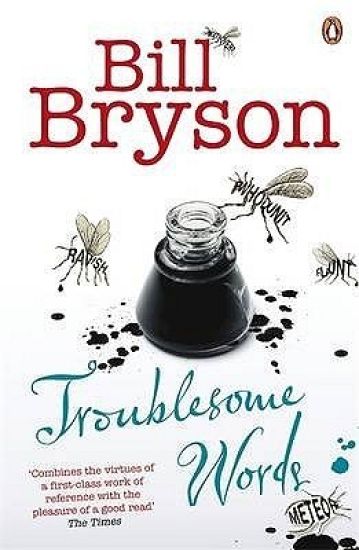
What is the difference between mean and median, blatant and flagrant, flout and flaunt? Is it whodunnit or whodunit? Do you know? Are you sure?With Troublesome Words, journalist and bestselling travel-writer Bill Bryson gives us a clear, concise and entertaining guide to the problems of English usage and spelling that has been an indispensable companion to those who work with the written word for over twenty years. So if you want to discover whether you should care about split infinitives, are cursed with an uncontrollable outbreak of commas or were wondering if that newsreader was right to say 'an historic day', this superb book is the place to find out.
In any society, a foreigner learning the language must also learn what passes for good manners. The same is true for the historian trying to understand the social rules of a period and why these change. This book explores the nature and development of early modern conceptions of good manners, and examines some of the particular forms of everyday behaviour which these conceptions implied. `Courtesy' and `Civility' were among the values central to Tudor and Stuart assumptions and fears about the social and political order.
This book discusses the impact of government policy, other institutional arrangements, organizational practices, collective and individual behaviour, on things of importance to many of us: work, employment, pay, work environments, learning, participation and voice. It is a unique volume of insights from leading researchers and research centres.