Kirjojen hintavertailu. Mukana 12 390 323 kirjaa ja 12 kauppaa.

Kirjahaku

Etsi kirjoja tekijän nimen, kirjan nimen tai ISBN:n perusteella.

1000 tulosta hakusanalla C.P. Courtney

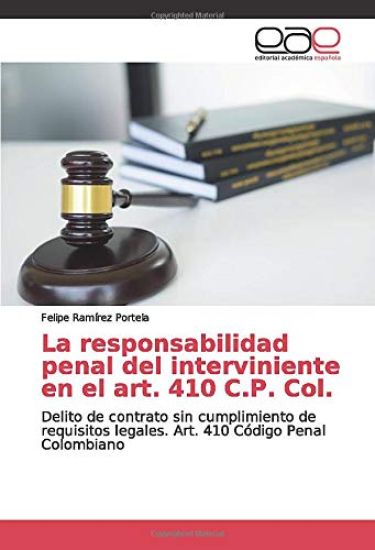
La responsabilidad penal del interviniente en el art. 410 C.P. Col.

La responsabilidad penal del interviniente en el art. 410 C.P. Col.

Felipe Ramírez Portela

Editorial Academica Espanola
2019
pokkari
Hacer revisiones constructivas de las decisiones de los jueces es de utilidad para la democracia. En esta monograf a se pretende hacer una revisi n detallada del precedente construido por la Corte Suprema de Justicia (-CSJ-) sobre la figura del interviniente, la cual se encuentra incorporada en el inciso final del art culo 30 del C digo Penal colombiano, con relaci n al delito de contrato sin cumplimiento de requisitos legales del art culo 410 del C digo Penal (C.P.). Para esto, se construye una l nea jurisprudencial que se analiza desde el enfoque dogm tico con el fin de estudiar si el tratamiento que la jurisprudencia de la CSJ le da a la categor a delictiva denominada interviniente es la m s ajustada a los postulados de la dogm tica penal con base en planteamientos hallados en doctrina. As las cosas, el objetivo principal del trabajo consiste en estudiar el precedente de la CSJ con relaci n a la figura del interviniente en los delitos de infracci n de deber contra la contrataci n estatal y, desde all , decantar la correcta interpretaci n dogm tica de la instituci n, poniendo de presente posibles problemas frente a los principios de legalidad y tipicidad estricta.
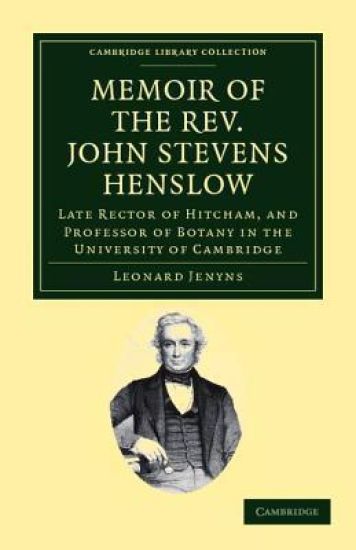
Memoir of the Rev. John Stevens Henslow, M.A., F.L.S., F.G.S., F.C.P.S.
John Stevens Henslow (1796–1861), professor of botany at Cambridge University and Anglican clergyman, is best remembered for his role as a mentor to Charles Darwin. First published in 1862, this biography by Henslow's colleague and brother-in-law, Leonard Jenyns, pays tribute to a man he describes as one of the most remarkable of his time. Through vivid accounts of times spent with Henslow both in the university and on travels around Britain, he paints a portrait of a modest and conscientious man, whose pursuits were intended solely for the benefit of others. Recounting Henslow's scientific work and religious endeavours, Jenyns also explores his pioneering contribution to botany and geology, his assistance to the farmers and the poor of his parish, and the role of his faith in his work. Compiled with help from Darwin and other colleagues, Jenyns' memoir provides a unique insight into an important figure in scientific history.
Daisy Ruffles and the Disappearance of Triple C

Daisy Ruffles and the Disappearance of Triple C

C.P. Simmons

SilverWood Books Ltd
2019
nidottu
Daisy Ruffles is a fourteen-year-old girl with untameable red hair and an extraordinary memory condition called hyperthymesia, meaning she remembers everything she sees. When Triple C, the most famous racehorse in the country, is stolen from her father's stable yard just five days before the Grand National, no one, not even Daisy - who knows Triple C better than anyone - has answers. As TV crews arrive, fear quickly spreads through the town and the police investigation hits a dead end. Daisy has her friends, her super-memory and five days to uncover the truth and save Triple C...
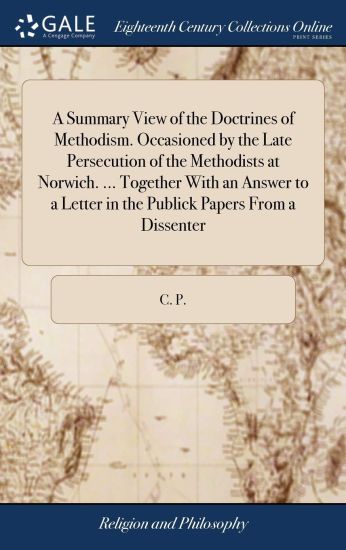
A Summary View of the Doctrines of Methodism. Occasioned by the Late Persecution of the Methodists at Norwich. ... Together With an Answer to a Letter in the Publick Papers From a Dissenter
The 18th century was a wealth of knowledge, exploration and rapidly growing technology and expanding record-keeping made possible by advances in the printing press. In its determination to preserve the century of revolution, Gale initiated a revolution of its own: digitization of epic proportions to preserve these invaluable works in the largest archive of its kind. Now for the first time these high-quality digital copies of original 18th century manuscripts are available in print, making them highly accessible to libraries, undergraduate students, and independent scholars.The Age of Enlightenment profoundly enriched religious and philosophical understanding and continues to influence present-day thinking. Works collected here include masterpieces by David Hume, Immanuel Kant, and Jean-Jacques Rousseau, as well as religious sermons and moral debates on the issues of the day, such as the slave trade. The Age of Reason saw conflict between Protestantism and Catholicism transformed into one between faith and logic -- a debate that continues in the twenty-first century.++++The below data was compiled from various identification fields in the bibliographic record of this title. This data is provided as an additional tool in helping to insure edition identification: ++++British LibraryT060892Signed on p. 13: C. P. Includes 'Extracts of private letters, from one in Norwich to his friend in London'.Bristol: printed by Felix Farley, 1752. 27, 1]p.; 12
Le Peuple Français Docteur-Médecin, Donnant Ses Consultations Gratuites À Cinq Puissances
Le peuple francais docteur-medecin, donnant ses consultations gratuites a cinq puissances qui sont indisposees depuis la guerre d'Italie / par C. P.Date de l'edition originale: 1861Sujet de l'ouvrage: France -- 1852-1870 (Second Empire)Ce livre est la reproduction fidele d une uvre publiee avant 1920 et fait partie d une collection de livres reimprimes a la demande editee par Hachette Livre, dans le cadre d un partenariat avec la Bibliotheque nationale de France, offrant l opportunite d acceder a des ouvrages anciens et souvent rares issus des fonds patrimoniaux de la BnF.Les uvres faisant partie de cette collection ont ete numerisees par la BnF et sont presentes sur Gallica, sa bibliotheque numerique.En entreprenant de redonner vie a ces ouvrages au travers d une collection de livres reimprimes a la demande, nous leur donnons la possibilite de rencontrer un public elargi et participons a la transmission de connaissances et de savoirs parfois difficilement accessibles.Nous avons cherche a concilier la reproduction fidele d un livre ancien a partir de sa version numerisee avec le souci d un confort de lecture optimal. Nous esperons que les ouvrages de cette nouvelle collection vous apporteront entiere satisfaction.Pour plus d informations, rendez-vous sur www.hachettebnf.fr
The Will to Reason

The Will to Reason

C.P. Ragland

Oxford University Press Inc
2016
sidottu
Offering an original perspective on the central project of Descartes' Meditations, this book argues that Descartes' free will theodicy is crucial to his refutation of skepticism. A common thread runs through Descartes' radical First Meditation doubts, his Fourth Meditation discussion of error, and his pious reconciliation of providence and freedom: each involves a clash of perspectives-thinking of God seems to force conclusions diametrically opposed to those we reach when thinking only of ourselves. Descartes fears that a skeptic could exploit this clash of perspectives to argue that Reason is not trustworthy because self-contradictory. To refute the skeptic and vindicate the consistency of Reason, it is not enough for Descartes to demonstrate (in the Third Meditation) that our Creator is perfect; he must also show (in the Fourth) that our errors cannot prove God's imperfection. To do this, Descartes invokes the idea that we err freely. However, prospects initially seem dim for this free will theodicy, because Descartes appears to lack any consistent or coherent understanding of human freedom. In an extremely in-depth analysis spanning four chapters, Ragland argues that despite initial appearances, Descartes consistently offered a coherent understanding of human freedom: for Descartes, freedom is most fundamentally the ability to do the right thing. Since we often do wrong, actual humans must therefore be able to do otherwise-our actions cannot be causally determined by God or our psychology. But freedom is in principle compatible with determinism: while leaving us free, God could have determined us to always do the good (or believe the true). Though this conception of freedom is both consistent and suitable to Descartes' purposes, when he attempts to reconcile it with divine providence, Descartes's strategy fails, running afoul of his infamous doctrine that God created the eternal truths.
A History of the County of Cambridge and the Isle of Ely
THE volume relates to the part of the county lying north-west of Cambridge and includes the histories of twenty-seven parishes forming the hundreds of Chesterton, Northstowe, and Papworth. The area is bounded on the south by the road to St. Neots, on the east by the river Cam, and on the north by the Great Ouse or Old West River; it falls into two distinct physical landscapes, the land in the south sloping gently from a ridge and that in the north formingan extension of the fenlands of the Isle of Ely. Two distinct settlement patterns reflect the geographical division. The villages on the higher ground were mainly devoted to arable farming. Some of the smaller parishes there cameinto or remained in the hands of a single landowner between the early 16th and the mid 17th century, and each parish tended to be dominated by its principal landowner and the Church of England; population rose steadily in the earlier 19th century but fell sharply from the 1870s. Along the fen edge the parishes were mostly larger and included extensive meadow and pasture created on former marshland; numerous smallholders could support themselves out of theresources of the fens, grazing sheep on the commons, fishing, fowling, and cutting peat, and in the 17th century the villagers combined to resist the attempts of new lay lords to restore seigneurial rights and to inclose large tracts of commons. Religious dissent was strong. From the 1870s the establishment of orchards and market gardens and the growth of the Chivers jam factory at Histon enabled the villages to maintain or increase their population. Thesouth-east corner of the area was particularly affected by the urban and academic expansion of Cambridge in the late 19th and the 20th century; several parishes were largely built up, Chesterton became fully suburban, and research organizations were established.
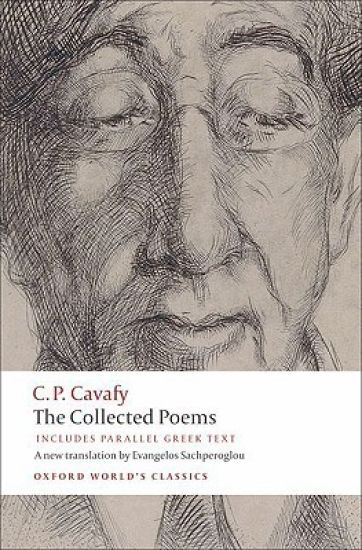
The Collected Poems

The Collected Poems

C.P. Cavafy

Oxford University Press
2008
nidottu
'a Greek gentleman in a straw hat, standing absolutely motionless at a slight angle to the universe' E. M. Forster E. M. Forster's description of C. P. Cavafy (1863-1933) perfectly encapsulates the unique perspective Cavafy brought to bear on history and geography, sexuality and language in his poems. Cavafy writes about people on the periphery, whose religious, ethnic and cultural identities are blurred, and he was one of the pioneers in expressing a specifically homosexual sensibility. His poems present brief and vivid evocations of historical scenes and sensual moments, often infused with his distinctive sense of irony. They have established him as one of the most important poets of the twentieth century. This volume presents the most authentic Greek text of the 154 authorized poems ever published, together with a new English translation that conveys the accent and rhythm of Cavafy's individual tone of voice. ABOUT THE SERIES: For over 100 years Oxford World's Classics has made available the widest range of literature from around the globe. Each affordable volume reflects Oxford's commitment to scholarship, providing the most accurate text plus a wealth of other valuable features, including expert introductions by leading authorities, helpful notes to clarify the text, up-to-date bibliographies for further study, and much more.