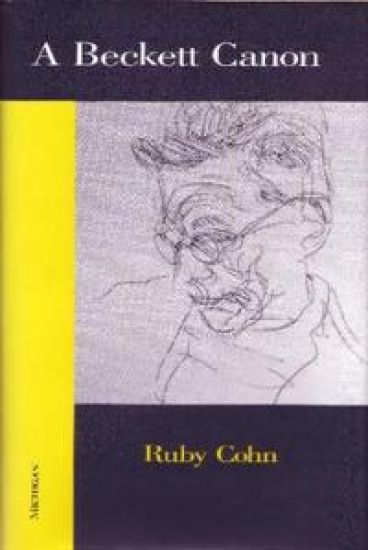
Samuel Beckett is unique in literature. Born and educated in Ireland, he lived most of his life in Paris. His literary output was rendered in either English or French, and he often translated one to the other, but there is disagreement about the contents of his bilingual corpus. A Beckett Canon by renowned theater scholar Ruby Cohn offers an invaluable guide to the entire corpus, commenting on Beckett's work in its original language.Beginning in 1929 with Beckett's earliest work, the book examines the variety of genres in which he worked: poems, short stories, novels, plays, radio pieces, teleplays, reviews, and criticism. Cohn grapples with the difficulties in Beckett's work, including the opaque erudition of the early English verse and fiction, and the searching depths and syntactical ellipsis of the late works.Specialist and nonspecialist readers will find A Beckett Canon valuable for its remarkable inclusiveness. Cohn has examined the holdings of all of the major Beckett depositories, and is thus able to highlight neglected manuscripts and correct occasional errors in their listings. Intended as a resource to accompany the reading of Beckett's writing--in English or French, published or unpublished, in part or as a whole--the book offers context, information, and interpretation of the work of one of the last century's most important writers.Ruby Cohn is Professor Emerita of Comparative Drama, University of California, Davis. She is author or editor of many books, including Anglo-American Interplay in Recent Drama; Retreats from Realism in Recent English Drama; From Desire to Godot; and Just Play: Beckett's Theater.
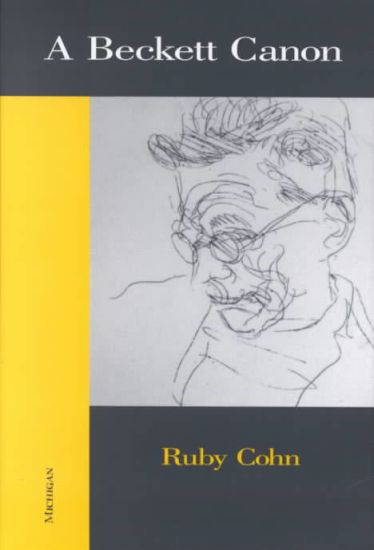
Samuel Beckett is unique in literature. Born and educated in Ireland, he lived most of his life in Paris. His literary output was rendered in either English or French, and he often translated one to the other, but there is disagreement about the contents of his bilingual corpus. A Beckett Canon by renowned theater scholar Ruby Cohn offers an invaluable guide to the entire corpus, commenting on Beckett's work in its original language.Beginning in 1929 with Beckett's earliest work, the book examines the variety of genres in which he worked: poems, short stories, novels, plays, radio pieces, teleplays, reviews, and criticism. Cohn grapples with the difficulties in Beckett's work, including the opaque erudition of the early English verse and fiction, and the searching depths and syntactical ellipsis of the late works.Specialist and nonspecialist readers will find A Beckett Canon valuable for its remarkable inclusiveness. Cohn has examined the holdings of all of the major Beckett depositories, and is thus able to highlight neglected manuscripts and correct occasional errors in their listings. Intended as a resource to accompany the reading of Beckett's writing--in English or French, published or unpublished, in part or as a whole--the book offers context, information, and interpretation of the work of one of the last century's most important writers.Ruby Cohn is Professor Emerita of Comparative Drama, University of California, Davis. She is author or editor of many books, including Anglo-American Interplay in Recent Drama; Retreats from Realism in Recent English Drama; From Desire to Godot; and Just Play: Beckett's Theater.
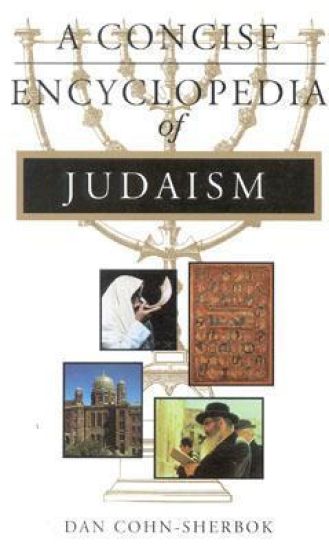
This concise dictionary of Judaism contains over a thousand entries describing all the key aspects of religion, culture and history in the Jewish faith. Designed for the student as well as the general reader, it deserves a place in every library and every Jewish home.
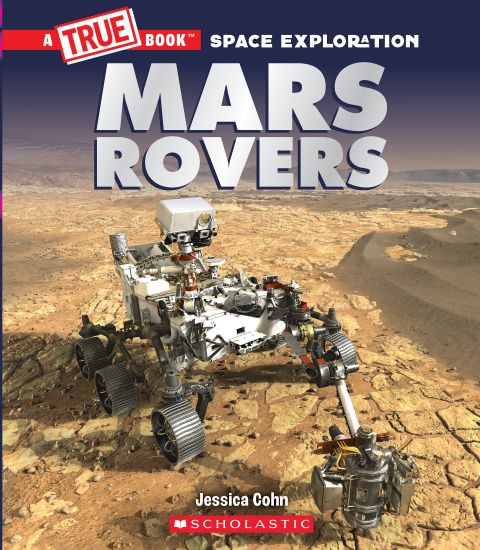
From the first time a person looked up at the sky and wondered "What's out there?" humans have dreamed about exploring the cosmos.For so long, our neighbor in the solar system has been shrouded in mystery. Was there ever life on Mars? How can we enable astronauts to land on that planet--and return safely? Mars rovers, including the latest: Perseverance, may just provide the answers They might even tell us if humans can live on Mars one day Share in the joy of exploration and discovery with Mars Rovers.ABOUT THE SERIES: This book is part of A True Book series, Space Exploration, that includes the titles Human Missions to Outer Space, Mars Rovers, The International Space Station, and UFO's. The series features the latest NASA imagery and lively text to bring the wonder of space exploration directly to readers.
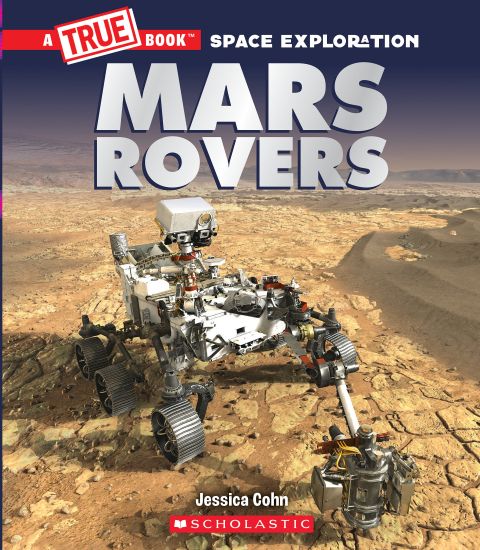
From the first time a person looked up at the sky and wondered "What's out there?" humans have dreamed about exploring the cosmos.For so long, our neighbor in the solar system has been shrouded in mystery. Was there ever life on Mars? How can we enable astronauts to land on that planet-and return safely? Mars rovers, including the latest: Perseverance, may just provide the answers They might even tell us if humans can live on Mars one day Share in the joy of exploration and discovery with Mars Rovers.ABOUT THE SERIES: This book is part of A True Book series, Space Exploration, that includes the titles Human Missions to Outer Space, Mars Rovers, The International Space Station, and UFO's. The series features the latest NASA imagery and lively text to bring the wonder of space exploration directly to readers.
Natural human communication is multimodal. We pair speech with gestures, and combine writing with pictures from online messaging to comics to advertising. This richness of human communication remains unaddressed in linguistic and cognitive theories which maintain traditional amodal assumptions about language. What is needed is a new, multimodal paradigm.This book posits a bold reorganization of the structures of language, and heralds a reconsideration of its guiding assumptions. Human expressive behaviors like speaking, signing, and drawing may seem distinct, but they decompose into similar cognitive building blocks which coalesce in emergent states from a singular multimodal communicative architecture. This cognitive model accounts for unimodal and multimodal expression across all of our modalities, providing a “grand unified theory” that incorporates insights from formal linguistics, cognitive semantics, metaphor theory, Peircean semiotics, sign language, gesture, visual language, psycholinguistics, and cognitive neuroscience. Such a perspective reconfigures how we understand linguistic structure, diversity, universals, innateness, relativity, and evolution. A Multimodal Language Faculty directly confronts centuries-old notions of language and offers a compelling reimagination of what language is and how it works.
Natural human communication is multimodal. We pair speech with gestures, and combine writing with pictures from online messaging to comics to advertising. This richness of human communication remains unaddressed in linguistic and cognitive theories which maintain traditional amodal assumptions about language. What is needed is a new, multimodal paradigm.This book posits a bold reorganization of the structures of language, and heralds a reconsideration of its guiding assumptions. Human expressive behaviors like speaking, signing, and drawing may seem distinct, but they decompose into similar cognitive building blocks which coalesce in emergent states from a singular multimodal communicative architecture. This cognitive model accounts for unimodal and multimodal expression across all of our modalities, providing a “grand unified theory” that incorporates insights from formal linguistics, cognitive semantics, metaphor theory, Peircean semiotics, sign language, gesture, visual language, psycholinguistics, and cognitive neuroscience. Such a perspective reconfigures how we understand linguistic structure, diversity, universals, innateness, relativity, and evolution. A Multimodal Language Faculty directly confronts centuries-old notions of language and offers a compelling reimagination of what language is and how it works.
Encourage readers to learn about the various animals that need help and what they can do to make a difference through volunteerism in this inspiring. Spanish-translated nonfiction title. Readers will discover different programs and organizations that work to protect animals, animal habitats, and endangered species through vibrant images and charts and informational text. Featuring a list of helpful and useful websites, this nonfiction title encourages readers to take part in animal activism in any way they can--from baking homemade dog biscuits to exploring careers that help sick or injured animals.
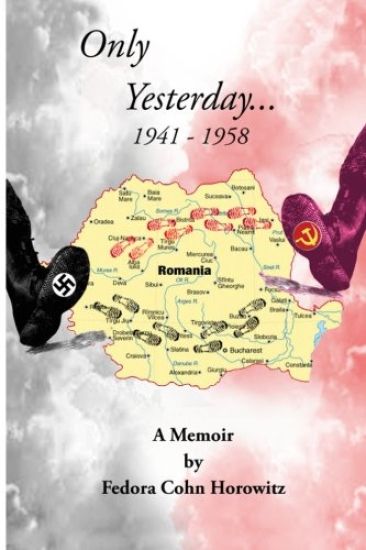
"Only Yesterday" 1941-1958, is a memoir of my life growing up in Romania during the Holocaust and during the Communist regime Romania. The first part titled "Darkness, My Life during WWII, the Romanian Holocaust, 1941-1945" describes the beginning of the horror and fear of the Jewish population after Romania's enter as an ally of Nazi Germany against the Soviet Union and its allies on June 22nd, 1941. Born in Iasi, I was 5 year old when the biggest pogrom took place in my home town, on September 29th 1941 when 10,000 Jews were killed by "Garda de Fier," the Romanian Fascist Party, helped by the city's authorities. The next morning, my father, together with other nine men were taken from our hiding place, to the train station and thrown into what became known as the "Death Trains," slow moving cattle trains where people died because of the lack of air and water. Fortunately, my father was one of the survivors, who was able to tell the world about the suffering, and about the crimes committed against the ones who died.In August 1944, afraid of the approaching Russian Army, the Romanian Government decided to sign an armistice with the Soviet Union, and turn its Army against its former ally, Germany.But this didn't mean that the war was over. The revenge of Nazi Germany, their nightly bombardments, shook our improvised shelter, where we took refuge; a shelter in which older people prayed and young children cried."A Ray of Sun, a Time of Freedom, 1945-1948" is the title of the second part, when May 9th 1945, signaled the end of the war and we were able to breathe freely.Those were three years in which optimism prevailed and we were looking forward to a life of freedom and prosperity. I was an only child and my parents wanted to expose me to experiences they had no opportunities for, during their childhood: sports, languages, and above all, piano. Both my parents loved music, my mother played piano, my father played violin, and wanted to instill in me what they loved most. At age eight, my father took me to my first encounter with opera. Later, during the communist times I was able to appreciate what my parents did for me. But the good times don't last forever. Gray clouds were hanging over our country. And the clouds, this time, appeared from the East. The Soviet Union was marching step by step to fold the Eastern European countries within their influence.The communists, who infiltrated our country and government, obtained the power after they forced King Mihai to abdicate, on December 30th, 1947.The third part of the book titled, "Tyranny, Under the Boot of Communism, 1948-1958" describes the dictatorship of the communist regime, the power in the hands of people without scruples, a regime which left its marks on my entire life. I was barely a teenager, when tragedies hit not only my family, but many of our friends' families as well. The music was my salvation, I tried to escape the dangerous times by burying myself in music. In 1958 after waiting for eight long years to be approved to immigrate to Israel, my family and I received the long awaited post-card announcing our departure.On December 3rd, in the train taking us to freedom, I took an oath, to never return to communist Romania. Forty years later, after Ceausescu, the most infamous dictator, Romania ever had, had been sentenced to death, I returned to visit my country of birth and together with my friends churn our memories, as we were the fifth column, the silent dissidents, which in spite of the terror we endured, our generation tried to maintain its sense of humor, dignity and hope for a better future.
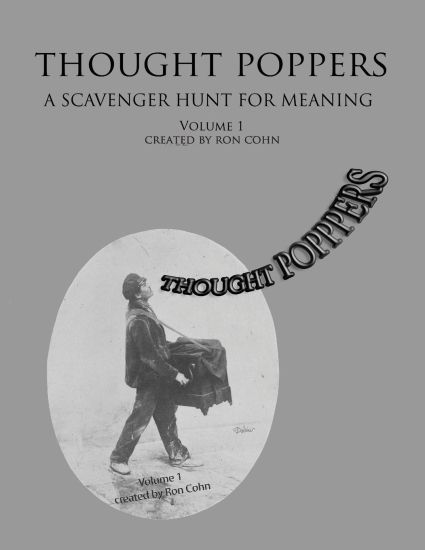
Thought Poppers presents the results of an experiment with adjectival phrases that began in the early 1990s. The experiment relies on a system of computer programs that the author created first in C language, then in Visual Basic, and now in Python 3.2. The author has also assembled a database of over 9000 adjectives or adjectival phrases and over 30,000 nouns or noun phrases. Two strictures have been employed on every word admitted to the database: 1) Is the word less than 25 characters in length 2) Can the word replace a word in the template phrase: "rational Western intellectual tradition." The system produces 10,000 phrases per second on an old-fashioned 2015 PC. Many of the phrases are pure poppycock and babble. The scene has been set. This book presents a scavenger hunt. The prizes are thought poppers.
Written with clarity and authority by an expert in the field, this new encyclopedia offers an in-depth study of all facets of this rich tradition. Combining breadth with a readable yet concise style, the author has produced a comprehensive volume that is balanced and accessible. It features a complete historical survey of Judaism, and covers figures from Cain to Chagall, topics from fasting to euthanasia, and locations from the Garden of Eden to the Wailing Wall. Dan Cohn-Sherbok's Concise Encyclopedia of Judaism is a lucid and invaluable addition to the library of students and anyone interested in the Jewish faith past and present.
If you are completely happy and carefree about being pregnant, you probably won't be holding this book but will be off painting the nursery and choosing a pram. If you are still reading this, then like many prospective parents there will be questions that you want answers to. Sometimes you will feel that these questions are too silly to bother the doctor or midwife. This book has been built around exactly those questions, asked by friends at parties or parents at the school gates who did not want to bother their doctor or midwife. The book is written with your child at the centre. So, if you do have any questions, what you want to know is 'how will this affect my baby?' and not just now, but also in the long term. The book covers normal and abnormal pregnancies, antenatal testing, delivery, what to expect from newborn babies, prematurity, neonatal care and other issues such as sleep, immunisations and the crying baby. If you do read this book, the hope is that it will answer your questions clearly, and help to ease any anxiety so that you can enjoy your pregnancy and feel more confident as a new parent. You should get only joy and pleasure from your children.
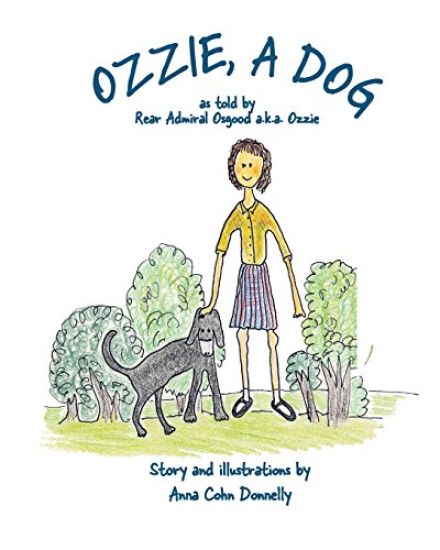
Ozzie, a black mutt, tells his story of being adopted by the large and active Cohn family from Jack's Dog Farm and finding adventure and love there, particularly with the youngest child Julie who arrived after he did. This is a heart warming tale of life on four paws.
This illustrated book is the story told by Bear Donnelly, a 14 year old Bouvier de Flanders, of her life in the Donnelly household. Some of Bear's stories are happy ones, and some are not. Bear's younger sisters, Nellie and Rosie, also tell a bit about their lives.
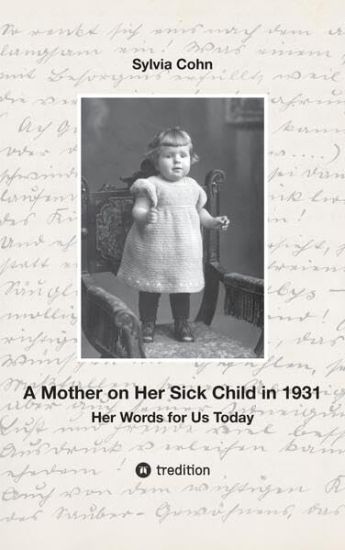
A little girl is the victim of dangers that we often casually refer to as children's diseases. She overcomes her lengthy painful diseases thanks to her own vital energy and the loving care of her mother, together with the art of medicine. But fate overtakes her because she lived at the wrong time.
This book has been considered by academicians and scholars of great significance and value to literature. This forms a part of the knowledge base for future generations. So that the book is never forgotten we have represented this book in a print format as the same form as it was originally first published. Hence any marks or annotations seen are left intentionally to preserve its true nature.
Detailed, Proven Techniques for Estimating and Planning Any Agile Project Agile Estimating and Planning is the definitive, practical guide to estimating and planning agile projects. In this book, Agile Alliance cofounder Mike Cohn discusses the philosophy of agile estimating and planning and shows you exactly how to get the job done, with real-world examples and case studies. Concepts are clearly illustrated and readers are guided, step by step, toward how to answer the following questions: What will we build? How big will it be? When must it be done? How much can I really complete by then? You will first learn what makes a good plan-and then what makes it agile. Using the techniques in Agile Estimating and Planning, you can stay agile from start to finish, saving time, conserving resources, and accomplishing more. Highlights include: Why conventional prescriptive planning fails and why agile planning works How to estimate feature size using story points and ideal days--and when to use each How and when to re-estimate How to prioritize features using both financial and nonfinancial approaches How to split large features into smaller, more manageable ones How to plan iterations and predict your team's initial rate of progress How to schedule projects that have unusually high uncertainty or schedule-related risk How to estimate projects that will be worked on by multiple teams Agile Estimating and Planning supports any agile, semiagile, or iterative process, including Scrum, XP, Feature-Driven Development, Crystal, Adaptive Software Development, DSDM, Unified Process, and many more. It will be an indispensable resource for every development manager, team leader, and team member.