Kirjojen hintavertailu. Mukana 11 244 527 kirjaa ja 12 kauppaa.

Kirjahaku

Etsi kirjoja tekijän nimen, kirjan nimen tai ISBN:n perusteella.

1000 tulosta hakusanalla Conrad Mbewe

Conrad Wise Chapman

Conrad Wise Chapman

Kent State University Press
1998
sidottu
Conrad Wise Chapman (1842-1910) is unique among Civil War artists: he painted and sketched while on duty as a Confederate soldier who served in three theaters of the war. Chapman's first-hand knowledge is evident in his work. Ben Bassham has written both a critical study of Chapman's art and a biography, incorporating Chapman's correspondence and Civil War memoirs.Conrad's father, artist and teacher John Gadsby Chapman, moved his family from the U.S. to Italy in 1850. In 1861, Conrad returned to enlist in the Confederate Army. He served for a year in the West and was wounded at Shiloh. Following his recovery, he was transferred to a regiment in Virginia, and a year later he went to Charleston, where he was ordered by General Pierre G. T. Beauregard to create a pictorial record of the Confederate Army's defense of Charleston harbor. Chapman completed a series of 31 paintings of Charleston as well as many other Civil War-related pictures familiar to historians. In 1867 he wrote his memoirs of his days as a soldier, a record that contains vivid descriptions of camp life, his first taste of battle, and his weeks in Confederate hospitals.After the war, Chapman spent eighteen months in Mexico, becoming the first American artist to paint that country's landscape. He lived the remainder of his life in Europe, Mexico, and the United States. The historical importance of Chapman's paintings as a record of the Civil War cannot be overemphasized, but this study also places Chapman's art for the first time in the context of Southern as well as American art.

Conrad in Germany

Conrad in Germany

Ulrich Seeber; Walter Goebel; Martin Windisch

East European Monographs
2008
sidottu
A comprehensive collection of 20th century research on Joseph Conrad, this volume outlines the shift from a humanist and anthropological interest in Conrad as a 'metaphysical' author to the appreciation of Conrad as a nihilist and skeptic of the modernist epoch.
Conrad and Turgenev – Towards the Real

Conrad and Turgenev – Towards the Real

Katarzyna Sokolowska

East European Monographs
2011
sidottu
The twentieth volume in the Conrad: Eastern and Western Perspectives series, Conrad and Turgenev: Towards the Real offers a comparative analysis of Joseph Conrad's and Ivan Turgenev's output and focuses on their outlooks and ideas concerning art, personality, and history. The analysis is based on Conrad's and Turgenev's major novels such as Lord Jim, Nostromo, Almayer's Folly, And Outcast of the Islands, The Return, Victory, The Secret Agent and Rudin, Home of the Gentry, One the Eve, Fathers and Sons, Smoke, as well as selected novellas, short stories, essays and letters. The affinities and differences between the two writers are discussed within the framework of realism and modernism. Main problems addressed are the relation between reality and representation in the two author's major works; the concept of the self and its duality, and the pessimistic vision of history devoid of purpose. The study is intended to highlight the affinities between Conrad and Turgenev, to acquaint the readers with those aspects of Turgenev's output that form the context for Conrad's oeuvre, to trace the echoes of Turgenev's aesthetics and worldview in Conrad's texts and to show how Conrad, a disciple of great realist masters, balanced his new modernist awareness against Turgenev who relies on the framework of realism.
Conrad in France

Conrad in France

Josiane Paccaud–huguet

East European Monographs
2007
sidottu
In this collection, French intellectuals and scholars comment on the relationship between British novelist Joseph Conrad's work and French culture and criticism. The book presents readings of Conrad's major texts by several generations of critics, such as Andre Gide, Andre Maurois, and Ramon Fernandez, with generation approaching his works from a variety of angles while remaining attentive to the link between the artist and his work.
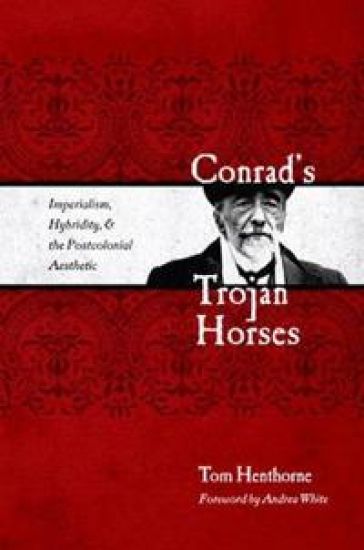
Conrad's Trojan Horses

Conrad's Trojan Horses

Tom Henthorne; Andrea White

Texas Tech Press,U.S.
2008
sidottu
With references to his work appearing everywhere from the ""New Yorker"" to The Simpsons, Joseph Conrad remains one of the twentieth century's most widely discussed literary figures. And yet it may be that an abundant scholarship has pigeonholed Conrad as an early modernist. Tom Henthorne counters that Conrads work can be best understood in relation to that of such early twentieth-century writers as S. K. Ghosh and Solomon Plaatje postcolonialists who developed innovative ways of cloaking their anti-imperialism when working with British publishers. In ""Almayer's Folly"", ""An Outcast of the Islands"", and his first short stories, Conrad attacks imperialism overtly. Yet as he began to work with more conservative publishers to acquire a larger, imperial audience, he developed a Trojan Horse strategy, deliberately obfuscating his radical politics through his use of multiple narrators, irony, free indirect discourse, and other devices that are now associated with modernism. Sensitive to the breadth of his prospective audience, Henthorne offers an engaging and accessible analysis of Conrads canon, from the early novels and short stories to the major works, including ""The Nigger of the Narcissus"", ""Heart of Darkness"", ""Lord Jim"", and ""Nostromo"". He also considers critical responses to Conrad and the influence Conrad has had upon modernist and postcolonial writers.
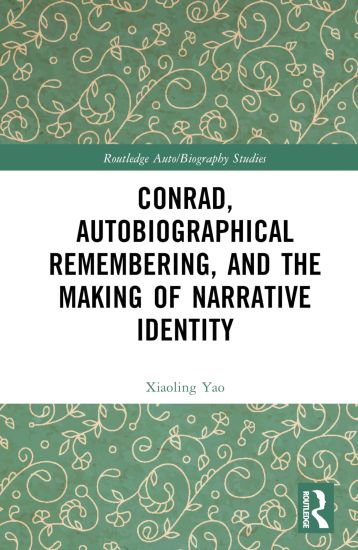
Conrad, Autobiographical Remembering, and the Making of Narrative Identity
Drawing on recent studies on life writing, memory, the narrative turn, and psychology, Conrad, Autobiographical Remembering, and the Making of Narrative Identity is the first major work that extensively explores the dynamic interplay between Conrad’s autobiographical remembering and storytelling in relation to his identity construction within a historical and cultural context. This unique perspective makes the book particularly attractive for students, teachers, and researchers of Conrad. Contrary to the prevalent "achievement-and-decline" paradigm that implies a decline in quality of Conrad’s works in his later period, this volume contends that Conrad’s later works continue to engage with the complex questions of memory, identity, and culture, demonstrating a sustained commitment to exploring the intricacies of the human experiences. Essential reading for Conrad enthusiasts, but also for those who seek to explore how memory studies in literature intersect with psychology, philosophy, and cultural studies.
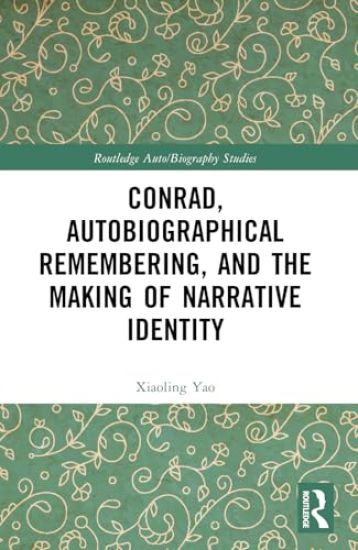
Conrad, Autobiographical Remembering, and the Making of Narrative Identity
Drawing on recent studies on life writing, memory, the narrative turn, and psychology, Conrad, Autobiographical Remembering, and the Making of Narrative Identity is the first major work that extensively explores the dynamic interplay between Conrad’s autobiographical remembering and storytelling in relation to his identity construction within a historical and cultural context. This unique perspective makes the book particularly attractive for students, teachers, and researchers of Conrad. Contrary to the prevalent "achievement-and-decline" paradigm that implies a decline in quality of Conrad’s works in his later period, this volume contends that Conrad’s later works continue to engage with the complex questions of memory, identity, and culture, demonstrating a sustained commitment to exploring the intricacies of the human experiences. Essential reading for Conrad enthusiasts, but also for those who seek to explore how memory studies in literature intersect with psychology, philosophy, and cultural studies.