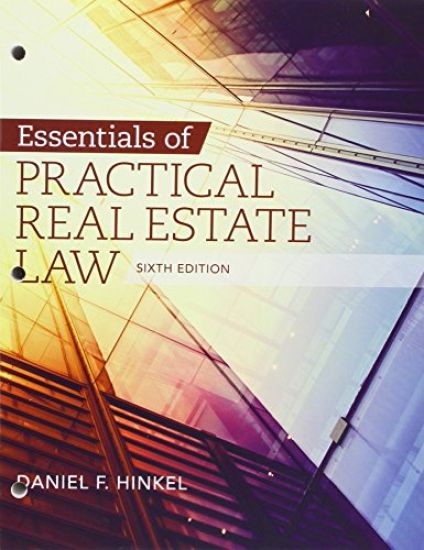
Master the essentials of real estate law and develop a strong understanding of the role of the real estate paralegal with this concise, yet comprehensive text. Taking a case-based approach, ESSENTIALS OF PRACTICAL REAL ESTATE LAW, 6e details the transactional aspects of the law needed to assist attorneys with closing real estate purchases, sales, and mortgage loans secured by real estate. Case summaries throughout give you a chance to practice your analytical skills and see how concepts are applied in practice. In addition, each chapter includes practical assignments and a self-study examination, along with numerous forms and checklists to ensure that you are well prepared to work as a professional in real estate. Offering up-to-date coverage of technology and the impact of the recent recession, this resource reflects the latest laws and regulations of the industry.
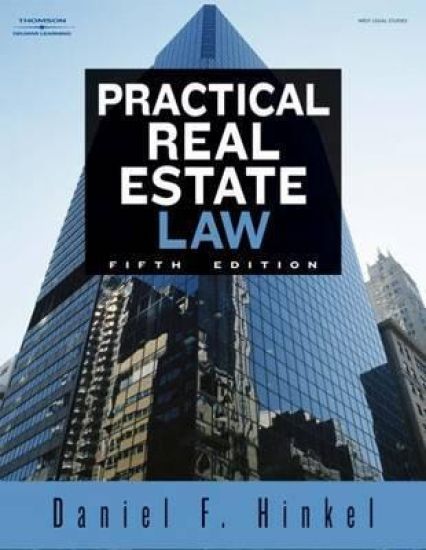
The perfect mix of theory and practice make Practical Real Estate Law, fifth editon a must have resource for paralegal students and professionals dealing with real estate law and transactions. The intricacies of real estate law, both residential and commercial, are presented in an easy-to-understand format through numerous examples, checklists, and sample forms. This book includes critical topics such as closings, sales, loans, surveys, title insurance, and a chapter devoted to leasing with an emphasis on commercial leasing.
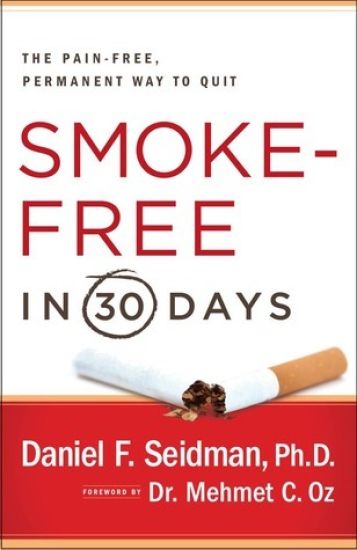
I'M TOO STRESSED TO STOP. I'LL GAIN WEIGHT IF I QUIT. I'VE TRIED AND FAILED TOO MANY TIMES TO COUNT. Why are you still smoking, even though you want to quit? Based on twenty years of research and hands-on work with countless smokers in his clinics at Columbia University and New York Presbyterian Hospital, Dr. Daniel F. Seidman understands that people smoke -- and quit -- for different reasons and what works for one smoker might not work for another. - Are you a Situational Smoker? Monitoring your reactions in different situations is a step toward permanently losing interest in cigarettes. - Are you a Worried-about-Weight Smoker? Properly using treatments like Nicotine Replacement Therapy (NRT) can help you quit and get healthy in all aspects of your life. - Are you an Emotion-Triggered Smoker? Scheduling your smoking breaks and sticking to a rigid "smoking schedule" helps break the link between stressful situations and craving cigarettes. In a comprehensive, 30-day program, Dr. Seidman explains how to retrain your brain, take advantage of all the tools at your disposal, and end the month smoke-free and feeling stronger than ever
A child’s close bond with mother, father, or guardian usually provides a foundation for trust in all future attachments. Children deprived of early and healthy dependency—who do not form normal attachment with their caregivers—may later suffer from Reactive Attachment Disorder (RAD). This childhood disorder is characterized by a general failure in social relationships resulting from pathogenic care.Although first included in the third edition of the Diagnostic and Statistical Manual (DSM-III) in 1980, RAD is one of the more uncommon and understudied forms of psychopathology. Reactive Attachment Disorder: A Case-Based Approach adds to a now growing research base, providing scholars and clinicians with a well-rounded analysis of RAD and suggested treatments. The case-based approach used in this Brief follows the representative case of “Jorge,” presented as unfolding over time and structured to illustrate challenges of diagnosis, to show examples of co-morbidity, and to provoke reflection on what questions may arise during treatment. Readers are asked to appraise the overlap with other clinical syndromes, the forms of psychotherapy which may apply, and the potential role of psychiatric medications as part of a comprehensive treatment plan.
"If there's one thing this boy knows about, it's birds." So said Javi's father, with a tinge of embarrassment, as he responded to a claim excusing prolonged absence. Birdwatching became an outlet of expression as Javi tried to fit into a world that seemed to be offended by his mere presence. The avocation became a distinction, for better and worse, and coincidentally led to other, unexpected and unlikely interests - bringing new friendships and reconnection with old acquaintances. Though Javi finds many experiences to support his expectations, it is those that do not that he finds most difficult to accept.
In 1898 after the murder of a white woman, two young Seminoles were chained and burned alive. Hiding behind a wall of silence and fearing reprisal for identifying their executioners, virtually the entire white community became involved with the ghastly execution.In this absorbing narrative Daniel F. Littlefield, Jr., captures the horror and details the events that incited this alarming act of mob violence and community complicity. Seminole Burning not only gives an account of a dramatic, violent event in Indian–white relations but also provides insights into the social, economic, and legal history of the times.Although occurring during the heyday of lynching in America, the execution of the young Seminoles proved to be not just another sad episode in the history of injustice. Apparently a vendetta organized by the extended family of the dead woman’s husband, it was orchestrated by landless whites, who for a week after her murder, had harassed and terrorized more than twenty Seminole men and boys in selecting victims.For having taken them out of Indian Territory and into Oklahoma for execution, the mob leaders became the target of federal authorities. In the first successful prosecution of lynchers in the Southwest, a special prosecutor revealed underlying motives for the crime and convicted six.Seminole Burning is not just the story of a lynching and an account of how landless Americans invaded Indian Territory. By placing this tragic case in context and against the large backdrop of history, Littlefield connects it to federal expansion of court jurisdiction, to federal attempts to dissolve land titles of the Five Civilized Tribes, and indeed to the establishing of the state of Oklahoma.
Where is "America" and what do we mean when we call America "the nation"?The United States is a union of states that is located on the continent of North America and on the Hawaiian Islands in the middle of the Pacific Ocean. A more exact name for "the nation" would be, "The United States of North America and the Pacific Ocean." Whatever the name, the union has always had difficulty being one nation since it has been adding states since 1787, in all 37 new states. Has the actual history of America since the ratification of the Constitution been the construction of a nation or of a union of states? The Constitution takes some sovereign powers away from states and transfers them to the Federal Government but as a result no government in the union is fully sovereign and each must function by law as a democracy. The Constitution reduces the power that makes an American state a normal state, full sovereignty, and it does not grant even the status of a state to the Federal Government. The government in Washington D.C. is located in a district, not a state, and its sovereign powers are limited by the Constitution just as are the powers of states. In this book, twelve essays on American history explore the struggle for power between the states and the Federal Government and conclude that the central idea of the Constitution is that all governments of the union at any level must be democracies. The men who created the Constitution and the men who ratified it gambled that to have democratic governments in their states full sovereignty was not necessary. Their gamble has paid off to such an extent that our American political system, a union of states with limited sovereignty, is the only political system in the world that can realistically produce a union of democratic states worldwide. The Federal Government should give up trying to be the head of "the nation" and instead become the central supranational government of a world union of states. The Constitution gives Congress the power to admit new states. States worldwide should apply for admission to the American union in order to guarantee for themselves economic development and a democratic government. The United States of America should become The United States of the World in order to secure by a strong central government and a written constitution the right of its peoples to be citizens in any democratic state of their union where they choose to reside.