Kirjojen hintavertailu. Mukana 11 244 527 kirjaa ja 12 kauppaa.

Kirjahaku

Etsi kirjoja tekijän nimen, kirjan nimen tai ISBN:n perusteella.

1000 tulosta hakusanalla David R Addleman

Pure and True

Pure and True

David R. Stroup

University of Washington Press
2022
sidottu
What are the boundaries of Hui identity?The Chinese Communist Party points to the Hui—China's largest Muslim ethnic group—as a model ethnic minority and touts its harmonious relations with the group as an example of the Party's great success in ethnic politics. The Hui number over ten million, but they lack a common homeland or a distinct language, and have long been partitioned by sect, class, region, and language. Despite these divisions, they still express a common ethnic identity. Why doesn't conflict plague relationships between the Hui and the state? And how do they navigate their ethnicity in a political climate that is increasingly hostile to Muslims?Pure and True draws on interviews with ordinary urban Hui—cooks, entrepreneurs, imams, students, and retirees—to explore the conduct of ethnic politics within Hui communities in the cities of Jinan, Beijing, Xining, and Yinchuan and between Hui and the Chinese party-state. By examining the ways in which Hui maintain ethnic identity through daily practices, it illuminates China's management of relations with its religious and ethnic minority communities. It finds that amid state-sponsored urbanization projects and in-country migration, the boundaries of Hui identity are contested primarily among groups of Hui rather than between Hui and the state. As a result, understandings of which daily habits should be considered "proper" or "correct" forms of Hui identity diverge along professional, class, regional, sectarian, and other lines. By channeling contentious politics toward internal boundaries, the state is able to manage ethnic politics and exert control.
Pure and True

Pure and True

David R. Stroup

University of Washington Press
2022
pokkari
What are the boundaries of Hui identity?The Chinese Communist Party points to the Hui—China's largest Muslim ethnic group—as a model ethnic minority and touts its harmonious relations with the group as an example of the Party's great success in ethnic politics. The Hui number over ten million, but they lack a common homeland or a distinct language, and have long been partitioned by sect, class, region, and language. Despite these divisions, they still express a common ethnic identity. Why doesn't conflict plague relationships between the Hui and the state? And how do they navigate their ethnicity in a political climate that is increasingly hostile to Muslims?Pure and True draws on interviews with ordinary urban Hui—cooks, entrepreneurs, imams, students, and retirees—to explore the conduct of ethnic politics within Hui communities in the cities of Jinan, Beijing, Xining, and Yinchuan and between Hui and the Chinese party-state. By examining the ways in which Hui maintain ethnic identity through daily practices, it illuminates China's management of relations with its religious and ethnic minority communities. It finds that amid state-sponsored urbanization projects and in-country migration, the boundaries of Hui identity are contested primarily among groups of Hui rather than between Hui and the state. As a result, understandings of which daily habits should be considered "proper" or "correct" forms of Hui identity diverge along professional, class, regional, sectarian, and other lines. By channeling contentious politics toward internal boundaries, the state is able to manage ethnic politics and exert control.
Rhetoric and the Discourses of Power in Court Culture

Rhetoric and the Discourses of Power in Court Culture

David R. Knechtges; Eugene Vance

University of Washington Press
2005
sidottu
Key imperial and royal courts--in Han, Tang, and Song dynasty China; medieval and renaissance Europe; and Heian and Muromachi Japan--are examined in this comparative and interdisciplinary volume as loci of power and as entities that establish, influence, or counter the norms of a larger society. Contributions by twelve scholars are organized into sections on the rhetoric of persuasion, taste, communication, gender, and natural nobility. Writing from the perspectives of literature, history, and philosophy, the authors examine the use and purpose of rhetoric in their respective areas.In Rhetoric of Persuasion, we see that in both the third-century court of the last Han emperor and the fourteenth-century court of Edward II, rhetoric served to justify the deposition of a ruler and the establishment of a new regime. Rhetoric of Taste examines the court's influence on aesthetic values in China and Japan, specifically literary tastes in ninth-century China, the melding of literary and historical texts into a sort of national history in fifteenth-century Japan, and the embrace of literati painting innovations in twelfth-century China during a time when the literati themselves were out of favor. Rhetoric of Communication considers official communications to the throne in third-century China, the importance of secret communications in Charlemagne's court, and the implications of the use of classical Chinese in the Japanese court during the eighth and ninth centuries. Rhetoric of Gender offers the biography of a former Han emperor's favorite consort and studies the metaphorical possibilities of Tang palace plaints. Rhetoric of Natural Nobility focuses on Dante's efforts to confirm his nobility of soul as a poet, surmounting his non-noble ancestry, and the development of the texts that supported the political ideologies of the fifteenth-century Burgundian dukes Philip the Good and Charles the Bold.
Raising Hell for Justice

Raising Hell for Justice

David R. Obey

University of Wisconsin Press
2007
sidottu
David Obey has in his nearly forty years in the U.S. House of Representatives worked to bring economic and social justice to America's working families. In 2007 he assumed the chair of the Appropriations Committee and is positioned to pursue his priority concerns for affordable health care, education, environmental protection, and a foreign policy consistent with American democratic ideals. Here, in his autobiography, Obey looks back on his journey in politics beginning with his early years in the Wisconsin Legislature, when Wisconsin moved through eras of shifting balance between Republicans and Democrats. On a national level Obey traces, a few others have done, the dramatic changes in the workings of the U.S. Congress since his first election to the House in 1969. He discusses his own central role in the evolution of Congress and ethics reforms and his view of the recent Bush presidency - crucial chapters in our democracy, of interest to all who observe politics and modern U.S. history.
America's Congress

America's Congress

David R. Mayhew

Yale University Press
2002
pokkari
To understand American politics and government, we need to recognize not only that members of Congress are agents of societal interests and preferences but also that they act with a certain degree of autonomy and consequence in the country’s public sphere. In this illuminating book, a distinguished political scientist examines actions performed by members of Congress throughout American history, assessing their patterns and importance and their role in the American system of separation of powers.David R. Mayhew examines standard history books on the United States and identifies more than two thousand actions by individual members of the House and Senate that are significant enough to be mentioned. Mayhew offers insights into a wide range of matters, from the nature of congressional opposition to presidents and the surprising frequency of foreign policy actions to the timing of notable activity within congressional careers (and the way that congressional term limits might affect these performances). His book sheds new light on the contributions to U.S. history made by members of Congress.
Electoral Realignments

Electoral Realignments

David R. Mayhew

Yale University Press
2004
pokkari
The study of electoral realignments is one of the most influential and intellectually stimulating enterprises undertaken by American political scientists. Realignment theory has been seen as a science able to predict changes, and generations of students, journalists, pundits, and political scientists have been trained to be on the lookout for “signs” of new electoral realignments. Now a major political scientist argues that the essential claims of realignment theory are wrong—that American elections, parties, and policymaking are not (and never were) reconfigured according to the realignment calendar.David Mayhew examines fifteen key empirical claims of realignment theory in detail and shows us why each in turn does not hold up under scrutiny. It is time, he insists, to open the field to new ideas. We might, for example, adopt a more nominalistic, skeptical way of thinking about American elections that highlights contingency, short-term election strategies, and valence issues. Or we might examine such broad topics as bellicosity in early American history, or racial questions in much of our electoral history. But we must move on from an old orthodoxy and failed model of illumination.
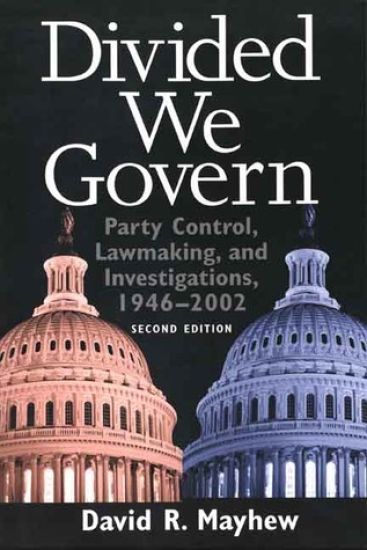
Divided We Govern

Divided We Govern

David R. Mayhew

Yale University Press
2005
pokkari
In this prize-winning book, a renowned political scientist debunks the commonly held myth that the American national government functions effectively only when one political party controls the presidency and Congress. For this new edition, David R. Mayhew has provided a new Preface, a new appendix, and a new concluding chapter that brings the historical narrative up to date.“Important, accessible, and compelling, David Mayhew’s second edition of Divided We Govern takes the best book on the history of US lawmaking and—against all odds—makes it better.”—Keith Krehbiel, Stanford University“In this welcome updating of his agenda-setting classic, David Mayhew cogently defends his original methodology and finds that divided government remains no less productive of important legislation than unified government, although it is now (thanks mainly to Clinton’s impeachment) strongly associated with prominent investigations of the executive branch. Written with Mayhew’s usual clarity and grace, this is a book to be enjoyed by beginning and veteran students of Congress alike.”—Gary JacobsonFrom reviews of the first edition:"First-rate. . . . Mayhew’s tabulations and analysis are, quite simply, unimpeachable."—Morris Fiorina, Washington Monthly"Will stand for years as a classic."—L. Sandy Maisel, Political Science Quarterly"Should be read by every student of American politics."—Gillian Peele, Times Higher Education Supplement
Congress

Congress

David R. Mayhew

Yale University Press
2004
pokkari
"Any short list of major analyses of Congress must of necessity include David Mayhew’s Congress: The Electoral Connection." —Fred Greenstein In this second edition to a book that has achieved canonical status, David R. Mayhew argues that the principal motivation of legislators is reelection and that the pursuit of this goal affects the way they behave and the way that they make public policy. In a new foreword for this edition, R. Douglas Arnold discusses why the book revolutionized the study of Congress and how it has stood the test of time.
Parties and Policies

Parties and Policies

David R. Mayhew

Yale University Press
2008
pokkari
In this wide-ranging new volume, one of our most important and perceptive scholars of the workings of the American government investigates political parties, politicians, elections, and policymaking to discover why public policy emerges in the shape that it does. David R. Mayhew looks at two centuries of policy making—from the Civil War and Reconstruction era through the Progressive era, the New Deal, the Great Society, the Reagan years, and the aspirations of the Clinton and Bush administrations—and offers his original insights on the ever-evolving American policy experience. These fourteen essays were written over the past three decades and collectively showcase Mayhew’s skepticism of the usefulness of political parties as an analytic window into American politics. These writings, which include a new introductory essay, probe beneath the parties to the essentials of the U.S. constitutional system and the impulses and idiosyncrasies of history.
Policing Stalin's Socialism

Policing Stalin's Socialism

David R. Shearer

Yale University Press
2009
pokkari
Policing Stalin’s Socialism is one of the first books to emphasize the importance of social order repression by Stalin’s Soviet regime in contrast to the traditional emphasis of historians on political repression. Based on extensive examination of new archival materials, David Shearer finds that most repression during the Stalinist dictatorship of the 1930s was against marginal social groups such as petty criminals, deviant youth, sectarians, and the unemployed and unproductive. It was because Soviet leaders regarded social disorder as more of a danger to the state than political opposition that they instituted a new form of class war to defend themselves against this perceived threat. Despite the combined work of the political and civil police the efforts to cleanse society failed; this failure set the stage for the massive purges that decimated the country in the late 1930s.
Stalin and the Lubianka

Stalin and the Lubianka

David R. Shearer; Vladimir Khaustov

Yale University Press
2015
sidottu
This fascinating documentary history is the first English-language exploration of Joseph Stalin's relationship with, and manipulation of, the Soviet political police. The story follows the changing functions, organization, and fortunes of the political police and security organs from the early 1920s until Stalin’s death in 1953, and it provides documented detail about how Stalin used these organs to achieve and maintain undisputed power. Although written as a narrative, it includes translations of more than 170 documents from Soviet archives.
Stonewall

Stonewall

David R Carter

Saint Martin's Griffin,U.S.
2011
nidottu
The basis of the PBS American Experience documentary Stonewall Uprising.In 1969, a series of riots over police action against The Stonewall Inn, a gay bar in New York City's Greenwich Village, changed the longtime landscape of the homosexual in society literally overnight. Since then the event itself has become the stuff of legend, with relatively little hard information available on the riots themselves. Now, based on hundreds of interviews, an exhaustive search of public and previously sealed files, and over a decade of intensive research into the history and the topic, Stonewall: The Riots That Sparked the Gay Revolution brings this singular event to vivid life in this, the definitive story of one of history's most singular events. A Randy Shilts / Publishing Triangle Award Finalist"Riveting...Not only the definitive examination of the riots but an absorbing history of pre-Stonewall America, and how the oppression and pent-up rage of those years finally ignited on a hot New York night." - Boston Globe
A Retrospective Bibliography of American Demographic History from Colonial Times to 1983
Modern American demographic history emerged as a clearly defined discipline in the 1960s when historians began to realize the full value of demographic information to their studies of both population and more indirectly related subjects. In recent years a large body of literature has been produced, but there is a significant amount of material, which originated before demographic history became popular, that is still useful to scholars today. In addition, the range of related topics has broadened considerably, making the information more difficult to locate. This bibliography is the first comprehensive guide to the entire field of Amerian demographic history. It contains over 3,800 citations of published materials on all aspects of the subject, including marriage and fertility, family and societal values, and the interactions of population with economics, politics, and society. Each section is introduced with a substantial bibliographic essay highlighting the chief works, the contours of the field, and the directions it appears to be taking.The first of two volumes, this scholarly work offers reader access through an elaborate table of contents that points up subject arrangement; an author index, a place name index, and an index of groups of people according to ethnic and national division, ages, religions, occupations, and gender. The extensive preface provides a discerning overview of the history of demographic research, and the literature covered spans the period from the colonial times to 1983. The companion volume will present the available sources from 1984 to the present. This exhaustive survey will be an important addition to academic and research libraries and a valuable resource for scholars, students, and genealogists.
Our Own Time

Our Own Time

David R. Roediger; Philip S. Foner

Praeger Publishers Inc
1989
sidottu
Our Own Time provides the first full account of the movement to shorten the working day in the United States. Combining the narrative and trade union emphasis of traditional labor history with the focus on culture and the labor process characteristic of contemporary labor history, the book offers an illuminating reinterpretation of the history of the U.S. labor movement from the colonial period onward. The authors argue that the length of the working day or week historically has been the central issue raised by the American labor movement during its most vigorous periods of organization.Beginning with a picture of working hours in colonial America and the early republic, Roediger and Foner then analyze the ideology of the movement for a ten-hour workday in the early nineteenth century. They demonstrate that the ten-hour issue was a key to the dynamism of the Jacksonian labor movement as well as to the unity of male artisans and female factory workers in the 1840s. The authors proceed to examine the subsequent demands for an eight-hour day, which helped to produce the mass labor struggles of the late nineteenth century and established the American Federation of Labor as the dominant force in American trade unionism. Chapters on labor movement defeats following World War I, on the depression years, and on the lack of progress over the last half-century complete the study. Our Own Time will be an ideal supplemental text for courses in U.S. labor and economic history.
Bibliography of American Demographic History

Bibliography of American Demographic History

David R. Gerhan

Greenwood Press
1995
sidottu
A companion to the ALA-award-winning Retrospective Bibliography of American Demographic History (1989), this volume includes literature on American demographic history published from 1984 to 1994. It covers such topics as marriage and fertility; health, sickness, and mortality; immigration, settlement, and cultural patterns; and family and its structures, roles and values (including both gender and sexuality issues). It also cites works showing the broad intersections between population matters and such economic, political, and social phenomena as war, oppression, government policy, elections, labor stereotype, discrimination, and cross-cultural contact or relations.The bibliography organizes and describes citations to the rich historical literature on the ordinary life experiences of Americans, such as marriage, childbearing, health, migration, and ethnicity, and how these fundamental phenomena have been interconnected with the events of headline history. The book provides multiple points of access, through the detailed contents and through indexes of place, ethnicity, and topic.
Peacekeepers and Their Wives

Peacekeepers and Their Wives

David R. Segal; Mady Wechsler Segal

Praeger Publishers Inc
1993
sidottu
David and Mady Segal analyze the adaptation of American soldiers assigned to the Multinational Force and Observers (MFO) in the Sinai Desert in support of the Camp David Accords, in the context of the evolution of multinational peacekeeping forces as mechanisms for achieving international security. The reactions of soldiers and their wives to the peacekeeping assignment are considered from the perspective of the social construction of reality, in which the role of the military has been defined as war-fighting. The press has ignored peacekeeping until very recently, and it falls to military organizations, to soldiers and their families, to make sense of the mission. Lessons learned from the Sinai MFO experience should be used to help U.S. troops better prepare for their increasing role in multinational peacekeeping.
County Governments in an Era of Change

County Governments in an Era of Change

David R. Berman

Praeger Publishers Inc
1993
sidottu
This long-needed, volume gives an overview of the past, present, and future of American county government. Recognized authorities describe how county governments have developed, how they are chosen and function in metropolitan and rural counties, and how they interrelate with state and national units of government. This primer analyzing how governmental roles are changing and how counties governments in the future might better deliver essential human services is intended for students and professionals and for classroom use, for courses in state and local government, urban and rural studies, and public administration.This expert overview begins with a short introduction and brief history. Then three chapters outline the broad characteristics of county governments today in terms of authority, structure, elections, legislatures and legislation, the capacities of county governments, and intergovernmental relations. Five chapters assess in turn how counties provide full-service government, the characteristics of metropolitan counties and urbanization, the special problems of rural county governments, shifting roles in county-state relations, and county policy objectives at the national level. The conclusion discusses counties, other governments, and future prospects. The reference list points to related readings of note.
The Postwar Decline of American Newspapers, 1945-1965

The Postwar Decline of American Newspapers, 1945-1965

David R. Davies

Praeger Publishers Inc
2006
sidottu
On the surface, the American newspaper industry appears to have changed little from 1945 to 1965, remaining both healthy and prosperous. The number of newspapers in 1965 was about the same as in 1945, while during the twenty-year period advertising revenues increased substantially despite new competition from television. Just as in 1945, the vast majority of newspapers went to press with improved but old-fashioned letterpress methods in 1965. And newspaper reporters still professed a strong, if now somewhat shaken, faith in the federal government at the end of the twenty years.But the surface appearance of both stability and profitability obscured profound change. In the two decades after World War II, the business of newspaper publishing changed significantly in myriad ways. By 1965, editors and publishers had recognized the extent of these changes and were beginning to adjust. Each of the changes was significant of its own accord, and the range of challenges throughout the period combined to transform newspapers and the nation they served by 1965. This transformation was evident, to varying degrees, in newspapers' content, their production methods, their economic position within the overall media marketplace, and their relationship with government. Newspapers - some more than others - made strides to keep up with and overcome some of these challenges. But in each of these areas, newspapers as a group were slow to respond to the problems facing journalism.
America's Prophets

America's Prophets

David R. Dow

Praeger Publishers Inc
2009
sidottu
America's Prophets: How Judicial Activism Makes America Great fills a major void in the popular literature by providing a thorough definition and historical account of judicial activism and by arguing that it is a method of prophetic adjudication which is essential to preserving American values. Dow confounds the allegation of the Christian right that judicial activism is legally and morally unsound by tracing the roots of American judicial activism to the methods of legal and moral interpretation developed by the prophets of the Hebrew Bible. He claims that Isaiah, Amos, and Jesus are archetypal activist judges and, conversely, that modern activist judges are America's prophets. Dow argues that judicial restraint is a priestly method of adjudication and that it, not judicial activism, is the legally and morally unsound method. Race and gender discrimination, separation of church and state, privacy rights, and same-sex marriage are all issues that have divided our nation and required judicial intervention. Every time the courts address a hot-button issue and strike down entrenched bias or bigotry, critics accuse the justices of being judicial activists, whose decisions promote their personal biases and flout constitutional principles. This term, despite its widespread currency as a pejorative, has never been rigorously defined. Critics of judicial activism properly point out that when judges overturn laws that enforce popular norms they thwart the will of the majority. But Dow argues that so-called activist judges uphold two other American legal values that are as deeply embedded in American legal culture as majoritarianism: liberty and equality. He challenges the notion that judicial activism is unprincipled, and he provides a vocabulary and historical context for defending progressive decisions.