Kirjojen hintavertailu. Mukana 12 418 675 kirjaa ja 12 kauppaa.

Kirjahaku

Etsi kirjoja tekijän nimen, kirjan nimen tai ISBN:n perusteella.

1000 tulosta hakusanalla David W Gordon

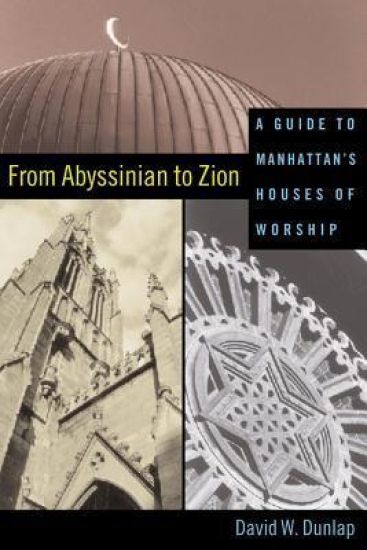
From Abyssinian to Zion

From Abyssinian to Zion

David W. Dunlap

Columbia University Press
2004
sidottu
From modest chapels to majestic cathedrals, and historic synagogues to modern mosques and Buddhist temples: this photo-filled, pocket-size guidebook presents 1,079 houses of worship in Manhattan and lays to rest the common perception that skyscrapers, bridges, and parks are the only defining moments in the architectural history of New York City. With his exhaustive research of the city's religious buildings, David W. Dunlap has revealed (and at times unearthed) an urban history that reinforces New York as a truly vibrant center of community and cultural diversity. Published in conjunction with a New-York Historical Society exhibition, From Abyssinian to Zion is a sometimes quirky, always intriguing journey of discovery for tourists as well as native New Yorkers. Which popular pizzeria occupies the site of the cradle of the Christian and Missionary Alliance movement, the Gospel Tabernacle? And where can you find the only house of worship in Manhattan built during the reign of Caesar Augustus? Arranged alphabetically, this handy guide chronicles both extant and historical structures and includes * 650 original photographs and 250 photographs from rarely seen archives * 24 detailed neighborhood maps, pinpointing the location of each building * concise listings, with histories of the congregations, descriptions of architecture, and accounts of prominent priests, ministers, rabbis, imams, and leading personalities in many of the congregations
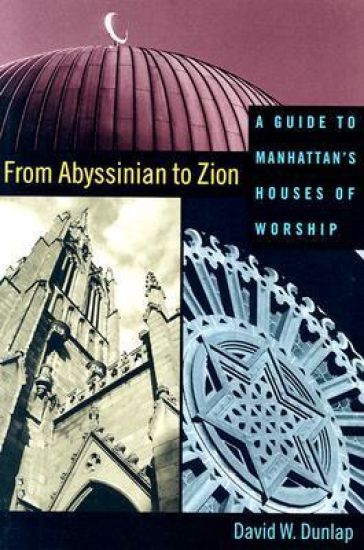
From Abyssinian to Zion

From Abyssinian to Zion

David W. Dunlap

Columbia University Press
2004
pokkari
From modest chapels to majestic cathedrals, and historic synagogues to modern mosques and Buddhist temples: this photo-filled, pocket-size guidebook presents 1,079 houses of worship in Manhattan and lays to rest the common perception that skyscrapers, bridges, and parks are the only defining moments in the architectural history of New York City. With his exhaustive research of the city's religious buildings, David W. Dunlap has revealed (and at times unearthed) an urban history that reinforces New York as a truly vibrant center of community and cultural diversity. Published in conjunction with a New-York Historical Society exhibition, From Abyssinian to Zion is a sometimes quirky, always intriguing journey of discovery for tourists as well as native New Yorkers. Which popular pizzeria occupies the site of the cradle of the Christian and Missionary Alliance movement, the Gospel Tabernacle? And where can you find the only house of worship in Manhattan built during the reign of Caesar Augustus? Arranged alphabetically, this handy guide chronicles both extant and historical structures and includes * 650 original photographs and 250 photographs from rarely seen archives * 24 detailed neighborhood maps, pinpointing the location of each building * concise listings, with histories of the congregations, descriptions of architecture, and accounts of prominent priests, ministers, rabbis, imams, and leading personalities in many of the congregations

50 Days of Love

50 Days of Love

David W Palmer

Lulu.com
2017
pokkari
50 Days of Love: Compelling Devotional Teachings by David W. Palmer; Unlocking God's love for you, in you, and through you. Do you realize that he has made his love available to us? Did you know that we can walk in his kind of love today? In "50 Days of Love," David W. Palmer breaks open God's word in a way that discloses God's heart, and reveals his plan for a kingdom of love. You will be inspired, instructed, and satiated as you devour these daily revelations. Each one looks at scriptural aspects of love from different angles; each one will challenge you with thought-provoking truths that reach the heart; and each one will stir you to action through real life application. "50 Days of Love" will help you draw closer to God, empower you to fulfil his commandments to love him and others, and help you discover deep contentment in God's love for you.
The Day God Explained Himself

The Day God Explained Himself

David W. Palmer

Lulu.com
2020
nidottu
Why is it so confusing to understand God at times?Why doesn't God just come and explain himself?This book will guide you through The Day God Explained Himself, and show you how to apply it.Jesus is the master communicator. He is the best teacher, using the best technique to convey the most crucial content ever disclosed to man. Jesus reveals God's purpose for us; He also shows us how God interacts with man and how his system works. Jesus' ministry led up to (and continued to build on the foundation of) a specific explanation he gave of God and his system. This happened on a particular day - The Day God Explained Himself. If we miss the significance of that day, and if we don't put sufficient emphasis on the value of Jesus' teaching on it, we could miss God's best for our lives. In this book, David W. Palmer pinpoints the heart of Jesus' teaching. If we make this our anchor point, the remainder of Jesus' teaching, his ministry (and other New Testament writings) will fall into place.
How to Operate in the Spirit and Power of Elijah
Why is it that in the final chapter of the Old Testament, God promised to restore Elijah to active ministry? Were you aware that this promise points to our generation for another manifestation of a ministry in the spirit and power of Elijah? Do you know why God likes Elijah and his ministry so much? Discover the true Spirit and Power of Elijah Receive keys for having the Spirit and Power of Elijah operating in your life
I Wore Babe Ruth's Hat

I Wore Babe Ruth's Hat

David W. Zang

University of Illinois Press
2015
sidottu
David W. Zang played junior high school basketball in a drained swimming pool. He wore a rubber suit to bed to make weight for a wrestling meet. He kept a log as an obsessive runner (not a jogger). In short, he soldiered through the life of an ordinary athlete. Whether pondering his long-unbuilt replica of Connie Mack Stadium or his eye-opening turn as the Baltimore Ravens' mascot, Zang offers tales at turns poignant and hilarious as he engages with the passions that shaped his life. Yet his meditations also probe the tragedy of a modern athletic culture that substitutes hyped spectatorship for participation. As he laments, American society's increasing scorn for taking part in play robs adults of the life-affirming virtues of games that challenge us to accomplish the impossible for the most transcendent of reasons: to see if it can be done. From teammates named Lop to tracing Joe Paterno's long shadow over Happy Valley, I Wore Babe Ruth's Hat reports from the everyman's Elysium where games and life intersect.
I Wore Babe Ruth's Hat

I Wore Babe Ruth's Hat

David W. Zang

University of Illinois Press
2015
nidottu
David W. Zang played junior high school basketball in a drained swimming pool. He wore a rubber suit to bed to make weight for a wrestling meet. He kept a log as an obsessive runner (not a jogger). In short, he soldiered through the life of an ordinary athlete. Whether pondering his long-unbuilt replica of Connie Mack Stadium or his eye-opening turn as the Baltimore Ravens' mascot, Zang offers tales at turns poignant and hilarious as he engages with the passions that shaped his life. Yet his meditations also probe the tragedy of a modern athletic culture that substitutes hyped spectatorship for participation. As he laments, American society's increasing scorn for taking part in play robs adults of the life-affirming virtues of games that challenge us to accomplish the impossible for the most transcendent of reasons: to see if it can be done. From teammates named Lop to tracing Joe Paterno's long shadow over Happy Valley, I Wore Babe Ruth's Hat reports from the everyman's Elysium where games and life intersect.
Mass Motorization and Mass Transit

Mass Motorization and Mass Transit

David W. Jones

Indiana University Press
2010
pokkari
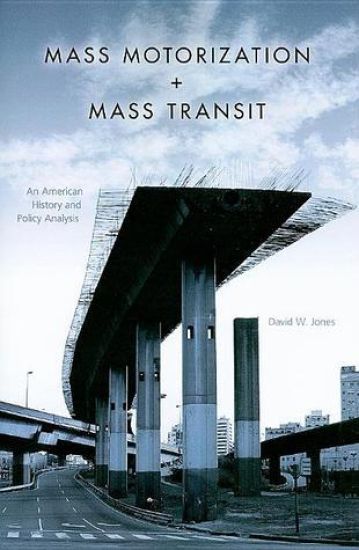
Mass Motorization and Mass Transit examines how the United States became the world's most thoroughly motorized nation and why mass transit has been more displaced in the United States than in any other advanced industrial nation. The book's historical and international perspective provides a uniquely effective framework for understanding both the intensity of U.S. motorization and the difficulties the country will face in moderating its demands on the world's oil supply and reducing the CO2 emissions generated by motor vehicles. No other book offers as comprehensive a history of mass transit, mass motorization, highway development, and suburbanization or provides as penetrating an analysis of the historical differences between motorization in the United States and that of other advanced industrial nations.
Born to Parse

Born to Parse

David W. Lightfoot

MIT Press
2020
sidottu
In this book, David Lightfoot argues that just as some birds are born to chirp, humans are born to parse-predisposed to assign linguistic structures to their ambient external language. This approach to language acquisition makes two contributions to the development of Minimalist thinking. First, it minimizes grammatical theory, dispensing with three major entities- parameters; an evaluation metric for the selection of grammars; and any independent parsing mechanism. Instead, Lightfoot argues, children parse their ambient external language using their internal language. Universal Grammar is "open," consistent with what children learn through parsing with their internal language system. Second, this understanding of language acquisition yields a new view of variable properties in language-properties that occur only in certain languages. Under the open UG vision, very specific language particularities arise in response to new parses. Both external and internal languages play crucial, interacting roles- unstructured, amorphous external language is parsed and an internal language system results.Lightfoot explores case studies that show such innovative parses of external language in the history of English- development of modal verbs, loss of verb movement, and nineteenth-century changes in the syntax of the verb to be. He then discusses how children learn through parsing; the role of parsing at the syntactic structure's interface with the externalization system and logical form; language change; and variable properties seen through the lens of an open UG.
Democracy in a Hotter Time

Democracy in a Hotter Time

David W. Orr; Bill McKibben

MIT PRESS LTD
2023
nidottu
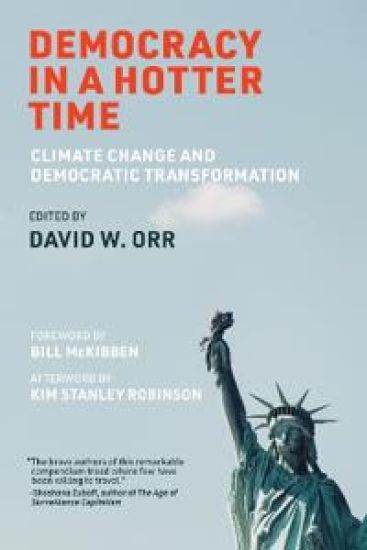
The first major book to deal with the dual crises of democracy and climate change as one interrelated threat to the human future and to identify a path forward.Democracy in a Hotter Time calls for reforming democratic institutions as a prerequisite for avoiding climate chaos and adapting governance to how Earth works as a physical system. To survive in the “long emergency” ahead, we must reform and strengthen democratic institutions, making them assets rather than liabilities. Edited by David W. Orr, this vital collection of essays proposes a new political order that will not only help humanity survive but also enable us to thrive in the transition to a post–fossil fuel world.Orr gathers leading scholars, public intellectuals, and political leaders to address the many problems confronting our current political systems. Few other books have taken a systems view of the effects of a rapidly destabilizing climate on our laws and governance or offered such a diversity of solutions. These thoughtful and incisive essays cover subjects from Constitutional reform to participatory urban design to education; together, they aim to invigorate the conversation about the human future in practical ways that will improve the effectiveness of democratic institutions and lay the foundation for a more durable and just democracy.ContributorsWilliam J. Barber III, JD, William S. Becker, Holly Jean Buck, Stan Cox, Michael M. Crow, William B. Dabars, Ann Florini, David H. Guston, Katrina Kuh, Gordon LaForge, Hélène Landemore, Frances Moore Lappé, Daniel Lindvall, Richard Louv, James R. May, Frederick W. Mayer, Bill McKibben, Michael Oppenheimer, David W. Orr, Wellington Reiter, Kim Stanley Robinson, Anne-Marie Slaughter
Experiments in the Machine Interpretation of Visual Motion

Experiments in the Machine Interpretation of Visual Motion

David W. Murray; Bernard Buxton

MIT Press
1990
pokkari
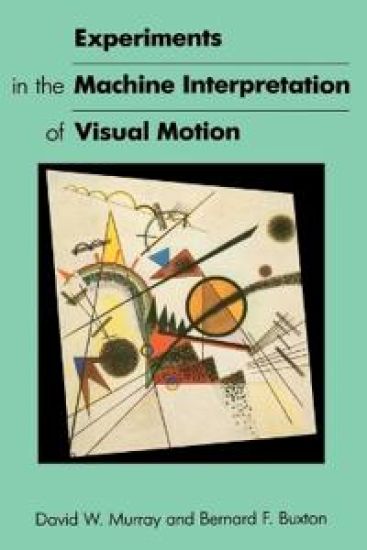
This book describes experimental advances made in the interpretation of visual motion over the last few years that have moved researchers closer to emulating the way in which we recover information about the surrounding world. If robots are to act intelligently in everyday environments, they must have a perception of motion and its consequences. This book describes experimental advances made in the interpretation of visual motion over the last few years that have moved researchers closer to emulating the way in which we recover information about the surrounding world. It describes algorithms that form a complete, implemented, and tested system developed by the authors to measure two-dimensional motion in an image sequence, then to compute three-dimensional structure and motion, and finally to recognize the moving objects.The authors develop algorithms to interpret visual motion around four principal constraints. The first and simplest allows the scene structure to be recovered on a pointwise basis. The second constrains the scene to a set of connected straight edges. The third makes the transition between edge and surface representations by demanding that the wireframe recovered is strictly polyhedral. And the final constraint assumes that the scene is comprised of planar surfaces, and recovers them directly.ContentsImage, Scene, and Motion * Computing Image Motion * Structure from Motion of Points * The Structure and Motion of Edges * From Edges to Surfaces * Structure and Motion of Planes * Visual Motion Segmentation * Matching to Edge Models * Matching to Planar Surfaces
How to Set Parameters

How to Set Parameters

David W. Lightfoot

Bradford Books
1993
pokkari
Over the past decade, generative grammarians have viewed language acquisition as a process of fixing option points or parameters defined in Universal Grammar. Here David Lightfoot addresses the crucial question of what it takes to set a parameter - of what kind of experience is needed to trigger the emergence of a natural kind of grammar. Lightfoot asserts that parameter setting is not sensitive to embedded material, and that it is triggered only by robust elements that are structurally simple. He observes that morphological properties play a significant role in setting parameters which have widespread syntactic effects. Using evidence from data on diachronic changes and from current work in syntactic theory, Lightfoot makes precise claims about the triggering experience that can explain a number of historical puzzles. He argues that the changes could have taken place in the way they did only if language acquisition proceeds on the basis of simple, unembedded experiences.
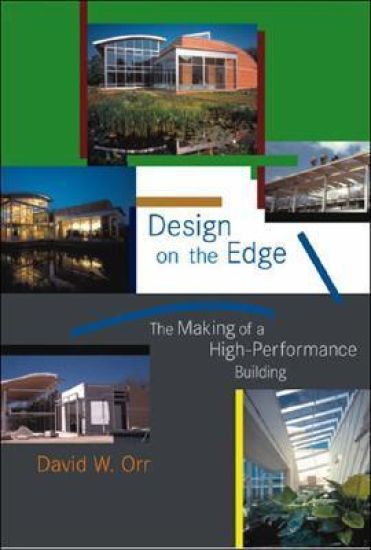
Design on the Edge

Design on the Edge

David W. Orr

MIT Press
2008
pokkari
The story of the building of the Adam Joseph Lewis Center at Oberlin College in the context of ecological design, institutional learning, and the green campus movement. The story of the Adam Joseph Lewis Center at Oberlin College-the first substantially green building to be built on a college campus-encompasses more than the particulars of one building. In Design on the Edge, David Orr writes about the planning and design of Oberlin's environmental studies building as part of a larger story about the art and science of ecological design and the ability of institutions of higher learning themselves to learn. The Lewis Center, which has attracted worldwide attention as a model of ecological design, operates according to environmental principles. It is powered entirely by solar energy, features landscaping with fruit trees and vegetable gardens, and houses a Living Machine, which processes all wastewater for reuse in the building or landscape. Orr puts the Lewis Center into historical design context and describes the obstacles and successes he encountered in obtaining funds and college approval, interweaving the particulars of the center with thoughts on the larger environmental and societal issues the building process illustrates. Equal parts analysis, personal reflection, and call to action, Design on the Edge illustrates the process of institutional change, institutional learning, and the political economy of design. It describes how the idea of the Lewis Center originated and was translated into reality with the help of such environmental visionaries as William McDonough and John Todd, and how the building has performed since its completion. College and university administrators will spend 17 billion dollars on new buildings over the next few years. Design on the Edge is essential reading for architects, planners, and environmentalists who need to sell the innovations of ecological design to wary institutions, and for educators and students whose profession is undermined by the very buildings they work in-and for anyone who has ever tried to change an organization for the better.
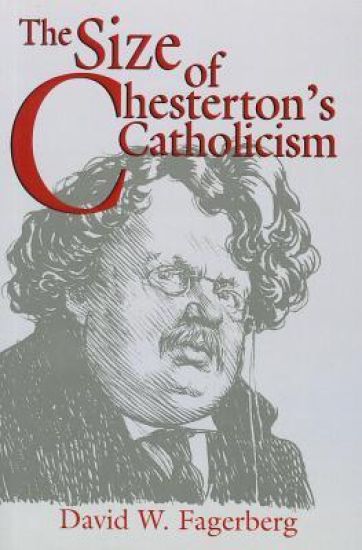
The Size of Chesterton's Catholicism

The Size of Chesterton's Catholicism

David W. Fagerberg

University of Notre Dame Press
2015
nidottu
English writer Gilbert Keith Chesterton was widely known not only for his newspaper columns, novels, poetry, plays, and detective stories, but also for his theological and Catholic apologetical works. This celebration of Chesterton's passion for his faith builds on his own words to reveal the Catholic paradox he was so fond of exploring and which he articulated with zeal, wit, and total lack of animosity. David W. Fagerberg draws on Chesterton's theological writings—avoiding secondary sources so that the reader can encounter his thought as directly as possible—to show how Chesterton championed a Catholicism of great robustness accessible by a thousand doors. Through these doors, Fagerberg shows that Chesterton believed the Church to be a living institution that confounds its critics. He organizes Chesterton's material around seven themes, fashioning a mosaic from the illustrations and arguments found in these apolegetical works. We see how Chesterton responded to accusations that the Church avoids the world with his defense of ordinary life and to the allegation of blind obedience with a defense of doctrinal complexity. We explore his interest in paganism and ritual and learn his response to the objections of liberal Protestantism. Chesterton is shown to be an apologist for a "catholic" Catholicism and he saw in every heresy an effort to narrow the Church. Chesterton said about the Church "that it is not only larger than me, but larger then anything in the world; that it is indeed larger than the world." Fagerberg suggests that the ultimate apology Chesterton made for Catholicism is that it is capacious enough to accommodate the paradoxical combinations which reveal reality—that the Church is a trysting-place for all the truths in the world.
Christianity in the United States

Christianity in the United States

David W. Wills

University of Notre Dame Press
2005
nidottu
In this brief but comprehensive study, David W. Wills provides both a broad interpretation and a wealth of factual information on the history of Christianity in the United States. Though Wills pays careful attention to the diversity of American Christianity, charting the growth of American religious pluralism is only one of his goals. He also emphasizes Christian efforts to build a holy commonwealth and the role of religion in America's still unresolved effort to come to terms with the realities of race. Wills places the history of Christianity in the United States in the larger context of the globalization of the Christian religion. He links the rise of African-American Christianity with the emergence of Christianity in the non-western world. He also argues that the history of Christianity in the United States concerns itself in a central way with the relation of religious ideas, institutions, constituencies, and practices to the creation and exercise of political power. This compelling work will be an invaluable text for courses in religious studies, American history, American studies, and African-American studies.
Powwowing Among the Pennsylvania Dutch

Powwowing Among the Pennsylvania Dutch

David W. Kriebel

Pennsylvania State University Press
2008
sidottu
Known in Pennsylvania Dutch as Brauche or Braucherei, the folk-healing practice of powwowing was thought to draw upon the power of God to heal all manner of physical and spiritual ills. Yet some people believed-and still believe today-that this power to heal came not from God, but from the devil. Controversy over powwowing came to a climax in 1929 with the York Hex Murder Trial, in which one powwower killed another who, he believed, had placed a hex on him.Based on seven years of fieldwork and extensive interviews, David Kriebel's study reveals the vibrant world, history, and culture of powwowing in southeastern and central Pennsylvania. He describes, compares, and contrasts powwowing practices of the past and the present; discusses in detail the belief in powwowing as healing; and assesses the future of Braucherei. Biographical sketches of seven living powwowers shed additional light on this little-understood topic.A groundbreaking inquiry into Pennsylvania German culture and history, Powwowing Among the Pennsylvania Dutch opens a window onto an archaic, semi-mystical tradition still very much in practice today.
History of Independence Hall

History of Independence Hall

David W. Belisle

Metalmark Books
2008
pokkari
First published in Philadelphia in 1859, History of Independence Hall combines Belisle’s meditations on the hall as a sacred part of our nation’s history with biographical accounts of each signer of the Declaration of Independence and a meticulous catalogue of the contents of the hall. The author states his hope that the publication will serve as more than just a mere guidebook, but rather will “inspire a deeper love for the Temple wherein our nation’s infancy was cradled and defended.”The author compares the significance of Independence Hall in the history of national independence to that of of other sites in the Western tradition, including Greek, Roman, and biblical sites. As such, Belisle’s record is much more than a thoroughly researched history of Independence Hall: it provides a view of nineteenth-century understandings of nationalism, historiography, and the cultural heritage of the United States. Of particular interest to students of the early history of the United States is the extensive documentation, including an early draft of the Declaration of Independence and sketches of revolutionary relics such as Washington’s pew.