Kirjojen hintavertailu. Mukana 11 244 527 kirjaa ja 12 kauppaa.

Kirjahaku

Etsi kirjoja tekijän nimen, kirjan nimen tai ISBN:n perusteella.

1000 tulosta hakusanalla Debora Pol

The Rise of Dogwhistle Politics

The Rise of Dogwhistle Politics

Deborah Cameron

JOHN WILEY AND SONS LTD
2025
sidottu
The term dogwhistle, meaning a political message with a hidden or coded meaning, only entered mainstream usage in the mid-1990s, but today it seems to be everywhere. Accusations of dogwhistling fly in every political direction, and the meaning of the term has broadened to encompass an ever-expanding range of words, images, actions and objects. This book investigates the rise of the dogwhistle as a key cultural and political reference point, arguing that it’s a sign of our political times. It’s related both to the polarized nature of politics in the era of populism, culture wars and online echo-chambers, and to the preoccupation of radical activists on both sides of the traditional left/right divide with controlling language as a way of remaking culture. Their political aims are different, but their tactics are more similar than they might appear. As well as examining how these tactics have recently been used and looking at the arguments they now regularly prompt in public settings from social media to courts of law, this book by linguist Deborah Cameron considers some of the theoretical questions they raise about the way communication works and the effects it is capable of producing. It asks why contemporary radical movements put so much emphasis on words and symbols—and whether their faith in the power of language is justified.

EU Food Law and Policy

EU Food Law and Policy

Debra Holland; Helen Pope

Kluwer Law International
2004
sidottu
To all appearances, Europe is at present undergoing a crisis of consumer confidence with respect to the food industry. Recent food scares, the genetically-modified food controversy, a growing public awareness of the environmental footprint of intensive faming methods, and a perceived threat to the deeply-held European cultural values surrounding diet and cuisine all have combined to expose the vulnerability of consumers in the very ordinary activity of purchasing food. Although the creation of the European Food Safety Authority (EFSA) in February 2002 can be viewed as an EU response to this crisis, it in fact represents an inevitable milestone in a body of food-specific European legislation and case law that has been growing for many years. The EFSA does, however, clearly establish food law as an autonomous branch of EU law. This is the first book to survey and analyze this body of law in depth, drawing together the relevant laws and cases and taking stock of the trends and likely future developments in this dynamic and emotive area of law and policy.
Aid and Technical Cooperation as a Foreign Policy Tool for Emerging Donors
The question of why countries give aid and assistance to other countries has long been a topic of debate- is it altruism, or selfishness? The assumption is sometimes made that donors from developing countries might be more motivated by altruism than ‘traditional’ western donors. This book demonstrates that on the contrary, the provision of development assistance can be used to serve national interests, allowing so-called ‘emerging’ donors to gain soft power in the international sphere by improving their image and global influence.Technical cooperation, or the transfer of knowledge, is an area of particular interest, as it can enable donors to position themselves as a global leader in a given field, with a unique set of skills and expertise in a knowledge area. This book uses the Brazilian case to demonstrate how a country such as Brazil can seek power and influence by providing no-strings-attached technical assistance. The empirical analysis unpicks the motivations behind development assistance, and how it can be used as a foreign policy tool. In doing so, the book sheds light upon the similarities and variations in the provision of technical cooperation as a foreign policy tool by China, India, and Brazil. This book will be of interest to researchers of International Development, South-South Cooperation, International Relations, and those working on Brazil specifically.
Aid and Technical Cooperation as a Foreign Policy Tool for Emerging Donors
The question of why countries give aid and assistance to other countries has long been a topic of debate- is it altruism, or selfishness? The assumption is sometimes made that donors from developing countries might be more motivated by altruism than ‘traditional’ western donors. This book demonstrates that on the contrary, the provision of development assistance can be used to serve national interests, allowing so-called ‘emerging’ donors to gain soft power in the international sphere by improving their image and global influence.Technical cooperation, or the transfer of knowledge, is an area of particular interest, as it can enable donors to position themselves as a global leader in a given field, with a unique set of skills and expertise in a knowledge area. This book uses the Brazilian case to demonstrate how a country such as Brazil can seek power and influence by providing no-strings-attached technical assistance. The empirical analysis unpicks the motivations behind development assistance, and how it can be used as a foreign policy tool. In doing so, the book sheds light upon the similarities and variations in the provision of technical cooperation as a foreign policy tool by China, India, and Brazil. This book will be of interest to researchers of International Development, South-South Cooperation, International Relations, and those working on Brazil specifically.
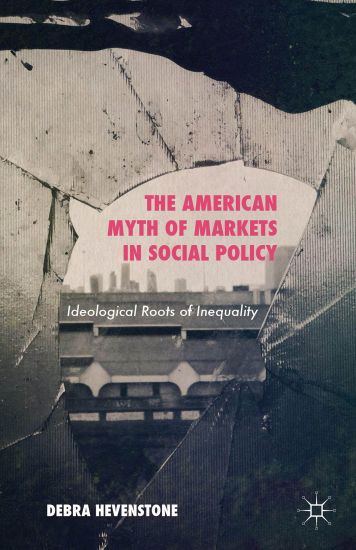
The American Myth of Markets in Social Policy

The American Myth of Markets in Social Policy

Debra Hevenstone

Palgrave Macmillan
2015
sidottu
The American Myth of Markets in Social Policy examines how implementing American tropes in policy design inadvertently frustrates policy goals. The book investigates multiple market-oriented designs including funding for private organizations to deliver public services, funding for individuals to buy services, and policies incentivizing or mandating private actors to provide social policy. Hevenstone shows that these solutions often not only fail to achieve social goals, but actively undermine them. The book carefully details the mechanisms through which this occurs, and examines several policies in depth, covering universal social insurance programs like healthcare and pensions, as well as smaller interventions like programs for the homeless.
U.S. Immigration Policy in an Age of Rights

U.S. Immigration Policy in an Age of Rights

Debra L. DeLaet

Praeger Publishers Inc
2000
sidottu
Civil rights rhetoric has been central to the debate over U.S. immigration policy since at least the 1960s. A coalition of interest groups, including churches, ethnic organizations, civil rights groups, and employer associations has played a fundamental role in advancing civil rights norms in the immigration arena. The growing importance of civil rights rhetoric in the debate over U.S. immigration policy, DeLaet asserts, helps to explain the liberalization of U.S. immigration policy in spite of growing evidence that the public opposition to immigration has grown during the same period. In turn, the liberalization of U.S. immigration policy has contributed to rising numbers of both legal and illegal immigrants. Thus, high levels of immigration reflect the basic provisions of current U.S. immigration policy, rather than a loss of governmental control.Many analysts have suggested that the immigration policy reforms passed by Congress in 1996 marked the beginning of a new era of restrictionism. However, as DeLaet illustrates, the new restrictions adopted in 1996 contain many of the same loopholes as previous legislation, indicating the coalition of interest groups supporting immigration still pose a significant obstacle to efforts to restrict immigration.
U.S. Immigration Policy in an Age of Rights

U.S. Immigration Policy in an Age of Rights

Debra L. DeLaet

Praeger Publishers Inc
2000
nidottu
Civil rights rhetoric has been central to the debate over U.S. immigration policy since at least the 1960s. A coalition of interest groups, including churches, ethnic organizations, civil rights groups, and employer associations has played a fundamental role in advancing civil rights norms in the immigration arena. The growing importance of civil rights rhetoric in the debate over U.S. immigration policy, DeLaet asserts, helps to explain the liberalization of U.S. immigration policy in spite of growing evidence that the public opposition to immigration has grown during the same period. In turn, the liberalization of U.S. immigration policy has contributed to rising numbers of both legal and illegal immigrants. Thus, high levels of immigration reflect the basic provisions of current U.S. immigration policy, rather than a loss of governmental control.Many analysts have suggested that the immigration policy reforms passed by Congress in 1996 marked the beginning of a new era of restrictionism. However, as DeLaet illustrates, the new restrictions adopted in 1996 contain many of the same loopholes as previous legislation, indicating the coalition of interest groups supporting immigration still pose a significant obstacle to efforts to restrict immigration.
The Politics of Regulatory Reform

The Politics of Regulatory Reform

Stuart Shapiro; Debra Borie-Holtz

Routledge
2013
sidottu
Regulation has become a front-page topic recently, often referenced by politicians in conjunction with the current state of the U.S. economy. Yet despite regulation’s increased presence in current politics and media, The Politics of Regulatory Reform argues that the regulatory process and its influence on the economy is misunderstood by the general public as well as by many politicians.In this book, two experienced regulation scholars confront questions relevant to both academic scholars and those with a general interest in ascertaining the effects and importance of regulation. How does regulation impact the economy? What roles do politicians play in making regulatory decisions? Why do politicians enact laws that require regulations and then try to hamper agencies abilities to issue those same regulations? The authors answer these questions and untangle the misperceptions behind regulation by using an area of regulatory policy that has been underutilized until now. Rather than focusing on the federal government, Shapiro and Borie-Holtz have gathered a unique dataset on the regulatory process and output in the United States. They use state-specific data from twenty-eight states, as well as a series of case studies on regulatory reform, to question widespread impressions and ideas about the regulatory process.The result is an incisive and comprehensive study of the relationship between politics and regulation that also encompasses the effects of regulation and the reasons why regulatory reforms are enacted.
Healthcare Solved - Real Answers, No Politics
Written for the citizen consumer, healthcare professional and employer who asks: "What is health reform going to mean for me?" If you want to know more, this is the book for you. It is written in response to politicians attempting to hijack healthcare at the expense of the American people. As both a physician and economist, Dr. Smith plainly lays out the problems and real, workable solutions. With clinical and administrative experience, Dr. Smith has worked in every area of healthcare, from hospitals to insurance companies. She has seen what's worked and what hasn't in the United States, Europe and the Third World. The answers to how healthcare is actually delivered and where the money is really going will likely surprise you. If we are going to have a serious debate about healthcare, it is time for the American people, healthcare professionals and employers to fully understand and reclaim this most important issue.
Healthcare Solved - Real Answers, No Politics
Written for the citizen consumer, healthcare professional and employer who asks: "What is health reform going to mean for me?" If you want to know more, this is the book for you. It is written in response to politicians attempting to hijack healthcare at the expense of the American people. As both a physician and economist, Dr. Smith plainly lays out the problems and real, workable solutions. With clinical and administrative experience, Dr. Smith has worked in every area of healthcare, from hospitals to insurance companies. She has seen what's worked and what hasn't in the United States, Europe and the Third World. The answers to how healthcare is actually delivered and where the money is really going will likely surprise you. If we are going to have a serious debate about healthcare, it is time for the American people, healthcare professionals and employers to fully understand and reclaim this most important issue.
Gender, Power and Political Speech

Gender, Power and Political Speech

Deborah Cameron; Sylvia Shaw

Palgrave Macmillan
2016
sidottu
Gender, Power and Political Speech explores the influence of gender on political speech by analyzing the performances of three female party leaders who took part in televised debates during the 2015 UK General Election campaign. The analysis considers similarities and differences between the women and their male colleagues, as well as between the women themselves; it also discusses the way gender - and its relationship to language - was taken up as an issue in media coverage of the campaign.
The Politics of Regulatory Reform

The Politics of Regulatory Reform

Stuart Shapiro; Debra Borie-Holtz

Routledge
2015
nidottu
Regulation has become a front-page topic recently, often referenced by politicians in conjunction with the current state of the U.S. economy. Yet despite regulation’s increased presence in current politics and media, The Politics of Regulatory Reform argues that the regulatory process and its influence on the economy is misunderstood by the general public as well as by many politicians.In this book, two experienced regulation scholars confront questions relevant to both academic scholars and those with a general interest in ascertaining the effects and importance of regulation. How does regulation impact the economy? What roles do politicians play in making regulatory decisions? Why do politicians enact laws that require regulations and then try to hamper agencies abilities to issue those same regulations? The authors answer these questions and untangle the misperceptions behind regulation by using an area of regulatory policy that has been underutilized until now. Rather than focusing on the federal government, Shapiro and Borie-Holtz have gathered a unique dataset on the regulatory process and output in the United States. They use state-specific data from twenty-eight states, as well as a series of case studies on regulatory reform, to question widespread impressions and ideas about the regulatory process.The result is an incisive and comprehensive study of the relationship between politics and regulation that also encompasses the effects of regulation and the reasons why regulatory reforms are enacted.
Healthcare Solved - Real Answers, No Politics

Healthcare Solved - Real Answers, No Politics

Debra Smith

Booksurge Publishing
2009
nidottu
Written for the citizen consumer, healthcare professional and employer who asks: "What is health reform going to mean for me? "If you want to know more, this is the book for you. It is written in response to politicians attempting to hijack healthcare at the expense of the American people. As both a physician and economist, Dr. Smith plainly lays out the problems and real, workable solutions. With clinical and administrative experience, Dr. Smith has worked in every area of healthcare, from hospitals to insurance companies. She has seen what's worked and what hasn't in the United States, Europe and the Third World.The answers to how healthcare is actually delivered and where the money is really going will likely surprise you. If we are going to have a serious debate about healthcare, it is time for the American people, healthcare professionals and employers to fully understand and reclaim this most important issue
Stop Politically Driven Education

Stop Politically Driven Education

Eldon "Cap" Lee; Deborah Meier

Rowman Littlefield
2019
nidottu
On these pages is a call to action for teachers who have been shackled by the self-serving motives of agenda driven politicians. Here we present a new innovative process designed to prepare children to be productive members of their community. Students are empowered to take charge of their educational lives where thinking is valued above obedience, and their parents are respected as full partners in the process. The greatest challenge to educators in this decade is to prepare children to rise above the confirmation bias and embrace critical thinking. In this day of continuous propaganda from many directions, everything requires in depth thinking, research and processing. Change won’t come from the top! The time has come to go underground to subvert the system from the bottom up. We infuse creative ideas while providing a pattern for systemic change that empowers teachers allowing them to take back their profession. Teachers are the saviors who are in the position to expand children’s minds to the stars and beyond, giving them hope that they will make the world a better place. It is time to take a risk for children by subverting the system with the goal of true, whole child education.
Woman of Light: A novel based on the life of Deborah

Woman of Light: A novel based on the life of Deborah

Teresa Pollard

Createspace Independent Publishing Platform
2016
nidottu
Christian fiction, inspired by Judges 4 & 5. On his deathbed, Deborah's grandfather prophesied she would be a Judge for Israel. But the elders of Ramah vowed a woman would never sit in the city gates to listen to cases. So Deborah and her husband, Barak, returned to his hometown of Kedesh, in the northern part of the Israel, where trouble brewed nearby: King Jabin II had appointed Sisera to be commander of his army... and his nine-hundred iron chariots. Meanwhile, God brings disputes to Deborah for her to adjudicate, and soon she is holding court under the palm trees outside of Kedesh. Then God tells Deborah to hurry back to Ramah, and the family escapes just before Commander Sisera invades Israel and ransacks Kedesh. But Israel has no standing army to respond, and not a shield or a spear was seen among forty-thousand men. How will God use two such improbable people, a peasant woman and her husband, to lead Israel to victory against this formidable foe?
Who Lives Here? Polar Animals

Who Lives Here? Polar Animals

Deborah Hodge

Kids Can Press
2008
nidottu
The polar regions are home to amazing animals whose bodies are built for living in the extreme cold. Emperor penguins, snowy owls and beluga whales all have special ways of staying warm, finding food and raising their young in a polar habitat of thick ice and snow.The Who Lives Here? series looks at animals in their natural habitats - rain forests, polar regions, deserts and wetlands - and explains how the body and habits of each animal are suited to the place it lives. Charming, realistic illustrations, playful language and intriguing facts make these books a perfect read for young children.
Feminism, Digital Culture and the Politics of Transmission

Feminism, Digital Culture and the Politics of Transmission

Deborah Withers

Rowman Littlefield International
2015
sidottu
Feminism, Digital Culture and the Politics of Transmission argues that despite the prevalence of generational narratives within feminism, the technical processes through which knowledge is transmitted across generations remain unexplored. Taking Bernard Stiegler's concept of the already-there as its starting point the book considers how the politics of transmission operates within digital culture. It argues that it is necessary to re-orient feminism's political project within what is already-there so that it may respond to an emergent feminist tradition. Grounded in the author's work collecting and interpreting the music-making heritage of the UK Women's Liberation Movement, it explores how digital technologies have enabled empassioned amateurs to make 'archives' within the first decade of the 21st century. The book reflects on what is technically and politically at stake in the organization and transmission of digital artifacts, and explores what happens to feminist cultural heritage when circuits shut down, stall or become diverted.