Kirjojen hintavertailu. Mukana 11 342 296 kirjaa ja 12 kauppaa.

Kirjahaku

Etsi kirjoja tekijän nimen, kirjan nimen tai ISBN:n perusteella.

1000 tulosta hakusanalla E-Energy 15 Conference Committee

World Energy Resources

World Energy Resources

Charles E. Brown

Springer-Verlag Berlin and Heidelberg GmbH Co. K
2002
sidottu
World Energy Resources is an explanatory energy survey of the countries and major regions of the world, their geographic and economic settings, and signif­ icant inter-relationships. This book attempts to combine several interacting energy themes that encompass a historical development, energy issues and forecasts, economic geography, environmental programs, and world energy use. The main thrust of this book -World Energy Resources - is based on princi­ ples of energy science, applied geology, geophysics, and other environmental sciences as they relate to the exploration, exploitation, and production of resources in this country and throughout the world. This work is an analysis of the United States (USA) and world oil, gas, coal, and alternative energy resources and their associated issues, forecasts, and related policy. This book could not have been attempted without a broad geological exposure and international ge­ ographic awareness. Much information is scattered among federal and state agencies, schools, and other institutions, and this book has attempted to com­ bine some of the vast information base. This attempt can only skim the infor­ mation surface at best, but its regional and topical coverage is broad in scope. Part I introduces conventional energy resources and their historical develop­ ments, and includes chapters 1 to 7. The basic concepts and supporting facts on energy sources are presented here for the general education of energy analysts, policy makers, and scientists that desire a brief review of advanced technologies and history.
Alternative Energy Sources

Alternative Energy Sources

Efstathios E (Stathis) Michaelides

Springer-Verlag Berlin and Heidelberg GmbH Co. K
2012
sidottu
Alternative Energy Sources is designed to give the reader, a clear view of the role each form of alternative energy may play in supplying the energy needs of the human society in the near future (20-50 years).The two first chapters on "energy demand and supply" and "environmental effects," set the tone as to why alternative energy is essential for the future. The third chapter gives the laws of energy conversion processes, as well as the limitations of converting one energy form to another. The section on exergy gives a quantitative background on the capability/potential of each energy source to produce power. The fourth, fifth and sixth chapters are expositions of fission and fusion nuclear energy, the power plants that may produce power from these sources and the issues that will frame the public debate on nuclear energy. The following five chapters include descriptions of the most common renewable energy sources (wind, solar, geothermal, biomass, hydroelectric) some ofthe less common sources (e.g. tidal and wave energy). The emphasis of these chapters will be on the global potential of each source, the engineering/technical systems that are used in harnessing the potential of each source, the technological developments that will contribute to wider utilization of the sources and environmental effects associated with their wider use. The last three chapters are: "energy storage," which will become an important issue if renewable energy sources are used widely.The fourteen chapters in the book have been chosen so that one may fit a semester University course around this book. At the end of every chapter, there are 10-20 problems and 1-3 suggestions of semester projects that may be assigned to students for further research.
Alternative Energy Sources

Alternative Energy Sources

Efstathios E (Stathis) Michaelides

Springer-Verlag Berlin and Heidelberg GmbH Co. K
2014
nidottu
Alternative Energy Sources is designed to give the reader, a clear view of the role each form of alternative energy may play in supplying the energy needs of the human society in the near future (20-50 years).The two first chapters on "energy demand and supply" and "environmental effects," set the tone as to why alternative energy is essential for the future. The third chapter gives the laws of energy conversion processes, as well as the limitations of converting one energy form to another. The section on exergy gives a quantitative background on the capability/potential of each energy source to produce power. The fourth, fifth and sixth chapters are expositions of fission and fusion nuclear energy, the power plants that may produce power from these sources and the issues that will frame the public debate on nuclear energy. The following five chapters include descriptions of the most common renewable energy sources (wind, solar, geothermal, biomass, hydroelectric) some ofthe less common sources (e.g. tidal and wave energy). The emphasis of these chapters will be on the global potential of each source, the engineering/technical systems that are used in harnessing the potential of each source, the technological developments that will contribute to wider utilization of the sources and environmental effects associated with their wider use. The last three chapters are: "energy storage," which will become an important issue if renewable energy sources are used widely.The fourteen chapters in the book have been chosen so that one may fit a semester University course around this book. At the end of every chapter, there are 10-20 problems and 1-3 suggestions of semester projects that may be assigned to students for further research.
World Energy Resources

World Energy Resources

Charles E. Brown

Springer-Verlag Berlin and Heidelberg GmbH Co. K
2012
nidottu
World Energy Resources is an explanatory energy survey of the countries and major regions of the world, their geographic and economic settings, and signif­ icant inter-relationships. This book attempts to combine several interacting energy themes that encompass a historical development, energy issues and forecasts, economic geography, environmental programs, and world energy use. The main thrust of this book -World Energy Resources - is based on princi­ ples of energy science, applied geology, geophysics, and other environmental sciences as they relate to the exploration, exploitation, and production of resources in this country and throughout the world. This work is an analysis of the United States (USA) and world oil, gas, coal, and alternative energy resources and their associated issues, forecasts, and related policy. This book could not have been attempted without a broad geological exposure and international ge­ ographic awareness. Much information is scattered among federal and state agencies, schools, and other institutions, and this book has attempted to com­ bine some of the vast information base. This attempt can only skim the infor­ mation surface at best, but its regional and topical coverage is broad in scope. Part I introduces conventional energy resources and their historical develop­ ments, and includes chapters 1 to 7. The basic concepts and supporting facts on energy sources are presented here for the general education of energy analysts, policy makers, and scientists that desire a brief review of advanced technologies and history.
Industrial Energy Systems Handbook

Industrial Energy Systems Handbook

A.E. Williams

River Publishers
2023
sidottu
Industrial Energy Systems Handbook is a supplementary reading resource for candidates undertaking the Association of Energy Engineers (AEE) Certified Industrial Energy Professional (CIEP) program.Understanding how the various industrial systems work is key to identifying savings opportunities. An overview is given of the global energy situation as at the time of publication which cements the necessity to improve energy intensive processes to become more optimized.Comprehension of opportunities to optimize an industrial energy system starts with the fundamentals of energy, electrical energy and thermal energy, and the importance of energy management systems and industrial energy audits.The main energy consuming systems in industry are covered such as steam, compressed air, motors, drives, fans, pumps, lighting, furnaces, heat exchange systems, and large scale cooling and industrial refrigeration. The instrumentation and control as well as toolkits available rounds off the handbook topics.
Sea-Bed Energy and Minerals
This three-volume work is concerned with the rules of international law governing the exploitation of the energy and mineral resources to be found on and under the sea-bed. The purpose of the second volume is to present an analysis of the legal regime governing the exploration and exploitation of the mineral resources of the area beyond the limits of national jurisdiction, that is, the area lying seaward of the outer limit of the continental shelf. It places the United Nations regime in historical perspective by examining the forces which have shaped the compromise embodied in the UN Convention on the Law of the Sea, as modified by the 1994 Implementation Agreement, and provides a comprehensive study of the three pillars of the regime: Part XI of the Convention, with the related Resolution on pioneer activities in the Area; the Implementation Agreement; and the Mining Code adopted in July 2000. Detailed though the provisions of Part XI of the Convention and of the Implementation Agreement are, a Mining Code is required for the practical day-to-day implementation of the regime.This text provides a detailed analysis of this Code, together with an examination of the special provision made for pioneer investors. An account is also given of the conflict which existed between the UN regime and the Reciprocating States Regime, showing how a compromise solution was facilitated by the adoption of the Implementation Agreement.
The Great Energy Transition

The Great Energy Transition

David E. Nye

MIT PRESS LTD
2026
nidottu
How new forms of energy transformed every aspect of American life in a span of 50 years, from 1876 to 1929--and how it seeded our current polarization. The Era of Reform. The Gilded Age. The Progressive Era. What historians often divide into discrete eras was one period of profound change: a massive, multipronged energy transition. Oil, gas, and electricity were woven into a culture that had to heal sectional differences after the Civil War, absorb an enormous influx of immigrants, shift from a rural to an urban society, and adopt a scientific understanding of nature. Every job, business, house, and street underwent a transformation so rapid and radical that Americans simply could not grasp the larger pattern. The concepts of "technology" and an "energy transition" had yet to emerge, and observers struggled to understand their experiences using inadequate terms such as "kaleidoscopic change," "applied science," and "the machine age." In The Great Energy Transition, David Nye documents this transformation--and explains our failure to see it for what it was. In this disorienting transformation, Nye locates the roots of today's cultural polarization. The great energy transition accelerated demographic and economic trends, including higher wages, increasing longevity, the commodification of experience, engineering nature, corporatism, urbanization, resistance to science, and racial segregation. At the same time, the book points to the innovations and institutions that held the country together, from national parks and monuments to mass consumption and newly invented media events.
Energy-Efficient Electric Motors and their Applications

Energy-Efficient Electric Motors and their Applications

H.E. Jordan

Kluwer Academic/Plenum Publishers
1994
sidottu
In this revised and expanded edition, Howard E. Jordan explains-in a clear manner-the technology of energy efficient electric motors including motor losses, testing, and efficiency labeling. He also discusses how to calculate the return on investment for an energy efficient motor in addition to several other subjects related to effective motor applications. New chapters explore permanent magnet synchronous motors and transistor pulse-width-modulated inverters. Engineers, purchasing managers, and executives who make decisions on motor selection will find this an invaluable reference.
Energy, Economics, And The Environment
This book gives an overview of the problem of providing economics with a biophysical foundation, explains the importance of energy in economic valuation and aims to develop novel ways of evaluating the physical constraints of our planet and the services provided by the natural environment.
Energy, Economics, And The Environment
This book gives an overview of the problem of providing economics with a biophysical foundation, explains the importance of energy in economic valuation and aims to develop novel ways of evaluating the physical constraints of our planet and the services provided by the natural environment.
Energy and Entropy

Energy and Entropy

Michael E. Starzak

Springer-Verlag New York Inc.
2010
sidottu
The study of thermodynamics is often limited to classical thermodynamics where minimal laws and concepts lead to a wealth of equations and applications. The resultant equations best describe systems at equilibrium with no temporal or s- tial parameters. The equations do, however, often provide accurate descriptions for systems close to equilibrium. . Statistical thermodynamics produces the same equilibrium information starting with the microscopic properties of the atoms or molecules in the system that correlates with the results from macroscopic classical thermodynamics. Because both these disciplines develop a wealth of information from a few starting postulates, e. g. , the laws of thermodyamics, they are often introduced as independent disciplines. However, the concepts and techniques dev- oped for these disciplines are extremely useful in many other disciplines. This book is intended to provide an introduction to these disciplines while revealing the connections between them. Chemical kinetics uses the statistics and probabilities developed for statistical thermodynamics to explain the evolution of a system to equilibrium. Irreversible thermodynamics, which is developed from the equations of classical thermodyn- ics, centers on distance-dependent forces, and time-dependent ?uxes. The force ?ux equations of irreversible thermodynamics lead are generated from the intensive and extensive variables of classical thermodynamics. These force ?ux equations lead, in turn, to transport equations such as Fick’s ?rst law of diffusion and the Nernst Planck equation for electrochemical transport. The book illustrates the concepts using some simple examples.
Ocean Wave Energy Conversion

Ocean Wave Energy Conversion

Michael E McCormick

Dover Publications Inc.
2007
nidottu
This volume will prove of vital interest to those studying the use of renewable resources. It presents physical and mathematical descriptions of the nine generic wave energy conversion techniques, along with their uses and performance characteristics, plus several electro-mechanical energy conversion techniques and worked examples. 1981 edition.
Energy Economics: A Modern Introduction

Energy Economics: A Modern Introduction

Ferdinand E. Banks

Springer
2000
sidottu
"Energy is the go of things", as James Clerk Maxwell pointed out. This th simple truth was largely overlooked during the first 70 years of the 20 century, because in the industrial world most politicians, civil servants, and opinion makers were inclined to believe that virtually an infinite supply of reasonably priced energy would always be available, and so things would continue to 'go' in the manner to which many of their constituents and admirers had become accustomed. Similar opinions were held about fresh air, and water for consumption and agricultural uses. As a result, it was not until the last two decades of the century that serious courses in energy and environmental economics began to be offered at institutions of higher learning around the world. This book is intended as a comprehensive introductory text and/or reference book for courses of this nature having to do with energy economics. (I have also attempted to make the book useful for self study. ) As far as I know, there are no energy economics text or reference books on the level of this book in the English language. Needless to say, if I am wrong then I apologise to their authors; but right or wrong, I would like to see more energy economics books of all descriptions now. We cannot afford to have the same kind of mistakes made with energy policy that (in much of the world) are being made with e. g. employment policy.
Energy Crises

Energy Crises

Jay E. Hakes

University of Oklahoma Press
2021
sidottu
The 1970s were a decade of historic American energy crises - major interruptions in oil supplies from the Middle East, the country's most dangerous nuclear accident, and chronic shortages of natural gas. In Energy Crises, Jay Hakes brings his expertise in energy and presidential history to bear on the questions of why these crises occurred, how different choices might have prevented or ameliorated them, and what they have meant for the half-century since - and likely the half-century ahead. Hakes deftly intertwines the domestic and international aspects of the long-misunderstood fuel shortages that still affect our lives today. This approach, drawing on previously unavailable and inaccessible records, affords an insider's view of decision-making by three U.S. presidents, the influence of their sometimes-combative aides, and their often tortuous relations with the rulers of Iran and Saudi Arabia. Hakes skillfully dissects inept federal attempts to regulate oil prices and allocation, but also identifies the decade's more positive legacies - from the nation's first massive commitment to the development of alternative energy sources other than nuclear power, to the initial movement toward a less polluting, more efficient energy economy. The 1970s brought about a tectonic shift in the world of energy. Tracing these consequences to their origins in policy and practice, Hakes makes their lessons available at a critical moment - as the nation faces the challenge of climate change resulting from the burning of fossil fuels.
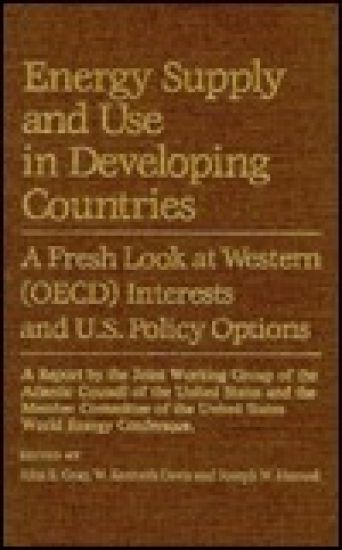
Energy Supply and Use in Developing Countries

Energy Supply and Use in Developing Countries

John E. Gray; Kenneth W. Davis; Joseph W. Harned

University Press of America
1987
sidottu
It is in the interest of the United States and the other industrialized nations that the economic well-being of the developing countries be enhanced. Adequate supply and effective use of energy at reasonable cost are a necessary underpinning for economic development. The developing countries need assistance in assessing, planning, financing, and implementing energy supply programs. This volume examines the issues and options related to energy supply, use and financing in developing countries. Co-published with the Atlantic Council of the United States.