Kirjojen hintavertailu. Mukana 11 244 527 kirjaa ja 12 kauppaa.

Kirjahaku

Etsi kirjoja tekijän nimen, kirjan nimen tai ISBN:n perusteella.

1000 tulosta hakusanalla Edwin Booth

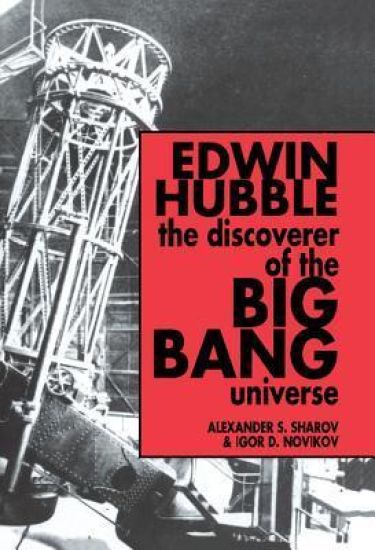
Edwin Hubble, The Discoverer of the Big Bang Universe

Edwin Hubble, The Discoverer of the Big Bang Universe

Alexander S. Sharov; Igor D. Novikov

Cambridge University Press
1993
sidottu
This book is the first complete account of the scientific life and work of Edwin Hubble, whose discoveries firmly established the United States as the leading nation in observational astronomy. One of the outstanding astronomers of the twentieth century, Hubble discovered the expansion of the Universe. He opened the world of galaxies for science when he showed that spiral nebulae beyond the Milky Way are galaxies extending to the limits of the Universe, and participating in a general expansion of the cosmos. The exploding Universe of Hubble, now termed the Big Bang, determined the origin of the elements, of galaxies and of the stars. The second part of the book describes the fundamental discoveries on the nature of the Universe made subsequently, and thus sets his achievements in context. Written by two prominent astronomers who have built on Hubble’s work, this book is a classic of science, setting out the thrilling story of the exploding Universe.
Edwin Muir Selected Poems

Edwin Muir Selected Poems

Edwin Muir

Faber Faber
2008
nidottu
Born on the Orkney island of Wyre in 1887, Edwin Muir settled in various parts of Europe during the first half of the twentieth century - from Glasgow, to Austria and Czechoslovakia throughout to 1920s, 1930s and again after the war. Muir's poetry bears oblique witness to the most traumatic years and events of this century, and is haunted by the symbolic 'fable' which he longed to find beneath the surface 'story' of mere events, as he came to terms with his own nature amidst the terror and confusion of the European maelstrom. As Seamus Heaney has written: 'Muir's poetic strength revealed itself in being able to co-ordinate the nightmare of history with that place in himself where he had trembled with anticipation . . . His simultaneous at-homeness and abroadness is exemplary.'
Edwin J. Cohn and the Development of Protein Chemistry

Edwin J. Cohn and the Development of Protein Chemistry

Douglas M. Surgenor

Harvard University Press
2002
sidottu
“Blood,” Goethe observed in Faust, “is a very special juice.” How special it is and how complex as well is revealed in Douglas Surgenor’s Edwin J. Cohn and the Development of Protein Chemistry.As Surgenor aptly shows, what began as a modest program in basic research at the Harvard Medical School in 1920 with the establishment of a small laboratory for the study of the physical chemistry of proteins, suddenly and quite unexpectedly took on immensely practical proportions twenty years later when the onset of World War II made requisite new sophisticated blood techniques and blood substitutes for the treatment of military casualties.The knowledge and expertise gained by Edwin Cohn and his laboratory associates in the study of proteins, amino acids, and peptides in blood after 1920 put them in a unique position to carry out the search for new blood products. Edwin J. Cohn and the Development of Protein Chemistry discloses how the wartime emergency called into play Cohn’s talents as a leader who drew together chemists, clinicians, pathologists, immunologists, and others in the attainment of a complex goal. The revolution Cohn started has still not run its course.
Edwin Arlington Robinson’s Letters to Edith Brower

Edwin Arlington Robinson’s Letters to Edith Brower

Edwin Arlington Robinson

The Belknap Press
1968
sidottu
This volume contains 189 hitherto unpublished letters by Edwin Arlington Robinson. They were written between 1897 and 1930 to one of his first admirers, Edith Brower of Pennsylvania.The letters begin when the twenty-seven-year-old poet writes gratefully to the stranger who has expressed appreciation of his first, privately printed, book of poems, The Torrent and the Night Before. Soon he was carrying on an intense correspondence, baring his soul—safely, he believed, because the woman he described as “infernally bright and not at all ugly,” with “something of a literary reputation,” was “too old to give me a chance to bother myself with any sentimental uneasiness.” (She was twenty-one years his senior.)Continually reflecting his laconic, self-deprecating Yankee spirit, the letters range from the uncontrollable outpourings of a lonely individual, desperate for encouragement and understanding, to brief words of greeting or farewell. Without reserve, Robinson—who was eventually awarded the Pulitzer prize for poetry three times—confides his reactions to people and places, his thoughts about his own work, and his personal opinions of such writers as Browning, Dickens, Hardy, Moody, and Pater.Mr. Cary has included Miss Brower’s unpublished memoir on the poet’s character and literary career, “Memories of Edwin Arlington Robinson,” and her penetrating review of The Children of the Night. In addition to an informative Introduction, he contributes full explanatory notes, a list of Robinson’s works, and an index.
Edwin Mullhouse

Edwin Mullhouse

Steven Millhauser

Vintage Books
1996
nidottu
dwin Mullhouse, a novelist at 10, is mysteriously dead at 11. As a memorial, Edwin's bestfriend, Jeffrey Cartwright, decides that the life of this great American writer must be told. He follows Edwin's development from his preverbal first noises through his love for comic books to the fulfillment of his literary genius in the remarkable novel, Cartoons.
Edwin Lutyens

Edwin Lutyens

Jane Ridley

VINTAGE
2003
pokkari
The work of Edwin Lutyens (1869-1944) includes the Cenotaph in Whitehall, much of Imperial New Delhi and especially his masterpiece, Viceroy's House (now Rashtrapati Bhavan), Queen Mary's dolls' house and Hampstead Garden Suburb.
Edwin Morgan

Edwin Morgan

Colin Nicholson

Manchester University Press
2009
nidottu
Edwin Morgan is Scotland's major living poet, and Inventions of modernity was the first book-length study of his work. Since the 1940s Morgan's poetry has been carving out an alternative to the conventional evolutions from Modernism to Postmodernism, creating instead a substantial body of writing that ranges from the sublime to the hilarious. Instinctively at odds with the literary politics of the Pound-Eliot axis that remained influential deep into the twentieth century, Morgan develops instead a radical and libertarian poetics in an encyclopaedia of forms; from Anglo-Saxon metre through sonnet-sequences to concrete poems, and including gay poetry, science fiction verse and prize-winning translations into both English and Scots from numerous languages. This authoritative volume is of interest to students, teachers and academic researchers involved with strategies of reading, with cultural studies, with the politics of literary history and with gay and transgressive writing.