Kirjojen hintavertailu. Mukana 11 244 527 kirjaa ja 12 kauppaa.

Kirjahaku

Etsi kirjoja tekijän nimen, kirjan nimen tai ISBN:n perusteella.

1000 tulosta hakusanalla Evripides

Euripides

Euripides

Emma Griffiths

Bristol Classical Press
2006
nidottu
In Euripides' play we see a very different figure from the Herakles of popular imagination. In his account of Herakles' maddened killing of his children, Euripides emphasises the human to the hero's character, presenting him as a loving father. Herakles is an ideal text for those new to ancient drama, raising many central issues of Greek tragedy. Emma Griffiths analyses the key themes and characters while situating the drama in the wider context of Greek tragedy and mythology. Euripides' approach to drama is illustrated through consideration of the hero's self-awareness, and the reception of the play in later art and literature is discussed as part of an exploration of the 'universality' of tragedy.
Euripides

Euripides

Colonel William Allan

Bristol Classical Press
2002
pokkari
Euripides' "Medea" is one of the greatest and most influential Greek tragedies. This book outlines the development of the Medea myth before Euripides and explores his uniquely powerful version from various angles. There are chapters on the play's relationship to the gender politics of fifth-century Athens, Medea's status as a barbarian, and the complex moral and emotional impact of her revenge. Particular attention is paid to the tragic effect of Medea's great monologue and the significance of her role as a divine avenger. The book ends by considering the varied and fascinating reception of Euripides' play from antiquity to the present day.
Euripides

Euripides

Sophie Mills

Bristol Classical Press
2006
nidottu
Accessible introductions to ancient tragedies discussing the main themes of a play and the developments in modern criticism, while also addressing the play's historical context and the history of its performance and adaptation. This book explores Dionysus place in Athenian religion, and what Euripides makes of him in the play.
Euripides

Euripides

Thalia Papadopolou

Bristol Classical Press
2008
nidottu
"Phoenician Women", one of Euripides' later tragedies, is an intriguing play that arguably displays some of his finest dramatic technique. Rich in cast and varied in incident, it is an example of Euripides' experimentation with structure. It dramatises the most fertile mythical tradition of the city of Thebes and its doomed royal family, focusing in particular on the conflict between Eteocles and Polyneices as a result of their father Oedipus' curse, which eventually leads to mutual fratricide. The play was very popular throughout antiquity, and became part of the so-called "Byzantine Triad" (along with "Hecuba" and "Orestes"), of plays studied in the school curriculum.Thalia Papadopoulou here offers a thorough survey of the play in its historical context, against the background of Athenian tragedy and Euripidean dramaturgy. Employing various critical approaches, she investigates the literary tradition and the dynamics of intertextuality, Euripidean dramatic technique, the use of rhetoric, characterisation, gender, the function of the Chorus, aspects of performance and the reception of the play from antiquity to modern times.
Euripides

Euripides

Barbara Goff

Bristol Classical Press
2008
nidottu
Set at the end of the Trojan war, "Euripides' Trojan Women" depicts the women of Troy as they wait to be taken into slavery. While choral songs recall the death-throes of the great city, the scenes between the old queen, Hekabe, and the women of her family explore the consequences of the defeat, from the rape of Cassandra, through the triumphant self-exculpation of Helen, to the pitiful death of the child Astyanax, who is thrown from the walls of his ravaged city. Barbara Goff sets the play in its historical, dramatic and literary contexts, and provides a scene-by-scene analysis which brings out the pace and intellectual vigour of the play. The main themes are fully discussed, and the book also introduces readers to the issues that have divided critics, such as the extent to which the play responds to the historical events of the Peloponnesian War. The final chapter, which deals with the reception of the play, offers new insights into several modern works.
Euripides: Suppliant Women

Euripides: Suppliant Women

Ian C. Storey

Bristol Classical Press
2008
nidottu
Euripides' "Suppliant Women" is an unfairly neglected master work by the most controversial of the three great tragedians of Ancient Greece. It dramatises the story of one of the proudest moments in Athenian mythical history: the intervention of Theseus in support of international law to force the burial of the Argives who were killed during their attack on Thebes. But Euripides adds new characters to the story and presents the myth in a different and sometimes ambiguous light. A sense of uncertainty and undercutting pervades this play, which dramatises the sufferings of the innocent in war and then at the end foretells more war. As well as presenting a scene-by-scene analysis, this book will discuss the date and background of the play, whether people and events from contemporary Athens can be glimpsed in the drama; the problems of staging, and finally the story in later tradition.
Euripides

Euripides

Matthew Wright

Bristol Classical Press
2008
nidottu
"Orestes" was one of Euripides' most popular plays in antiquity. Its plot, which centres on Orestes' murder of his mother Clytemnestra and its aftermath, is exciting as well as morally complex; its presentation of madness is unusually intense and disturbing; it deals with politics in a way which has resonances for both ancient and modern democracies; and, it has a brilliantly unexpected and ironic ending. Nevertheless, "Orestes" is not much read or performed in modern times. Why should this be so? Perhaps it is because "Orestes" does not conform to modern audiences' expectations of what a 'Greek tragedy' should be. This book makes "Orestes" accessible to modern readers and performers by explicitly acknowledging the gap between ancient and modern ideas of tragedy. If we are to appreciate what is unusual about the play, we have to think in terms of its impact on its original audience. What did they expect from a tragedy, and what would they have made of "Orestes"?
Euripides: Ion

Euripides: Ion

Laura Swift

Bristol Classical Press
2008
nidottu
"Euripides' Ion" is the story of a young man's search for his identity, and a woman's attempt to come to terms with her past. Through the story of a divine rape and its consequences, it asks questions about the justice of the gods and the nature of parenthood, encouraging its audience to consider contemporary concerns through the filter of traditional myth. This detailed study outlines the pre-history and later reception of the Ion myth, and provides a literary interpretation of the play's main themes, aiming to combine analysis of the text with a consideration of its cultural contexts. Chapters on religion, family, and national identity investigate how Euripides handles these issues in the light of the values of his day, and a chapter on genre discusses the play's upbeat ending and explores how we should define tragedy.
Euripides' Use of Psychological Terminology

Euripides' Use of Psychological Terminology

Shirley D. Sullivan

McGill-Queen's University Press
2000
sidottu
Sullivan discusses each term separately, gathering them from Euripides' seventeen extant tragedies and from fragments of other plays. She begins with a broad look at how both earlier and contemporary poets used the various terms, moving on to a detailed discussion of Euripides' own usage, from his most often used phr_n to his new use of psych_. Euripides' Use of Psychological Terminology will be of interest to scholars of classics, in particular those studying the fifth-century, as well as to those interested in psychology and its presentation in ancient literature.
Euripides: Hecuba

Euripides: Hecuba

Euripides

Oxford University Press Inc
1999
nidottu
The first modern, full-length commentary of Hecuba suitable for classroom use, this edition also contains material directed to more advanced students and to scholars. It includes an introduction, appendix on lyric meters, bibliography, and index.
Euripides: Hecuba

Euripides: Hecuba

Euripides

Oxford University Press Inc
1999
sidottu
This student's edition of Hecuba prepared by Justina Gregory offers the first modern, full-length commentary suitable for classroom use. It includes an introduction, appendix on lyric meters, bibliography, and index.
Euripides, Freud, and the Romance of Belonging

Euripides, Freud, and the Romance of Belonging

Pedrick Victoria

Johns Hopkins University Press
2007
sidottu
Freud's interpretation of the ancient legend of Oedipus-as formulated in Sophocles' tragic drama-is among the most widely known concepts of psychoanalysis. Euripides' Ion, however, presents a more complex version of the development of personal identity. Here, the discovery of family origins is a process in which parent and child both take part as distinct agents driven by their own impulses of violence and desire. Euripides, Freud, and the Romance of Belonging studies the construction of identity and the origins of the primal trauma in two texts, the Ion and Freud's case history of the Wolf Man. Victoria Pedrick challenges the conventional psychoanalytic theory of the development of the individual within the family, presenting instead a richer and more complex economy of exchange between the parent and the child. She provides a new perspective on Freud's appropriation of ancient texts and moves beyond the familiar reunion in Oedipus to the more nuanced scene of abandonment present in Ion. Her parallel investigation of these texts suggests that contemporary culture remains preoccupied by the problems of the past in the determination of identity. Pedrick's fresh perspectives on both texts as well as on their relationship to each other shed new light on two foundational moments in the intellectual development of the West: Greek tragedy and Freudian psychoanalysis.
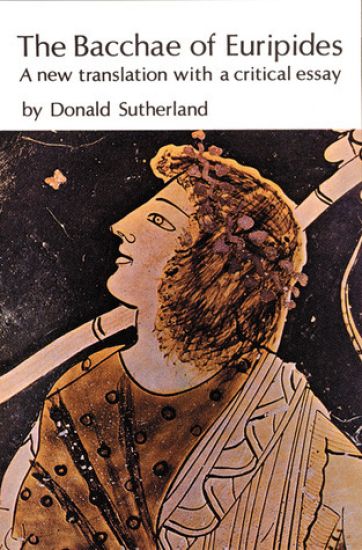
The Bacchae of Euripides

The Bacchae of Euripides

Euripides

University of Nebraska Press
1968
pokkari
This new translation of The Bacchae-that strange blend of Aeschylean grandeur and Euripidean finesse-is an attempt to reproduce for the American stage the play as it most probably was when new and unmutilated in 406 B.C. The achievement of this aim involves a restoration of the "great lacuna" at the climax and the discovery of several primary stage effects very likely intended by Euripides. These effects and controversial questions of the composition and stylistics are discussed in the notes and the accompanying essay.
Euripides' Alcestis

Euripides' Alcestis

Euripides

University of Oklahoma Press
2003
nidottu
Euripides' Alcestis - perhaps the most anthologized Attic drama--is an ideal text for students reading their first play in the original Greek. Literary commentaries and language aids in most editions are too advanced or too elementary for intermediate students of the language, but in their new student edition, C. A. E. Luschnig and H. M. Roisman remedy such deficiencies.The introductory section of this edition provides historical and literary perspective; the commentary explains points of grammar, syntax, and vocabulary, as well as elucidating background features such as dramatic conventions and mythology; and a discussion section introduces the controversies surrounding this most elusive drama. In their presentation, Luschnig and Roisman have initiated a new method for introducing students to current scholarship. This edition also includes a glossary, an index, a bibliography, and grammatical reviews designed specifically for students of Greek language and culture in their second year of university study or third year of high school. Luschnig and Roisman, who have published numerous articles and books on Greek literature, bring to this volume decades of experience teaching classical Greek. ""General readers could well benefit from using this book, as it contains valuable literary discussion and explication of the conventions of Greek drama."" - Daniel H. Garrison, author of Sexual Culture in Ancient GreeceC. A. E. Luschnig, Professor of Classics at the University of Idaho in Moscow, is the author of An Introduction to Ancient Greek and The Gorgon's Severed Head: Studies in Euripides' Alcestis, Electra, and Phoenissae. H. M. Roisman, Professor of Classics at Colby College in Waterville, Maine, is the author of Loyalty in Early Greek Epic and Tragedy and Nothing Is As It Seems: The Tragedy of the Implicit in Euripides' Hippolytus.
Euripides' Electra

Euripides' Electra

Hanna M. Roisman; C. A. E. Luschnig

University of Oklahoma Press
2011
nidottu
Among the best-known Greek tragedies, Electra is also one of the plays students of Greek often read in the original language. It tells the story of how Electra and her brother, Orestes, avenge the murder of their father, Agamemnon, by their mother and her lover. H. M. Roisman and C. A. E. Luschnig have developed a new edition of this seminal tragedy designed for twenty-first-century classrooms. Included with the Greek text are a useful introduction, line-by-line commentary, and other materials in English, all intended to support intermediate and advanced undergraduate students.Electra's gripping story and almost contemporary feel help make the play accessible and interesting to modern audiences. The liberties Euripides took with the traditional myth and the playwright's attitudes toward the gods can inspire fruitful classroom discussion about fifth-century Athenian thought, manners, and morals. Roisman and Luschnig invite readers to compare Euripides' treatment of the myth with those of Aeschylus and Sophocles and with variant presentations in epic and lyric poetry, later drama, and modern film. The introduction also places the play in historical context and describes conventions of the Greek theater specific to the work.Extensive appendices provide a complete metrical analysis of the play, helpful notes on grammar and syntax, an index of verbs, and a Greek-English glossary. In short, the authors have included everything students need to support and enhance their reading of Electra in its original language.
Euripides' Hippolytus Volume 64

Euripides' Hippolytus Volume 64

Hanna M. Roisman

UNIVERSITY OF OKLAHOMA PRESS
2024
nidottu
Euripides’ Hippolytus is a fascinating play about passion, innocence, rejection, betrayal, and the tragic breakdown of a family. This commentary, designed for intermediate and advanced students of ancient Greek, helps readers understand and fully appreciate this classic tragedy in all its rich complexity. The volume is the first commentary on the play to appear in print since 1996, and it is the most student-friendly guide to Hippolytus currently available. To make the play accessible to students who are tackling it for the first time, this book features the Greek text in sections followed immediately by detailed line-by-line notes. By explaining various points of vocabulary, grammar, syntax, and content, these notes allow students to read the play on their own without resorting frequently to dictionaries or other outside aids. The volume also includes the complete, uninterrupted text of the play. In her wide-ranging introduction to the book, Hanna M. Roisman discusses the play’s mythological background and relevant aspects of Greek tragedy and performance. In addition, she explains the literary devices Euripides employs, as well as meter, prosody, and lexicality. Comprehensive in scope, this commentary concludes with a detailed glossary; a line-by-line index of grammatical, syntactical, literary, and rhetorical figures; a list of irregular verbs; and a select bibliography.
Euripides, 1

Euripides, 1

University of Pennsylvania Press
1997
pokkari
The Penn Greek Drama Series presents original literary translations of the entire corpus of classical Greek drama: tragedies, comedies, and satyr plays. It is the only contemporary series of all the surviving work of Aeschylus, Sophocles, Euripides, Aristophanes, and Menander. This volume includes translations by Eleanor Wilner with Inés Azar (Medea), Marilyn Nelson (Hecuba), Donald Junkins (Andromache), and Daniel Mark Epstein (The Bacchae).
Euripides, 2

Euripides, 2

University of Pennsylvania Press
1997
pokkari
The Penn Greek Drama Series presents original literary translations of the entire corpus of classical Greek drama: tragedies, comedies, and satyr plays. It is the only contemporary series of all the surviving work of Aeschylus, Sophocles, Euripides, Aristophanes, and Menander. This volume includes translations by Richard Moore (Hippolytus), John Frederick Nims (Suppliant Women), Rachel Hadas (Helen), Elizabeth Seydel Morgan (Electra), and Palmer Bovie (Cyclops).