Kirjojen hintavertailu. Mukana 11 627 463 kirjaa ja 12 kauppaa.

Kirjahaku

Etsi kirjoja tekijän nimen, kirjan nimen tai ISBN:n perusteella.

1000 tulosta hakusanalla Francis Laveaux

Francis Bacon: Discovery and the Art of Discourse

Francis Bacon: Discovery and the Art of Discourse

Lisa Jardine

Cambridge University Press
2009
pokkari
By modern standards Bacon's writings are striking in their range and diversity, and they are too often considered a separate specialist concerns in isolation from each other. Dr Jardine finds a unifying principle in Bacon's preoccupation with 'method', the evaluation and organisation of information as a procedure of investigation or of presentation. She shows how such an interpretation makes consistent (and often surprising) sense of the whole corpus of Bacon's writings: how the familiar but misunderstood inductive method for natural science relations to the more information strategies of argument in his historical, ethical, political and literary work. There is a substantial and valuable study of the intellectual Renaissance background from which Bacon emerged and against which he reacted. Through a series of details comparisons and contrasts we are led to appreciate the true originality and ingenuity of Bacon's own views and also to discount the more superficial resemblances between them and later developments in the philosophy of science.
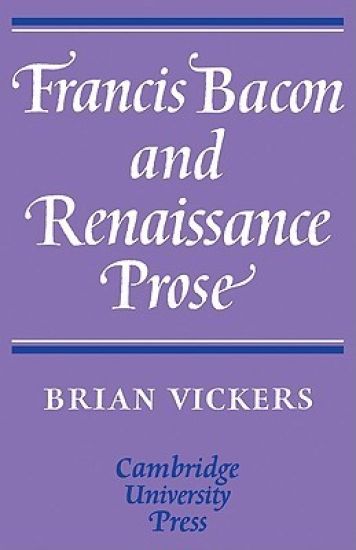
Francis Bacon and Renaissance Prose

Francis Bacon and Renaissance Prose

Vickers Brian

Cambridge University Press
2009
pokkari
The full study of Bacon as a writer, Dr Vickers takes into account the whole corpus of Bacon's work, in Latin as well as in English. His chief sources are the The Advancement of Learning and the Essays. His purpose is to reinstate Bacon as one of the supreme masters of English prose in a period which made rich use of all the expressive resources of the medium. The study is both analytical and historical: it isolates the major features of Bacon's style, and sets them in the context of Renaissance theory and practice. The features include the overall structure of Bacon's works, his important concept of the aphorism, and his use of the traditional patterns of syntax. Dr Vickers makes a challenging reassessment of the accepted view of Bacon as a 'Senecan' or 'anti-Ciceronian' prose writer. Particular attention is paid to imagery, in which Bacon's powers as an imaginative writer are greatest. There are two general chapters, the first being the problem of analysing style, the last on reactions to Bacon's style since the seventeenth century. This book also provides the basis for a fresh assessment of Renaissance prose.
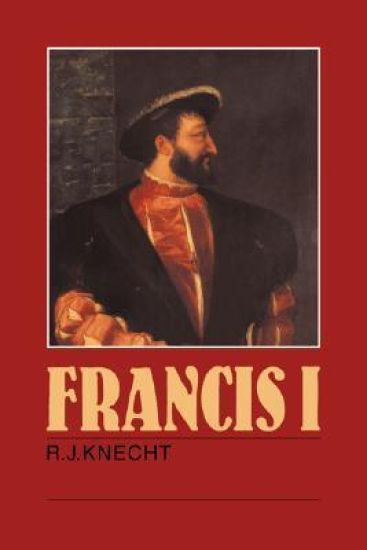
Francis I

Francis I

R. J. Knecht

Cambridge University Press
1984
pokkari
The name of Francis I and his emblem, the salamander, are familiar to the many thousands of tourists who visit the chateaux of the Loire each year. But what sort of monarch was he? Whereas in his own day he was acclaimed as 'the great king Francis', in more recent times he has generally been taken less seriously than his exact contemporaries Henry VIII of England and the Emperor Charles V. Yet his reign was no less important than theirs. It witnessed and promoted fundamental changes in France's political structure, economy, society, religion and cultural life. The king's obsession with war stimulated constitutional change. By entailing expenditures far in excess of the crown's traditional resources, it obliged him to tap new sources of wealth, to reorganise the fiscal system and to promote administrative centralisation. Economically, Francis' reign saw the completion of the recovery that had followed the Hundred Years' War. While the land was reclaimed, the population grew, town life flourished and trade expanded.
Francis Bacon

Francis Bacon

Brian Harvey Goodwin Wormald

Cambridge University Press
1993
sidottu
In the centuries since his death, Francis Bacon has been perceived as a promoter and prophet of ‘natural science’. Certainly Bacon expected to fill the vacuum which he saw existing in the study of nature; but he also saw himself as a clarifier and promoter of what he called ‘policy’, that is, the study and improvement of the structure and function of civil states including the then new British state. In this major new study, Brian Wormald’s first since his work on Clarendon, Bacon is shown resolving this conflict by attending assiduously to both fields, arguing that work on one would help progress in the other. In his teaching, in his practice, and in terms of what was actually achieved, the junction between the two enterprises was affected by Bacon’s work in history - civil and natural. In this fundamental reappraisal of one of the most complex and innovative figures of the age, Brian Wormald reveals how Bacon’s conception and practice of history provided an answer to his strivings in both policy and natural philosophy.
Francis Ford Coppola's The Godfather Trilogy
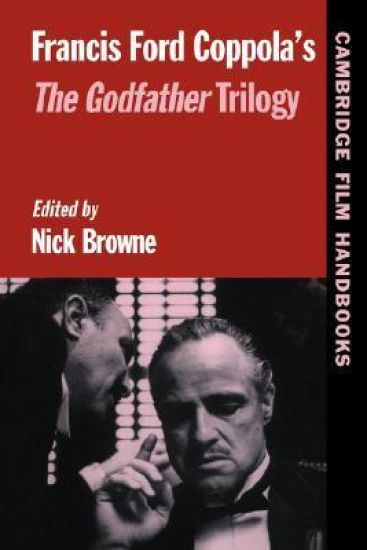
The Godfather trilogy is among the most significant works of Hollywood cinema of the last quarter century. They provide a richly complex look at a whole segment of American life and culture spanning almost the whole century. In six essays, written especially for this volume, The Godfather trilogy is re-examined from a variety of perspectives. Providing original analyses on the form and significance of Coppola’s achievement, they demonstrate how the filmmaker revised the conventions of the American crime film in the Viet Nam era, his treatment of the capitalism of the criminal underworld and its inherent violence, the power struggles within Hollywood over the film, and the contribution of opera to the epic force and cinematic style of Coppola’s vision of an American criminal dynasty. The Godfather articulates the themes, styles, mythologies, performances, and underlying cultural values that have made the film a modern classic.
Francis Ford Coppola's The Godfather Trilogy
The Godfather trilogy is among the most significant works of Hollywood cinema of the last quarter century. They provide a richly complex look at a whole segment of American life and culture spanning almost the whole century. In six essays, written especially for this volume, The Godfather trilogy is re-examined from a variety of perspectives. Providing original analyses on the form and significance of Coppola’s achievement, they demonstrate how the filmmaker revised the conventions of the American crime film in the Viet Nam era, his treatment of the capitalism of the criminal underworld and its inherent violence, the power struggles within Hollywood over the film, and the contribution of opera to the epic force and cinematic style of Coppola’s vision of an American criminal dynasty. The Godfather articulates the themes, styles, mythologies, performances, and underlying cultural values that have made the film a modern classic.
Francis Bacon: The New Organon

Francis Bacon: The New Organon

Francis Bacon

Cambridge University Press
2000
sidottu
When the New Organon appeared in 1620, part of a six-part programme of scientific inquiry entitled 'The Great Renewal of Learning', Francis Bacon was at the high point of his political career, and his ambitious work was groundbreaking in its attempt to give formal philosophical shape to a new and rapidly emerging experimentally-based science. Bacon combines theoretical scientific epistemology with examples from applied science, examining phenomena as various as magnetism, gravity, and the ebb and flow of the tides, and anticipating later experimental work by Robert Boyle and others. His work challenges the entire edifice of the philosophy and learning of his time, and has left its mark on all subsequent philosophical discussions of scientific method. This volume presents a new translation of the text into modern English by Michael Silverthorne, and an introduction by Lisa Jardine that sets the work in the context of Bacon's scientific and philosophical activities.
Francis Bacon: The New Organon

Francis Bacon: The New Organon

Bacon Francis

Cambridge University Press
2000
pokkari
When the New Organon appeared in 1620, part of a six-part programme of scientific inquiry entitled ‘The Great Renewal of Learning’, Francis Bacon was at the high point of his political career, and his ambitious work was groundbreaking in its attempt to give formal philosophical shape to a new and rapidly emerging experimentally-based science. Bacon combines theoretical scientific epistemology with examples from applied science, examining phenomena as various as magnetism, gravity, and the ebb and flow of the tides, and anticipating later experimental work by Robert Boyle and others. His work challenges the entire edifice of the philosophy and learning of his time, and has left its mark on all subsequent philosophical discussions of scientific method. This volume presents a new translation of the text into modern English by Michael Silverthorne, and an introduction by Lisa Jardine that sets the work in the context of Bacon’s scientific and philosophical activities.
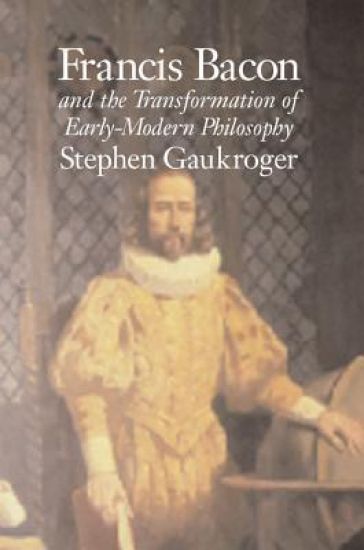
Francis Bacon and the Transformation of Early-Modern Philosophy

Francis Bacon and the Transformation of Early-Modern Philosophy

Stephen Gaukroger

Cambridge University Press
2001
sidottu
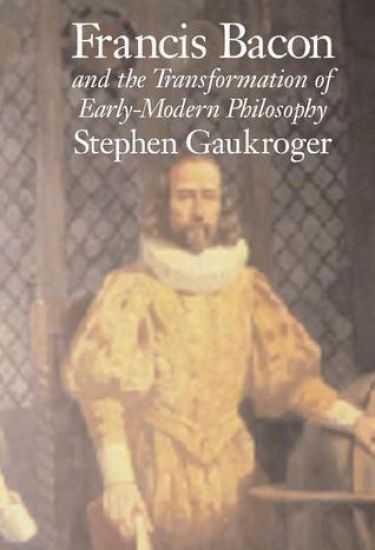
This ambitious and important book, first published in 2001, provides a truly general account of Francis Bacon as a philosopher. It describes how Bacon transformed the values that had underpinned philosophical culture since antiquity by rejecting the traditional idea of a philosopher as someone engaged in contemplation of the cosmos. The book explores in detail how and why Bacon attempted to transform the largely esoteric discipline of natural philosophy into a public practice through a program in which practical science provided a model that inspired many from the seventeenth to the twentieth centuries. Stephen Gaukroger shows that this reform of natural philosophy was dependent on the creation of a new philosophical persona: a natural philosopher shaped through submission to the dictates of Baconian method. This book will be recognized as a major contribution to Baconian scholarship, of special interest to historians of early-modern philosophy, science, and ideas.
Francis Bacon and the Transformation of Early-Modern Philosophy

Francis Bacon and the Transformation of Early-Modern Philosophy

Stephen Gaukroger

Cambridge University Press
2001
pokkari
This ambitious and important book, first published in 2001, provides a truly general account of Francis Bacon as a philosopher. It describes how Bacon transformed the values that had underpinned philosophical culture since antiquity by rejecting the traditional idea of a philosopher as someone engaged in contemplation of the cosmos. The book explores in detail how and why Bacon attempted to transform the largely esoteric discipline of natural philosophy into a public practice through a program in which practical science provided a model that inspired many from the seventeenth to the twentieth centuries. Stephen Gaukroger shows that this reform of natural philosophy was dependent on the creation of a new philosophical persona: a natural philosopher shaped through submission to the dictates of Baconian method. This book will be recognized as a major contribution to Baconian scholarship, of special interest to historians of early-modern philosophy, science, and ideas.