Kirjahaku
Etsi kirjoja tekijän nimen, kirjan nimen tai ISBN:n perusteella.
1000 tulosta hakusanalla Frank Stepnowski

The story--personal and professional--of one of the greatest architects who ever lived is here told by the man whom Frank Lloyd Wright once introduced as "Grant Manson, who knows more about me than I do." This volume takes the reader up to 1910, a turning point in Wright's life as an architect and as an individual. Wright's accomplishment by 1910 was considerable; he had already enjoyed what to many people would have been a full career. Most outstanding perhaps was his conception and evolution of the Prairie House, an expression of organic architecture that was the result of many factors: Wright's resourceful Welsh forebears, his Midwest background, his experience with Lyman Silsbee and Louis Sullivan, his interest in Japanese art, and especially his native genius. During the same period Wright also set many precedents for nonresidential architecture, including Unity Church and the Larkin Building. These buildings--residential and nonresidential--plus the unexecuted projects shown add up to a new understanding of Wright's mentality. Grant Carpenter Manson first met Mr. Wright in 1939 while preparing his Harvard doctoral thesis, but his influence reaches back to Mr. Manson's childhood. He fell in love with the Husser House at the age of six and has been faithful ever since.
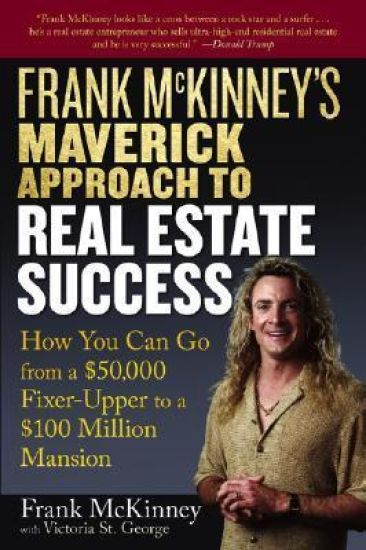
Frank McKinney's Maverick Approach to Real Estate Success
Frank E. McKinney
John Wiley Sons Inc
2006
nidottu
Praise for Frank McKinney "My neighbor, Frank McKinney, is certainly a maverick and a spiritually grounded young man. The oceanfront homes he builds here in Florida are magnificent and unique. More important, Frank's life and the contributions he makes to his community and the world illustrate how a successful businessman can do well while doing good. The principles in Frank McKinney's Maverick Approach to Real Estate Success represent a road map of his achievements--a proven strategy for succeeding not just in real estate, but also in the business of life." --Rich DeVos, cofounder of Amway, owner of the Orlando Magic "If you're ready to make big profits in real estate, then read, absorb, and use the brilliance of Frank McKinney." --Mark Victor Hansen, coauthor of The One Minute Millionaire "Frank McKinney's book is an excellent how-to guide to earning real estate profits by using McKinney's maverick formulas to find undervalued real estate with profit potential. McKinney is different. This isn't another how-to-get-rich-in-real-estate book. Instead, it is the lively success story of a real estate maverick. McKinney reveals his simple strategies, with intriguing personal profit examples that explain how his repeatable techniques work over and over." --Robert J. Bruss, syndicated real estate columnist "If Hollywood were casting the role of a maverick who started with very little and went from a $50,000 fixer-upper to a $100 million mansion, they would choose Frank McKinney. Frank McKinney's Maverick Approach to Real Estate Success represents his approach to life. He decided to apply that approach to real estate and look what happened!" --Kendra Todd, winner of The Apprentice

A complete biography based on a wide range of previously untapped primary sources, covering Wright's private life, architecture, and role in American society, culture, and politics. Views Wright's buildings as biographical as well as social statements, analyzing his work by type, category, and individual structure. Examines Wright's struggle to develop a new artistic statement, his dramatic personal life, and his political and economic ideas, including those on cities, energy conservation, cooperative home building, and environmental preservation. Includes over 150 illustrations (photographs, floor plans, and drawingsmany never before published), extensive footnotes, and the most exhaustive bibliography of Wright's published work available.

Tells of Frank Murphy's early career as Recorder's Court judge and mayor of Depression-era Detroit
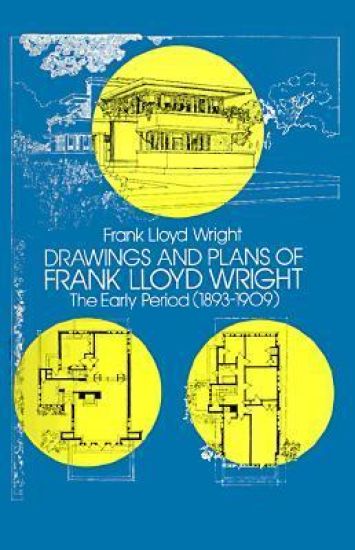
Drawings and Plans of Frank Lloyd Wright: The Early Period (1893-1909)
Frank Lloyd Wright
DOVER PUBLICATIONS
1984
nidottu
"I would much rather build than write about building, but when I am not building, I will write about building -- or the significance of those buildings I have already built." -- Frank Lloyd WrightFrank Lloyd Wright built a body of works and drawings to illustrate and explain his work: collections of designs with commentary that temperamentally parallel that work: irascible, radical, powerful and dense, astonishing and simple in its clarity. One of his earliest published works illustrates the parallel, preserving thought and design at a prophetic moment, shortly before Wright's genius and fame captured two continents and many converts. The Wasmuth portfolio of drawings (named after the original German publisher) is reproduced here from an extremely rare first edition (1910).Wright's polemical preface indicates the importance he attached to the drawings and their publication: ". . . the work illustrated in this volume, with the exception of the work of Louis Sullivan, is the first consistent protest in bricks and mortar against this pitiful waste academic, inorganic styles]. It is a serious attempt to formulate some industrial and aesthetic ideals that in a quiet, rational way will help to make a lovely thing of an American's home environment. . . ." "Home environment" for Wright was the Midwestern plain; these these drawings, perhaps his earliest experiments in organic design, partake of the Illinois, Indiana, Michigan and Wisconsin prairie with their emphasis on the horizontal ("the line of domesticity") and the environmental motif: "A beautiful elm standing near gave the suggestion for the mass of the building," Wright says of the Winslow house in River Forest, Illinois, a dwelling he cites as the first embodiment of many of his ideas. Elegant full-page architectural drawings and plans show Wright's atelier in Oak Park, Illinois, many homes, cottages, banks, a burial chapel, Unity Church temple, a concrete house designed for Ladies' Home Journal and numerous studies for buildings, treated as problems in design, that were never built.The republication of this rare work gives access again to what has been called "the single most important collection of work published by Frank Lloyd Wright." Students of American architectural genius will find here the seeds of Wright's greatness.
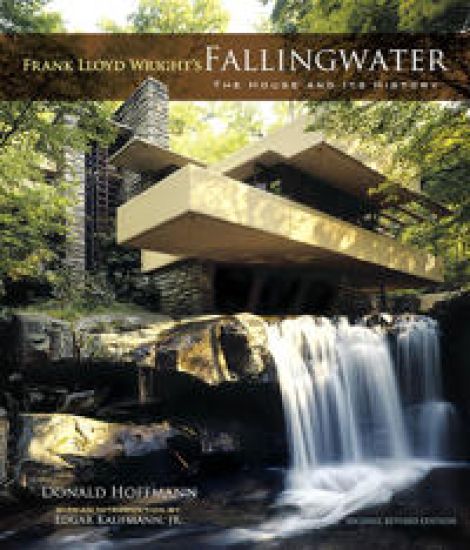
A total revision of the standard document on Fallingwater, the boldest, most personal architectural statement of Wright's mature years. Updated with valuable new material from the recently opened Frank Lloyd Wright Archives, the book gives special emphasis to Fallingwater's architectural innovations. "Fascinating." — The New York Times. 116 illustrations.

Born in Berlin in 1931 to Jewish parents, the eight-year-old Auerbach was sent to England in 1939 to escape the Nazi regime. His parents stayed behind and died in a concentration camp in 1943. Now in his eighties, Auerbach is still producing his distinctly sculptural paintings of friends, family and surroundings in north London, where he has made his home since the war. The art historian and curator Catherine Lampert has had unique access to the artist since 1978 when she first became one of his sitters. With an emphasis on Auerbach’s own words, culled from her conversations with him and archival interviews, she provides a rare insight into his professional life, working methods and philosophy. Auerbach also reflects on the places, people and inspirations that have shaped his life. These include his experiences as a refugee child, finding his way in the London art world of the 1950s and 1960s, his friendships with Lucian Freud, Francis Bacon and Leon Kossoff, among many others, and his approaches to looking and painting throughout his career. For anyone interested in how an artist approaches his craft or his method of capturing reality this is essential reading.

A compact survey of the photographer Frank Horvat, best known for his fashion photography published between the mid 1950s and the late 1980s. Frank Horvat (1928-2020) changed the course of fashion photography forever. The Italian-born photographer made his debut as a photojournalist in France, where he continued to live and work for the rest of his life. It was here he met Henri Cartier-Bresson, who encouraged him to continue his marvellous photojournalism. By the mid-1950s Horvat was collaborating with the biggest fashion magazines in the world, such as Elle, Vogue and Jardin des Modes – revolutionizing fashion photography through a more realistic lens, photographing models on the streets, in the squares and alongside the locals of post-war Europe. Horvat’s fresh and often imitated style, which brought reportage techniques and the 35mm film camera to the forefront of fashion photography, impressed designers and inspired fashion photographers for generations to come. Frank Horvat’s work can now be found in permanent collections in prestigious institutions around the world, including The Museum of Modern Art in New York and the Centre Pompidou in Paris. With a foreword by Virginie Chardin, this title in the renowned Photofile series exhibits Horvat’s photographic opus through sixty full-page reproductions in a handsome and collectible pocket format.

The Collected Poems of Frank O'Hara
Frank O'Hara; Donald Merriam (EDT) Allen
University of California Press
1995
pokkari
Available for the first time in paperback, "The Collected Poems of Frank O'Hara" reflects the poet's growth as an artist from the earliest dazzling, experimental verses that he began writing in the late 1940s to the years before his accidental death at forty, when his poems became increasingly individual and reflective.
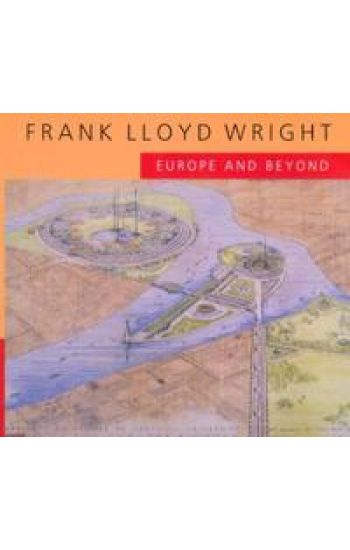
Frank Lloyd Wright
University of California Press
1999
sidottu
Ask Americans to think of a famous architect and the person they are most likely to name is Frank Lloyd Wright. Wright's work, his reputation, and his long and colorful career have made him an icon of modern American architecture. But despite his status as America's most celebrated architect, his influence throughout an active practice spanning the years 1896 to 1959 is so wide and complex that it has been difficult to grasp fully. The essays in this book look not at the United States, the context usually associated with Wright, but at countries around the globe. Anthony Alofsin has assembled a superb collection of scholars to examine Wright's importance from Japan to Great Britain, France to Chile, Mexico to Russia, and the Middle East. Interwoven in the essays are stories of champions and critics, rivals and acolytes, books and exhibitions, attitudes toward America and individualism, and the many ways Wright's ideas were brought to the world. Together the essays represent a first look at Wright's impact abroad, some from the perspective of natives of the countries discussed and others from that of informed outsiders. Of special note is Bruno Zevi's firsthand account of traveling with Wright in Italy. Zevi was instrumental in bringing Wright's ideas to Italy and in helping launch the movement for organic architecture. Of unusual interest in light of today's events in Iraq is Mina Marefat's essay on Wright's elaborate designs for a cultural center for the city of Baghdad. The Baghdad projects, which were never realized after the assassination of King Faisal II, were Wright's principal focus in his last decade. In searching out the little known rather than reexamining the well-established aspects of Frank Lloyd Wright's work, this collection is a rewarding exploration of his vision and influence.
Frank Roney, Irish Rebel and California Labor Leader
Ira B. Cross
University of California Press
2022
pokkari
This title is part of UC Press's Voices Revived program, which commemorates University of California Press’s mission to seek out and cultivate the brightest minds and give them voice, reach, and impact. Drawing on a backlist dating to 1893, Voices Revived makes high-quality, peer-reviewed scholarship accessible once again using print-on-demand technology. This title was originally published in 1931.

Frank Roney, Irish Rebel and California Labor Leader
Ira B. Cross
University of California Press
2022
sidottu
This title is part of UC Press's Voices Revived program, which commemorates University of California Press’s mission to seek out and cultivate the brightest minds and give them voice, reach, and impact. Drawing on a backlist dating to 1893, Voices Revived makes high-quality, peer-reviewed scholarship accessible once again using print-on-demand technology. This title was originally published in 1931.

Winner of the National Book Award for Poetry "During the halcyon days of the Abstract Expressionist and Imaginative Realism movements, Frank O'Hara was the laureate of the New York art scene."--New York Times The Collected Poems of Frank O'Hara, edited by Donald Allen and with an introduction by John Ashbery, captures the full range of one of postwar America's most original and influential poets. Born in Massachusetts in 1926, O'Hara became the quintessential voice of mid-century Manhattan, evolving a witty, mercurial, and glamorous urban poetry that captured the artistic scene of 1950s to '60s New York. Including poems from his dazzling early experimental verses of the late 1940s to his more reflective work before his untimely death at the age of forty, the collection reveals O'Hara's inventive voice, blending French post-symbolism, surrealist, and Dada techniques and the everyday American experience into a uniquely postmodern poetics. First published posthumously in 1972, this landmark collection affirms Frank O'Hara's central place in American poetry: witty, fantastical, vital.