

Kirjahaku
Etsi kirjoja tekijän nimen, kirjan nimen tai ISBN:n perusteella.
1000 tulosta hakusanalla Fred C (Fred Charters) Kelly

In the early 1990s, Albania, arguably Europe's most closed and repressive state, began a startling transition out of forty years of self-imposed Communist isolation. Albanians who were not allowed to practice religion, travel abroad, wear jeans, or read "decadent" Western literature began to devour the outside world. They opened cafés, companies, and newspapers. Previously banned rock music blared in the streets. Modern Albania offers a vivid history of the Albanian Communist regime's fall and the trials and tribulations that led the country to become the state it is today. The book provides an in-depth look at the Communists' last Politburo meetings and the first student revolts, the fall of the Stalinist regime, the outflows of refugees, the crash of the massive pyramid-loan schemes, the war in neighboring Kosovo, and Albania's relationship with the United States. Fred Abrahams weaves together personal experience from more than twenty years of work in Albania, interviews with key Albanians and foreigners who played a role in the country's politics since 1990—including former Politburo members, opposition leaders, intelligence agents, diplomats, and founders of the Kosovo Liberation Army—and a close examination of hundreds of previously secret government records from Albania and the United States. A rich, narratively-driven account, Modern Albania gives readers a front-row seat to the dramatic events of the last battle of Cold War Europe.





Ergonomic Assessment of Musculoskeletal Risk Factors at Four Mine Sites: Underground Coal, Surface Copper, Surface Phosphate, and Underground Limeston
Fred C. Turin; Centers for Disease Control and Preventi; National Institute for Occupational Safe
Createspace Independent Publishing Platform
2004
nidottu



The Great Depression emboldened Americans to tolerate radical experimentation in search of solutions to seemingly overwhelming economic problems. Amongst the thorniest of those was rural southern poverty. In Trouble in Goshen, Fred C. Smith focuses on three communities designed and implemented to meet that challenge. This book examines the economic and social theories - and their histories - that resulted in the creation and operation of the most aggressive and radical experiments in the United States. Trouble in Goshen chronicles three communitarian experiments, both the administrative details and the struggles and reactions of the clients. Smith covers the Tupelo Homesteads in Mississippi, the Dyess Colony in Arkansas, and the Delta Cooperative Farm, also in Mississippi. The Tupelo Homesteads were created under the aegis of the tiny Division of Subsistence Homesteads, a short-lived, ""first New Deal"" agency. Dyess Colony was the largest of the Resettlement Administration's efforts to transform failed farmers into Jeffersonian yeoman farmers. The third community, the Delta Cooperative Farm, a product of the active cooperation between the Socialist Party of America and a cadre of liberal churchmen led by Reinhold Niebuhr, attempted to meld the pieties, passions, propaganda, and theories of Jesus and Marx. The equipment, facilities, and management styles of the projects reveal a clearly delineated class order among the poor. Trouble in Goshen demonstrates the class conscious angst that enveloped three distinct levels of poverty and the struggles of plain folk to preserve their tenuous status and avoid overt peasantry.


Hunting and Trapping on the Upper Magalloway River and Parmachenee Lake: First Winter in the Wilderness (1882)
Fred C. Barker; John S. Danforth
Literary Licensing, LLC
2014
nidottu


In Origins of Existence astrophysicist Fred Adams takes a radically different approach from the long tradition of biologists and spiritual leaders who have tried to explain how the universe supports the development of life. He argues that life followed naturally from the laws of physics -- which were established as the universe burst into existence at the big bang. Those elegant laws drove the formation of galaxies, stars, and planets -- including some like our Earth. That chain of creation produced all the tiny chemical structures and vast celestial landscapes required for life. Ultimately, physical laws and the complexity they generate define the kind of biospheres that are possible -- from an Amazon rain forest to a frigid ocean beneath an ice sheet on a Jovian moon. Adams suggests that life was not merely some lucky break, but rather a natural outcome of the ascending ladder of complexity supported by our universe. Since our galaxy seems to harbor millions of planets with the same basic elements of habitability as Earth, the emergence of life is probably not a rare event. If life emerges deep inside planets and moons, as new research suggests happened on our planet, the number of viable habitats is truly enormous. Seven chronological chapters take the reader from the laws of physics and birth of the universe to the origins of life on Earth -- showing how energy flowed, exploded, and was repeatedly harnessed in replicating structures and organisms. In his groundbreaking first book, Fred Adams established the five eras of the universe with a focus on its long-term future. It is perhaps not surprising that he now turns his attention to the mystery of our astronomical origins. Here is a stunning new perspective, a book of genesis for our time, revealing how the laws of physics created galaxies, stars, planets, and even life in the universe.





There has in recent years been a lively debate among ANglo-Saxonists about the principles on which Old English verse should be edited. The present collection of essays, by the foremost living critic of Old English poetry, will move this debate on to a new plane. Robinson approaches editorial problems from a variety of perspectives: several essays show how insufficient attention to the manuscript context of a poem has led earlier scholars into error; on other occasions, scholars are shown to have resorted too quickly to emendation when a fresh combination of philological skill and intelligence can make a transmitted reading yield good sense; on yet other occasions, Robinson solves intractable textual problems by clean and elegant emendation. THe message of the book is one which no student of Old English literature can ignore: namely that the interpretation of Old English poems requires thorough familiarity with the manuscript context in which the poem is preserved, together with deep philological learning and penetrating common sense. No student of Old English poetry has these qualities in greater abundance than Fred C Robinson.
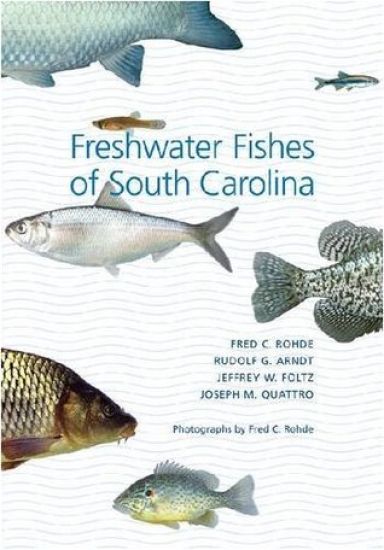
Freshwater Fishes of South Carolina
Fred C. Rohde; Rudolf G. Arndt; Jeffrey W. Foltz; Joseph M. Quattro
University of South Carolina Press
2009
sidottu
This is a landmark volume in South Carolina marine biology for specialists and sportsmen alike. A scientific milestone, this comprehensive illustrated guide to the characteristics, distribution, and ecology of freshwater fishes in South Carolina marks the first such endeavor since 1860 to document this aspect of the Palmetto State's diverse natural history. ""Freshwater Fishes of South Carolina"" is the result of longterm collaboration between a quartet of leading experts on the state's freshwater fishes - Fred C. Rohde, Rudolf G. Arndt, Jeffrey W. Foltz, and Joseph M. Quattro. From mudminnows and sunfishes to lampreys and sturgeons, the guide describes more than one hundred fifty species of freshwater and coastal estuarine fishes that spend all or major portions of their lives in the fresh waters of South Carolina. For each species the authors provide diagnostic characteristics including size, markings, similar species, and sexual dimorphism as well as information on biology, habitat, and distribution. Color photographs and detailed distribution maps accompany each description. The volume also includes a history of ichthyology in South Carolina, a chapter on methods for the collection and identification of fishes, and a chapter on conservation biology documenting species of concern for the state and reasons for their decline. This handsome reminder of the rich biodiversity in South Carolina's rivers, streams, and lakes serves not only as a vital scientific tool for marine researchers, students, resource managers, ecologists, and state policy makers but also as a valuable resource for sportsmen and natural history enthusiasts across the region.