Kirjahaku
Etsi kirjoja tekijän nimen, kirjan nimen tai ISBN:n perusteella.
1000 tulosta hakusanalla Gilberto Gil

Datos Para Varios Estudios V1-2 (1899)
Gilberto Crespo Y Martinez
KESSINGER PUBLISHING, LLC
2010
pokkari

Pedro Albizu Campos et al., Petitioners, V. the United States of America. U.S. Supreme Court Transcript of Record with Supporting Pleadings
Gilberto Concepcion
Gale, U.S. Supreme Court Records
2011
pokkari
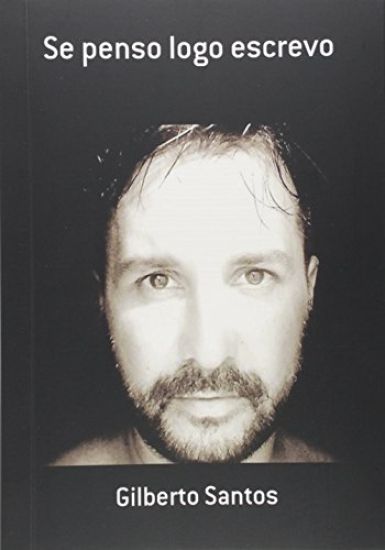
Se penso logo existo, se penso logo escrevo, o ser humano feito de pensamentos que povoam a mente. A sua exist ncia vem a ser uma vida inteira justificadas em pensamentos e a es.

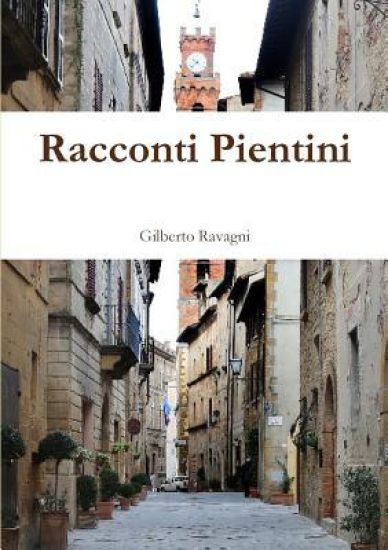
Una fiaba! Una fiaba!- Fin da piccola, prima di addormentarmi, chiedevo a mio nonno di raccontarmi una storia. Non mi ha mai fatto mancare niente su questo: quando ero sazia di almeno cinque o sei storielle, mi addormentavo tranquilla e i personaggi buffi e fuori dal comune prendevano vita nella mia mente e accompagnavano i miei sogni. Non potevo sapere allora che la maggior parte dei suoi racconti erano frutto di vicende che egli stesso aveva sentito narrare da giovane. Quando all'eta di quasi 92 anni decise di leggermi alcuni suoi scritti che aveva scarabocchiato a penna su dei fogli bianchi, convenni con lui che pubblicarli - e quindi trasmetterli - non sarebbe stata una cattiva idea...

Clasificaciones, criterios diagnosticos, factores pronosticos e informacion util en medicina.
Finite Commutative Rings and Their Applications
Gilberto Bini; Flaminio Flamini
Springer-Verlag New York Inc.
2002
sidottu
Foreword by Dieter Jungnickel Finite Commutative Rings and their Applications answers a need for an introductory reference in finite commutative ring theory as applied to information and communication theory. This book will be of interest to both professional and academic researchers in the fields of communication and coding theory. The book is a concrete and self-contained introduction to finite commutative local rings, focusing in particular on Galois and Quasi-Galois rings. The reader is provided with an active and concrete approach to the study of the purely algebraic structure and properties of finite commutative rings (in particular, Galois rings) as well as to their applications to coding theory. Finite Commutative Rings and their Applications is the first to address both theoretical and practical aspects of finite ring theory. The authors provide a practical approach to finite rings through explanatory examples, thereby avoiding an abstract presentation of the subject. The section on Quasi-Galois rings presents new and unpublished results as well. The authors then introduce some applications of finite rings, in particular Galois rings, to coding theory, using a solid algebraic and geometric theoretical background.
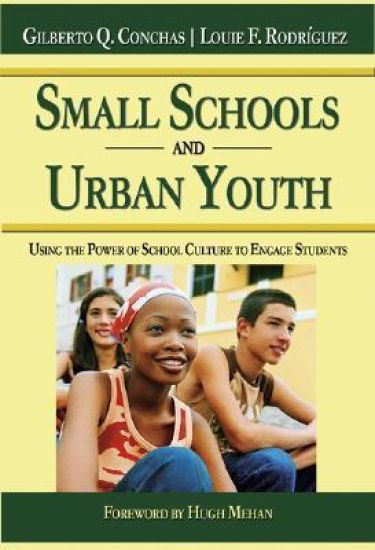
Small Schools and Urban Youth
Conchas Gilberto Q.; Rodriguez Louie F.
SAGE Publications Inc
2007
nidottu
This book explores in-depth the unique aspects of school culture and student personalization characteristic of small learning communities in order to offer insights and suggestions to school reformers, particularly those in urban centers, at all levels and in any kind of school. The authors share conclusions from their original research based in four small learning communities in Boston, MA and Oakland, CA, offering student voice, implications for practice, and suggestions for improving school reform based on the school culture and personalization found in these small learning communities.
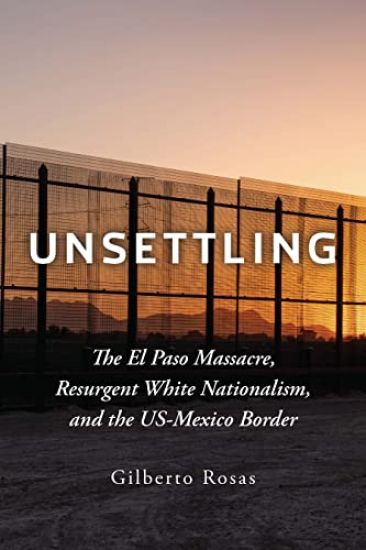
Analyzes how border and immigration enforcement culminated in a mass shooting in El Paso, Texas.Honorable Mention for the American Ethnological Society Senior Book PrizeOn August 3, 2019, a far-right extremist committed a deadly mass shooting at a major shopping center in El Paso, Texas, a city on the border of the United States and Mexico. In Unsettling, Gilberto Rosas situates this devastating shooting as the latest unsettling consequence of our border crisis and currents of deeply rooted white nationalism embedded in the United States. Tracing strict immigration policies and inhumane border treatment from the Clinton era through Democratic and Republican administrations alike, Rosas shows how the rhetoric around these policies helped lead to the Trump administration's brutal crackdown on migration—and the massacre in El Paso. Rosas draws on poignant stories and compelling testimonies from workers in immigrant justice organizations, federal public defenders, immigration attorneys, and human rights activists to document the cruelties and indignities inflicted on border crossers. Borders, as sites of crossings and spaces long inhabited by marginalized populations, generate deep anxiety across much of the contemporary world. Rosas demonstrates how the Trump administration amplified and weaponized immigration and border policy, including family separation, torture, and murder. None of this dehumanization and violence was inevitable, however. The border zone in El Paso (which translates to "the Pass") was once a very different place, one marked by frequent and inconsequential crossings to and from both sides—and with more humane immigration policies, it could become that once again.
This book aims at providing the framework and the tools for the transformation of the workplace. The core framework here proposed to teachers, school administrators, counselors, parents, and education leaders from kindergarten to college consists of building domestic knowledge. Unearthing and fostering an organization’s own knowledge, the book posits, translates into collectively shared understandings, skills, and dispositions which, in the aggregate translates into local capacity. The more members of an organization become involved in knowledge production, the denser its ability to deliver its stated mission. When an organization systematically implements a critical, intentional, and collective action to dig into its own day-to-day practices and brings up to the surface knowledge that has not been systematized, the higher the chances for the organization to create a shared sense of purpose and the know-how to deliver its promises. Thus, the book walks the reader from the very first to the last step of this knowledge making through an innovative approach to collaborative action research.
This book aims at providing the framework and the tools for the transformation of the workplace. The core framework here proposed to teachers, school administrators, counselors, parents, and education leaders from kindergarten to college consists of building domestic knowledge. Unearthing and fostering an organization’s own knowledge, the book posits, translates into collectively shared understandings, skills, and dispositions which, in the aggregate translates into local capacity. The more members of an organization become involved in knowledge production, the denser its ability to deliver its stated mission. When an organization systematically implements a critical, intentional, and collective action to dig into its own day-to-day practices and brings up to the surface knowledge that has not been systematized, the higher the chances for the organization to create a shared sense of purpose and the know-how to deliver its promises. Thus, the book walks the reader from the very first to the last step of this knowledge making through an innovative approach to collaborative action research.
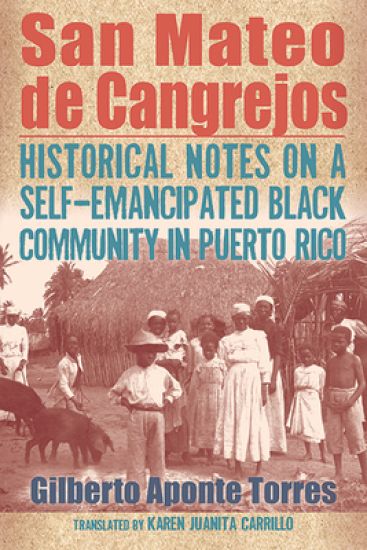
Establishes the central role of Afro-Puerto Ricans in the island's history and the creation of its capital city, San Juan.Originally published in Spanish in 1985 as part of a book series commissioned by Banco Popular, this slim volume makes an invaluable contribution to the history of Black people in Puerto Rico and the Caribbean more broadly. Today, San Mateo de Cangrejos is known as Santurce-a stylish district in the capital of San Juan, birthplace of Harlem Renaissance intellectual and collector Arturo Alfonso Schomburg, and home of the Santurce Cangrejeros for which baseball legends Roberto Clemente and Willie Mays once played. Gilberto Aponte Torres's brief yet transformative history is not about the feats of such "great men" but rather the "human foundations" of this unique municipality. San Mateo de Cangrejos was founded in the seventeenth century by cimarrones, or maroons, who were fleeing enslavement on neighboring islands and were later recognized as free by local authorities. Never losing sight of the significance of this fact, Aponte Torres details the religious life of Cangrejos, its economic and urban development, demography, military contributions, and eventual annexation by San Juan in 1862. Thoughtfully translated by Karen Juanita Carrillo, the English edition of San Mateo de Cangrejos includes photographs, a glossary, and other new features to help situate readers and further illuminate the deep roots of Black culture on the island.
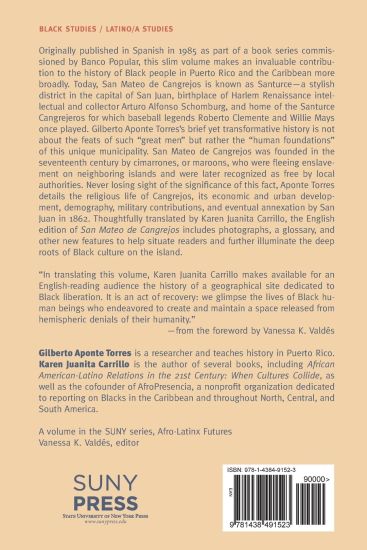
Establishes the central role of Afro-Puerto Ricans in the island's history and the creation of its capital city, San Juan.Originally published in Spanish in 1985 as part of a book series commissioned by Banco Popular, this slim volume makes an invaluable contribution to the history of Black people in Puerto Rico and the Caribbean more broadly. Today, San Mateo de Cangrejos is known as Santurce-a stylish district in the capital of San Juan, birthplace of Harlem Renaissance intellectual and collector Arturo Alfonso Schomburg, and home of the Santurce Cangrejeros for which baseball legends Roberto Clemente and Willie Mays once played. Gilberto Aponte Torres's brief yet transformative history is not about the feats of such "great men" but rather the "human foundations" of this unique municipality. San Mateo de Cangrejos was founded in the seventeenth century by cimarrones, or maroons, who were fleeing enslavement on neighboring islands and were later recognized as free by local authorities. Never losing sight of the significance of this fact, Aponte Torres details the religious life of Cangrejos, its economic and urban development, demography, military contributions, and eventual annexation by San Juan in 1862. Thoughtfully translated by Karen Juanita Carrillo, the English edition of San Mateo de Cangrejos includes photographs, a glossary, and other new features to help situate readers and further illuminate the deep roots of Black culture on the island.