Kirjojen hintavertailu. Mukana 12 494 933 kirjaa ja 12 kauppaa.

Kirjahaku

Etsi kirjoja tekijän nimen, kirjan nimen tai ISBN:n perusteella.

1000 tulosta hakusanalla H H Field

Curious George: Field Day

Curious George: Field Day

H. A. Rey

Clarion Books
2025
nidottu
In this Level Two I Can Read Comic join Curious George and friends for a day of outdoor fun and field games It's the perfect day for some outdoor fun, and Curious George has big plans With the help of the man with the yellow hat, George hosts a series of field games for his friends.While everyone splits up into teams and keeps score, George learns that field day is about having fun--win or lose When all the players have a good time, everyone wins.With a gentle SEL message and reminder about good sportsmanship, this latest adventure is perfect for beginning readers. Curious George: Field Day is a Level Two I Can Read Comic, geared for kids who are comfortable with comics and can read on their own but still need a little help.
Curious George: Field Day

Curious George: Field Day

H. A. Rey

Clarion Books
2025
sidottu
In this Level Two I Can Read Comic join Curious George and friends for a day of outdoor fun and field games It's the perfect day for some outdoor fun, and Curious George has big plans With the help of the man with the yellow hat, George hosts a series of field games for his friends.While everyone splits up into teams and keeps score, George learns that field day is about having fun--win or lose When all the players have a good time, everyone wins.With a gentle SEL message and reminder about good sportsmanship, this latest adventure is perfect for beginning readers. Curious George: Field Day is a Level Two I Can Read Comic, geared for kids who are comfortable with comics and can read on their own but still need a little help.
Disasters in Field Research

Disasters in Field Research

Gillian H. Ice; Darna L. Dufour; Nancy J. Stevens

Rowman Littlefield Publishers
2015
sidottu
From ravenous ants and temperamental gear to debilitating illness and unpredictable politics, field research can be fraught with challenges and opportunities for mishap. Disasters in Field Research is your guide to what can go wrong while conducting fieldwork—and what you can do to avoid or minimize the impact of unexpected events. Ice, Dufour, and Stevens address the issues confronting both students and professional researchers as they embark on field research. For example, permits may be difficult to obtain—or even revoked at the last minute. Cultural differences and misunderstandings can disrupt data collection. Equipment can be held up by customs—or fail to work as expected. The authors offer practical advice on preparing for such possibilities, while active researchers from a wide array of disciplines relate, in brief first-person narratives, their own encounters with disaster, how they solved (or failed to solve) the problem, and their recommendations for avoiding similar issues in the future. Each thematic chapter concludes with strategies and suggestions for making the most of your preparations, recovering from missteps, and coping with calamity. The result is an excellent companion book for field methods courses in a variety of disciplines—and an excellent companion to carry with you into the field.
Disasters in Field Research

Disasters in Field Research

Gillian H. Ice; Darna L. Dufour; Nancy J. Stevens

Rowman Littlefield Publishers
2015
nidottu
From ravenous ants and temperamental gear to debilitating illness and unpredictable politics, field research can be fraught with challenges and opportunities for mishap. Disasters in Field Research is your guide to what can go wrong while conducting fieldwork—and what you can do to avoid or minimize the impact of unexpected events. Ice, Dufour, and Stevens address the issues confronting both students and professional researchers as they embark on field research. For example, permits may be difficult to obtain—or even revoked at the last minute. Cultural differences and misunderstandings can disrupt data collection. Equipment can be held up by customs—or fail to work as expected. The authors offer practical advice on preparing for such possibilities, while active researchers from a wide array of disciplines relate, in brief first-person narratives, their own encounters with disaster, how they solved (or failed to solve) the problem, and their recommendations for avoiding similar issues in the future. Each thematic chapter concludes with strategies and suggestions for making the most of your preparations, recovering from missteps, and coping with calamity. The result is an excellent companion book for field methods courses in a variety of disciplines—and an excellent companion to carry with you into the field.
Malware Forensics Field Guide for Windows Systems

Malware Forensics Field Guide for Windows Systems

Cameron H. Malin; Eoghan Casey; James M. Aquilina

Syngress Media,U.S.
2012
nidottu
Malware Forensics Field Guide for Windows Systems is a handy reference that shows students the essential tools needed to do computer forensics analysis at the crime scene. It is part of Syngress Digital Forensics Field Guides, a series of companions for any digital and computer forensic student, investigator or analyst. Each Guide is a toolkit, with checklists for specific tasks, case studies of difficult situations, and expert analyst tips that will aid in recovering data from digital media that will be used in criminal prosecution. This book collects data from all methods of electronic data storage and transfer devices, including computers, laptops, PDAs and the images, spreadsheets and other types of files stored on these devices. It is specific for Windows-based systems, the largest running OS in the world. The authors are world-renowned leaders in investigating and analyzing malicious code. Chapters cover malware incident response - volatile data collection and examination on a live Windows system; analysis of physical and process memory dumps for malware artifacts; post-mortem forensics - discovering and extracting malware and associated artifacts from Windows systems; legal considerations; file identification and profiling initial analysis of a suspect file on a Windows system; and analysis of a suspect program. This field guide is intended for computer forensic investigators, analysts, and specialists.
Nonlocal Quantum Field Theory and Stochastic Quantum Mechanics
over this stochastic space-time leads to the non local fields considered by G. V. Efimov. In other words, stochasticity of space-time (after being averaged on a large scale) as a self-memory makes the theory nonlocal. This allows one to consider in a unified way the effect of stochasticity (or nonlocality) in all physical processes. Moreover, the universal character of this hypothesis of space-time at small distances enables us to re-interpret the dynamics of stochastic particles and to study some important problems of the theory of stochastic processes [such as the relativistic description of diffusion, Feynman­ type processes, and the problem of the origin of self-turbulence in the motion of free particles within nonlinear (stochastic) mechanics]. In this direction our approach (Part II) may be useful in recent developments of the stochastic interpretation of quantum mechanics and fields due to E. Nelson, D. Kershaw, I. Fenyes, F. Guerra, de la Pena-Auerbach, J. -P. Vigier, M. Davidson, and others. In particular, as shown by N. Cufaro Petroni and J. -P. Vigier, within the discussed approach, a causal action-at-distance interpretation of a series of experiments by A. Aspect and his co-workers indicating a possible non locality property of quantum mechanics, may also be obtained. Aspect's results have recently inspired a great interest in different nonlocal theories and models devoted to an understanding of the implications of this nonlocality. This book consists of two parts.
Nonlocal Quantum Field Theory and Stochastic Quantum Mechanics
over this stochastic space-time leads to the non local fields considered by G. V. Efimov. In other words, stochasticity of space-time (after being averaged on a large scale) as a self-memory makes the theory nonlocal. This allows one to consider in a unified way the effect of stochasticity (or nonlocality) in all physical processes. Moreover, the universal character of this hypothesis of space-time at small distances enables us to re-interpret the dynamics of stochastic particles and to study some important problems of the theory of stochastic processes [such as the relativistic description of diffusion, Feynman­ type processes, and the problem of the origin of self-turbulence in the motion of free particles within nonlinear (stochastic) mechanics]. In this direction our approach (Part II) may be useful in recent developments of the stochastic interpretation of quantum mechanics and fields due to E. Nelson, D. Kershaw, I. Fenyes, F. Guerra, de la Pena-Auerbach, J. -P. Vigier, M. Davidson, and others. In particular, as shown by N. Cufaro Petroni and J. -P. Vigier, within the discussed approach, a causal action-at-distance interpretation of a series of experiments by A. Aspect and his co-workers indicating a possible non locality property of quantum mechanics, may also be obtained. Aspect's results have recently inspired a great interest in different nonlocal theories and models devoted to an understanding of the implications of this nonlocality. This book consists of two parts.
Maldives Fish Field Guide “Top 200+”

Maldives Fish Field Guide “Top 200+”

Rudie H Kuiter; Tim Godfrey

ATOLL EDITIONS
2026
muu
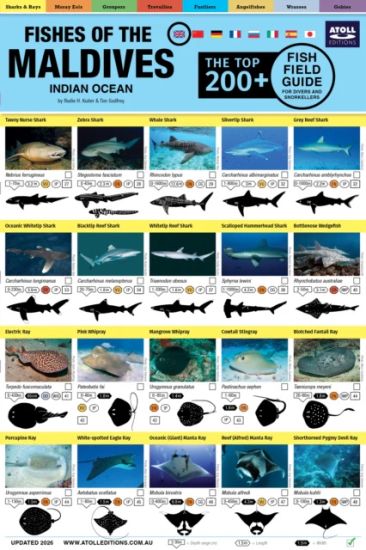
The Maldives Fish Field Guide features the Top 200+ species of sharks, rays and fishes of the Maldives. A companion guide to the book Fishes of the Maldives, Indian Ocean (3rd Edn, 2026). Includes a silhouette of each fish for easy identification, details including depth range, size, distribution, IUCN Red List status, page reference to the book and a checkbox for recording species. A quick fish identification guide for divers and snorkellers in the Maldives and wider Indian Ocean region. A perfect guide to check on those mystery fishes seen during dives. Symbols highlight points of interest and differences between similar species. The Fish Field Guide Maldives is compact, easy to use and is designed to assist in field work and conservation initiatives.
Super-Real Fields

Super-Real Fields

H. Garth Dales; W. Hugh Woodin

Clarendon Press
1996
sidottu
Super-real fields are a class of large totally ordered fields. These fields are larger than the real line. They arise from quotients of the algebra of continuous functions on a compact space by a prime ideal, and generalize the well-known class of ultrapowers, and indeed the continuous ultrapowers. These fields are of interest in their own right and have many surprising applications, both in analysis and logic. The authors introduce some exciting new fields, including a natural generalization of the real line R, and resolve a number of open problems. The book is intended to be accessible to analysts and logicians. After an exposition of the general theory of ordered fields and a careful proof of some classic theorems, including Kaplansky's embedding theorems , the authors establish important new results in Banach algebra theory, non-standard analysis, an model theory.
The Classical Fields

The Classical Fields

H. Salzmann; T. Grundhöfer; H. Hähl; R. Löwen

Cambridge University Press
2007
sidottu
The classical fields are the real, rational, complex and p-adic numbers. Each of these fields comprises several intimately interwoven algebraical and topological structures. This comprehensive volume analyzes the interaction and interdependencies of these different aspects. The real and rational numbers are examined additionally with respect to their orderings, and these fields are compared to their non-standard counterparts. Typical substructures and quotients, relevant automorphism groups and many counterexamples are described. Also discussed are completion procedures of chains and of ordered and topological groups, with applications to classical fields. The p-adic numbers are placed in the context of general topological fields: absolute values, valuations and the corresponding topologies are studied, and the classification of all locally compact fields and skew fields is presented. Exercises are provided with hints and solutions at the end of the book. An appendix reviews ordinals and cardinals, duality theory of locally compact Abelian groups and various constructions of fields.
On the Fields of Friendly Strife: The Dichotomy of Air Force Doctrine and Training Involving Real-Time Targeting
The impact of advanced information systems on military strategy strains the relationship between doctrine, operations, and technology. If doctrine exceeds operational capability by looking too far into the future, the US military may face significant challenges by employing tactics and techniques not yet operational. While accounting for current capabilities, doctrine must also provide guidance for future systems and operations that fulfill each service's vision for the future. Indeed, the relationship between doctrine and technology is a delicate one. This study examines this relationship by comparing current doctrine and training involving interdiction with real-time information. Current doctrine relies on information superiority for advantages on the battlefield. Supporting this, doctrine describes "aerial" maneuver forces that execute interdiction missions with dynamic targeting. Current doctrine supports the technology of today, but current training does not support the concepts and capabilities called for by doctrine. Limited resources, scope, and assets compartmentalize current Air Force training. Furthermore, exercises do not effectively train at the operational-level since no exercise incorporates all the elements of the theater air control system. As strategy evolves towards supporting halt phase operations that permit minimum spin-up time, military forces must prepare for battle with the most realistic training available. Current training should support today's doctrine and include information integration, real-time targeting, and operational-level maneuver. One solution to this challenge is distributed mission training that combines information systems, planning, control, and strike assets in a unified training exercise. This work has been selected by scholars as being culturally important, and is part of the knowledge base of civilization as we know it. This work was reproduced from the original artifact, and remains as true to the original work as possible. Therefore, you will see the original copyright references, library stamps (as most of these works have been housed in our most important libraries around the world), and other notations in the work. This work is in the public domain in the United States of America, and possibly other nations. Within the United States, you may freely copy and distribute this work, as no entity (individual or corporate) has a copyright on the body of the work. As a reproduction of a historical artifact, this work may contain missing or blurred pages, poor pictures, errant marks, etc. Scholars believe, and we concur, that this work is important enough to be preserved, reproduced, and made generally available to the public. We appreciate your support of the preservation process, and thank you for being an important part of keeping this knowledge alive and relevant.
In Flanders Fields and Other Poems; With an Essay in Character, by Sir Andrew Macphail (Edition1)
Dieses klassische Buch wurde urspr nglich vor Jahrzehnten ver ffentlicht als "Mammals taken Along the Alaska Highway" . Es wurde jetzt von Writat f r seine deutschsprachigen Leser ins Deutsche bersetzt. Bei Writat liegt uns die Bewahrung des literarischen Erbes der Vergangenheit sehr am Herzen. Wir haben dieses Buch ins Deutsche bersetzt, damit es heutige und zuk nftige Generationen lesen und bewahren k nnen.
A Field Guide to the Families and Genera of Woody Plants of Northwest South America
To understand almost any part of the tropical rain forest's fabulously complex web of life, one must first learn to identify a bewildering array of plants. Alwyn Gentry's landmark book, completed just before his tragic death in 1993, is the only field guide to the nearly 250 families of woody plants in the most species-rich region of South America.As a consummate field researcher, Gentry designed this guide to be not just comprehensive, but also easy to use in rigorous field conditions. Unlike many field guides, which rely for their identifications on flowers and fruits that are only present during certain seasons, Gentry's book focuses on characters such as bark, leaves, and odor that are present year-round. His guide is filled with clear illustrations, step-by-step keys to identification, and a wealth of previously unpublished data.All biologists, wildlife managers, conservationists, and government officials concerned with the tropical rain forests will need and use this field guide.Alwyn Gentry was one of the world's foremost experts on the biology of tropical plants. He was senior curator at the Missouri Botanical Garden, and was a member of Conservation International's interdisciplinary Rapid Assessment Program (RAP) team, which inventories the biodiversity of the most threatened tropical areas. From 1967 to 1993 he collected more than 80,000 plant specimens, many of them new to science.
The Tilted Playing Field

The Tilted Playing Field

H. Richard Uviller

Yale University Press
2011
pokkari
Although evenly matched adversaries make for a more exciting athletic contest, and a level playing field is essential to a fair game, is the same true in a criminal trial? In this compelling new book, H. Richard Uviller argues that a criminal trial is not analogous to a sporting event. Prosecutors and defense attorneys are, in critical respects, different from each other, and the allocation of advantages to each must be uneven in order to be fair.In a lively exploration of the powers of the prosecutor and the prerogatives of the defense, Uviller asks where our criminal justice system is fair though unequal and where its inequalities may subvert fair results. On the one hand, he points out, the prosecutor has unmatched and virtually unreviewable discretion to choose the target of a prosecution, the charge, and to a large extent the timing of an indictment. The prosecution also is first on the scene to develop evidence and is entitled to compel the production of evidence from reluctant custodians. The lawyer for the defendant, on the other hand, enjoys virtually unrestricted license to argue contrary to his or her own sincere belief, as well as broad powers to discover evidence from the prosecutor’s file. Are these unequal advantages necessary? Are they fair? Uviller concludes that although the overall criminal justice system reflects a fair distribution of advantages and disadvantages, in certain areas the imbalance is so severe as to undermine justice. He offers realistic, carefully considered recommendations for reform in these problem areas.