Kirjojen hintavertailu. Mukana 12 257 946 kirjaa ja 12 kauppaa.

Kirjahaku

Etsi kirjoja tekijän nimen, kirjan nimen tai ISBN:n perusteella.

368 tulosta hakusanalla Hadrien Seret; Lucile Lhoste

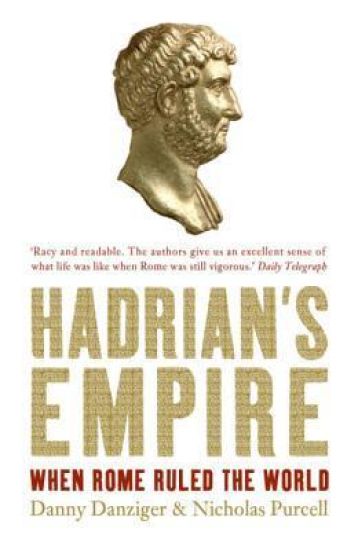
Hadrian's Empire

Hadrian's Empire

Danny Danziger; Nicholas Purcell

Hodder Paperback
2006
pokkari
Hadrian's Wall is one of the world's best known legacies of the Roman Empire. It has stood for two thousand years as a moment to its creator, and yet he himself remains an enigmatic figure. Now bestselling author Danny Danziger and Nicholas Purcell reveal the details of the extraordinary life of this mysterious man, and the age in which he lived and ruled.Hadrian was Spanish, and a restless, inquiring intellectual. He travelled constantly and spent much time in cultural centres like Athens and Alexandria. Although he was not warlike, he was a good soldier, and was comfortable mingling amongst all ranks. And yet his personal life was a complicated one, rife with scandal and conflicted sexuality.This complex character was also responsible for some of the world's most enduring architectural treasures. He built the Pantheon in Rome, the largest dome built using pre-industrial methods and a sprawling 900-room villa at Tivoli with a towering 'pumpkin dome' - a fittingly idiosyncratic memorial to this most unusual of emperors.
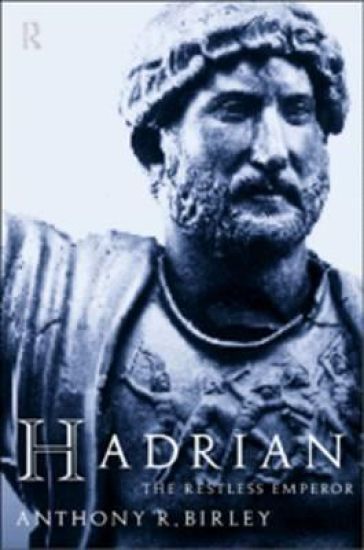
Hadrian

Hadrian

Anthony R Birley; Anthony R. Birley

Routledge
1997
sidottu
Hadrian's reign (AD 117-138) was a watershed in the history of the Roman Empire. Hadrian abandoned his predecessor Trajan's eastern conquests - Mesopotamia and Armenia - trimmed down the lands beyond the lower Danube, and constructed new demarcation lines in Germany, North Africa, and most famously Hadrian's Wall in Britain, to delimit the empire.The emperor Hadrian, a strange and baffling figure to his contemporaries, had a many-sided personality. Insatiably ambitious, and a passionate Philhellene, he promoted the 'Greek Renaissance' extravagantly. But his attempt to Hellenize the Jews, including the outlawing of circumcision, had disastrous consequences, and his 'Greek' love of the beautiful Bithynian boy Antinous ended in tragedy.No comprehensive account of Hadrian's life and reign has been attempted for over seventy years. In Hadrian: The Restless Emperor, Anthony Birley brings together the new evidence from inscriptions and papyri, and up-to-date and in-depth examination of the work of other scholars on aspects of Hadrian's reign and policies such as the Jewish war, the coinage, Hadrian's building programme in Rome, Athens and Tivoli, and his relationship with his favourite, Antinous, to provide a thorough and fascinating account of the private and public life of a man who, though hated when he died, left an indelible mark on the Roman Empire.
Hadrian

Hadrian

Anthony R Birley; Anthony R. Birley

Routledge
2000
nidottu
Hadrian's reign (AD 117-138) was a watershed in the history of the Roman Empire. Hadrian abandoned his predecessor Trajan's eastern conquests - Mesopotamia and Armenia - trimmed down the lands beyond the lower Danube, and constructed new demarcation lines in Germany, North Africa, and most famously Hadrian's Wall in Britain, to delimit the empire.The emperor Hadrian, a strange and baffling figure to his contemporaries, had a many-sided personality. Insatiably ambitious, and a passionate Philhellene, he promoted the 'Greek Renaissance' extravagantly. But his attempt to Hellenize the Jews, including the outlawing of circumcision, had disastrous consequences, and his 'Greek' love of the beautiful Bithynian boy Antinous ended in tragedy.No comprehensive account of Hadrian's life and reign has been attempted for over seventy years. In Hadrian: The Restless Emperor, Anthony Birley brings together the new evidence from inscriptions and papyri, and up-to-date and in-depth examination of the work of other scholars on aspects of Hadrian's reign and policies such as the Jewish war, the coinage, Hadrian's building programme in Rome, Athens and Tivoli, and his relationship with his favourite, Antinous, to provide a thorough and fascinating account of the private and public life of a man who, though hated when he died, left an indelible mark on the Roman Empire.
Hadrian's Wall and the End of Empire
There is no synthetic or comprehensive treatment of any late Roman frontier in the English language to date, despite the political and economic significance of the frontiers in the late antique period. Examining Hadrian’s Wall and the Roman frontier of northern England from the fourth century into the Early Medieval period, this book investigates a late frontier in transition from an imperial border zone to incorporation into Anglo-Saxon kingdoms, using both archaeological and documentary evidence. With an emphasis on the late Roman occupation and Roman military, it places the frontier in the broader imperial context. In contrast to other works, Hadrian’s Wall and the End of Empire challenges existing ideas of decline, collapse, and transformation in the Roman period, as well as its impact on local frontier communities. Author Rob Collins analyzes in detail the limitanei, the frontier soldiers of the late empire essential for the successful maintenance of the frontiers, and the relationship between imperial authorities and local frontier dynamics. Finally, the impact of the end of the Roman period in Britain is assessed, as well as the influence that the frontier had on the development of the Anglian kingdom of Northumbria.
Hadrian VII

Hadrian VII

Frederick William Rolfe

Samuel French Ltd
1968
nidottu
Contrite priests suddenly bestow Holy Orders on a wretched failure who was expelled from the seminary for lack of a true vocation. He is soon in Rome with his bishop to elect a new Pope. The stymied conclave elects the dedicated new priest: Hadrian VII. The new Pope decides to sell Vatican art treasures to finance feeding the world's poor. He smokes on the throne and entertains old friends like his landlady and new ones like a seminarian who is having a hard go of it until an assassin puts an end to Hadrian VII.2 women, 26 men
Hadrian and the Cities of the Roman Empire

Hadrian and the Cities of the Roman Empire

Mary Taliaferro Boatwright

Princeton University Press
2002
pokkari
Cities throughout the Roman Empire flourished during the reign of Hadrian (A.D. 117-138), a phenomenon that not only strengthened and legitimized Roman dominion over its possessions but also revealed Hadrian as a masterful negotiator of power relationships. In this comprehensive investigation into the vibrant urban life that existed under Hadrian's rule, Mary T. Boatwright focuses on the emperor's direct interactions with Rome's cities, exploring the many benefactions for which he was celebrated on coins and in literary works and inscriptions. Although such evidence is often as imprecise as it is laudatory, its collective analysis, undertaken for the first time together with all other related material, reveals that over 130 cities received at least one benefaction directly from Hadrian. The benefactions, mediated by members of the empire's municipal elite, touched all aspects of urban life; they included imperial patronage of temples and hero tombs, engineering projects, promotion of athletic and cultural competitions, settlement of boundary disputes, and remission of taxes. Even as he manifested imperial benevolence, Hadrian reaffirmed the self-sufficiency and traditions of cities from Spain to Syria, the major exception being his harsh treatment of Jerusalem, which sparked the Third Jewish Revolt. Overall, the assembled evidence points to Hadrian's recognition of imperial munificence to cities as essential to the peace and prosperity of the empire. Boatwright's treatment of Hadrian and Rome's cities is unique in that it encompasses events throughout the empire, drawing insights from archaeology and art history as well as literature, economy, and religion.
Hadrian's Wall

Hadrian's Wall

Nick Hodgson

Robert Hale Ltd
2017
sidottu
Built around AD122, Hadrian's Wall was guarded by the Roman army for over three centuries and has left an indelible mark on the landscape of northern Britain. It was a wonder of the ancient world and is a World Heritage Site. Written by a leading archaeologist who has excavated widely on the Wall, this is an authoritative yet accessible treatment of the archaeological evidence. The book explains why the expansion of the Roman empire ground to a halt in remote northern Britain, how the Wall came to be built and the purpose it was intended to serve. It is not a guidebook to the remains, but an introduction to the Wall and the soldiers and civilians, men, women and children, who once peopled the abandoned ruins visited by tourists today.
Hadrian's Wall

Hadrian's Wall

Guy Bedoyere

The History Press Ltd
1998
nidottu
Stretching for 73 miles from coast to coast, and reaching a height of about 13 feet, Hadrian's Wall attracts millions of visitors every year and is a designated World Heritage site. This book offers a detailed guide to Hadrian's Wall.
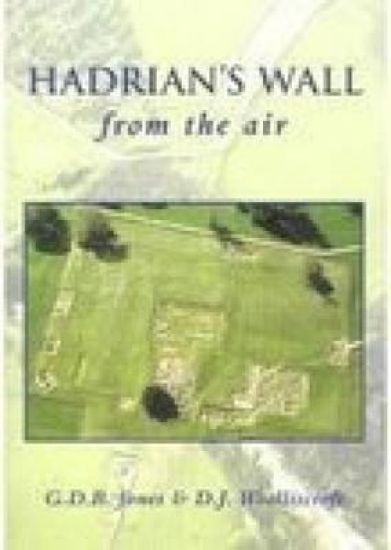
Hadrian's Wall From the Air

Hadrian's Wall From the Air

G D B Jones; David Woolliscroft

The History Press Ltd
2001
nidottu
Hadrian's Wall is Britain's premier and most visited Roman monument, and is now recognised as a World Heritage site. The archaeological remains are the best preserved and most intensely studied of their kind anywhere, and much has been written at academic and popular levels. Until now, however, there has not been a book on the substantial contribution made by aerial photography. The late Professor Jones spent 20 years taking aerial photographs of Hadrian's Wall. Not only do they illustrate the history, development, topography and surviving remains of the Wall (both the military works and the remains of civilian occupation), but they give an entirely new perspective that cannot be appreciated at ground level. In chapters on the Stanegate frontier, the history and development of Hadrian's Wall itself, the outposts and coastal defences, and an appendix detailing the anatomy of a Roman fort, along with a bibliography containing useful websites, the authors show a far more complex and fascinating history than has been traditionally envisaged - illuminated by over 120 superb photographs and maps, many in full colour.
Hadrian's Wall: Archaeological Walking Guides

Hadrian's Wall: Archaeological Walking Guides

Clifford Jones

The History Press Ltd
2012
nidottu
The frontier of Hadrian’s Wall, once the most heavily fortified border of the Roman Empire, is an ever-popular destination for both walkers and those fascinated by the remarkable remnants of Rome’s occupation. In this guide, the reader is invited on an archaeological adventure, not just to the Wall’s well-known sites, but to its many forgotten places along the way – sites every bit as important as the iconic forts and milecastles. The author presents a landscape which is not simply a piece of dramatic rural scenery, but a living and vibrant entity, and explores some of the many theories surrounding the Wall and its origins. Clifford Jones is an archaeologist, lecturer and author. He began digging at the age of nine under the mentorship of Sir Mortimer Wheeler. An expert on Roman frontier infrastructure, he has conducted extensive research of Hadrian’s Wall, and is the author of Hadrian's Coastal Route: Ravenglass to Bowness-on-Solway (also published by The History Press).
Hadrian and the Triumph of Rome

Hadrian and the Triumph of Rome

Anthony Everitt

Random House Trade
2010
nidottu
"A fascinating insight into the mind of the Roman emperor."--Sunday Telegraph (London) Born in A.D. 76, Hadrian lived through and ruled during a tempestuous era, a time when the Colosseum was opened to the public and Pompeii was buried under a mountain of lava and ash. Acclaimed author Anthony Everitt vividly recounts Hadrian's thrilling life, in which the emperor brings a century of disorder and costly warfare to a peaceful conclusion while demonstrating how a monarchy can be compatible with good governance. What distinguished Hadrian's rule, according to Everitt, were two insights that inevitably ensured the empire's long and prosperous future: He ended Rome's territorial expansion, which had become strategically and economically untenable, by fortifying her boundaries (the many famed Walls of Hadrian), and he effectively "Hellenized" Rome by anointing Athens the empire's cultural center, thereby making Greek learning and art vastly more prominent in Roman life. By making splendid use of recently discovered archaeological materials and his own exhaustive research, Everitt sheds new light on one of the most important figures of the ancient world.
Hadrian's Roads

Hadrian's Roads

Atlantic Books
2014
sidottu
The Roman emperor Hadrian (r. AD 118-135) inherited an empire which the conquests of his predecessor Trajan had brought to its greatest extent, stretching from Hadrian's Wall in the north to the deserts of Egypt in the south, and from the breezy coasts of Lusitania in the west to the rugged mountains of Armenia in the east. This vast area was interconnected by a complex network of roads, whose structural sophistication rendered them an unsung wonder of the ancient world. The fruit of colossal infrastructure projects, they allowed Rome to expand from a city-state into an immense empire, dominating one-sixth of the earth, and controlling a population of some 60 million people. Hadrian's Roads begins with a scene-setting profile of Hadrian and his empire, describing how the road system knitted together its constituent parts. Thereafter, the reader is offered a choice of twenty-five different road journeys through which to explore the towns, cities, temples, theatres and other landmarks of the Roman world of the first century AD, and to revel in the wealth of facts, stories and anecdotes associated with people and places along these routes. Hadrian himself was a restlessly inquisitive intellectual, and an inveterate traveller of the roads and sea-lanes of this imperium. The itineraries allow the reader to travel some of the routes followed by Hadrian himself. But they do much more than guide the reader along the second-century AD tourist trail: each road-based chapter reveals and explains a particular facet of life under the Empire, be it trade or provincial government; military campaigning or religious observance; leisure pursuits or food and drink. Hadrian's Roads is a rigorously researched and exquisitely finished portrait of the shape and contours of the Roman imperial polity: a luxury tour, led by an expert guide, of one of the world's great empires at a moment in time that coincides with its supreme political power and most refulgent glory.
Hadrian

Hadrian

British Museum Press
2013
nidottu
This book presents the proceedings of the 2009 conference relating to the 2008 exhibition at the British Museum entitled "Hadrian: Empire and Conflict" and complements and expands upon the exhibition catalogue. It covers such subjects as architecture, sculpture, archaeology, economics, numismatics and philhellenism and ranges over the Roman Empire from Britain and Spain in the West to Turkey and Georgia in the East. The original contributions by international scholars present the latest state of research and the first publication of some new material. Thorsten Opper is a curator of Greek and Roman sculpture at the British Museum. He organised the internationally acclaimed 2008 exhibition "Hadrian: Empire and Conflict" and authored the accompanying catalogue (British Museum Press 2008). He currently directs a fieldwork project at Hadrian's Villa, near Rome.
Hadrian The Seventh

Hadrian The Seventh

Fr. Rolfe

NYRB Classics
2001
nidottu
One day George Arthur Rose, hack writer and minor priest, discovers that he has been picked to be Pope. He is hardly surprised and not in the least daunted. "The previous English pontiff was Hadrian the Fourth," he declares. "The present English pontiff is Hadrian the Seventh. It pleases Us; and so, by Our own impulse, We command."Hadrian is conceived in the image of his creator, Fr. Rolfe, whose aristocratic pretensions (he called himself Baron Corvo), religious obsession, and anarchic and self-aggrandizing sensibility have made him known as one of the great English eccentrics. Fr. Rolfe endured a lifetime of indignities and disappointments. However, in the hilarious and touching pages of this, his finest novel, he triumphs.