

Kirjahaku
Etsi kirjoja tekijän nimen, kirjan nimen tai ISBN:n perusteella.
1000 tulosta hakusanalla Harold L Doerr

Ionic Solution Theory: Based on Cluster Expansion Methods
Harold L. Friedman; Ilya Prigogine
Literary Licensing, LLC
2013
sidottu
Ionic Solution Theory: Based On Cluster Expansion Methods is a comprehensive book written by Harold L. Friedman. The book focuses on the theory of ionic solutions, which is a fundamental topic in physical chemistry. The author presents the theory of ionic solutions using cluster expansion methods, which are powerful mathematical tools used to describe the behavior of complex systems.The book is divided into eleven chapters, each of which covers a specific aspect of ionic solution theory. The first chapter provides an introduction to the theory of ionic solutions and explains the basic concepts and principles. The following chapters cover topics such as the thermodynamics of ionic solutions, the structure of electrolyte solutions, the properties of ionic solutions at high temperatures and pressures, and the behavior of ionic solutions in the presence of other solutes.The author also discusses the cluster expansion method in detail, which is used to calculate the thermodynamic properties of ionic solutions. The book includes numerous examples and exercises to help readers understand the concepts and apply them to real-world problems.Overall, Ionic Solution Theory: Based On Cluster Expansion Methods is an invaluable resource for students and researchers in physical chemistry, chemical engineering, and materials science. The book provides a thorough and detailed explanation of the theory of ionic solutions and the cluster expansion method, making it an essential reference for anyone working in this field.Monographs In Statistical Physics And Thermodynamics, Volume 3.This scarce antiquarian book is a facsimile reprint of the old original and may contain some imperfections such as library marks and notations. Because we believe this work is culturally important, we have made it available as part of our commitment for protecting, preserving, and promoting the world's literature in affordable, high quality, modern editions, that are true to their original work.
Ionic Solution Theory: Based on Cluster Expansion Methods
Harold L. Friedman; Ilya Prigogine
Literary Licensing, LLC
2013
nidottu

Electrical Water Level Control and Recording Equipment for Model of Cape Cod Canal
Harold L. Hazen
Literary Licensing, LLC
2013
nidottu

Mathis (Glenn) V. Arkansas U.S. Supreme Court Transcript of Record with Supporting Pleadings
Harold L Hall
Gale, U.S. Supreme Court Records
2011
pokkari


Effect of Unification on Logistical Organizations and Procedures in the Armed Forces in the Zone of Interior
Harold L Dorsett
Biblioscholar
2012
pokkari


Willmington's Guide to the Bible 30th Anniversary Edition
Harold L. Willmington
Tyndale House Publishers
2011
sidottu




Building the Urban Environment is a comparative study of the contestation among planners, policymakers, and the grassroots over the production and meaning of urban space. Award-winning historian Harold Platt presents case studies of seven cities, including Rotterdam, Chicago, and Sao Paulo, to show how, over time, urban life created hybrid spaces that transformed people, culture, and their environments. As Platt explains, during the post-1945 race to technological modernization, policymakers gave urban planners of the International Style extraordinary influence to build their utopian vision of a self-sustaining “organic city.” However, in the 1960s, they faced a revolt of the grassroots. Building the Urban Environment traces the rise and fall of the Modernist planners during an era of Cold War, urban crisis, unnatural disasters, and global restructuring in the wake of the oil-energy embargo of the ’70s.Ultimately, Platt provides a way to measure different visions of the postwar city against actual results in terms of the built environment, contrasting how each city created a unique urban space.

Building the Urban Environment is a comparative study of the contestation among planners, policymakers, and the grassroots over the production and meaning of urban space. Award-winning historian Harold Platt presents case studies of seven cities, including Rotterdam, Chicago, and Sao Paulo, to show how, over time, urban life created hybrid spaces that transformed people, culture, and their environments. As Platt explains, during the post-1945 race to technological modernization, policymakers gave urban planners of the International Style extraordinary influence to build their utopian vision of a self-sustaining “organic city.” However, in the 1960s, they faced a revolt of the grassroots. Building the Urban Environment traces the rise and fall of the Modernist planners during an era of Cold War, urban crisis, unnatural disasters, and global restructuring in the wake of the oil-energy embargo of the ’70s.Ultimately, Platt provides a way to measure different visions of the postwar city against actual results in terms of the built environment, contrasting how each city created a unique urban space.
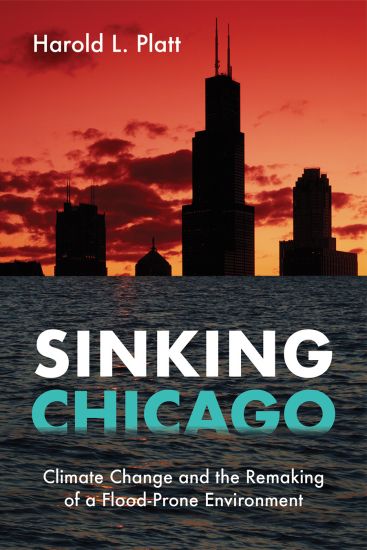
In Sinking Chicago, Harold Platt shows how people responded to climate change in one American city over a hundred-and-fifty-year period. During a long dry spell before 1945, city residents lost sight of the connections between land use, flood control, and water quality. Then, a combination of suburban sprawl and a wet period of extreme weather events created damaging runoff surges that sank Chicago and contaminated drinking supplies with raw sewage. Chicagoans had to learn how to remake a city built on a prairie wetland. They organized a grassroots movement to protect the six river watersheds in the semi-sacred forest preserves from being turned into open sewers, like the Chicago River. The politics of outdoor recreation clashed with the politics of water management. Platt charts a growing constituency of citizens who fought a corrupt political machine to reclaim the region’s waterways and Lake Michigan as a single eco-system. Environmentalists contested policymakers’ heroic, big-technology approaches with small-scale solutions for a flood-prone environment. Sinking Chicago lays out a roadmap to future planning outcomes.
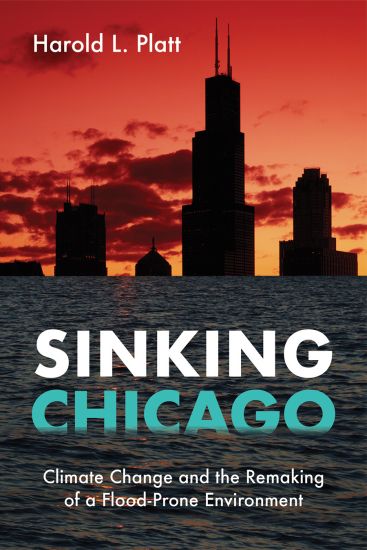
In Sinking Chicago, Harold Platt shows how people responded to climate change in one American city over a hundred-and-fifty-year period. During a long dry spell before 1945, city residents lost sight of the connections between land use, flood control, and water quality. Then, a combination of suburban sprawl and a wet period of extreme weather events created damaging runoff surges that sank Chicago and contaminated drinking supplies with raw sewage. Chicagoans had to learn how to remake a city built on a prairie wetland. They organized a grassroots movement to protect the six river watersheds in the semi-sacred forest preserves from being turned into open sewers, like the Chicago River. The politics of outdoor recreation clashed with the politics of water management. Platt charts a growing constituency of citizens who fought a corrupt political machine to reclaim the region’s waterways and Lake Michigan as a single eco-system. Environmentalists contested policymakers’ heroic, big-technology approaches with small-scale solutions for a flood-prone environment. Sinking Chicago lays out a roadmap to future planning outcomes.

From Electric Numbers To Hal Trees
Harold L. Reed
Createspace Independent Publishing Platform
2009
nidottu

ACS Without an Attitude
Harold L. Hallock; Gary Welter; David G. Simpson; Christopher Rouff
Springer London Ltd
2017
sidottu
This book de-emphasizes the formal mathematical description of spacecraft on-board attitude and orbit applications in favor of a more qualitative, concept-oriented presentation of these topics. The information presented in this book was originally given as a set of lectures in 1999 and 2000 instigated by a NASA Flight Software Branch Chief at Goddard Space Flight Center. The Branch Chief later suggested this book. It provides an approachable insight into the area and is not intended as an essential reference work.ACS Without an Attitude is intended for programmers and testers new to the field who are seeking a commonsense understanding of the subject matter they are coding and testing in the hope that they will reduce their risk of introducing or missing the key software bug that causes an abrupt termination in their spacecraft’s mission. In addition, the book will provide managers and others working with spacecraft with a basic understanding of this subject.