Kirjojen hintavertailu. Mukana 12 459 402 kirjaa ja 12 kauppaa.

Kirjahaku

Etsi kirjoja tekijän nimen, kirjan nimen tai ISBN:n perusteella.

1000 tulosta hakusanalla J. M. Neale

Emotions in the Workplace

Emotions in the Workplace

Neal M. Ashkanasy; Charmine E. Hartel; Wilfred J. Zerbe

Praeger Publishers Inc
2000
sidottu
Spanning a variety of disciplines, theories, and methods, the editors and the contributors to this uniquely cross- and interdisciplinary volume explore the factors that provoke emotions in the workplace, their effects, and how they should be managed. Among the propositions they examine are: emotions are not just effects in organizations but contribute to their structure; by examining emotions we learn more about certain organizational dynamics that may seem unemotional; the display of emotions may not be harmful; and leadership is actually about emotion management. An important, far-reaching exploration for specialists and academics in organizational behavior, psychology, and other fields in the social and behavioral sciences and for their executive counterparts in management. The editors and their contributors start from the premise that organizations are emotional places, that they use emotions to motivate employees to perform and customers to buy. Using quantitative as well as qualitative methods, and theoretical as well as methodological approaches, they show how events in organizations create emotions—how it is that we come to experience a sense of satisfaction or outrage. They explore how our sense of organizational identity is connected to how we feel; how rules about the display of emotions act as organizing forces within organizations, creating organizational structure and shaping behavior; how emotions can harm employees, how they react to pressures to feel, and how emotions are essential to inspirational leadership. Not just for theoreticians and academicians, the volume is also a rich source of advice for organizational management and for those who wish to influence how management is practiced.
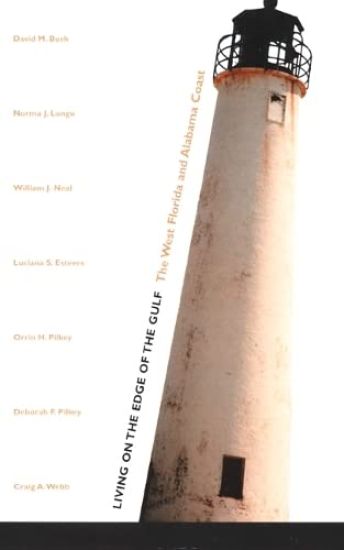
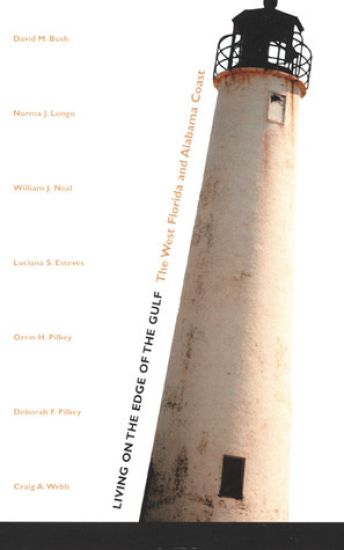
Living on the Edge of the Gulf

Living on the Edge of the Gulf

David M. Bush; Norma J. Longo; William J. Neal; Luciana S. Esteves; Orrin H. Pilkey; Deborah F. Pilkey; Craig A. Webb

Duke University Press
2001
sidottu
The Gulf coast of Florida and Alabama is a fragile combination of barrier islands, low-lying marshes, and highly erodable mainland shores. In addition to sea-level rise, winter storms, and altered sediment supplies, hurricanes frequently damage or destroy the human developments and infrastructures that line this coast. Indeed, a single storm can cause billions of dollars in losses. Memories of such hurricanes as Camille, Frederic, Opal, and Andrew cause great concern for residents and property owners alike; events of equal magnitude are always just beyond the horizon and the uninformed have much to lose.The authors of Living on the Edge of the Gulf seek to counteract potential loss by providing an illustrated introduction to coastal processes, a history of hazards for the region, and risk-reduction guidance in the form of site evaluations, community mitigation techniques, and storm-resistant construction practices. Risk maps that focus on individual coastal beaches are designed to assist property owners, community planners, and officials in prudent decision making, while a review of coastal regulations helps owners to understand and navigate various permit requirements.This latest book in the Living with the Shore series replaces the earlier guide Living with the West Florida Shore and supplements the Alabama portion of Living with the Alabama/Mississippi Shore.
Living on the Edge of the Gulf

Living on the Edge of the Gulf

David M. Bush; Norma J. Longo; William J. Neal; Luciana S. Esteves; Orrin H. Pilkey; Deborah F. Pilkey; Craig A. Webb

Duke University Press
2001
pokkari
The Gulf coast of Florida and Alabama is a fragile combination of barrier islands, low-lying marshes, and highly erodable mainland shores. In addition to sea-level rise, winter storms, and altered sediment supplies, hurricanes frequently damage or destroy the human developments and infrastructures that line this coast. Indeed, a single storm can cause billions of dollars in losses. Memories of such hurricanes as Camille, Frederic, Opal, and Andrew cause great concern for residents and property owners alike; events of equal magnitude are always just beyond the horizon and the uninformed have much to lose.The authors of Living on the Edge of the Gulf seek to counteract potential loss by providing an illustrated introduction to coastal processes, a history of hazards for the region, and risk-reduction guidance in the form of site evaluations, community mitigation techniques, and storm-resistant construction practices. Risk maps that focus on individual coastal beaches are designed to assist property owners, community planners, and officials in prudent decision making, while a review of coastal regulations helps owners to understand and navigate various permit requirements.This latest book in the Living with the Shore series replaces the earlier guide Living with the West Florida Shore and supplements the Alabama portion of Living with the Alabama/Mississippi Shore.
Living by the Rules of the Sea

Living by the Rules of the Sea

David M. Bush; Orrin H. Pilkey; William J. Neal

Duke University Press
1996
pokkari
Living by the Rules of the Sea is a primer for people living along the nation's coastlines, those considering moving to the coast, or those who want a greater understanding of the risks and dangers posed by living at the seacoast. Published as part of Duke University Press's Living with the Shore series, but without a direct focus on the coastline of one particular state, this book is intended as an overall guide to coastal physical processes, risk assessment of potential property damage from coastal natural hazards, and property damage mitigation.Over the past twenty years, the authors have mapped and studied most of the barrier islands in the United States and have experienced coastal processes such as storms and shoreline retreat at close range. They represent a coastal geology/oceanographic perspective that is decidedly in favor of preserving the natural protective capabilities of the native coastal environment. While strongly anti-engineering in outlook, Living by the Rules of the Sea does provide a review of coastal engineering techniques. It also examines methods of repairing damage to the natural environment that lessen the prospect of further property damage. Finally, it employs a more inclusive "coastal zone" approach rather than simply concentrating on a more narrowly defined shoreline. Barrier islands are viewed as part of a larger system in which changes in one part of the system-for example, the mining of sand dunes or dredging offshore for beach replenishment sand-can have profound effects on another part of the system, predictable effects even though they may not be visible for years or decades.A comprehensive handbook with references to recent storms including hurricanes Andrew, Gilbert, Hugo, Emily, and Opal, Living by the Rules of the Sea is designed to help people make better and more informed choices about where or if to live at the coast.
Living by the Rules of the Sea

Living by the Rules of the Sea

David M. Bush; Orrin H. Pilkey; William J. Neal

Duke University Press
1996
sidottu
Living by the Rules of the Sea is a primer for people living along the nation's coastlines, those considering moving to the coast, or those who want a greater understanding of the risks and dangers posed by living at the seacoast. Published as part of Duke University Press's Living with the Shore series, but without a direct focus on the coastline of one particular state, this book is intended as an overall guide to coastal physical processes, risk assessment of potential property damage from coastal natural hazards, and property damage mitigation.Over the past twenty years, the authors have mapped and studied most of the barrier islands in the United States and have experienced coastal processes such as storms and shoreline retreat at close range. They represent a coastal geology/oceanographic perspective that is decidedly in favor of preserving the natural protective capabilities of the native coastal environment. While strongly anti-engineering in outlook, Living by the Rules of the Sea does provide a review of coastal engineering techniques. It also examines methods of repairing damage to the natural environment that lessen the prospect of further property damage. Finally, it employs a more inclusive "coastal zone" approach rather than simply concentrating on a more narrowly defined shoreline. Barrier islands are viewed as part of a larger system in which changes in one part of the system-for example, the mining of sand dunes or dredging offshore for beach replenishment sand-can have profound effects on another part of the system, predictable effects even though they may not be visible for years or decades.A comprehensive handbook with references to recent storms including hurricanes Andrew, Gilbert, Hugo, Emily, and Opal, Living by the Rules of the Sea is designed to help people make better and more informed choices about where or if to live at the coast.
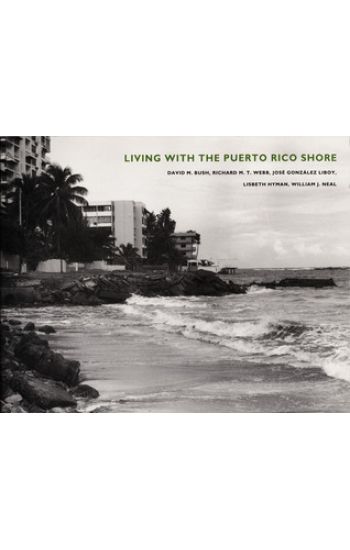
Living with the Puerto Rico Shore

Living with the Puerto Rico Shore

David M. Bush; Richard M. T. Webb; José González Liboy; Lisbeth Hyman; William J. Neal

Duke University Press
1995
sidottu
In this, the eighteenth title in Duke University Press's Living With the Shore series, the authors present a "user's guide" to the coastal zone of Puerto Rico. Presenting a geological appraisal of the history, dynamics, and hazards of the island's coastline, Living With the Puerto Rico Shore is the first in the series to examine a tropical region and the first to examine an area outside the continental United States. The book provides detailed descriptions of the entire shoreline, noting the specific coastal hazards of each coastal reach. These hazards include coastal erosion, storm surge flooding, and potential damage from earthquakes. Where high-density development or significant roads and utilities are particularly at risk, these are also noted. The effects that sand mining, seawalls, jetties, and other attempts at coastal engineering have had on the island are examined. Finally, the authors discuss historical and legal aspects of coastal planning in Puerto Rico, presenting guidelines for selecting building sites. Of interest to all concerned with protecting our shores and beaches and useful to the coastal planner and manager, Living With the Puerto Rico Shore contains an extensive bibliography and a list of agencies involved in coastal issues.
Living with the Puerto Rico Shore

Living with the Puerto Rico Shore

David M. Bush; Richard M. T. Webb; José González Liboy; Lisbeth Hyman; William J. Neal

Duke University Press
1995
pokkari
In this, the eighteenth title in Duke University Press's Living With the Shore series, the authors present a "user's guide" to the coastal zone of Puerto Rico. Presenting a geological appraisal of the history, dynamics, and hazards of the island's coastline, Living With the Puerto Rico Shore is the first in the series to examine a tropical region and the first to examine an area outside the continental United States. The book provides detailed descriptions of the entire shoreline, noting the specific coastal hazards of each coastal reach. These hazards include coastal erosion, storm surge flooding, and potential damage from earthquakes. Where high-density development or significant roads and utilities are particularly at risk, these are also noted. The effects that sand mining, seawalls, jetties, and other attempts at coastal engineering have had on the island are examined. Finally, the authors discuss historical and legal aspects of coastal planning in Puerto Rico, presenting guidelines for selecting building sites. Of interest to all concerned with protecting our shores and beaches and useful to the coastal planner and manager, Living With the Puerto Rico Shore contains an extensive bibliography and a list of agencies involved in coastal issues.
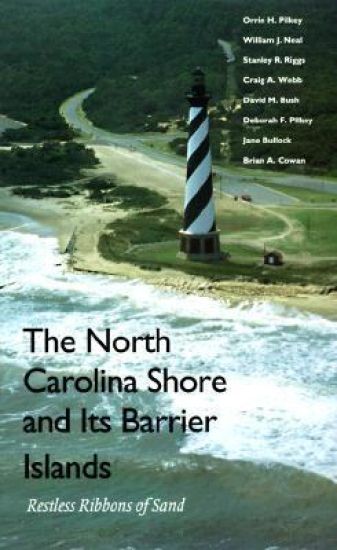
The North Carolina Shore and Its Barrier Islands

The North Carolina Shore and Its Barrier Islands

Orrin H. Pilkey; William J. Neal; Stanley R. Riggs; Craig A. Webb; David M. Bush; Deborah F. Pilkey; Jane Bullock; Brian A. Cowan

Duke University Press
1998
sidottu
Devastation wrought by Hurricane Fran is a reminder of the fragility of the North Carolina coast. Arguing for a policy of intelligent development this text includes practical information on hazards of many kinds - storms, tides, floods, erosion, island migration and earthquakes.
The North Carolina Shore and Its Barrier Islands

The North Carolina Shore and Its Barrier Islands

Orrin H. Pilkey; William J. Neal; Stanley R. Riggs; Craig A. Webb; David M. Bush; Deborah F. Pilkey; Jane Bullock; Brian A. Cowan

Duke University Press
1998
pokkari
The North Carolina Shore and Its Barrier Islands is the latest volume in the series, Living with the Shore. Replacing an earlier volume, this thoroughly new book provides a diverse guide to one of America’s most popular shorelines. As is true for all books in the series, it is based on the premise that understanding the changing nature of beaches and barrier islands is essential if we are to preserve them for future generations.Evidence that the North Carolina shore is changing is never hard to find, but recently the devastation wrought by Hurricane Fran and the perilous situation of the historic lighthouse at Cape Hatteras have reminded all concerned of the fragility of this coast. Arguing for a policy of intelligent development, one in which residential and commercial structures meet rather than confront the changing nature of the shore, the authors have included practical information on hazards of many kinds-storms, tides, floods, erosion, island migration, and earthquakes. Diagrams and photographs clearly illustrate coastal processes and aid in understanding the impact of hurricanes and northeasters, wave and current dynamics, as well as pollution and other environmental destruction due to overdevelopment. A chapter on estuaries provides related information on the shores of back barrier areas that are growing in popularity for recreational residences. Risk maps focus on the natural hazards of each island and together with construction guidelines provide a basis for informed island management. Lastly, the dynamics of coastal politics and management are reviewed through an analysis of the controversies over the decision to move the Cape Hatteras lighthouse and a proposed effort to stabilize Oregon Inlet. From the natural and historic perspective of the opening chapters to the regional discussions of individual barrier islands, this book is both a primer on coastal processes for the first time visitor as well as a guide to hazard identification for property owners.
J. M. Synge

J. M. Synge

Seán Hewitt

Oxford University Press
2021
sidottu
This book is a complete re-assessment of the works of J.M. Synge, one of Ireland's major playwrights. The book offers the first complete consideration of all of Synge's major plays and prose works in nearly 30 years, drawing on extensive archival research to offer innovative new readings. Much work has been done in recent years to uncover Synge's modernity and to emphasise his political consciousness. This book builds on this re-assessment, undertaking a full systematic exploration of Synge's published and unpublished works. Tracing his journey from an early Romanticism through to the more combative modernism of his later work, the book's innovative methodology treats text as process, and considers Synge's reading materials, his drafts, letters, diaries, and journalism, turning up exciting and unexpected revelations. Thus, Synge's engagement with occultism, pantheism, socialism, Darwinism, and even a late reaction against eugenic nationalisms, are all brought into the critical discussion. Breaking new ground in ascertaining the tenets of Synge's spirituality, and his aesthetic and political idealization of harmony with nature, the book also builds on new work in modernist studies, arguing that Synge can be understood as a leftist modernist, exhibiting many of the key concerns of early modernism, but routing them through a socialist politics. Thus, this book is valuable not only to considerations of Synge and the Irish Revival, but also to modernist studies more broadly.
J. M. Coetzee and the Ethics of Reading

J. M. Coetzee and the Ethics of Reading

Derek Attridge

University of Chicago Press
2004
sidottu
Nobel Prize-winning novelist J. M. Coetzee is one of the most widely taught contemporary writers, but also one of the most elusive. Many critics who have addressed his work have devoted themselves to rendering it more accessible and acceptable, often playing down the features that discomfort and perplex his readers.Yet it is just these features, Derek Attridge argues, that give Coetzee's work its haunting power and offer its greatest rewards. Attridge does justice to this power and these rewards in a study that serves as an introduction for readers new to Coetzee and a stimulus for thought for those who know his work well. Without overlooking the South African dimension of his fiction, Attridge treats Coetzee as a writer who raises questions of central importance to current debates both within literary studies and more widely in the ethical arena. Implicit throughout the book is Attridge's view that literature, more than philosophy, politics, or even religion, does singular justice to our ethical impulses and acts. Attridge follows Coetzee's lead in exploring a number of issues such as interpretation and literary judgment, responsibility to the other, trust and betrayal, artistic commitment, confession, and the problematic idea of truth to the self.
J. M. Coetzee and the Ethics of Reading – Literature in the Event
Nobel Prize-winning novelist J. M. Coetzee is one of the most widely taught contemporary writers, but also one of the most elusive. Many critics who have addressed his work have devoted themselves to rendering it more accessible and acceptable, often playing down the features that discomfort and perplex his readers.Yet it is just these features, Derek Attridge argues, that give Coetzee's work its haunting power and offer its greatest rewards. Attridge does justice to this power and these rewards in a study that serves as an introduction for readers new to Coetzee and a stimulus for thought for those who know his work well. Without overlooking the South African dimension of his fiction, Attridge treats Coetzee as a writer who raises questions of central importance to current debates both within literary studies and more widely in the ethical arena. Implicit throughout the book is Attridge's view that literature, more than philosophy, politics, or even religion, does singular justice to our ethical impulses and acts. Attridge follows Coetzee's lead in exploring a number of issues such as interpretation and literary judgment, responsibility to the other, trust and betrayal, artistic commitment, confession, and the problematic idea of truth to the self.
J. M. Coetzee: Countervoices

J. M. Coetzee: Countervoices

Carrol Clarkson

Palgrave Macmillan
2009
sidottu
Clarkson pays sustained attention to the dynamic interaction between Coetzee's fiction and his critical writing, exploring the Nobel prize-winner's participation in, and contribution to, contemporary literary-philosophical debates. The book engages with the most recent literary and philosophical responses to Coetzee's work.
J. M. Coetzee and Ethics

J. M. Coetzee and Ethics

Columbia University Press
2010
sidottu
In 2003, South African writer J. M. Coetzee was awarded the Nobel Prize in Literature for his riveting portrayals of racial repression, sexual politics, the guises of reason, and the hypocrisy of human beings toward animals and nature. Coetzee was credited with being "a scrupulous doubter, ruthless in his criticism of the cruel rationalism and cosmetic morality of western civilization." The film of his novel Disgrace, starring John Malkovich, brought his challenging ideas to a new audience. Anton Leist and Peter Singer have assembled an outstanding group of contributors who probe deeply into Coetzee's extensive and extraordinary corpus. They explore his approach to ethical theory and philosophy and pay particular attention to his representation of the human-animal relationship. They also confront Coetzee's depiction of the elementary conditions of life, the origins of morality, the recognition of value in others, the sexual dynamics between men and women, the normality of suppression, and the possibility of equality in postcolonial society. With its wide-ranging consideration of philosophical issues, especially in relation to fiction, this volume stands alone in its extraordinary exchange of ethical and literary inquiry.
J. M. Coetzee and Ethics

J. M. Coetzee and Ethics

Columbia University Press
2010
pokkari
In 2003, South African writer J. M. Coetzee was awarded the Nobel Prize in Literature for his riveting portrayals of racial repression, sexual politics, the guises of reason, and the hypocrisy of human beings toward animals and nature. Coetzee was credited with being "a scrupulous doubter, ruthless in his criticism of the cruel rationalism and cosmetic morality of western civilization." The film of his novel Disgrace, starring John Malkovich, brought his challenging ideas to a new audience. Anton Leist and Peter Singer have assembled an outstanding group of contributors who probe deeply into Coetzee's extensive and extraordinary corpus. They explore his approach to ethical theory and philosophy and pay particular attention to his representation of the human-animal relationship. They also confront Coetzee's depiction of the elementary conditions of life, the origins of morality, the recognition of value in others, the sexual dynamics between men and women, the normality of suppression, and the possibility of equality in postcolonial society. With its wide-ranging consideration of philosophical issues, especially in relation to fiction, this volume stands alone in its extraordinary exchange of ethical and literary inquiry.
J. M. Coetzee

J. M. Coetzee

Dominic Head

Cambridge University Press
1998
sidottu
The importance of J. M. Coetzee in the development of twentieth-century fiction is now widely recognised. His work addresses some of the key critical issues of our time: the relationship between postmodernism and postcolonialism, the role of history in the novel, and, repeatedly, the question of how the author can combine an ethical and political consciousness with a commitment to the novel as a work of fiction. In this study, which may be used as an introduction and by those already familiar with Coetzee’s work, Dominic Head assesses Coetzee’s position as a white South African writer engaged with the legacy of colonialism. Through close readings of all the novels, Head shows how Coetzee inhabits a transitional site between Europe and Africa, and it is from this position that his more general concerns emerge. Coetzee’s engagement with the problems facing the postcolonial writer, Head argues, is always enriched by his awareness of a wider literary tradition.
J. M. Coetzee

J. M. Coetzee

Dominic Head

Cambridge University Press
2010
pokkari
The importance of J. M. Coetzee in the development of twentieth-century fiction is widely recognised. His work addresses some of the key issues of the late twentieth and early twenty-first centuries: the relationship between postmodernism and postcolonialism, the role of history in the novel, and the question of how the author can combine an ethical and political consciousness with a commitment to the novel as a work of fiction. In this study, written in 1998, Dominic Head assesses Coetzee's position as a white South African writer engaged with the legacy of colonialism. Through close readings of all the novels, Head shows how Coetzee inhabits a transitional site between Europe and Africa, and it is from this position that his more general concerns emerge. Coetzee's engagement with the problems facing the postcolonial writer, Head argues, is always enriched by his awareness of a wider literary tradition.