Kirjojen hintavertailu. Mukana 12 459 402 kirjaa ja 12 kauppaa.

Kirjahaku

Etsi kirjoja tekijän nimen, kirjan nimen tai ISBN:n perusteella.

525 tulosta hakusanalla Jaakko Teppo

Åpne samtaler

Åpne samtaler

Jaakko Seikkula

Universitetsforlaget
2012
nidottu
Denne andre utgaven på norsk omtales av Seikkula selv som det fjerde trinnet i bokas utviklingsprosess. Den har blitt oppdatert med både nye undersøkelser av sosiale nettverk og revisjon av teksten. Men som i den aller første versjonen av boka, som ble utgitt på finsk, består boka fortsatt av to ulike typer beskrivelser, nemlig av sosiale nettverk og sosiale nettverksintervensjoner. Her gir psykolog og forfatter Jaakko Seikkula en introduksjon av den arbeidsformen han og hans kolleger har stått i spissen for gjennom 25 år, og som ble introdusert for norske fagmiljøer gjennom det såkalte «nordkalott»-samarbeidet med nå avdøde professor Tom Andersen (1936-2007). Boken beskriver hvorfor klientens sosiale nettverk er en viktig ressurs som må trekkes inn og aktivt brukes i behandlingen. Seikkula introduserer metoden «åpen dialog» der det terapeutiske teamet møter klienten og dennes nettverk for å bearbeide problemene i fellesskap. Metoden har hatt enestående resultater. Som Seikkula beskriver i boken, har mer enn 80 % av pasientene i løpet av en femårig oppfølgingsperiode levd en alminnelig tilværelse uten psykotiske symptomer. Seikkula redegjør for teoriene han bygger på, og gjennom en rekke eksempler og praktiske råd gir han leseren verktøy for å ta metoden med åpen dialog i bruk i nettverksarbeid. Boken er illustrert med kliniske eksempler og beskrivelser av ulike metoder for intervensjon. Andre utgivelser av Jaakko Seikkula på norsk er antologien Reflekterende prosesser (2006), redigert sammen med den norske familieterapeuten og psykologen Helge Elisassen og Nettverksdialoger (2007) som han skrev sammen med Tom Arnkil.
Åben dialog og relationel praksis. Respekt for anderledeshed i øjeblikket

Åben dialog og relationel praksis. Respekt for anderledeshed i øjeblikket

Jaakko Seikkula; Tom Erik Arnkil

Lindhardt og Ringhof
2014
nidottu
Ånden eller livsnerven i Åben Dialog er noget helt grundlæggende menneskeligt, som handler om at blive set, hørt, forstået og anerkendt. Noget, vi som mennesker alle søger og har brug for. Det er herigennem, at man finder sig selv som menneske, og det er i samme bevægelse, at man udvikler sine sociale kompetencer. Åben Dialog er udtryk for en generel tilgang til andre mennesker, som har vist sig effektiv i terapeutisk og anden relationel praksis: Flere kommer fri af medicinering og færre får tilbagefald end med traditionelle behandlingsmetoder. Åben Dialog respekterer og finder udviklingspotentialet hos hver enkelt klient, barn eller patient. Det handler først og fremmest om at lytte – dernæst om at iværksætte umiddelbar hjælp, inddrage det sociale netværk, tilpasse behandlingen til den enkeltes konkrete behov, afklare teamets ansvar, sikre kontinuitet i den psykologiske behandling samt at undgå at ty til for hurtige løsninger. Med konkrete praksiseksempler præsenterer forfatterne grundlag og principper for tilgangen, samt hvordan samtaler kan analyseres i mindre sekvenser, så opmærksomheden på og åbenheden over for det essentielle i dialogen skærpes. Og med afsæt i egne erfaringer beskriver de, hvordan man kan udvikle en dialogorienteret kultur i den professionelle praksis. Bogen henvender sig til studerende og praktikere inden for relationsprofessionerne – socialarbejdere, pædagoger, lærere, sygeplejersker, terapeuter, læger og andre behandlere. Jaakko Seikkula er uddannet klinisk psykolog og familieterapeut og ansat som professor ved psykologisk institut ved Jyväskylä Universitet i Finland. Tom Erik Arnkil er uddannet samfundsforsker og lærer og ansat som forskningsprofessor ved Finlands nationale institut for sundhed og velfærd.
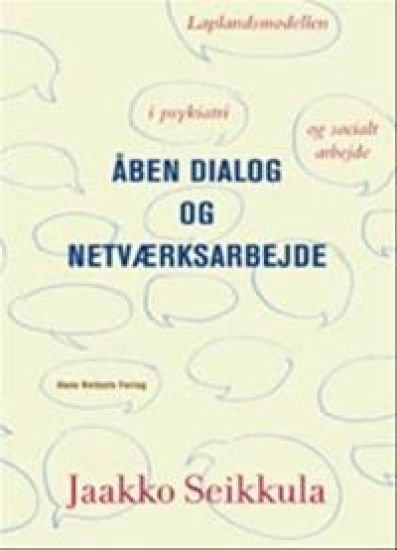
Åben dialog og netværksarbejde

Åben dialog og netværksarbejde

Jaakko Seikkula

Gyldendal
2008
nidottu
Igennem to årtier har den finske psykolog Jaakko Seikkula stået i spidsen for en nyorientering inden for arbejde med psykisk syge. Omdrejnings-punktet i denne behandlingsform – som herhjemme er blevet kendt under betegnelsen ”laplandsmodellen” – er en idé om, at klientens sociale netværk udgør en ressource, der kan bruges som element i et samlet behandlings-tilbud. I forlængelse heraf arrangeres der møder, hvor klienten sammen med sit netværk og et terapeutisk team bearbejder sine problemer. Laplandsmodellen har vundet stor anerkendelse verden over. For det første på grund af sin humanistiske og respektfulde åbenhed over for de menneskelige og sociale dimensioner af psykiske problemer. For det andet på grund af sine enestående resultater: For psykotiske patienter har man eksempelvis påvist, at i løbet af en femårig opfølgningsperiode vender de fleste tilbage til arbejde eller uddannelse, og mere end 80 % har ikke længere psykotiske symptomer overhovedet. Disse tal må siges at være helt enestående. Bogen består af to dele. I de første kapitler undersøger Seikkula, hvad begrebet ”netværk” dækker over, og hvilken betydning netværket har for menneskelivet. I løbet af de senere kapitler lader han gradvist disse erkendelser munde ud i en model for netværksarbejde i praksis. Bogen byder på talrige cases, og Seikkula opsummerer derudover sine vigtigste punkter i en række råd til, hvordan man kan praktisere netværksarbejde. Åben dialog og netværksarbejde er Seikkulas hovedværk og en klassiker inden for netværksarbejde. Den foreligger her for første gang på dansk, og forfatteren har til lejligheden revideret og opdateret den med den nyeste viden på området. Bogen henvender sig til psykologer, psykiatere og andre sundhedsfaglige samt til socialrådgivere, socialpædagoger og andre, som beskæftiger sig med socialt arbejde. Jaakko Seikkula er professor ved Institut for Psykologi på Jyväskylä Universitetet, Finland.
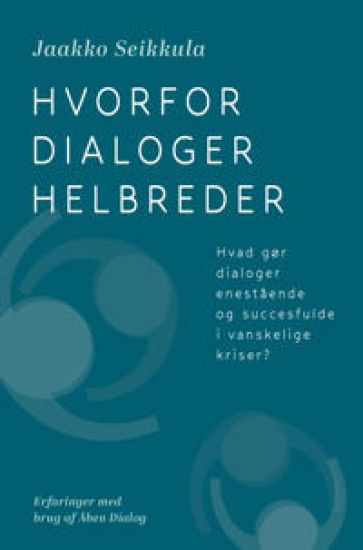
Hvorfor dialoger helbreder

Hvorfor dialoger helbreder

Jaakko Seikkula

Forlaget Klim
2024
nidottu
Hvorfor dialoger helbreder er Jaakko Seikkulas hidtil mest klare og tilgængelige bog. I et åbent og konkret sprog inviterer den verdensberømte psykolog, familieterapeut og forsker fra Finland ind i den forskning, der ligger bag stiftelsen og udviklingen af den terapeutiske tilgangsmetode Åben Dialog. Her forklarer han ikke bare, hvordan dialogerne helbreder, men endnu vigtigere med rod i den ekstensive forskning i feltet, hvorfor de gør det. Vores liv defineres og fungerer gennem de dialoger, vi fører med menneskerne omkring os. Vi kommunikerer med sproget, kroppen, sanserne og følelserne. Vi ånder dialog, og hvis vi ikke formår at føre den hensigtsmæssigt, så risikerer vi at falde fra hinanden.
Al-Maqrīzī's Al-Ḫabar ʿan Al-Basar: Vol. V, Section 4: Persia and Its Kings, Part II
Al-Maqrīzī's (d. 845/1442) last work, al-Ḫabar ʿan al-basar, was completed a year before his death. This volume, edited by Jaakko H meen-Anttila, covers the history of pre-Islamic Iran during the Sasanian period and the conquest. Al-Maqrīzī's work shows how Arab historians integrated Iran into world history and how they harmonised various currents of historiography (Middle Persian historiography, Islamic sacred history, Greek and Latin historiography). This part harmonises the versions of Miskawayh's Tağārib, al-Ṭabarī's Taʾrīḫ, and several other sources, producing a fluent narrative of Iran from the early 3rd century until 651. It also includes the complete text of ʿAhd Ardasīr, here translated for the first time into English.
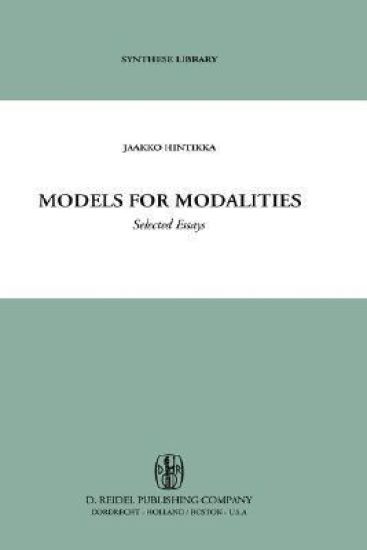
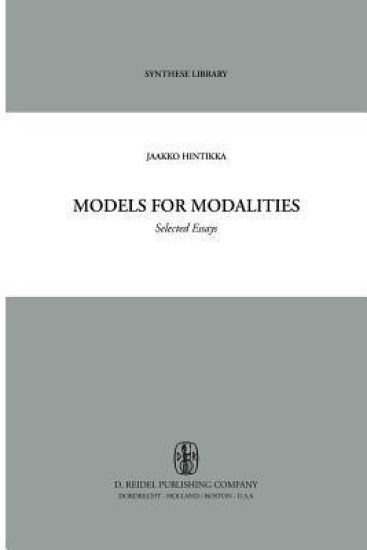
Models for Modalities

Models for Modalities

Jaakko Hintikka

Kluwer Academic Publishers
1975
sidottu
The papers collected in this volume were written over a period of some eight or nine years, with some still earlier material incorporated in one of them. Publishing them under the same cover does not make a con­ tinuous book of them. The papers are thematically connected with each other, however, in a way which has led me to think that they can naturally be grouped together. In any list of philosophically important concepts, those falling within the range of application of modal logic will rank high in interest. They include necessity, possibility, obligation, permission, knowledge, belief, perception, memory, hoping, and striving, to mention just a few of the more obvious ones. When a satisfactory semantics (in the sense of Tarski and Carnap) was first developed for modal logic, a fascinating new set of methods and ideas was thus made available for philosophical studies. The pioneers of this model theory of modality include prominently Stig Kanger and Saul Kripke. Several others were working in the same area independently and more or less concurrently. Some of the older papers in this collection, especially 'Quantification and Modality' and 'Modes of Modality', serve to clarify some of the main possibilities in the semantics of modal logics in general.
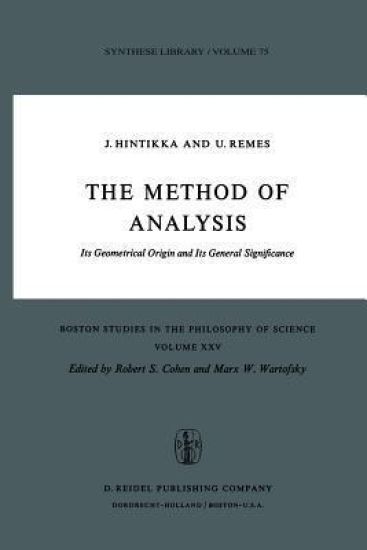
The Method of Analysis

The Method of Analysis

Jaakko Hintikka; U. Remes

Kluwer Academic Publishers
1974
sidottu
As official sponsors of the First International Conference in the History and Philosophy of Science, the two Divisions of the International Union of the History and Philosophy of Science owe a great deal to the University of Jyvliskyla and the 1973 Jyvliskylli Summer Festival for the extra­ ordinarily generous hospitality they provided. But there is an additional debt owed, not simply for the locale but for the very substance of the Conference, to the two Finnish scholars who have jointly authored the present volume. For this volume represents not only the first part of the published proceedings of this First International Conference in the History and Philosophy of Science, but also, most fittingly, the paper that opened the Conference itself. Yet the appropriateness of the paper from which this book has resulted opening the Conference lies far less in the fact that it was a contribution by two Finnish authors to a meeting hosted in Finland than it does to the fact that this paper, and now the present book, comes to grips in an extreme­ ly direct way with the very problem the whole Conference was from the outset designed to treat. Generally put, this problem was to bring to­ gether a number of historians and philosophers of science whose contrib­ uted papers would bear witness to the ways in which the two disciplines can be, and are, of value to each other.
The Method of Analysis

The Method of Analysis

Jaakko Hintikka; U. Remes

Kluwer Academic Publishers
1974
nidottu
As official sponsors of the First International Conference in the History and Philosophy of Science, the two Divisions of the International Union of the History and Philosophy of Science owe a great deal to the University of Jyvliskyla and the 1973 Jyvliskylli Summer Festival for the extra­ ordinarily generous hospitality they provided. But there is an additional debt owed, not simply for the locale but for the very substance of the Conference, to the two Finnish scholars who have jointly authored the present volume. For this volume represents not only the first part of the published proceedings of this First International Conference in the History and Philosophy of Science, but also, most fittingly, the paper that opened the Conference itself. Yet the appropriateness of the paper from which this book has resulted opening the Conference lies far less in the fact that it was a contribution by two Finnish authors to a meeting hosted in Finland than it does to the fact that this paper, and now the present book, comes to grips in an extreme­ ly direct way with the very problem the whole Conference was from the outset designed to treat. Generally put, this problem was to bring to­ gether a number of historians and philosophers of science whose contrib­ uted papers would bear witness to the ways in which the two disciplines can be, and are, of value to each other.
Models for Modalities

Models for Modalities

Jaakko Hintikka

Kluwer Academic Publishers
1975
nidottu
The papers collected in this volume were written over a period of some eight or nine years, with some still earlier material incorporated in one of them. Publishing them under the same cover does not make a con­ tinuous book of them. The papers are thematically connected with each other, however, in a way which has led me to think that they can naturally be grouped together. In any list of philosophically important concepts, those falling within the range of application of modal logic will rank high in interest. They include necessity, possibility, obligation, permission, knowledge, belief, perception, memory, hoping, and striving, to mention just a few of the more obvious ones. When a satisfactory semantics (in the sense of Tarski and Carnap) was first developed for modal logic, a fascinating new set of methods and ideas was thus made available for philosophical studies. The pioneers of this model theory of modality include prominently Stig Kanger and Saul Kripke. Several others were working in the same area independently and more or less concurrently. Some of the older papers in this collection, especially 'Quantification and Modality' and 'Modes of Modality', serve to clarify some of the main possibilities in the semantics of modal logics in general.
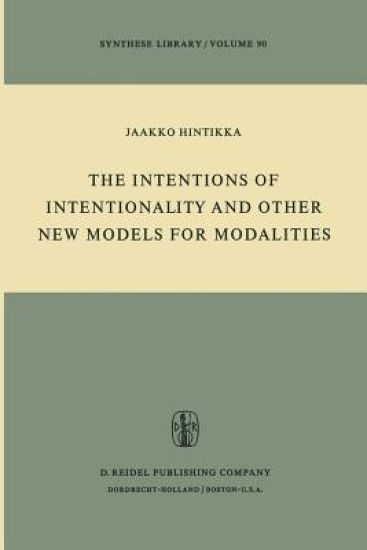
The Intentions of Intentionality and Other New Models for Modalities
The leisure to do the thinking whose results are gathered here has largely been provided by the Academy of Finland, whose support has also made possible the help and co-operation of a group of younger logicians and philosophers. Less tangible support and help is unfortunately harder to record and to thank for. Once again, in working on the many themes I have tried to weave together in this book I have incurred more intellectual and moral debts I can in so many words acknowledge here. Let me only say that the closer to home I get the greater they become. I have especially in mind my colleagues and students at Stanford; my colleagues in Helsinki; the past and present members of my research group in Helsinki; and incom­ parably more than anybody else my wife Soili. Helsinki, April 1975 JAAKKO HINTIKKA INTRODUCTION A literal-minded reader might easily object to the (sub)title of this volume. What is to be found here, he might allege, are neither models, nor modalities stricto sensu, nor yet any completely new applications of modal logic. Even though the purpose of the title is only to signal the con­ tinuity between the present volume and its predecessor, Models for Modalities (D. Reidel Publishing Co., Dordrecht, 1969), the objection is sufficiently well taken to serve as an excuse for an attempt to put my enterprise in a wider perspective.
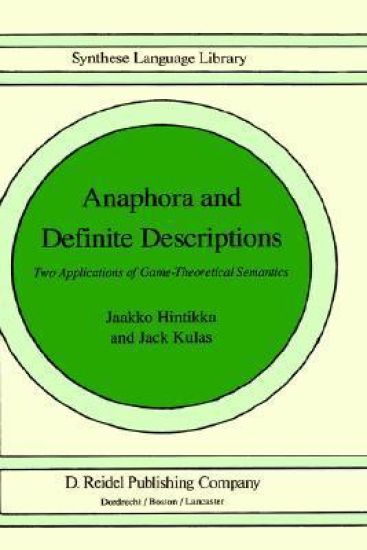
Anaphora and Definite Descriptions

Anaphora and Definite Descriptions

Jaakko Hintikka; J. Kulas

Kluwer Academic Publishers
1985
sidottu
I n order to appreciate properly what we are doing in this book it is necessary to realize that our approach to linguistic theorizing differs from the prevailing views. Our approach can be described by indicating what distinguishes it from the methodological ideas current in theoretical linguistics, which I consider seriously misguided. Linguists typically construe their task in these days as that of making exceptionless generalizations from particular examples. This explanatory strategy is wrong in several different ways. It presupposes that we can have "intuitions" about particular examples, usually examples invented by the linguist himself or herself, reliable and sharp enough to serve as a basis of sharp generalizations. It also presupposes that we cannot have equally reliable direct access to general linguistic regularities. Both assumptions appear to me extremely dubious, and the first of them has in effect been challenged by linguists like Dwight Bol inger. There is also some evidence that the degree of unanimity among linguists is fairly low when it comes to less clear cases, even in connection with such relatively simple questions as grammaticality (acceptability). For this reason we have tried to rely more on quotations from contemporary fiction, newspapers and magazines than on linguists' and philosophers' ad hoc examples. I also find it strange that some of the same linguists as believe that we all possess innate ideas about general characteristics of humanly possible grammars assume that we can have access to them only via their particular consequences.
Anaphora and Definite Descriptions

Anaphora and Definite Descriptions

Jaakko Hintikka; J. Kulas

Kluwer Academic Publishers
1985
nidottu
I n order to appreciate properly what we are doing in this book it is necessary to realize that our approach to linguistic theorizing differs from the prevailing views. Our approach can be described by indicating what distinguishes it from the methodological ideas current in theoretical linguistics, which I consider seriously misguided. Linguists typically construe their task in these days as that of making exceptionless generalizations from particular examples. This explanatory strategy is wrong in several different ways. It presupposes that we can have "intuitions" about particular examples, usually examples invented by the linguist himself or herself, reliable and sharp enough to serve as a basis of sharp generalizations. It also presupposes that we cannot have equally reliable direct access to general linguistic regularities. Both assumptions appear to me extremely dubious, and the first of them has in effect been challenged by linguists like Dwight Bol inger. There is also some evidence that the degree of unanimity among linguists is fairly low when it comes to less clear cases, even in connection with such relatively simple questions as grammaticality (acceptability). For this reason we have tried to rely more on quotations from contemporary fiction, newspapers and magazines than on linguists' and philosophers' ad hoc examples. I also find it strange that some of the same linguists as believe that we all possess innate ideas about general characteristics of humanly possible grammars assume that we can have access to them only via their particular consequences.
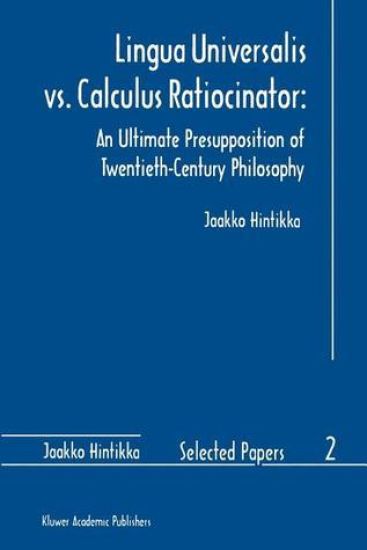
Lingua Universalis vs. Calculus Ratiocinator:
R. G. Collingwood saw one of the main tasks of philosophers and of historians of human thought in uncovering what he called the ultimate presuppositions of different thinkers, of different philosophical movements and of entire eras of intellectual history. He also noted that such ultimate presuppositions usually remain tacit at first, and are discovered only by subsequent reflection. Collingwood would have been delighted by the contrast that constitutes the overall theme of the essays collected in this volume. Not only has this dichotomy ofviews been one ofthe mostcrucial watersheds in the entire twentieth-century philosophical thought. Not only has it remained largely implicit in the writings of the philosophers for whom it mattered most. It is a truly Collingwoodian presupposition also in that it is not apremise assumed by different thinkers in their argumentation. It is the presupposition of a question, an assumption to the effect that a certain general question can be raised and answered. Its role is not belied by the fact that several philosophers who answered it one way or the other seem to be largely unaware that the other answer also makes sense - if it does. This Collingwoodian question can be formulated in a first rough approximation by asking whether language - our actual working language, Tarski's "colloquiallanguage" - is universal in the sense of being inescapable. This formulation needs all sorts of explanations, however.
Language, Truth and Logic in Mathematics
One can distinguish, roughly speaking, two different approaches to the philosophy of mathematics. On the one hand, some philosophers (and some mathematicians) take the nature and the results of mathematicians' activities as given, and go on to ask what philosophical morals one might perhaps find in their story. On the other hand, some philosophers, logicians and mathematicians have tried or are trying to subject the very concepts which mathematicians are using in their work to critical scrutiny. In practice this usually means scrutinizing the logical and linguistic tools mathematicians wield. Such scrutiny can scarcely help relying on philosophical ideas and principles. In other words it can scarcely help being literally a study of language, truth and logic in mathematics, albeit not necessarily in the spirit of AJ. Ayer. As its title indicates, the essays included in the present volume represent the latter approach. In most of them one of the fundamental concepts in the foundations of mathematics and logic is subjected to a scrutiny from a largely novel point of view. Typically, it turns out that the concept in question is in need of a revision or reconsideration or at least can be given a new twist. The results of such a re-examination are not primarily critical, however, but typically open up new constructive possibilities. The consequences of such deconstructions and reconstructions are often quite sweeping, and are explored in the same paper or in others.
Paradigms for Language Theory and Other Essays
Several of the basic ideas of current language theory are subjected to critical scrutiny and found wanting, including the concept of scope, the hegemony of generative syntax, the Frege-Russell claim that verbs like `is' are ambiguous, and the assumptions underlying the so-called New Theory of Reference. In their stead, new constructive ideas are proposed.
Inquiry as Inquiry: A Logic of Scientific Discovery
Is a genuine logic of scientific discovery possible? In the essays collected here, Hintikka not only defends an affirmative answer; he also outlines such a logic. It is the logic of questions and answers. Thus inquiry in the sense of knowledge-seeking becomes inquiry in the sense of interrogation. Using this new logic, Hintikka establishes a result that will undoubtedly be considered the fundamental theorem of all epistemology, viz., the virtual identity of optimal strategies of pure discovery with optimal deductive strategies. Questions to Nature, of course, must include observations and experiments. Hintikka shows, in fact, how the logic of experimental inquiry can be understood from the interrogative vantage point. Other important topics examined include induction (in a forgotten sense that has nevertheless played a role in science), explanation, the incommensurability of theories, theory-ladenness of observations, and identifiability.
Analyses of Aristotle

Analyses of Aristotle

Jaakko Hintikka

Springer
2010
nidottu
Aristotle thought of his logic and methodology as applications of the Socratic questioning method. In particular, logic was originally a study of answers necessitated by earlier answers. For Aristotle, thought-experiments were real experiments in the sense that by realizing forms in one's mind, one can read off their properties and interrelations. Treating forms as independent entities, knowable one by one, committed Aristotle to his mode of syllogistic explanation. He did not think of existence, predication and identity as separate senses of estin. Aristotle thus serves as an example of a thinker who did not rely on the distinction between the allegedly different Fregean senses, thereby shedding new light on our own conceptual presuppositions. This collection comprises several striking interpretations that Jaakko Hintikka has put forward over the years, constituting a challenge not only to Aristotelian scholars and historians of ideas, but to everyone interested in logic, epistemology or metaphysics and in their history.
Transnational public administration : Background study for the development of a course and competence centre on transnational public administration
If public administration is about providing the public with public goods, then transnational public administration implies the organisation and provision of public goods across national borders. Civil servants increasingly need to account for jurisdictions, practices and multiple stakeholder interests emanating from international context and from cooperation with other countries. Similarly, the public services they produce have transnational target groups. The growing transnational dimension in public administration weakens the prerogative of the state over public administration. Transnational public administration is often practice-driven and builds upon shared problems emphasising bottom-up processes in public administration. Within the EU, the Macro-Regional strategies are a good example of supranational policies that promote bottom-up and practice-driven public administration in the transnational sphere and at the expense of the state. The growing transnational dimension in public administration necessitates new ways of thinking about accountability and democratic anchoring of public administration. This report comprises three independent parts: frst looking at diferent ways of approaching public administration in its transnational dimension; second developing and illustrating an analytical framework for the analysis of transnational public administration; and third scouting the emerging questions of transnational public administration.
Reträtt

Reträtt

Jaakko Pallasvuo

Lystring
2023
sidottu
Ett homosexuellt par flyr staden från en annalkande apokalyps. De möter en annan konstnär på vägen och deras förhoppningar och planer ändras. Den finska allkonstnären Jaakko Pallasvuos "Reträtt" är en postmodern tolkning av dystopisk-genren, i vilken när han utforskar de motstridiga ideologierna och känslorna i en queer kärlekstriangel som utspelar sig under en tid där mänskligheten närmar sig utplåning. En uttrycksfull, sardonisk återgivning av kärlek, rädsla och leda inför undergången. "Reträtt" tar slitna narrativa troper i uppfriskande nya riktningar. Jaakko Pallasvuo är numera förmodligen mest känd för sitt instagramkonto avocado_ibuprofen, som har 100 000 följare. Han har varit aktiv som konstnär, skribent och serietecknare i många år innan dess. Han har ställt ut över hela världen och tidigare givit ut böcker på finska, franska och engelska. Efter flera års medverkan i tidskriften Det Grymma Svärdet är detta hans svenska debutbok.
Knowledge and the Known

Knowledge and the Known

Jaakko Hintikka

Springer
2011
nidottu
A word of warning concerning the aims of this volume is in order. Other­ wise some readers might be unpleasantly surprised by the fact that two of the chapters of an ostensibly historical book are largely topical rather than historical. They are Chapters 7 and 9, respectively entitled 'Are Logical Truths Analytic?' and 'A Priori Truths and Things-In-Them­ selves'. Moreover, the history dealt with in Chapter 11 is so recent as to have more critical than antiquarian interest. This mixture of materials may seem all the more surprising as I shall myself criticize (in Chapter I) too facile assimilations of earlier thinkers' concepts and problems to later ones. There is no inconsistency here, it seems to me. The aims of the present volume are historical, and for that very purpose, for the purpose of understanding and evaluating earlier thinkers it is vital to know the conceptual landscape in which they were moving. A crude analogy may be helpful here. No military historian can afford to neglect the topo­ graphy of the battles he is studying. If he does not know in some detail what kind of pass Thermopylae is or on what sort of ridge the battle of Bussaco was fought, he has no business of discussing these battles, even if this topographical information alone does not yet amount to historical knowledge.