The inferiority of women, and the inherent sinfulness of humanity, are demeaning ideas arising from a literal acceptance of the Jewish Creation Story in Genesis. But Kabbalah (Jewish mysticism) shows these concepts are false, and in explaining why Dr. Judd reveals the inner beauty of Scripture that contains no such negative or limiting ideas.Author Biography: Dr. James N. Judd is President of Universal Teachings, and has lectured extensively in the United States and England, including addresses at Parliament of World's Religions (Chicago, 1993). He is past-President, Vedanta Society of Houston, and is listed in Who's Who Worldwide. Dr. Judd is the author of eight books, and numerous articles.
Despite the brevity of John F. Kennedy's presidency, its significance endures. From the Cuban Missile Crisis and the creation of the Berlin Wall to the Peace Corps and the civil rights movement, Kennedy's presidency was one of crisis and change. In Debating the Kennedy Presidency, noted scholars James N. Giglio and Stephen G. Rabe examine the successes and failures of Kennedy's foreign and domestic policies. Rabe focuses on the administration's foreign relations and argues that JFK was a relentless Cold Warrior who perpetuated the Cold War more than he resolved it. Conversely, Giglio sympathetically surveys domestic policies and defends Kennedy's record by emphasizing the constraints under which the president had to operate. The differing viewpoints of the two authors, as well as the supplementary documents, provide an ideal introduction allowing readers to examine the issues and draw their own conclusions about America's 35th president.
This new book covers every nuclear delivery system the United States ever deployed. With few exceptions, each weapon and system is illustrated by either color or black and white photographs. Each weapon also comes with specifications and a history of its development, deployment and retirement (if retired).
In moments of reflection, I often recall how my early years were altered through addiction. As I ripened, I watched a spirit diminish from the afflictions deep inside. It carried with it a heavy burden, inciting my soul endlessly for peace, a peace that never came. Looking back with a tender sadness, I can now understand it was a time of darkness and euphoria. These words are a way of forgiving myself for not appreciating the difficulties of life that can break a young man's spirit. I have come to those dark memories with a perspective that, in those moments, I was naive, not realizing there would be more to me than yesterday. But now it's in these words that I'm able to acknowledge it, listen to its truth, and speak it back to you as poetry; it's a form of acceptance - it's this tender sadness that gives birth to a new consciousness, welcoming peace that finally has arrived. These words of poetry are reflections of my travels throughout life. They represent a lifetime of joy, suffering, pain, grief, anxieties, those love things, and moments of peaceful solitude. They are my way of expunging those introspections I've carried for too long. I hope you enjoy these words about the poetic complexity of one man's travels through life.
The exodus of the Northern Cheyennes in 1878 and 1879, an attempt to flee from Indian Territory to their Montana homeland, is an important event in American Indian history. It is equally important in the history of towns like Oberlin, Kansas, where Cheyenne warriors killed more than forty settlers. The Cheyennes, in turn, suffered losses through violent encounters with the U.S. Army. More than a century later, the story remains familiar because it has been told by historians and novelists, and on film. In The Northern Cheyenne Exodus in History and Memory, James N. Leiker and Ramon Powers explore how the event has been remembered, told, and retold. They examine the recollections of Indians and settlers and their descendants, and they consider local history, mass-media treatments, and literature to draw thought-provoking conclusions about how this story has changed over time.The Cheyennes' journey has always been recounted in melodramatic stereotypes, and for the last fifty years most versions have featured ""noble savages"" trying to reclaim their birthright. Here, Leiker and Powers deconstruct those stereotypes and transcend them, pointing out that history is never so simple. ""The Cheyennes' flight,"" they write, ""had left white and Indian bones alike scattered along its route from Oklahoma to Montana."" In this view, the descendants of the Cheyennes and the settlers they encountered are all westerners who need history as a ""way of explaining the bones and arrowheads"" that littered the plains.Leiker and Powers depict a rural West whose diverse peoples - Euro-American and Native American alike - seek to preserve their heritage through memory and history. Anyone who lives in the contemporary Great Plains or who wants to understand the West as a whole will find this book compelling.
For nearly twenty-five years, English studies has been focused on two terms: politics and ethics. However, the institutional emergence, development, and relationship of these two concepts have yet to be examined. ""Between Politics and Ethics: Toward a Vocative History of English Studies"" traces the development of politics and ethics in contemporary English studies, questions the current political orientation of the discipline, and proposes a rethinking of the history of English studies based on a ""vocative"" dimension of writing - the idea that writers form a virtual community by ""calling to"" and listening to other writers. In a series of interrelated discussions, James Comas examines the historical trends leading to recent confusion regarding ethics and its relation to the politics of English studies. Through close, rhetorical readings of texts by Judith Butler, Stephen Greenblatt, Edward Said, and others, Comas argues that this confusion is largely the result of a ""political turn"" that resists theorizing itself. In addition, he argues that work on ethics by Wayne Booth, Geoffrey Harpham, and J. Hillis Miller reflects an uneasy dialectic between the ethics and politics of reading and writing. In response to this discord, Comas turns to the theories of Emmanuel Levinas and Maurice Blanchot, as well as to the examples of Georges Bataille and Kenneth Burke, and proposes a vocative approach to assessing English studies and its history. In doing so, this volume offers a thoughtful reassessment of English studies that affects our understanding of the rhetoric of disciplinary histories.
This report presents an analysis of a prehistoric Pueblo community in structural, functional, and evolutionary terms; it is a sequel to William A. Longacre's Archaeology as Anthropology. The emphasis is on social organization (including the patterning of community activities) and on understanding changes in this organization in terms of adaptive responses to a shifting environment.
Describes the development of a new set of content scales for the MMPI-2, employing a rational-statistical approach to provide a psychometrically sound and effective way of assessing the major content dimensions of the revised test.
The best resource for interpreting these widely used personality assessment tests.The best resource for interpreting these widely used personality assessment tests.Essentials of MMPI-2 and MMPI-A Interpretation presents innovative interpretive strategies for both the Minnesota Multiphasic Personality Inventory-2, or MMPI-2, and the adaptation for adolescents, the MMPI-A. James N. Butcher and Carolyn L. Williams detail the rationale for the revision and development of the instruments and their scales, and describe how to administer, score, profile, code, and interpret the tests.The revised edition includes the most recent MMPI research, including new information on ethnic background and cultural setting as they relate to assessment. Focusing primarily on studies of profile validity and external correlates, the revision also includes interpretive guidelines for several scales that will be introduced into the MMPI tests in 2000.Translation inquiries: University of Minnesota Press
The best resource for interpreting these widely used personality assessment tests.Essentials of MMPI-2 and MMPI-A Interpretation presents innovative interpretive strategies for both the Minnesota Multiphasic Personality Inventory-2, or MMPI-2, and the adaptation for adolescents, the MMPI-A. James N. Butcher and Carolyn L. Williams detail the rationale for the revision and development of the instruments and their scales and describe how to administer, score, profile, code, and interpret the tests. This revised edition includes the most recent MMPI research, including new information on ethnic background and cultural setting as they relate to assessment. Focusing primarily on studies of profile validity and external correlates, the revision also includes interpretive guidelines for several scales newly introduced into the MMPI tests. A new workbook includes exercises related to Essentials of MMPI-2 and MMPI-A Interpretation in areas such as important test constructs, the interpretation of profile validity, and clinical and content scales.
Despite familiar images of the dropping of the atomic bomb on Japan and the controversy over its fiftieth anniversary, the human impact of those horrific events often seems lost to view. In this uncommon memoir, Dr. James N. Yamazaki tells us in personal and moving terms of the human toll of nuclear warfare and the specific vulnerability of children to the effects of these weapons. Giving voice to the brutal ironies of racial and cultural conflict, of war and sacrifice, his story creates an inspiring and humbling portrait of events whose lessons remain difficult and troubling fifty years later.Children of the Atomic Bomb is Dr. Yamazaki’s account of a lifelong effort to understand and document the impact of nuclear explosions on children, particularly the children conceived but not yet born at the time of the explosions. Assigned in 1949 as Physician-in-Charge of the United States Atomic Bomb Casualty Commission in Nagasaki, Yamazaki had served as a combat surgeon at the Battle of the Bulge where he had been captured and held as a prisoner of war by the Germans. In Japan he was confronted with violence of another dimension-the devastating impact of a nuclear blast and the particularly insidious effects of radiation on children. Yamazaki’s story is also one of striking juxtapositions, an account of a Japanese-American’s encounter with racism, the story of a man who fought for his country while his parents were interned in a concentration camp in Arkansas. Once the object of discrimination at home, Yamazaki paradoxically found himself in Japan for the first time as an American, part of the Allied occupation forces, and again an outsider. This experience resonates through his work with the children of Nagasaki and Hiroshima and with the Marshallese people who bore the brunt of America’s postwar testing of nuclear weapons in the Pacific. Recalling a career that has spanned five decades, Dr. Yamazaki chronicles the discoveries that helped chart the dangers of nuclear radiation and presents powerful observations of both the medical and social effects of the bomb. He offers an indelible picture of human tragedy, a tale of unimaginable suffering, and a dedication to healing that is ultimately an unwavering, impassioned plea for peace.
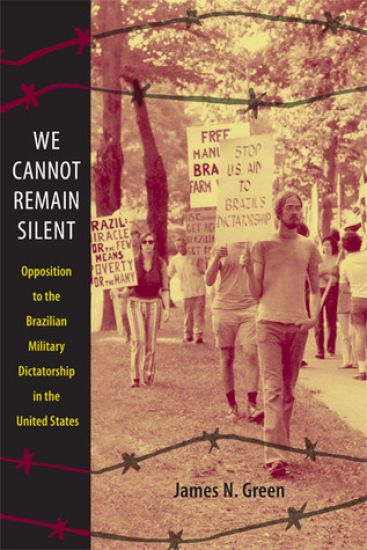
In 1964, Brazil’s democratically elected, left-wing government was ousted in a coup and replaced by a military junta. The Johnson administration quickly recognized the new government. The U.S. press and members of Congress were nearly unanimous in their support of the “revolution” and the coup leaders’ anticommunist agenda. Few Americans were aware of the human rights abuses perpetrated by Brazil’s new regime. By 1969, a small group of academics, clergy, Brazilian exiles, and political activists had begun to educate the American public about the violent repression in Brazil and mobilize opposition to the dictatorship. By 1974, most informed political activists in the United States associated the Brazilian government with its torture chambers. In We Cannot Remain Silent, James N. Green analyzes the U.S. grassroots activities against torture in Brazil, and the ways those efforts helped to create a new discourse about human-rights violations in Latin America. He explains how the campaign against Brazil’s dictatorship laid the groundwork for subsequent U.S. movements against human rights abuses in Chile, Uruguay, Argentina, and Central America.Green interviewed many of the activists who educated journalists, government officials, and the public about the abuses taking place under the Brazilian dictatorship. Drawing on those interviews and archival research from Brazil and the United States, he describes the creation of a network of activists with international connections, the documentation of systematic torture and repression, and the cultivation of Congressional allies and the press. Those efforts helped to expose the terror of the dictatorship and undermine U.S. support for the regime. Against the background of the political and social changes of the 1960s and 1970s, Green tells the story of a decentralized, international grassroots movement that effectively challenged U.S. foreign policy.
In 1964, Brazil’s democratically elected, left-wing government was ousted in a coup and replaced by a military junta. The Johnson administration quickly recognized the new government. The U.S. press and members of Congress were nearly unanimous in their support of the “revolution” and the coup leaders’ anticommunist agenda. Few Americans were aware of the human rights abuses perpetrated by Brazil’s new regime. By 1969, a small group of academics, clergy, Brazilian exiles, and political activists had begun to educate the American public about the violent repression in Brazil and mobilize opposition to the dictatorship. By 1974, most informed political activists in the United States associated the Brazilian government with its torture chambers. In We Cannot Remain Silent, James N. Green analyzes the U.S. grassroots activities against torture in Brazil, and the ways those efforts helped to create a new discourse about human-rights violations in Latin America. He explains how the campaign against Brazil’s dictatorship laid the groundwork for subsequent U.S. movements against human rights abuses in Chile, Uruguay, Argentina, and Central America.Green interviewed many of the activists who educated journalists, government officials, and the public about the abuses taking place under the Brazilian dictatorship. Drawing on those interviews and archival research from Brazil and the United States, he describes the creation of a network of activists with international connections, the documentation of systematic torture and repression, and the cultivation of Congressional allies and the press. Those efforts helped to expose the terror of the dictatorship and undermine U.S. support for the regime. Against the background of the political and social changes of the 1960s and 1970s, Green tells the story of a decentralized, international grassroots movement that effectively challenged U.S. foreign policy.
In the most comprehensive assessment of baseball legend Stan Musial's life and career to date, James N. Giglio places the St. Louis Cardinal star within the context of the times-the Great Depression and wartime and postwar America-and the issues then prevalent in professional baseball, particularly race and the changing economics of the game. Giglio illuminates how the times shaped Musial and delves further into his popular image as a warm, unfailingly gracious role model known for good sportsmanship and devotion to family.
Most therapeutic approaches, especially those of a cognitive orientation, are not very effective in dealing with high conflict relationships--couples often heading toward divorce by the time they seek help. Counseling Couples in Conflict is a resource for pastors and counselors who want to be ready for these uniquely difficult cases. Utilizing a relational conflict and restoration model Mark Yarhouse and James Sells point the way beyond the cycle of pain towards marital healing. Christian Association for Psychological Studies (CAPS) Books explore how Christianity relates to mental health and behavioral sciences including psychology, counseling, social work, and marriage and family therapy in order to equip Christian clinicians to support the well-being of their clients.
The Defense Department has been spending over USD100 million annually on recruiting advertising. Previous econometric studies of military advertising 1s effects have relied on data from time periods Unlike today 1s and have used models possibly inappropriate for supporting today's decisionmakers. This report details improved methods developed to assess military advertising 1s effectiveness and illustrates them using early 1980s and mid-1990s data.
U.S. Army Recruiting Command is faced with the challenge of ensuring that the flow of qualified volunteers is adequate to meet future active-duty accession requirements. This report documents research methods, findings, and policy conclusions from a project analyzing human resource management options for improving recruiting production. It details research designed to develop new insights to help guide future recruiter management policies.