Kirjojen hintavertailu. Mukana 12 400 935 kirjaa ja 12 kauppaa.

Kirjahaku

Etsi kirjoja tekijän nimen, kirjan nimen tai ISBN:n perusteella.

752 tulosta hakusanalla Jaymi Trimble

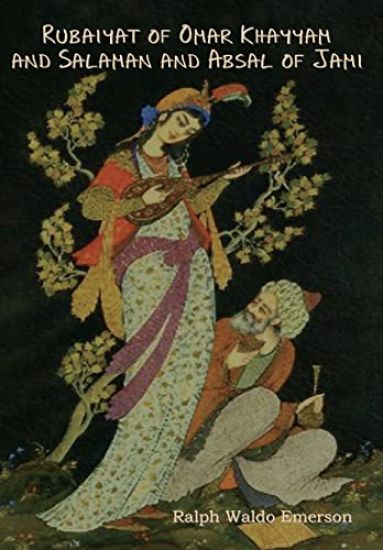
Rubaiyat of Omar Khayyam and Salaman and Absal of Jami

Rubaiyat of Omar Khayyam and Salaman and Absal of Jami

Omar Khayyam; Et Al Jami

Bibliotech Press
2019
pokkari
Omar Khayyam (18 May 1048 - 4 December 1131) was a Persian mathematician, astronomer, and poet. He was born in Nishapur, in northeastern Iran, and spent most of his life near the court of the Karakhanid and Seljuq rulers in the period which witnessed the First Crusade.As a mathematician, he is most notable for his work on the classification and solution of cubic equations, where he provided geometric solutions by the intersection of conics. Khayyam also contributed to the understanding of the parallel axiom. As an astronomer, he designed the Jalali calendar, a solar calendar with a very precise 33-year intercalation cycle.There is a tradition of attributing poetry to Omar Khayyam, written in the form of quatrains. This poetry became widely known to the English-reading world in a translation by Edward FitzGerald (Rubaiyat of Omar Khayyam, 1859), which enjoyed great success in the Orientalism of the fin de si cle.Omar Khayyam was born in Nishapur, a leading metropolis in Khorasan during medieval times that reached its climax of prosperity in the eleventh century under the Seljuq dynasty. Nishapur was, at the time, a major center of the Zoroastrian religion. It is likely that Khayyam's father was a Zoroastrian who had converted to Islam. He was born into a family of tent-makers (Khayyam). His full name, as it appears in the Arabic sources, was Abu'l Fath Omar ibn Ibrahim al-Khayyam. In medieval Persian texts he is usually simply called Omar Khayyām. His boyhood was spent in Nishapur. His gifts were recognized by his early tutors who sent him to study under Imam Muwaffaq Nishaburi, the greatest teacher of the Khorasan region who tutored the children of the highest nobility. In 1073, at the age of twenty-six, he entered the service of Sultan Malik-Shah I as an adviser. In 1076 Khayyam was invited to Isfahan by the vizier and political figure Nizam al-Mulk to take advantage of the libraries and centers in learning there. His years in Isfahan were productive. It was at this time that he began to study the work of Greek mathematicians Euclid and Apollonius much more closely. But after the death of Malik-Shah and his vizier (murdered, it is thought, by the Ismaili order of Assassins), Omar had fallen from favour at court, and as a result, he soon set out on his pilgrimage to Mecca... He was later allowed to return to Nishapur owing to his declining health. Upon his return, he seemed to have lived the life of a recluse. Khayyam died in 1131 and is buried in the Khayyam Garden. (wikipedia.org)
Rubaiyat of Omar Khayyam and Salaman and Absal of Jami

Rubaiyat of Omar Khayyam and Salaman and Absal of Jami

Omar Khayyam; Et Al Jami

Bibliotech Press
2019
sidottu
Omar Khayyam (18 May 1048 - 4 December 1131) was a Persian mathematician, astronomer, and poet. He was born in Nishapur, in northeastern Iran, and spent most of his life near the court of the Karakhanid and Seljuq rulers in the period which witnessed the First Crusade.As a mathematician, he is most notable for his work on the classification and solution of cubic equations, where he provided geometric solutions by the intersection of conics. Khayyam also contributed to the understanding of the parallel axiom. As an astronomer, he designed the Jalali calendar, a solar calendar with a very precise 33-year intercalation cycle.There is a tradition of attributing poetry to Omar Khayyam, written in the form of quatrains. This poetry became widely known to the English-reading world in a translation by Edward FitzGerald (Rubaiyat of Omar Khayyam, 1859), which enjoyed great success in the Orientalism of the fin de si cle.Omar Khayyam was born in Nishapur, a leading metropolis in Khorasan during medieval times that reached its climax of prosperity in the eleventh century under the Seljuq dynasty. Nishapur was, at the time, a major center of the Zoroastrian religion. It is likely that Khayyam's father was a Zoroastrian who had converted to Islam. He was born into a family of tent-makers (Khayyam). His full name, as it appears in the Arabic sources, was Abu'l Fath Omar ibn Ibrahim al-Khayyam. In medieval Persian texts he is usually simply called Omar Khayyām. His boyhood was spent in Nishapur. His gifts were recognized by his early tutors who sent him to study under Imam Muwaffaq Nishaburi, the greatest teacher of the Khorasan region who tutored the children of the highest nobility. In 1073, at the age of twenty-six, he entered the service of Sultan Malik-Shah I as an adviser. In 1076 Khayyam was invited to Isfahan by the vizier and political figure Nizam al-Mulk to take advantage of the libraries and centers in learning there. His years in Isfahan were productive. It was at this time that he began to study the work of Greek mathematicians Euclid and Apollonius much more closely. But after the death of Malik-Shah and his vizier (murdered, it is thought, by the Ismaili order of Assassins), Omar had fallen from favour at court, and as a result, he soon set out on his pilgrimage to Mecca... He was later allowed to return to Nishapur owing to his declining health. Upon his return, he seemed to have lived the life of a recluse. Khayyam died in 1131 and is buried in the Khayyam Garden. (wikipedia.org)
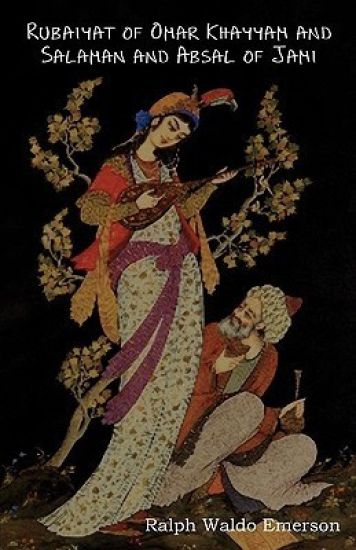
Rubaiyat of Omar Khayyam and Salaman and Absal of Jami

Rubaiyat of Omar Khayyam and Salaman and Absal of Jami

Ralph Waldo Emerson

INDOEUROPEANPUBLISHING.COM
2022
sidottu
Edward FitzGerald (31 March 1809 - 14 June 1883) was an English writer, best known as the poet of the first and most famous English translation of The Rubaiyat of Omar Khayyam. Rubaiyat of Omar Khayyam is the title that Edward FitzGerald gave to his translation of a selection of poems, originally written in Persian and of which there are about a thousand, attributed to Omar Khayy m (1048-1131), a Persian poet, mathematician and astronomer. A Persian ruba'i is a two line stanza with two parts (or hemistechs) per line, hence the word "Rubaiyat", (derived from the Arabic root word for 4), meaning "quatrains". Salaman and Absal is among the works of Jami who was one of the greatest Persian poets in the 15th century and one of the last great Sufi poets.
Classical Sufi Poetry: From Hazrat 'ali (7th C.) to Jami (15th C.)
CLASSICAL SUFI POETRY From Hazrat 'Ali (7th c.) to Jami (15th c. )Translation & Introduction Paul Smith Mohammed's son-in-law Hazrat Ali who composed one of the first ghazals ever recorded that essentially sums up the meaning of Sufism and Dervishness...You do not know it, but in you is the remedy; you cause the sickness, but this you don't see. You are but a small form... this, you assume: but you're larger than any universe, in reality. You are the book that of any fallacies is clear, in you are all letters spelling out, the mystery. You are the Being, you're the very Being, It: you contain That... which contained cannot be THE POETS... Hazrat Ali 31, Ali Ibn Husain 31, Rabi'a of Basra 32, Dhu'l-Nun 35, Bayazid Bistami 39, Al Nuri 40, Junaid 43, Sumnun 44, Mansur al-Hallaj 45, Ibn 'Ata 51, Rudaki 53, Shibli 57, Baba Tahir 58, Abu Said 62, Ibn Sina 68, Baba Kuhi 71, Ansari 73, Al-Ghazzali 74, Hamadani 77, Sana'i 79, Gilani 89, Ahmed Yesevi 91, Mahsati 103, Abu Maydan 107, Khaqani 109, Mu'in 118, Suhrawadi 130, Nizami 133, Ruzbihan 151, Baghdadi 152, 'Attar 154, Auhad-ud-din Kermani 171, Kamal ud-din 176, Ibn al-Farid 179, Ibn 'Arabi 189, Baba Farid 196, Hamavi 202, Baba Afzal 203, Rumi 206, Imami 249, Sadi 250, 'Iraqi 290, Sultan Valad 300, Humam 303, Yunus Emre 307, Shabistari 317, Amir Khusrau 324, Hasan Dihlavi 333, Simnani 343, Auhadi 345, Ibn Yamin 349, Khaju 353, Obeyd Zakani 358, Emad 368, Lalla Ded 375, Hafiz 377, Jahan Khatun 419, Ruh Attar 445, Haydar 451, Junaid Shirazi 460, Ahmedi 462, Kadi Burhan-ud-din 465, Kamal 469, Maghribi 472, Nesimi 480, Nund Rishi 487, 'Arifi 491, Suleyman Chelebi 496, Sheykhi 501, Kasim Anwar 502, Shah Ni'matu'llah 508, Shah Da'i 513, Kabir 518, Jami 530. The correct rhyme-structure & meaning has been kept in all poems... biographies of poets and 'Further Reading'. Introduction. Sufi Poetry & the Forms it takes. Large Format Paperback 7"x10" 542 pages.COMMENTS ON PAUL SMITH'S TRANSLATION OF HAFEZ'S GHAZALS."It is not a joke... the English version of ALL the ghazals of Hafez is a great feat and of paramount importance. I am astonished.." Dr. Mir Mohammad Taghavi (Dr. of Literature) Tehran."Superb translations. 99% Hafez 1% Paul Smith." Ali Akbar Shapurzman, translator of English to Persian and knower of Hafiz's Divan off by heart. Paul Smith (b.1945) is a poet, author and translator of many books of Sufi poets of Persian, Arabic, Urdu, Turkish and other languages including Hafez, Sadi, Nizami, Rumi, 'Attar, Sana'i, Jahan Khatun, Obeyd Zakani, Mu'in ud-din Chishti, Amir Khusrau, Nesimi, Kabir, Anvari, Ansari, Jami, Khayyam, Hallaj, Rudaki, Yunus Emre, Ghalib, 'Iraqi, Iqbal, Makhfi, Lalla Ded, Abu Nuwas, Ibn al-Farid, Rahman Baba, Nazir, and many others, as well as his own poetry, fiction, plays, biographies, childrens books and a dozen screenplays. amazon.com/author/smithpa
What's My Name? Jaimi

What's My Name? Jaimi

Tiina Walsh

Independently Published
2019
nidottu
A personalised storybook for girls called JAIMI. The story is based on the letters of the child's own name. All books are different from one another.The girl wakes up but can't remember her name. Magic Mouse knows how to solve the problem. They go on a wonderful adventure in the Magic Bus Translated and adapted by the author from the top-selling Finnish language children's namebook series "Tytt /Poika, joka unohti nimens ". The beautiful hand-drawn pictures will delight both the young and the young-at-heart Looking for a namebook "What's my name?" but couldn't find a book for the name you are looking for? Please don't hesitate to contact me with your name request -Tiina WalshAuthorfb.me/whatsmynamestorybooks for more details about the storybooks
What's My Name? Jami

What's My Name? Jami

Tiina Walsh

Independently Published
2019
nidottu
A personalised storybook for girls called JAMI. The story is based on the letters of the child's own name. All books are different from one another.The girl wakes up but can't remember her name. Magic Mouse knows how to solve the problem. They go on a wonderful adventure in the Magic Bus Translated and adapted by the author from the top-selling Finnish language children's namebook series "Tytt /Poika, joka unohti nimens ". The beautiful hand-drawn pictures will delight both the young and the young-at-heart Looking for a namebook "What's my name?" but couldn't find a book for the name you are looking for? Please don't hesitate to contact me with your name request -Tiina WalshAuthorfb.me/whatsmynamestorybooks for more details about the storybooks
What's My Name? Jaymie

What's My Name? Jaymie

Tiina Walsh

Independently Published
2019
nidottu
A personalised storybook for girls called JAYMIE. The story is based on the letters of the child's own name. All books are different from one another.The girl wakes up but can't remember her name. Magic Mouse knows how to solve the problem. They go on a wonderful adventure in the Magic Bus Translated and adapted by the author from the top-selling Finnish language children's namebook series "Tytt /Poika, joka unohti nimens ". The beautiful hand-drawn pictures will delight both the young and the young-at-heart Looking for a namebook "What's my name?" but couldn't find a book for the name you are looking for? Please don't hesitate to contact me with your name request -Tiina WalshAuthorfb.me/whatsmynamestorybooks for more details about the storybooks
What's My Name? Jayni

What's My Name? Jayni

Tiina Walsh

Independently Published
2019
nidottu
A personalised storybook for girls called JAYME. The story is based on the letters of the child's own name. All books are different from one another.The girl wakes up but can't remember her name. Magic Mouse knows how to solve the problem. They go on a wonderful adventure in the Magic Bus Translated and adapted by the author from the top-selling Finnish language children's namebook series "Tytt /Poika, joka unohti nimens ". The beautiful hand-drawn pictures will delight both the young and the young-at-heart Looking for a namebook "What's my name?" but couldn't find a book for the name you are looking for? Please don't hesitate to contact me with your name request -Tiina WalshAuthorfb.me/whatsmynamestorybooks for more details about the storybooks
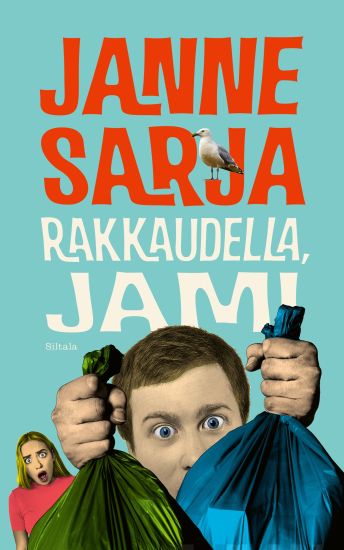
Rakkaudella, Jami

Rakkaudella, Jami

Janne Sarja

Siltala
2023
sidottu
Jami on hyväntahtoinen mies, joka joutuu vaikeuksiin kun kierrätystaloudeksi naamioitua hämäräbisnestä pyörittävä esimies Riku käskee hänet piilottamaanongelmajätettä luontoon.Tehtävä on haastava, koska jätteet on hävitettävä salaa vaimolta yhteisen kylpyläloman aikana. Miehen yölliset retket herättävät Ninan epäilykset, mutta hän tahtoisi uskoa Jamista hyvää.Rikun hähmäisestä liiketoiminnasta yrittää ottaa selvää skuuppia metsästävä toimittaja Paavo, joka epäonnekseen uskoo vakavan journalismin kiinnostavan lukijoita.Pian Jamia odottavat entistä oudommat haasteet Lapin lumisissa maisemissa. Tapansa mukaan hän yrittää parhaansa. Se ei useinkaan riitä kovin pitkälle.