Kirjojen hintavertailu. Mukana 11 342 296 kirjaa ja 12 kauppaa.

Kirjahaku

Etsi kirjoja tekijän nimen, kirjan nimen tai ISBN:n perusteella.

1000 tulosta hakusanalla Jefferson Hack

Jefferson County, Georgia, Inferior Court Minutes [Volume VII] October 26, 1835-May 20, 1868
The county's Inferior Court, made up of five justices of the peace for the county, tried any civil case except those involving title to land. The Inferior Court had jurisdiction over county business matters, such as care for the poor, building and maintaining the courthouse and jails, building and maintaining roads and bridges, issuing liquor licenses, nominating justices of the peace, performing naturalizations, appointing guardians, authorizing indentures, and maintaining a register of wills. The Clerk of the Inferior Court kept minutes of the foregoing proceedings--every one of which places individuals in Jefferson County at a particular point in time--and those minutes comprise the basis for this book. Volume VII of Inferior Court Minute transcriptions is based on the original Minute Books 10, 11, and 12 and carries the series forward from October 26, 1835, through May 20, 1868. Volume VII is the concluding volume in this series, and it is, by far, the largest one. It also encompasses the tumultuous years of the antebellum period and U.S. Civil War.
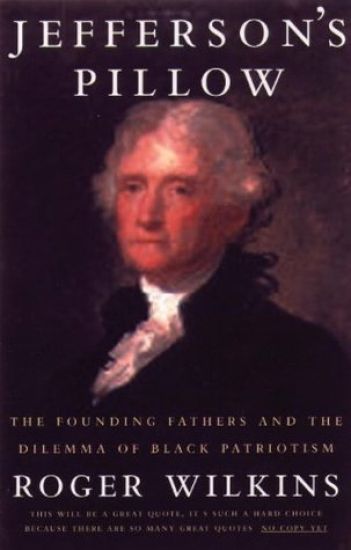
Jefferson's Pillow

Jefferson's Pillow

Roger W. Wilkins

Beacon Press
2002
pokkari
An outspoken participant in the civil rights movement, Roger Wilkins served as Assistant Attorney General during the Johnson administration. In 1972 he was awarded the Pulitzer Prize along with Bernstein and Herblock for his coverage of Watergate. Yet this black man, who has served the United States so well, feels at times an unwelcome guest here. In "Jefferson's Pillow, " Wilkins returns to America's beginnings and the founding fathers who preached and fought for freedom, even though they owned other human beings and legally denied them their humanity. He asserts that the mythic accounts of the American Revolution have ignored slavery and oversimplified history until the heroes, be they the founders or the slaves in their service, are denied any human complexity. Wilkins offers a thoughtful analysis of this fundamental paradox through his exploration of the lives of George Washington, George Mason, James Madison, and of course Thomas Jefferson. He discusses how class, education, and personality allowed for the institution of slavery, unravels how we as Americans tell different sides of that story, and explores the confounding ability of that narrative to limit who we are and who we can become. An important intellectual history of America's founding, "Jefferson's Pillow "will change the way we view our nation and ourselves.
The Papers of Jefferson Davis

The Papers of Jefferson Davis

Jefferson Davis

Louisiana State University Press
1975
sidottu
The five-year period from 1841 to 1846 saw the beginning of Jefferson Davis' political career. In this, the second volume of The Papers of Jefferson Davis, the documents cover Davis' unsuccessful race for the state legislature, his selection as a Democratic state elector, his marriage to Varina Howell, his election to the U.S. House of Representatives, and his departure therefrom to assume command of the First Mississippi Regiment in the Mexican War.In the congressional documents Davis emerges as a hardworking freshman representative who quickly won for himself the respect and esteem of his fellow congressmen. There were, however, notable exceptions. One such exception was Andrew Johnson, a tailor by trade, who strongly resented Davis' remark on the floor of the House that a ""blacksmith or tailor"" could not be expected to achieve the same results in battle as a trained military man. In the somewhat bitter exchange that followed, some have professed to see the beginnings of the long-standing animosity between Johnson and Davis.The 255 documents in this volume (two appendixes contain undated and late-arriving items) provide a clear picture of Jefferson Davis, the man and the politician, and give an intimate view of Mississippi in the 1840s.Throughout the volume are rumblings of the then distant storm that was to break so disastrously over the nation in the 1860s.
The Papers of Jefferson Davis

The Papers of Jefferson Davis

Jefferson Davis

Louisiana State University Press
1982
sidottu
At the end of Volume 2 Jefferson Davis had left Congress to become a colonel in the First Mississippi Regiment. The first item in this volume is a speech as he prepares to leave on a riverboat to serve in the Mexican War. The years 1846 through 1848 see Davis play a conspicuous role in the war and in the subsequent political clashes and controversies over slavery. Volume 3 details Davis' first experience in battle as an officer of a regiment as well as his initial term as a U.S. senator. He received both praise and criticism for his leadership in Mexico. In 1847 he returned to Mississippi a wounded hero of national fame, refused a brigadier generalship, and took his place in the U.S. Senate. There are several items of correspondence with Zachary Taylor that shed light on Taylor's attitude toward the proposed nomination that would lead to his election as president in 1848. Davis' first wife was Taylor's daughter; and in spite of political and family differences the two men maintained a close friendship. In a major speech in July, 1848, Davis protested the formal prohibition of slavery from the Oregon Territory; he then voted for the Senate's compromise bill on Oregon. Volume 3 of The Papers of Jefferson Davis includes letters to and from Davis, his speeches in chronological order, and other documents, further illuminating Davis' character, opinions, philosophy, and personal relationships as well as continuing the development of his military career.
The Papers of Jefferson Davis

The Papers of Jefferson Davis

Jefferson Davis

Louisiana State University Press
1971
sidottu
Much of Jefferson Davis' life and career has been obscured in controversy and misinterpretation. This full, carefully annotated edition will make it possible for scholars to reassess the man who served as President of the Confederacy and who in the aftermath of war became the symbolic leader of the South.For almost a decade a dedicated team of scholars has been collecting and documenting Davis' papers and correspondence for this multi-volume work. The first volume includes not only Davis' private and public correspondence but also the important letters and documents addressed to and concerning him. Two autobiographical accounts, a detailed genealogy of the Davis family, and a complete bibliography are also included.This volume covers Davis' early years in Mississippi and Kentucky, his career at West Point, his first military assignments, and his tragic marriage to Sarah Knox Taylor. Together, the letters and documents unfold a human story of the first thirty-two years of a long life that later became filled with turbulence and controversy.
The Papers of Jefferson Davis

The Papers of Jefferson Davis

Jefferson Davis

Louisiana State University Press
1983
sidottu
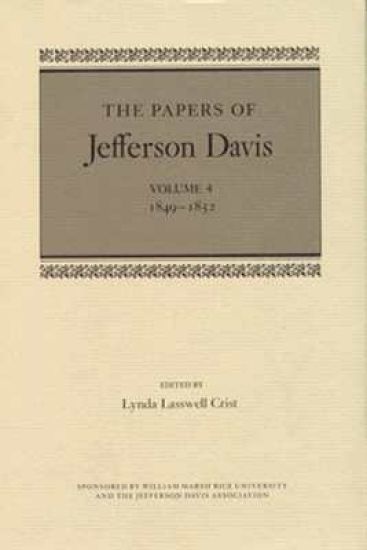
In Volume 4 of The Papers of Jefferson Davis, which covers the years 1849 to 1852, Davis had clearly chosen politics ar his life's work. He relished in his role as Mississippi's senior senator and willingly assumed the responsibility of being a national spokesman for the South. This period also saw a number of events in Davis' personal life, notably the birth of his first child and the beginning of a long estrangement from his brother Joseph.In January, 1849, Davis signed the Southern Address, although he occasionally disagreed with the extreme positions of its author, John C. Calhoun. Outside the Senate, Davis supported the objectives of the Nashville Convention and, later, the idea of a southern congress. During the crisis of 1850 Davis spoke often on such key issues as the regulation of slavery in the territories, the extension of the Missouri Compromise line, the admission of California, the Texas-New Mexico boundary, the continuation of the slave trade in the District of Columbia, and the Fugitive Slave Act. In 1851 he proposed purchasing camels for military transportation and urged that a Pacific railroad route be considered in the definition of the Mexican boundary. As a loyal Democrat, Davis had supported Lewis Cass in 1848, but he was a conspicuous personal favourite of Zachary Taylor, the new Whig president and his former father-in-law. In 1850 Taylor reportedly intervened to prevent a duel between Illinois representative William H. Bissell and Davis, who was incensed by Bissell's remarks about the Mississippi regiment at Buena Vista. Soon after joining the Taylor family at the president's deathbed in July, 1850, Davis defended Taylor's Mexican War performance in well-publicized Senate speech. Between sessions in 1849 Davis canvassed Mississippi, addressing gatherings throughout the state in favour of congressional candidates. He warned of northern aggressions, yet urged the exhaustion of all means of peaceful resistance before secession be considered. When he returned home after the arduous 1850 session, he defended his course, denying charges that he was a disunionist. In February, 1850, Davis had been reelected to the Senate for a full six-year term, but in September, 1851, he resigned to accept the Sate Rights nomination for governor in opposition to Union nominee Henry Foote. Although illness precluded much active campaigning in the few weeks before the election, Davis substantially reduced the Union lead and lost by a narrow margin. A private citizen for the first time since 1845, Davis continued his involvement in politics. Despite nagging personal problems and ill health, he promoted Democratic unity and took to the stump for Franklin Pierce in 1852.