
Kirjahaku
Etsi kirjoja tekijän nimen, kirjan nimen tai ISBN:n perusteella.
1000 tulosta hakusanalla John Calvin

John Calvin: The Organizer Of Reformed Protestantism 1509 To 1564
Williston Walker
Literary Licensing, LLC
2014
nidottu
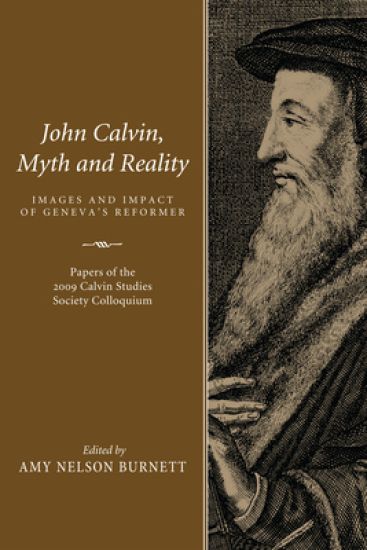
John Calvin, Myth and Reality
Cascade Books
2011
sidottu
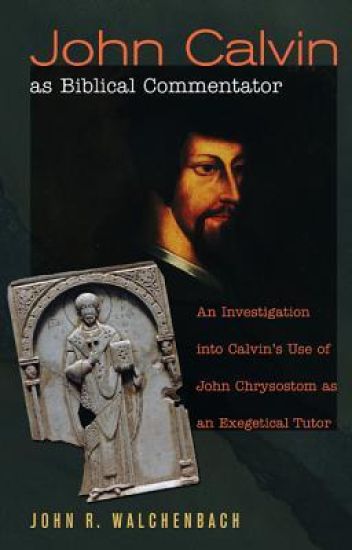
The year 2009 brought with it the 500th anniversary of the birth of John Calvin, a global celebration. With this commemorative event came a new and renewed appreciation for the life and thought of the French Reformer and his profound impact on the world. Scholars universally have acknowledged that while ""The Theologian of Geneva"" is mostly appreciated for his Institutes of the Christian Religion, it is Calvin as a biblical commentator that needs to be taken with revised interest. When Calvin first set out to write a commentary on virtually every book of the Bible, he was drawn to the exegetical work of the great Greek Patriarch of the fourth century, John Chrysostom, because of his ""straightforward, non-allegorical approach to the genuine, simple sense of the text."" It was also the method of Chrysostom to which Calvin was attracted, ""a continuous exposition"" that explains each verse. Calvin, in his life long work to produce commentaries on sacred Scripture, sought to emulate the approach and method of the amazing early church theologian, John Chrysostom. This book celebrates Calvin as Biblical commentator, and what he saw in the literary work of the Greek Father that was so influential on Calvin's immense contribution to our understanding the Bible. ""The publication of John Calvin as Biblical Commentator will at last bring the wide recognition that John Walchenbach's groundbreaking dissertation has always deserved. In one remarkable work he advanced two areas of Calvin research that were both in their infancy at the time: Calvin as biblical interpreter, and Calvin as a student of the early church teachers. Though both areas of Calvin research have grown considerably in recent years, Walchenbach's work is a benchmark to which we all return."" --Randall C. Zachman University of Notre Dame ""One of the first dissertations I ever bought was John Walchenbach's study of Calvin's use of Chrysostom, which was regarded as a kind of classic for the way it framed the history of exegesis questions in Calvin studies in terms of Calvin's use of this influential church father. Appearing in 1974, it was largely ahead of the pack in its field and served as a model for many of us who were cutting our teeth on Calvin and exegesis in the decade that followed. Students today can still benefit from studying Walchenbach's approach, arguments, and conclusions."" --John L. Thompson Fuller Theological Seminary ""John Calvin is best known as a reformer and theologian. However, biblical scholars as well as Calvin specialists point out the riches of his biblical expositions found in his sermons and commentaries as well as 'The Institutes.' What is frequently overlooked, however, is Calvin's indebtedness to Chrysostom, the greatest expositor of the early church. This outstanding study of Jack Walchenbach makes a distinctive contribution to our understanding of Calvin's exegetical approach."" --John Hesselink Western Theological Seminary, Emeritus John R. Walchenbach earned both the ThM and PhD under Ford Lewis Battles at Pittsburgh Theological Seminary and the University of Pittsburgh. He has served as a pastor in both the Reformed Church in America and the Presbyterian Church (USA). He is the author of a new curriculum on John Calvin for Congregational Ministries Publishing of the Presbyterian Church.

John Calvin: The Spirit and the Letter - Chirographic and semiotic studies
Z. W. Wolkowski
Createspace Independent Publishing Platform
2015
nidottu
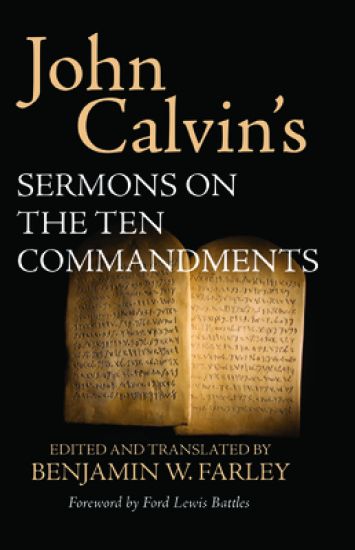
John Calvin's Sermons on the Ten Commandments
John Calvin; Ford Lewis Battles
Wipf Stock Publishers
2019
pokkari
A collection of sixteen sermons by John Calvin that shed light on his understanding and application of the Ten Commandments. Widely known as one of the church's most significant theologians, John Calvin was also a skilled preacher with the ability to proclaim biblical truth with power and relevance. These sermons develop the essence of his teaching on the moral law in a popular and engaging manner. Pastors preaching through the Ten Commandments, Bible students, and anyone interested in Calvin's views on the Ten Commandments will take great delight in reading his exposition of the Decalogue, which is called ""the true and eternal rule of righteousness for all] who wish to conform their lives to God's will.""
John Calvin's Sermons on the Ten Commandments
John Calvin; Ford Lewis Battles
Wipf Stock Publishers
2019
sidottu
A collection of sixteen sermons by John Calvin that shed light on his understanding and application of the Ten Commandments. Widely known as one of the church's most significant theologians, John Calvin was also a skilled preacher with the ability to proclaim biblical truth with power and relevance. These sermons develop the essence of his teaching on the moral law in a popular and engaging manner. Pastors preaching through the Ten Commandments, Bible students, and anyone interested in Calvin's views on the Ten Commandments will take great delight in reading his exposition of the Decalogue, which is called "the true and eternal rule of righteousness for all] who wish to conform their lives to God's will."

This book offers a robust introduction to John Calvin's writings through the lens of his experience as a religious refugee.Calvin knew about persecution and political exile from personal experience. He lived as an exiled fugitive engaged in pastoral ministry to a church that included large numbers of immigrants and refugees. Calvin's teaching also addressed an international community experiencing religious violence and displacement in his day. In this engaging book, Kenneth Woo demonstrates how Calvin sought to make the comfort he found in God accessible to others through sermons, commentaries, letters, polemical treatises, and his magisterial Institutes. In his distinct-yet-inseparable roles as teacher, pastor, and polemicist, the reformer adapted his message of hope in exile to diverse audiences. Woo shows how Calvin's theology is an example of Reformed Christianity's refugee roots and history of pastoral care from the margins. And in a brief conclusion, he offers reflections on what a greater awareness of Calvin as refugee theologian could mean for those engaging his theology today.John Calvin, Refugee Theologian helps students read Calvin for themselves, attuned to how his theology reflected dynamics of religious violence and migration in his day, making this book especially useful for undergraduate and seminary classes on Calvin, the Reformation, and the history of Christianity. It will also appeal to pastors and Christian educators.
This work makes three important contributions to Calvin studies and, more generally, adds to the growing literature on anthropology in the Middle Ages, Renaissance, and Reformation. First it challenges the prevalent bias toward focusing on Calvin's doctrine of God to the neglect of his doctrine of humankind. Second, it provides an original and provocative interpretation of the overall structure of Calvin's anthropology. And third, Engel's analysis of specific issues (imago dei, reason, and faith, the will, immortality and resurrection) present helpful insights into those areas of Calvin's thought which remain controversial. 'John Calvin's Perspectival Anthropology' succeeds T.F. Torrance's Calvin's Doctrine of Man as the second full-length examination of Calvin's anthropology.

John Calvin, Myth and Reality
Wipf Stock Publishers
2011
pokkari
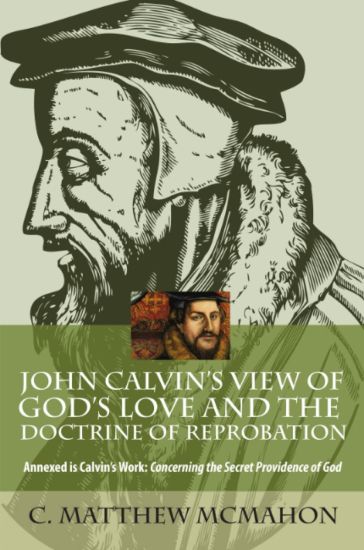
John Calvin's View of God's Love and the Doctrine of Reprobation
C Matthew McMahon
Puritan Publications
2015
pokkari
This new work explains the relationship between God's love and the reprobation of the wicked, aiding the reader to understand more simply the view of the Reformation's brightest Reformer, John Calvin (1509-1564). In this analysis of Calvin's view, McMahon explores Calvin's thoughts concerning reconciling God's love and the damnation of the reprobate. He explains Calvin's doctrine of accommodation, centering on understanding the difference between the will of God's decree and the precepts of God's word. Also analyzed is Calvin's view of God's province as Supreme Ruler over creation, Calvin's view of hardening the reprobate's heart, and his view of the Gospel call when the reprobate are called to repent and believe the Gospel. McMahon is an American Calvinist Reformed theologian and adjunct professor at Whitefield Theological Seminary. He is the founder of A Puritan's Mind and Puritan Publications which publishes Reformed and Puritan works from the 17th century.
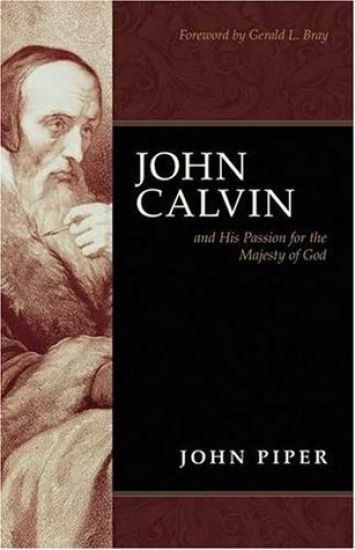
John Piper fires readers' passion for the centrality and supremacy of God by unfolding Calvin's exemplary zeal for the glory of God. John Calvin's aim, he wrote, was to 'set before, as the prime motive of his existence, zeal to illustrate the glory of God' - a fitting banner over all of the great Reformer's life and work. 'The essential meaning of Calvin's life and preaching,' writes John Piper, 'is that he recovered and embodied a passion for the absolute reality and majesty of God. Such is the aim and burden of this book as well.' As Piper concisely unfolds this predominant theme in Calvin's life, he seeks to fire every Christian's passion for the centrality and supremacy of God, so that God's self-identification in Exodus 3 as 'I am who I am' becomes the sun in our solar system too.
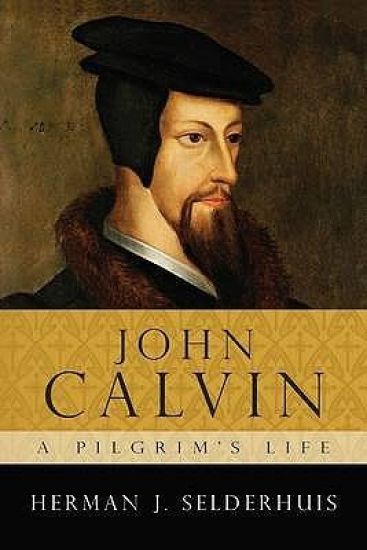
There are many biographies of John Calvin, the theologian - some vilifying him and others extolling his virtues - but few that reveal John Calvin, the man. Professor and renowned Reformation historian Herman Selderhuis has written this book to bring Calvin near to the reader, showing him as a man who had an impressive impact on the development of the Western world, but who was first of all a believer struggling with God and with the way God governed both the world and his own life. Selderhuis draws on Calvin's own publications and commentary on the biblical figures with whom he strongly identified to describe his theology in the context of his personal development. Throughout we see a person who found himself alone at many of the decisive moments of his life - a fact that echoed through Calvin's subsequent sermons and commentaries. Selderhuis's unique and compelling look at John Calvin, with all of his merits and foibles, ultimately discloses a man who could not find himself at home in the world in which he lived.
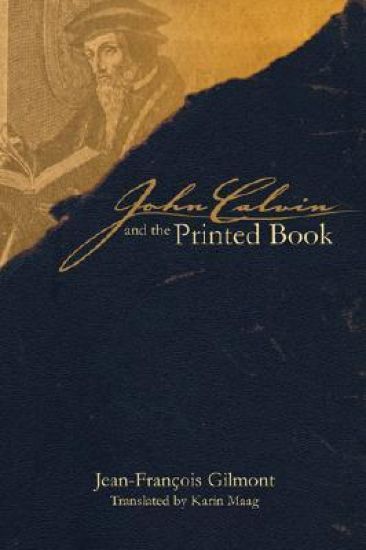
John Calvin made a significant contribution to the world of early modern printing. Jean-Francois Gilmont, one of the foremost experts in the field, has thoroughly researched and presented all aspects of John Calvin's interaction with books - from the authors he read, to the works he wrote, to his relationships with the printing and publishing world of the sixteenth century. Originally in French, Karin Maag makes Gilmont's research available in this English translation.
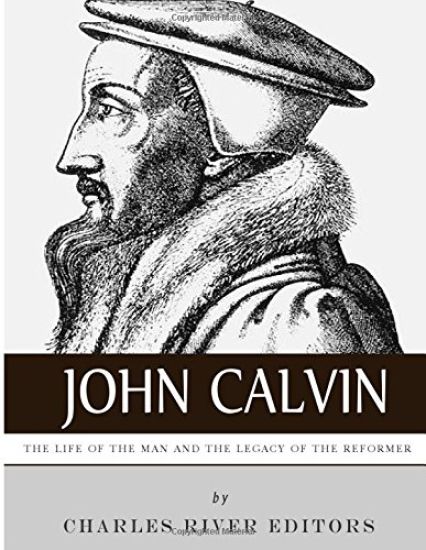
John Calvin: The Life of the Man and the Legacy of the Reformer
Charles River
Createspace Independent Publishing Platform
2017
nidottu
*Includes pictures of Calvin and important people. *Explains Calvin's theological beliefs and his break with the Catholic Church. *Includes a Bibliography for further reading. "God by a sudden conversion subdued and brought my mind to a teachable frame, which was more hardened in such matters than might have been expected from one at my early period of life. Having thus received some taste and knowledge of true godliness, I was immediately inflamed with so intense a desire to make progress therein, that although I did not altogether leave off other studies, yet I pursued them with less ardour." - John Calvin, Commentary on the Book of Psalms John Calvin (1509-1564) was one of the most important religious figures of the last millennium and an instantly recognizable name across the globe. An influential French theologian and pastor during the Protestant Reformation, the period when he was most active, namely the 1530s and 1540s, was marked by increased complexity and the diffusion of the Reformation into several branches. Alongside Martin Luther, Calvin was one of the central Reformers, and after fleeing to Basel, Switzerland, he published the Institutes of the Christian Religion in 1536. Calvin was a tireless and controversial worker who corresponded with other leading reformers of the day, but he was also a deeply theological man who published his own interpretations and teachings on Scripture. Today, he is chiefly remembered for the religious proponents that bear his name as Calvinists, and their steadfast devotion to the doctrine of predestination and the absolute sovereignty of God in salvation of the human soul from death and eternal damnation. Like Martin Luther, it has become hard to separate fact from fiction when it comes to historical accounts of Calvin, and it's just as difficult to determine what (if any) distinctions exist between the thoughts and writings of Calvin and the evolution of the Calvinists over the last 4 centuries. John Calvin: The Life of the Man and the Legacy of the Reformer provides an objective and comprehensive overview of Calvin's life while thoroughly contextualizing both the history of his life and the legacy of his work. Along with excerpts of his writings, a bibliography, and pictures depicting important people, places, and events, you will learn about John Calvin like you never have before, in no time at all.

John Calvin and the Righteousness of Works
Kevin P Emmert
VANDENHOECK RUPRECHT GMBH CO KG
2021
sidottu
John Calvin's understanding of works-righteousness is more complex than is often recognized. While he denounces it in some instances, he affirms it in others. This study shows that Calvin affirms works-righteousness within the context where faith-righteousness is already established, and that he even teaches a form of justification by works. Calvin ascribes not only a positive role to good works in relation to divine acceptance, but also soteriological value to believers' good works. This study demonstrates such by exploring Calvin's theological anthropology, his understanding of divine-human activity, his teaching on the nature of good works, and his understanding of divine grace and benevolence. It also addresses current debates in Calvin scholarship by exploring topics such as union with Christ, the relation between justification and sanctification, the relation between good works and divine acceptance, the role of good works in the Christian life, and the content of good works.
John Calvin, the Ascension, and the Papacy
Kevin Chiarot
Lap Lambert Academic Publishing
2016
nidottu