Kirjojen hintavertailu. Mukana 11 452 133 kirjaa ja 12 kauppaa.

Kirjahaku

Etsi kirjoja tekijän nimen, kirjan nimen tai ISBN:n perusteella.

1000 tulosta hakusanalla John Gilbert

The Art of Acrobatic Dancing: The Only Descriptive Acrobatic Book in the World
""The Art of Acrobatic Dancing"" by John Gilbert Keeling is a comprehensive guide to the world of acrobatic dance. This book is the only descriptive acrobatic book in the world and covers everything from basic acrobatic techniques to advanced moves and routines. The book is divided into several sections, each focusing on a different aspect of acrobatic dance. The first section covers the basics of acrobatics, including stretching, conditioning, and safety techniques. The second section delves into the various types of acrobatic dance, including partner acrobatics, group acrobatics, and solo acrobatics. The third section focuses on the art of choreography and how to create stunning acrobatic dance routines that are both visually impressive and technically challenging. The fourth section covers the business side of acrobatic dance, including marketing, branding, and networking strategies. Throughout the book, Keeling provides detailed descriptions and step-by-step instructions for each acrobatic move and routine, as well as tips and tricks for mastering each technique. The book also includes stunning photographs and illustrations that bring the world of acrobatic dance to life. Overall, ""The Art of Acrobatic Dancing"" is a must-read for anyone interested in acrobatics, dance, or performance art. Whether you are a beginner or an experienced acrobat, this book will provide you with the knowledge and inspiration you need to take your skills to the next level.This is a new release of the original 1929 edition.This scarce antiquarian book is a facsimile reprint of the old original and may contain some imperfections such as library marks and notations. Because we believe this work is culturally important, we have made it available as part of our commitment for protecting, preserving, and promoting the world's literature in affordable, high quality, modern editions, that are true to their original work.
Experimental Organic Chemistry

Experimental Organic Chemistry

John Gilbert; Stephen Martin

Brooks/Cole
2015
sidottu
Perform chemistry experiments with skill and confidence in your organic chemistry lab course with this easy-to-understand lab manual. EXPERIMENTAL ORGANIC CHEMISTRY: A MINISCALE AND MICROSCALE APPROACH, Sixth Edition first covers equipment, record keeping, and safety in the laboratory, then walks you step by step through the laboratory techniques you'll need to perform all experiments. Individual chapters show you how to use the techniques to synthesize compounds and analyze their properties, complete multi-step syntheses of organic compounds, and solve structures of unknown compounds. New experiments in Chapter 17 and 18 demonstrate the potential of chiral agents in fostering enantioselectivity and of performing solvent-free reactions. A bioorganic experiment in Chapter 24 gives you an opportunity to accomplish a mechanistically interesting and synthetically important coupling of two a-amino acids to produce a dipeptide.
Knuckles and Gloves

Knuckles and Gloves

John Gilbert Bohun Lynch

Sagwan Press
2018
pokkari
This work has been selected by scholars as being culturally important, and is part of the knowledge base of civilization as we know it. This work was reproduced from the original artifact, and remains as true to the original work as possible. Therefore, you will see the original copyright references, library stamps (as most of these works have been housed in our most important libraries around the world), and other notations in the work.This work is in the public domain in the United States of America, and possibly other nations. Within the United States, you may freely copy and distribute this work, as no entity (individual or corporate) has a copyright on the body of the work.As a reproduction of a historical artifact, this work may contain missing or blurred pages, poor pictures, errant marks, etc. Scholars believe, and we concur, that this work is important enough to be preserved, reproduced, and made generally available to the public. We appreciate your support of the preservation process, and thank you for being an important part of keeping this knowledge alive and relevant.
Word Building

Word Building

John Gilbert Thompson; Inez Bigwood

Palala Press
2018
pokkari
This work has been selected by scholars as being culturally important, and is part of the knowledge base of civilization as we know it. This work was reproduced from the original artifact, and remains as true to the original work as possible. Therefore, you will see the original copyright references, library stamps (as most of these works have been housed in our most important libraries around the world), and other notations in the work.This work is in the public domain in the United States of America, and possibly other nations. Within the United States, you may freely copy and distribute this work, as no entity (individual or corporate) has a copyright on the body of the work.As a reproduction of a historical artifact, this work may contain missing or blurred pages, poor pictures, errant marks, etc. Scholars believe, and we concur, that this work is important enough to be preserved, reproduced, and made generally available to the public. We appreciate your support of the preservation process, and thank you for being an important part of keeping this knowledge alive and relevant.
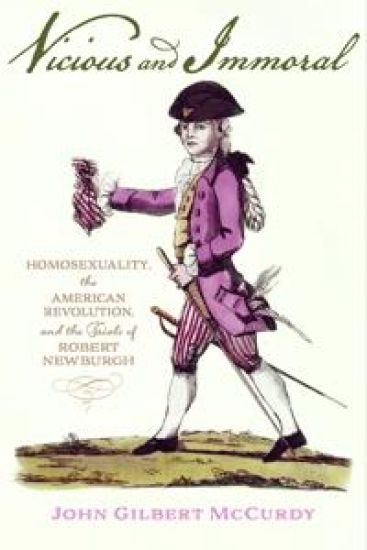
Vicious and Immoral

Vicious and Immoral

John Gilbert McCurdy

Johns Hopkins University Press
2024
sidottu
The fascinating story of a British army chaplain's buggery trial in 1774 reveals surprising truths about early America.On the eve of the American Revolution, the British army considered the case of a chaplain, Robert Newburgh, who had been accused of having sex with a man. Newburgh's enemies cited his flamboyant appearance, defiance of military authority, and seduction of soldiers as proof of his low character. Consumed by fears that the British Empire would soon be torn asunder, his opponents claimed that these supposed crimes against nature translated to crimes against the king. In Vicious and Immoral, historian John McCurdy tells this compelling story of male intimacy and provides an unparalleled glimpse inside eighteenth-century perceptions of queerness. By demanding to have his case heard, Newburgh invoked Enlightenment ideals of equality, arguing passionately that his style of dress and manner should not affect his place in the army or society. His accusers equated queer behavior with rebellion, and his defenders would go on to join the American cause. Newburgh's trial offers some clues to understanding a peculiarity of the late eighteenth and early nineteenth century: while gay acts were prohibited by law in much of the British empire, the newly formed United States was comparatively uninterested in legislating against same-sex intimacy. McCurdy imagines what life was like for a gay man in early America and captures the voices of those who loved and hated Newburgh, revealing how sexuality and revolution informed one another. Vicious and Immoral is the first book to place homosexuality in conversation with the American Revolution, and it dares us to rethink the place of LGBTQ people in the founding of the nation.
Quarters

Quarters

John Gilbert McCurdy

Cornell University Press
2019
sidottu
When Americans declared independence in 1776, they cited King George III "for quartering large bodies of armed troops among us." In Quarters, John Gilbert McCurdy explores the social and political history behind the charge, offering an authoritative account of the housing of British soldiers in America. Providing new interpretations and analysis of the Quartering Act of 1765, McCurdy sheds light on a misunderstood aspect of the American Revolution. Quarters unearths the vivid debate in eighteenth-century America over the meaning of place. It asks why the previously uncontroversial act of accommodating soldiers in one's house became an unconstitutional act. In so doing, Quarters reveals new dimensions of the origins of Americans' right to privacy. It also traces the transformation of military geography in the lead up to independence, asking how barracks changed cities and how attempts to reorder the empire and the borderland led the colonists to imagine a new nation. Quarters emphatically refutes the idea that the Quartering Act forced British soldiers in colonial houses, demonstrates the effectiveness of the Quartering Act at generating revenue, and examines aspects of the law long ignored, such as its application in the backcountry and its role in shaping Canadian provinces. Above all, Quarters argues that the lessons of accommodating British troops outlasted the Revolutionary War, profoundly affecting American notions of place. McCurdy shows that the Quartering Act had significant ramifications, codified in the Third Amendment, for contemporary ideas of the home as a place of domestic privacy, the city as a place without troops, and a nation with a civilian-led military.
Citizen Bachelors

Citizen Bachelors

John Gilbert McCurdy

Cornell University Press
2019
pokkari
In 1755 Benjamin Franklin observed "a man without a wife is but half a man" and since then historians have taken Franklin at his word. In Citizen Bachelors, John Gilbert McCurdy demonstrates that Franklin's comment was only one side of a much larger conversation. Early Americans vigorously debated the status of unmarried men and this debate was instrumental in the creation of American citizenship. In a sweeping examination of the bachelor in early America, McCurdy fleshes out a largely unexamined aspect of the history of gender. Single men were instrumental to the settlement of the United States and for most of the seventeenth century their presence was not particularly problematic. However, as the colonies matured, Americans began to worry about those who stood outside the family. Lawmakers began to limit the freedoms of single men with laws requiring bachelors to pay higher taxes and face harsher penalties for crimes than married men, while moralists began to decry the sexual immorality of unmarried men. But many resisted these new tactics, including single men who reveled in their hedonistic reputations by delighting in sexual horseplay without marital consequences. At the time of the Revolution, these conflicting views were confronted head-on. As the incipient American state needed men to stand at the forefront of the fight for independence, the bachelor came to be seen as possessing just the sort of political, social, and economic agency associated with citizenship in a democratic society. When the war was won, these men demanded an end to their unequal treatment, sometimes grudgingly, and the citizen bachelor was welcomed into American society. Drawing on sources as varied as laws, diaries, political manifestos, and newspapers, McCurdy shows that in the course of the seventeenth and eighteenth centuries the bachelor was a simultaneously suspicious and desirable figure: suspicious because he was not tethered to family and household obligations yet desirable because he was free to study, devote himself to political office, and fight and die in battle. He suggests that this dichotomy remains with us to this day and thus it is in early America that we find the origins of the modern-day identity of the bachelor as a symbol of masculine independence. McCurdy also observes that by extending citizenship to bachelors, the founders affirmed their commitment to individual freedom, a commitment that has subsequently come to define the very essence of American citizenship.