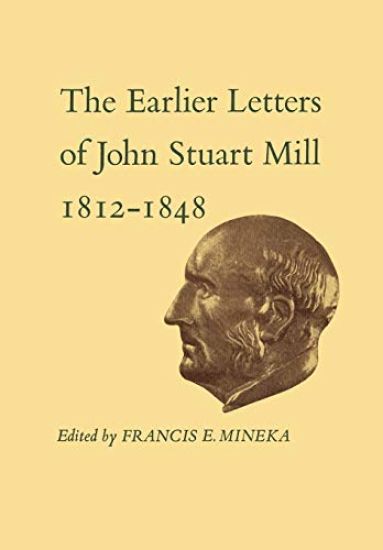
These volumes of Mill's letters have been awaited eagerly by all scholars in the field of nineteenth-century studies. They inaugurate most auspiciously the edition of the Collected Works of John Stuart Mill planned and directed by an editorial committee appointed from the Faculty of Arts and Science of the University of Toronto and from the University of Toronto Press. In this collection of 537 letters and excerpts of letters are included all the personal letters available. It contains 238 hitherto unpublished letters and 72 letters with previously unpublished passages. Letters previously published have been recollated whenever possible. All are meticulously edited and annotated.
John Stuart Mill, (20 May 1806 - 8 May 1873) was an English philosopher, political economist and civil servant. He was an influential contributor to social theory, political theory and political economy. He has been called "the most influential English-speaking philosopher of the nineteenth century". Mill's conception of liberty justified the freedom of the individual in opposition to unlimited state control. He was a proponent of utilitarianism, an ethical theory developed by Jeremy Bentham. Hoping to remedy the problems found in an inductive approach to science, such as confirmation bias, he clearly set forth the premises of falsifiability as the key component in the scientific method. Mill was also a Member of Parliament and an important figure in liberal political philosophy.
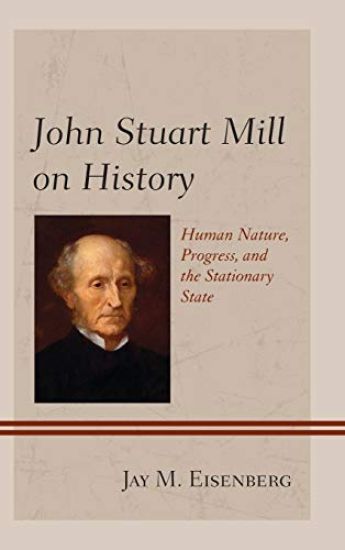
Though Mill has been the subject of an imposing volume of scholarship, his philosophy of history has received scant attention. This inquiry considers the role of history in Mill’s break from the Benthamite radicals, his effort to define a methodology for the study of society modelled on the natural sciences, and his speculations about the course and meaning of history. A dominant theme is Mill’s struggle to reconcile his ambition to develop a comprehensive science of society with his convictions that human nature is malleable and that history progresses as a consequence of intellectual achievement and diversity of beliefs. Mill’s compatibilist vision of the individual as driven by deterministic psychological laws and as also capable of freely choosing a life of autonomous “self-culture” was mirrored in his philosophy of history, as Mill retained the materialistic stadial theory of social development proposed during the Scottish Enlightenment, and an idealistic vision of history derived from the Saint-Simonians, Guizot and Comte. Though Mill claimed the primacy of the intellect in advancing material living conditions, he believed that the culmination of instrumental rationalism in his own Age of Commerce was undermining and marginalizing other forms of individual accomplishment—indeed, individuality itself—in the suffocating conformity of mass culture. Mindful of what he considered to be the culturally stationary states of Asia, Mill dreaded the prospect that a commercial culture with no higher ambition than the acquisition of ever-greater wealth would also become inert as the consequence of overbearing social conventions and intellectual stagnation. Like Smith and Ricardo, Mill anticipated the inevitability of the economically stationary state as the consequence of the fall in the rate of profits under free market capitalism, but rather than await its arrival, Mill seized on its possibilities. The stationary state became Mill’s vehicle for advocating an egalitarian supra-subsistence economy in the expectation that cultural priorities would shift to the pursuit of higher moral, intellectual and aesthetic aspirations, and the revitalization of individual autonomy.
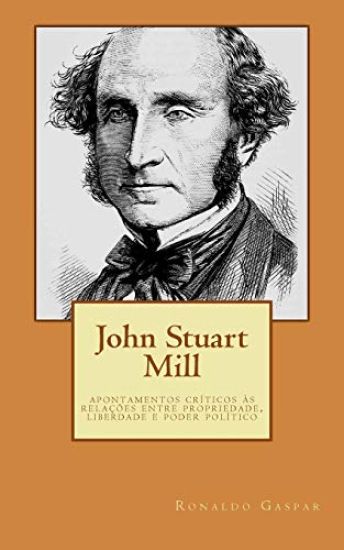
Neste livro, faz-se uma reflex o cr tica sobre o pensamento pol tico de John Stuart Mill. Suas ideias s o, ao mesmo tempo, expostas de modo detalhado e criticamente analisadas, permitindo-se, assim, mostrar tanto suas conquistas te ricas como os limites de seu reformismo liberal.
John Stuart Mill; His Life and Works is a classic biography of the great English philosopher by Herbert Spencer. John Stuart Mill (20 May 1806 - 8 May 1873) was a British philosopher, political economist and civil servant. One of the most influential thinkers in the history of liberalism, he contributed widely to social theory, political theory and political economy. Dubbed "the most influential English-speaking philosopher of the nineteenth century", Mill's conception of liberty justified the freedom of the individual in opposition to unlimited state and social control. Mill was a proponent of utilitarianism, an ethical theory developed by his predecessor Jeremy Bentham. He contributed to the investigation of scientific methodology, though his knowledge of the topic was based on the writings of others, notably William Whewell, John Herschel and Auguste Comte, and research carried out for Mill by Alexander Bain. Mill engaged in written debate with Whewell. A member of the Liberal Party, he was also the first Member of Parliament to call for women's suffrage. John Stuart Mill was born at 13 Rodney Street in Pentonville, Middlesex, the eldest son of the Scottish philosopher, historian and economist James Mill, and Harriet Burrow. John Stuart was educated by his father, with the advice and assistance of Jeremy Bentham and Francis Place. He was given an extremely rigorous upbringing, and was deliberately shielded from association with children his own age other than his siblings. His father, a follower of Bentham and an adherent of associationism, had as his explicit aim to create a genius intellect that would carry on the cause of utilitarianism and its implementation after he and Bentham had died. Mill was a notably precocious child. He describes his education in his autobiography. At the age of three he was taught Greek. 11] By the age of eight, he had read Aesop's Fables, Xenophon's Anabasis, 11] and the whole of Herodotus, 11] and was acquainted with Lucian, Diogenes La rtius, Isocrates and six dialogues of Plato. 11] He had also read a great deal of history in English and had been taught arithmetic, physics and astronomy. At the age of eight, Mill began studying Latin, the works of Euclid, and algebra, and was appointed schoolmaster to the younger children of the family. His main reading was still history, but he went through all the commonly taught Latin and Greek authors and by the age of ten could read Plato and Demosthenes with ease. His father also thought that it was important for Mill to study and compose poetry. One of Mill's earliest poetic compositions was a continuation of the Iliad. In his spare time he also enjoyed reading about natural sciences and popular novels, such as Don Quixote and Robinson Crusoe. His father's work, The History of British India was published in 1818; immediately thereafter, at about the age of twelve, Mill began a thorough study of the scholastic logic, at the same time reading Aristotle's logical treatises in the original language. In the following year he was introduced to political economy and studied Adam Smith and David Ricardo with his father, ultimately completing their classical economic view of factors of production. Mill's comptes rendus of his daily economy lessons helped his father in writing Elements of Political Economy in 1821, a textbook to promote the ideas of Ricardian economics; however, the book lacked popular support. 12] Ricardo, who was a close friend of his father, used to invite the young Mill to his house for a walk in order to talk about political economy.