

Kirjahaku
Etsi kirjoja tekijän nimen, kirjan nimen tai ISBN:n perusteella.
1000 tulosta hakusanalla Judith Cook

Judith
BoD - Books on Demand
2026
pokkari

A lavishly illustrated retrospective in celebration of 100 years since Judith Kerr’s birth, author of The Tiger Who Came to Tea and many other iconic books. Judith Kerr was one of the best-loved authors and illustrators to ever put pencil to paper. The books she created, including The Tiger Who Came to Tea, Mog the Forgetful Cat, When Hitler Stole Pink Rabbit and many many more, have become classics of children’s literature, loved by generations of readers. But what of the life behind the iconic characters? Judith’s own story is riveting, from her early childhood in Berlin, dramatically cut short by the family having to flee the rising Nazi Party, to her time at the BBC in the 1950s and her long and happy marriage to the celebrated screenwriter Nigel Kneale, creator of British television’s first major hit, The Quatermass Experiment. The joy of this very special book is in hearing this story from Judith herself, accompanied by a treasure trove of illustrations and memorabilia. All combine to give an unforgettable insight into the creative process behind these beloved stories. This book was published in 2013, but Judith continued to work up until her death in 2019. While she may have gone, her creatures live on. They are much-loved characters who spring to life from the pages of her books, but they are also those who have played a part in her inspirational life. They are to be found here, in a book to cherish and return to again and again. In 2023 we celebrate 100 years since Judith’s birth and in this updated edition, her final working years have been wonderfully evoked in a new chapter written by Judith’s son, the author, Matthew Kneale.

Share in the magic with five classic stories from Judith Kerr, the creator of the iconic The Tiger Who Came to Tea and Mog the Forgetful Cat.

Selected Writings of Judith Sargent Murray
Judith Sargent Murray
Oxford University Press Inc
1996
sidottu
BLIncludes selections from The Gleaner, her major work, and other publications As a novelist, essayist, dramatist, and poet, Judith Sargent Murray candidly and often humorously asserted her opinions about the social and political conditions of women in late eighteenth-century America. As a committed feminist, she urged American women to enter a `new era in female history', yet published her own writings under a man's name in the hopes of more widely disseminating her ideas.

Selected Writings of Judith Sargent Murray
Judith Sargent Murray
Oxford University Press Inc
1996
nidottu
As a novelist, essayist, dramatist, and poet, Judith Sargent Murray candidly and often humorously asserted her opinions about the social and political conditions of women in late eighteenth-century America. As a committed feminist, she urged American women to enter a "new era in female history", yet published her own writings under a man's name in the hopes of more widely disseminating her ideas. This volume includes selections from The Gleaner, her major work, and other publications.

Die junge JYdin Judith Trachtenberg lebt in einem Ghetto im damals ssterreichischen Galizien in SYdpolen. Auf einem Ball lernt sie den Graf Agenor Baranowski kennen. Sie verlieben sich...

The Old Testament story of the widow Judith—the irresistible siren who lured her people’s deadly enemy, Holofernes, to his death, beheading him in his own bed to save Jerusalem—is an enduring cultural myth in Western society. In this original and provocative book, Margarita Stocker explores the Western fascination with the image of Judith and the abundance of interpretations that have surrounded her at different times between the early Middle Ages and the present day. The myth of Judith provides an important key to modern society’s view of women and power, the book argues. In dealing with the threatening image of a powerful femme fatale who is also a saint, the vested interests of Western culture have deliberately, often deviously, subverted images of sex and death as a way of marginalizing women and protecting traditional notions of masculinity. The book investigates the periodic resurgence of the Judith legend and how the myth and history become confused. An ambiguous figure, Judith has served symbolic purposes for such diverse groups as Protestant partisans during the Wars of Religion and their Catholic counterparts, aristocratic women supporters of the Protestant Reformation, opponents of the French Revolution, Nazi myth- makers, filmmakers obsessed with gun-toting girls, freedom fighters, partisans in the former Yugoslavia, and many others. Judith’s various guises illuminate central issues of Western consciousness—sex, death, violence, politics, beliefs, identity, psychology, and perversion. In exploring the theme of Judith, an alternative history of Western attitudes emerges. Judith is not so much a killer as a liberating figure challenging our thinking about women and power and showing ways to break free from unconscious attitudes that imprison us.

Judith Butler and Education
Routledge
2020
nidottu
The work of Judith Butler has been at the forefront of both theorising the subject as a product of power and explicating possibilities for political alliances and action that are available to such subjects. Mobilising a range of philosophical resources from Hegel and Foucault to Lacan, Levinas Wittig and Arendt, her work has held a core concern with the way that the subject is made in terms of sex, gender and sexuality and has been an invaluable resource in the development of queer theory and thinking about queer practice. Butler’s scholarly work has been aimed primarily at a philosophical audience, yet her insights into the constitution, constraint and agency of subjects are profoundly political and have become invaluable resources in feminist, queer, anti-racist and anti-capitalist work. Over the last two decades she has been a major influence on research concerned with social justice in education and has changed the ways that classroom practices and relationships can be understood, transforming the way we think about both ‘teacher’ and ‘student’. This collection brings together some of the most outstanding work in education that has developed and applied Butler’s work to empirical questions, translating her philosophy for an education audience and providing compelling analyses of the ways that the subjects of education are made, how inequalities are produced in the minutiae of practice and how education’s subjectivated subjects can act politically. The chapters in this book were originally published as articles in Taylor and Francis journals.
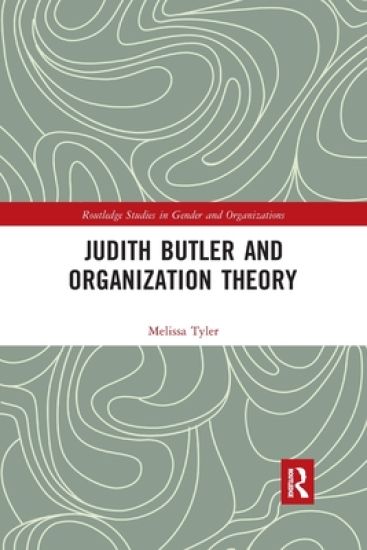
2020 will mark thirty years since the first publication of Judith Butler’s ground-breaking book, Gender Trouble. Here, and in subsequent work, Butler argues that gender and other forms of identity can best be understood as performative acts. These acts are what bring our subjectivities into existence, enabling us to be recognized as viable employable social beings, worthy of rights, responsibilities and respect. The three decades since the publication of Gender Trouble have witnessed Butler become one of the most widely cited and controversial figures in contemporary feminist thinking. While it is only in her most recent work that Butler has engaged directly with themes such as work and organization, her writing has profound implications for thinking, and acting, on the relationship between power, recognition and organization. Whilst her ideas have made important in-roads into work, organization and gender studies that are discussed here, there is considerable scope to explore further avenues that her concepts and theories open up. These inroads and avenues are the focus of this book.Judith Butler and Organization Theory makes a substantial contribution to the analysis of gender, work and organization. It not only covers central issues in Butler’s work, it also offers a close reading of the complexities and nuances in her thought. It does so by ‘reading’ Butler as a theorist of organization, whose work resonates with scholars, practitioners and activists concerned to understand and engage with organizational life, organization and organizing. Drawing from a range of illustrative examples, the book examines key texts or ‘moments’ in the development of Butler’s writing to date, positing her as a thinker concerned to understand and address the ways in which our most basic desire for recognition comes to be organized within the context of contemporary labour markets and workplaces. It examines insights from Butler’s work, and the philosophical ideas she draws on, considering the impact of these on work, organization and management studies thus far; it also explores some of the many ways in which her thinking might be mobilized in future, considering what scope there is for a non-violent ethics of organization, and for a (re)assembling of the relationship between vulnerability and resistance within and through organizational politics.

Since the publication of Gender Trouble in 1990, Judith Butler has revolutionised our understanding of identities and the ways in which they are constructed. This volume examines her critical thought through key texts, touching upon such issues as:* The subject* Gender* Sex* Language* The PsycheWith clear discussions of the context and impact of Butler's work and an extensive guide to further reading, this book offers an excellent introduction to one of the most influential critical thinkers writing today.

Since the publication of Gender Trouble in 1990, Judith Butler has revolutionised our understanding of identities and the ways in which they are constructed. This volume examines her critical thought through key texts, touching upon such issues as:* The subject* Gender* Sex* Language* The PsycheWith clear discussions of the context and impact of Butler's work and an extensive guide to further reading, this book offers an excellent introduction to one of the most influential critical thinkers writing today.

Judith Butler's work on gender, sexuality, identity, and the body has proved massively influential across a range of academic disciplines in the humanities and social sciences. Yet it is also notoriously difficult to access. This key book provides a comprehensive introduction to Butler's work, plus a critical examination of it and its precursors, both feminist (including Simone de Beauvoir, Monique Wittig, Julia Kristeva and Luce Irigaray), and non-feminist (including Erving Goffman, Michel Foucault, Jacques Lacan, and Jacques Derrida). The volume covers such topics as:gender as performance and performativity sociological notions of performancethe materiality of the body and the role of biologypower, identity and social regulationsubjectivity, agency and feminist political practice.A comprehensive introduction to Butler’s work, this book also covers melancholia and gender identity, hate speech, pornography and 'race', social change and transformation, and Butler’s shifting relation to psychoanalysis. Clearly laid out to cover key themes for a student audience, this text will be an essential read for undergraduates in the fields of gender, psychoanalysis and sociology.

Judith Butler's work on gender, sexuality, identity, and the body has proved massively influential across a range of academic disciplines in the humanities and social sciences. Yet it is also notoriously difficult to access. This key book provides a comprehensive introduction to Butler's work, plus a critical examination of it and its precursors, both feminist (including Simone de Beauvoir, Monique Wittig, Julia Kristeva and Luce Irigaray), and non-feminist (including Erving Goffman, Michel Foucault, Jacques Lacan, and Jacques Derrida). The volume covers such topics as:gender as performance and performativity sociological notions of performancethe materiality of the body and the role of biologypower, identity and social regulationsubjectivity, agency and feminist political practice.A comprehensive introduction to Butler’s work, this book also covers melancholia and gender identity, hate speech, pornography and 'race', social change and transformation, and Butler’s shifting relation to psychoanalysis. Clearly laid out to cover key themes for a student audience, this text will be an essential read for undergraduates in the fields of gender, psychoanalysis and sociology.

Over the past twenty-five years the work of Judith Butler has had an extraordinary impact on numerous disciplines and interdisciplinary projects across the humanities and social sciences. This original study is the first to take a thematic approach to Butler as a political thinker. Starting with an explanation of her terms of analysis, Judith Butler and Political Theory develops Butler’s theory of the political through an exploration of her politics of troubling given categories and approaches. By developing concepts such as normative violence and subversion and by elaborating her critique of heteronormativity, this book moves deftly between Butler’s earliest and most famous writings on gender and her more recent interventions in post-9/11 politics.This book, along with its companion volume, Judith Butler's Precarious Politics, marks an intellectual event for political theory, with major implications for feminism, women’s studies, gender studies, cultural studies, lesbian and gay studies, queer theory and anyone with a critical interest in contemporary American ‘great power’ politics.
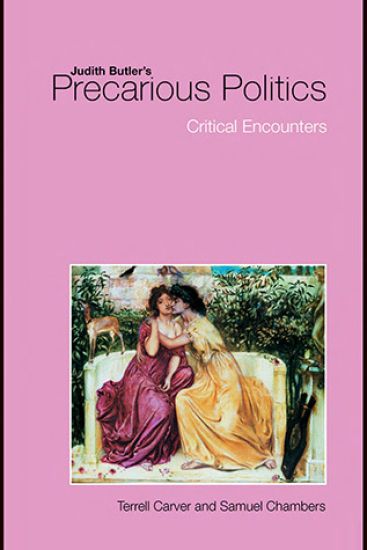
Judith Butler's Precarious Politics
Routledge
2008
sidottu
Judith Butler has been arguably the most important gender theorist of the past twenty years. This edited volume draws leading international political theorists into dialogue with her political theory.Each chapter is written by an acclaimed political theorist and concentrates on a particular aspect of Butler's work. The book is divided into five sections which reflect the interdisciplinary nature of Butler's work and activism: Butler and Philosophy: explores Butler’s unique relationship to the discipline of philosophy, considering her work in light of its philosophical contributions Butler and Subjectivity: covers the vexed question of subjectivity with which Butler has engaged throughout her published history Butler and Gender: considers the most problematic area, gender, taken by many to be primary to Butler’s work Butler and Democracy: engages with Butler’s significant contribution to the literature of radical democracy and to the central political issues faced by our post-cold war Butler and Action: focuses directly on the question of political agency and political action in Butler’s work. Along with its companion volume, Judith Butler and Political Theory, it marks an intellectual event for political theory, with major implications for feminism, women’s studies, gender studies, cultural studies, lesbian and gay studies, queer theory and anyone with a critical interest in contemporary American ‘great power’ politics.

Judith Butler's Precarious Politics
Routledge
2008
nidottu
Judith Butler has been arguably the most important gender theorist of the past twenty years. This edited volume draws leading international political theorists into dialogue with her political theory.Each chapter is written by an acclaimed political theorist and concentrates on a particular aspect of Butler's work. The book is divided into five sections which reflect the interdisciplinary nature of Butler's work and activism: Butler and Philosophy: explores Butler’s unique relationship to the discipline of philosophy, considering her work in light of its philosophical contributions Butler and Subjectivity: covers the vexed question of subjectivity with which Butler has engaged throughout her published history Butler and Gender: considers the most problematic area, gender, taken by many to be primary to Butler’s work Butler and Democracy: engages with Butler’s significant contribution to the literature of radical democracy and to the central political issues faced by our post-cold war Butler and Action: focuses directly on the question of political agency and political action in Butler’s work. Along with its companion volume, Judith Butler and Political Theory, it marks an intellectual event for political theory, with major implications for feminism, women’s studies, gender studies, cultural studies, lesbian and gay studies, queer theory and anyone with a critical interest in contemporary American ‘great power’ politics.

The first to use Judith Butler’s work as a reading of how the legal subject is formed, this book traces how Butler comes to the themes of ethics, law and politics analyzing their interrelation and explaining how they relate to Butler’s question of how people can have more liveable and viable lives.Acknowledging the potency and influence of Butler’s ‘concept’ of gender as process, which occupies a well developed and well discussed position in current literature, Elena Loizidou argues that the possibility of people having more liveable and viable lives is articulated by Butler within the parameters of a sustained agonistic relationship between the three spheres of ethics, law and politics.Suggesting that Butler’s rounded understanding of the interrelationship of these three spheres will enable critical legal scholarship, as well as critical theory more generally, to consider how the question of life’s unsustainable conditions can be rethought and redressed, this book is a key read for all students of legal ethics, political philosophy and social theory.

Over the past twenty-five years the work of Judith Butler has had an extraordinary impact on numerous disciplines and interdisciplinary projects across the humanities and social sciences. This original study is the first to take a thematic approach to Butler as a political thinker. Starting with an explanation of her terms of analysis, Judith Butler and Political Theory develops Butler’s theory of the political through an exploration of her politics of troubling given categories and approaches. By developing concepts such as normative violence and subversion and by elaborating her critique of heteronormativity, this book moves deftly between Butler’s earliest and most famous writings on gender and her more recent interventions in post-9/11 politics.This book, along with its companion volume, Judith Butler's Precarious Politics, marks an intellectual event for political theory, with major implications for feminism, women’s studies, gender studies, cultural studies, lesbian and gay studies, queer theory and anyone with a critical interest in contemporary American ‘great power’ politics.

How has Judith Butler’s writing contributed to thought in the Social Sciences and the Humanities? The participants in this project draw on various aspects of Butler’s conceptual work and they question how it has opened up the possibilities of thought in areas of study as diverse as theatre studies, education and narrative therapy. In a format that demands careful listening and response, the scholars in this book interact with Butler, her writing, and each other. Within this dynamic space they take up Butler’s body of work and carry it in new and exciting directions. Their conversations and writing are, in turn, funny, exciting, surprising and moving.