
Kirjahaku
Etsi kirjoja tekijän nimen, kirjan nimen tai ISBN:n perusteella.
1000 tulosta hakusanalla Justus Roth






Leopold Von Buch's Gesammelte Schriften; Volume 3
Leopold Von Buch; J Ewald; Justus Roth
Wentworth Press
2018
pokkari

Justus I'm not conceited. Really, I'm not. It just so happens I have a body a Greek God would be jealous of, and a face that could make an angel weep. Other than that, I'm just your everyday normal guy who happens to take his clothes off for money. Sure, I've had to dispose of a few guys for In Safe Hands, the organization I work with that helps track predators and child molesters, but other than that, completely normal.Women flock to me, screaming and paying for the right to touch me, so why is this woman so stubborn? Sadie Belmont's curvy body and sharp tongue have haunted me since I met her a year ago. There's something about her that gets stuck in my head like a bad song, and I'm determined to find out why I want her so badly, and why she can't stomach the thought. SadieI can't believe I'm doing this. Of all the men in the world, I'm taking Justus Alexander to my childhood home in Oklahoma to meet my mother. A stripper who has a revolving door of women jumping in and out of his bed.When I lied to my mother and told her I had a steady boyfriend, I didn't expect it to come to this. She doesn't have long to live, and her only wish is to know I have a man before she goes. I can't disappoint her, and male escorts cost way more than I can afford so when Justus volunteered, I took him up on his offer.I know what he wants. After annoying me with constant pick up lines for a year, he sees an opportunity to get me in bed. It's not going to happen. I just need to get through this week with my sanity intact. This is book three in a series of standalone novels.



Justus
VDM Publishing House
2010
nidottu
Observera att förlaget som ger ut denna produkt baserar innehållet i sina produkter på fria källor som Wikipedia. Boken är med stor sannolikhet endast ett utdrag ur dessa informationskällor, alltså inte en vanlig bok i den bemärkelsen.
Justus Moser and the German Enlightenment
Knudsen Jonathan B. Knudsen
Cambridge University Press
1986
sidottu
A biography of Justus Moser often called the Edmund Burke of Germany ad the father of German conservatism.
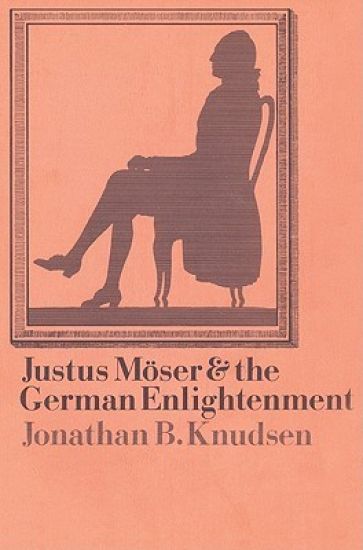
Justus Möser and the German Enlightenment
Knudsen Jonathan B.
Cambridge University Press
2002
pokkari
Justus Möser was a pivotal figure in the age of the German Enlightenment. Administrator, journalist, historian, man of letters, Möser is renowned as one of Germany’s finest prose stylists and as one of its most articulate political writers. Known through his political writings for his commitment to conservative reform, he is often called the Edmund Burke of Germany and the father of German conservatism. He is also celebrated for his pioneering Osnabrück History, the first modern social and economic history and a forerunner to Ranke, Marx, and the German historical revolution of the nineteenth century. This work is the first extensive biography of Möser to place him within his society and the world of the German Enlightenment. Using Möser’s published and unpublished writings, his letters, essays, and histories, the author has written a total history of Möser’s world through Möser’s eyes.

One of the founding fathers of organic chemistry and also a great teacher, the German scientist Justus von Liebig transformed scientific education, medical practice, and agriculture in Great Britain. William H. Brock’s fresh interpretation of Liebig’s stormy career shows how he moved chemistry into the sociopolitical marketplace, demonstrating its significance for society in food production, nutrition, and public health. Through his controversial ideas on artificial fertilizers and recycling, his theory of disease, and his stimulating suggestions concerning food and nutrition, he warned the world of the dangers of failing to recycle sewage or to replace soil nutrients. Liebig also played the role of an elder statesman of European science by commenting, via popular lectures and expansions of his readable Chemical Letters, on such issues as scientific methodology and materialism.

One of the founding fathers of organic chemistry and also a great teacher, the German scientist Justus von Liebig transformed scientific education, medical practice, and agriculture in Great Britain. William H. Brock's fresh interpretation of Liebig's stormy career shows how he moved chemistry into the sociopolitical marketplace, demonstrating its significance for society in food production, nutrition, and public health. Through his controversial ideas on artificial fertilizers and recycling, his theory of disease, and his stimulating suggestions concerning food and nutrition, he warned the world of the dangers of failing to recycle sewage or to replace soil nutrients. Liebig also played the role of an elder statesman of European science by commenting, via popular lectures and expansions of his readable Chemical Letters, on such issues as scientific methodology and materialism.



James has served 15 years behind bars and is now free. He is ready to turn his life around and establish a fresh start. But He finds it difficult to move forward living with a record. Soon enough James is back to his old habits, with old acquaintances living the street life. He then meets Kianne. She was different and pushed all the right buttons in him. Now James feels that he has a real opportunity to right his past and live a crime-free life.But when he discovers that the FEDS are building a case on drug trafficking in Minnesota, it threatens to drag him and his family back to his dangerous past. James takes his family and moves away from the madness, to continue living their lives. James soon discovers that distance only makes it easier for those who have turned against him, and in a world with no rules, he's at their mercy.

Justus Van Effen, Le Misanthrope
Voltaire Foundation
1987
sidottu
The Oxford University Studies in the Enlightenment series, previously known as SVEC (Studies on Voltaire and the Eighteenth Century), has published over 500 peer-reviewed scholarly volumes since 1955 as part of the Voltaire Foundation at the University of Oxford. International in focus, Oxford University Studies in the Enlightenment volumes cover wide-ranging aspects of the eighteenth century and the Enlightenment, from gender studies to political theory, and from economics to visual arts and music, and are published in English or French.