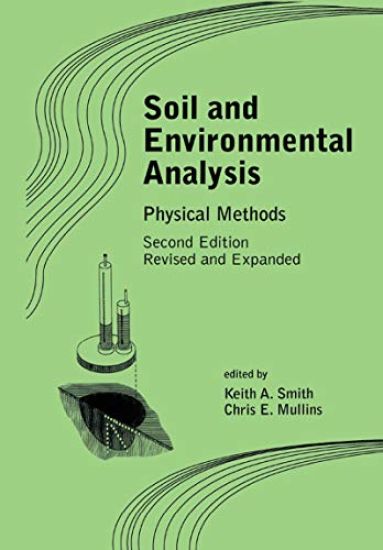
"Reviews a wide range of methods for soil physical analysis. Considers applications, accuracy, measurement time, and cost of equipment. Provides examples of applications."
This book covers the entire scope of computer programming and Structured Program Design, from problem identification to maintaining existing programs. It is intended for two audiences: beginning programmers and experienced programmers seeking ways to improve the quality of their software.
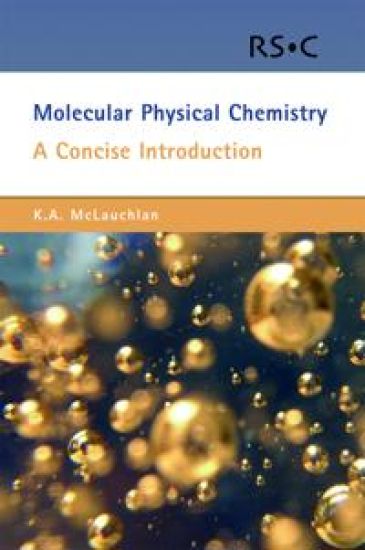
Molecular Physical Chemistry: A Concise Introduction focuses on two main aspects of physical chemistry: thermodynamics and reaction dynamics. By looking at the properties of the atoms and molecules that constitute matter, it makes use of results from modern experiments conducted on small numbers of molecules. These molecular properties allow the behaviour of larger groups of molecules to be predicted. This is in contrast to conventional approaches which are based upon how the subjects have developed historically. It attempts to show how some basic concepts can be easily applied to give verifiable results in simple systems before extending them to more complicated scenarios. The text is intended as an aid to understanding these central topics of physical chemistry, rather than an introduction to them, and some familiarity with them is assumed throughout. Worked examples and problems are given at the end of each chapter. Molecular Physical Chemistry: A Concise Introduction will be welcomed by graduate and advanced undergraduate students, as well as lecturers. Upon completion of this book the reader will see its subject matter as an integral part of their whole approach to chemistry. "Professor McLauchlin is certainly owed a debt of gratitude by the chemical community for this effort to bring enjoyment and understanding to the future generation. It will be interesting to see if this experiment helps students replace the fear of physical chemistry by an appreciation of its power and beauty." Professor William Klemperer, University of Harvard
Why Do Men Go To Brazil For Love?, a thriller, romance, and thought-provoking, daring read that challenges readers to look beyond the prism of their everyday lives.Following the story of one man's search for love in a Brazilian paradise, quickly discovering that life isn't always as it seems, Why Do Men Go To Brazil For Love? dives deep under the beach parties and beautiful women, showcasing a side of Brazil that's not normally discussed.The story follows protagonist Shawn Lane, a man filled with a thirst for adventure and a vision for making a difference. Stricken by wanderlust, the storyline kicks into gear when Shawn decides to visit Brazil to begin his journey of discovery and love and romance in Brazil.At first, enchanted with the parties, the women, and the food, Shawn thinks he's found paradise. Everything on a surface level is charming and seemingly blissful. But, slowly, he discovers that Brazil is a land of paradoxes, quickly turning from a wonderland to a nightmare.While Shawn taught English in Brazil, someone was trying to kill him. And he had a close call with cannibals. All of it is true, and inspiration for Why Do Men Go To Brazil For Love?Why Do Men Go To Brazil For Love? will challenge everything readers previously thought they knew about the South American country, from the culture, to the women that traverse its streets.
Aryan race warrior. A Mexican drug lord. A Korean hit man. A career stick-up man. The wrong guy at the wrong place at the wrong time. The puke Cho-mo-kiddy-toucher. And you! This ain't the Breakfast Club and these are ain't your new friends. Welcome to the Protective Housing Unit (PHU), home to some of world's worst criminals—many of whom so reviled they must not only be shielded from the American public, but the general prison population. This is your new life. Simon, a white-collar criminal, is a new transfer to Pensacola Federal Prison Camp. He's having a hard time adjusting to prison culture, and his newfound "friends" aren't all that interested in making his new life any easier. Everyone in the PHU has his own agenda; alliances are, at best, temporary; and even the notion of friendship is laughable. But all that is about to change. This brutal yet familiar life they've all grown accustomed to is about to come to an end as a mysterious stranger is transferred to their unit and these hardened inmates start to die… Horribly. One at a time. Manticore collects the 5-part prison horror comic series by Keith Miller and Ian Gabriel into one engrossing volume.
In this edge-of-your-seat, opening book of the Zach Templeton Thriller Series, Edge of Madness, former SEAL, Zachariah James Templeton, is plunged into a race against the clock as the United States teeters on the brink of global nuclear war."It felt like I was reading a Tom Clancy novel. Think Hunt For Red October. Exciting and fun read. Read it in one sitting..." Amazon Reviewer"I chose this book for the excitement of submarine warfare. It provides that and much more I highly recommend this book." Amazon ReviewerEdge of Madness is a high-octane thriller that has everything you want in a novel--treason, betrayal, murder, suspense, submarine warfare, realistic dialog, and an honor-driven, yet believable hero. Prepare yourself for the roller coaster ride that is Edge of Madness. A bomb rips through downtown Baltimore. In the cold North Atlantic, a U.S. Navy submarine is attacked without warning. A classified DOD communications system is plagued by unexplained interference. A deep cover operative is forced to make a harrowing, underwater rendezvous. Seemingly unconnected events threaten to plunge the America into a global war. Don't miss the fever-pitched action, as unsuspecting hero, Zach Templeton faces the toughest battle of his life. Can he discover the alarming truth and stop the madness before it is too late? But the real question is....will he live to tell anyone? Globe-spanning, terrifying, hold-your-breath action you will not want to miss. Are you ready for the best story you will read this year? Download it now, grab some coffee, and start reading.
This work has been selected by scholars as being culturally important and is part of the knowledge base of civilization as we know it.This work is in the public domain in the United States of America, and possibly other nations. Within the United States, you may freely copy and distribute this work, as no entity (individual or corporate) has a copyright on the body of the work.Scholars believe, and we concur, that this work is important enough to be preserved, reproduced, and made generally available to the public. To ensure a quality reading experience, this work has been proofread and republished using a format that seamlessly blends the original graphical elements with text in an easy-to-read typeface.We appreciate your support of the preservation process, and thank you for being an important part of keeping this knowledge alive and relevant.
This work has been selected by scholars as being culturally important and is part of the knowledge base of civilization as we know it.This work is in the public domain in the United States of America, and possibly other nations. Within the United States, you may freely copy and distribute this work, as no entity (individual or corporate) has a copyright on the body of the work.Scholars believe, and we concur, that this work is important enough to be preserved, reproduced, and made generally available to the public. To ensure a quality reading experience, this work has been proofread and republished using a format that seamlessly blends the original graphical elements with text in an easy-to-read typeface.We appreciate your support of the preservation process, and thank you for being an important part of keeping this knowledge alive and relevant.
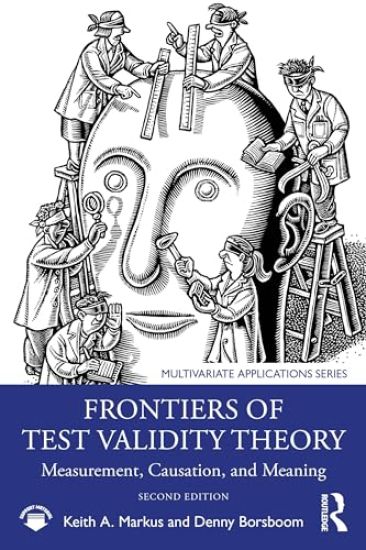
Now in its second edition, this important book examines test validity in the behavioral, social, and educational sciences by exploring three fundamental problems: measurement, causation, and meaning. Psychometric and philosophical perspectives and unresolved issues receive attention, as the authors explore how measurement is conceived from both the classical and modern perspectives.Split into three accessible sections, the first contrasts theories of measurement as applied to the validity of behavioral science measures, and the second considers causal theories of measurement as well as alternative theories of causation. The final section explores the meaning and interpretation of test scores as they apply to test validity, offering a conceptual overview of the field and its current state. Each carefully revised chapter begins with an overview of key theories and literature, concludes with a list of suggested readings, and features boxes with real-life situations that connect theory to practice. Examples of specific issues include:How tests can assess an attribute without measuring it.The role of values in test validity.Interpreting responses to the same question in different languages.Researchers, practitioners, and policy makers interested in test validity or developing tests will appreciate the book's cutting-edge review of test validity. Focusing on both the underlying concepts, as well as practical challenges of test construction and use, it also serves as a supplement in graduate or advanced undergraduate courses on test validity, psychometrics, testing, or measurement taught in psychology, education, sociology, social work, political science, business, criminal justice, and other fields. The book does not assume a background in measurement.
Now in its second edition, this important book examines test validity in the behavioral, social, and educational sciences by exploring three fundamental problems: measurement, causation, and meaning. Psychometric and philosophical perspectives and unresolved issues receive attention, as the authors explore how measurement is conceived from both the classical and modern perspectives.Split into three accessible sections, the first contrasts theories of measurement as applied to the validity of behavioral science measures, and the second considers causal theories of measurement as well as alternative theories of causation. The final section explores the meaning and interpretation of test scores as they apply to test validity, offering a conceptual overview of the field and its current state. Each carefully revised chapter begins with an overview of key theories and literature, concludes with a list of suggested readings, and features boxes with real-life situations that connect theory to practice. Examples of specific issues include:How tests can assess an attribute without measuring it.The role of values in test validity.Interpreting responses to the same question in different languages.Researchers, practitioners, and policy makers interested in test validity or developing tests will appreciate the book's cutting-edge review of test validity. Focusing on both the underlying concepts, as well as practical challenges of test construction and use, it also serves as a supplement in graduate or advanced undergraduate courses on test validity, psychometrics, testing, or measurement taught in psychology, education, sociology, social work, political science, business, criminal justice, and other fields. The book does not assume a background in measurement.