Kirjojen hintavertailu. Mukana 11 213 693 kirjaa ja 12 kauppaa.

Kirjahaku

Etsi kirjoja tekijän nimen, kirjan nimen tai ISBN:n perusteella.

1000 tulosta hakusanalla Kenneth Poolman

Kenneth W. Thompson, The Prophet of Norms

Kenneth W. Thompson, The Prophet of Norms

F. Rajaee

Palgrave Macmillan
2013
nidottu
The aim of this book is to capture, the international thought and practice of Kenneth W. Thompson. His career embodied three roles in which he revealed his thoughts and practice: as a facilitator of space for encouraging debates, scholarship and practice; as an educator; and most importantly as a theorist of international relations.
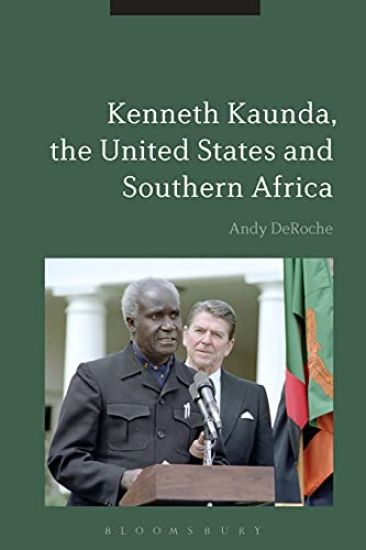
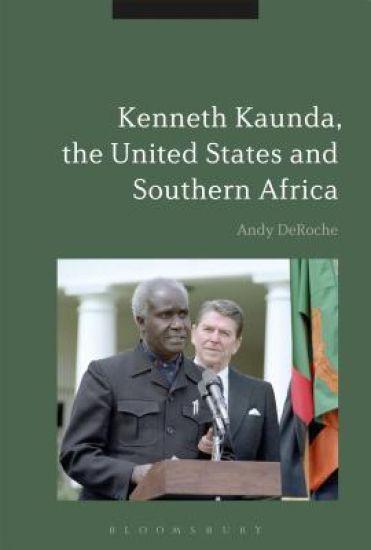
Kenneth Kaunda, the United States and Southern Africa
Kenneth Kaunda, the United States and Southern Africa carefully examines US policy towards the southern African region between 1974, when Portugal granted independence to its colonies of Angola and Mozambique, and 1984, the last full year of the Reagan administration’s Constructive Engagement approach. It focuses on the role of Zambian president Kenneth Kaunda, the key facilitator of international diplomacy towards the dangerous neighborhood surrounding his nation. The main themes include the influence of race, national security, economics, and African agency on international relations during the height of the Cold War. Andy DeRoche focuses on key issues such as the civil war in Angola, the fight against apartheid, the struggle for Namibia’s independence, the transition from Rhodesia to Zimbabwe, and bilateral US/ Zambian relations. The approach is traditional diplomatic history based on archival research in Zambia and the USA as well as interviews with key players such as Kaunda, Mark Chona, Siteke Mwale, Vernon Mwaanga, Chester Crocker, and Frank Wisner. The result offers an important new insight into the nuances of US policy toward southern Africa during the hottest days of the Cold War.
Kenneth Lonergan

Kenneth Lonergan

Todd May

Bloomsbury Academic
2020
sidottu
Kenneth Lonergan’s three films—You Can Count on Me (2000), Margaret (2011), and Manchester by the Sea (2016)—are rife with philosophical complexities. They challenge simple philosophical approaches to central issues of human behaviour. In particular, they ask questions about how to cope with suffering that one cannot overcome, the role that self- deception plays in people’s lives and how to think about characters who do not embody simplistic moral ideas of virtue and vice. By philosophically engaging with these themes as they unfold in Lonergan’s films, we are then able to formulate a more nuanced answer to the questions they pose. Kenneth Lonergan: Philosophical Filmmaker will draw from Lonergan’s films and plays, along with the philosophical literature on the topics that they explore. The rich history of philosophical reflection surrounding these areas enables the reader to determine how the themes central to Lonergan’s work have combined to create a rich cinematic oeuvre.
A Voyage to, and History of, St. Kilda. ... By the Rev. Mr. Kenneth Macaulay,
The 18th century was a wealth of knowledge, exploration and rapidly growing technology and expanding record-keeping made possible by advances in the printing press. In its determination to preserve the century of revolution, Gale initiated a revolution of its own: digitization of epic proportions to preserve these invaluable works in the largest archive of its kind. Now for the first time these high-quality digital copies of original 18th century manuscripts are available in print, making them highly accessible to libraries, undergraduate students, and independent scholars.Rich in titles on English life and social history, this collection spans the world as it was known to eighteenth-century historians and explorers. Titles include a wealth of travel accounts and diaries, histories of nations from throughout the world, and maps and charts of a world that was still being discovered. Students of the War of American Independence will find fascinating accounts from the British side of conflict. ++++The below data was compiled from various identification fields in the bibliographic record of this title. This data is provided as an additional tool in helping to insure edition identification: ++++British LibraryT076273Pp.241-242 misnumbered 265-266. With a half-title and final advertisement leaf.Dublin: printed by James Hoey, jun., 1765. 8],266 i.e.242], 2]p.; 12
The Collected Works of Kenneth White, Volume 1

The Collected Works of Kenneth White, Volume 1

Kenneth White

EDINBURGH UNIVERSITY PRESS
2023
nidottu
These three books reflect the beginnings of one of the most radical and exhilarating figures in modern literatureIncandescent Limbo recounts White's years in Paris. Many a writer in the modern era had made Paris a focal point of his or her activity, but probably no one made more of it or got more out of it than Kenneth White. While exploring a labyrinthine underworld, the book is fundamentally an autoanalysis and traces the birth of the writer as an intellectual nomad.Letters from Gourgounel takes us from the city to a wild part of south-eastern France, the Ard che, where White undertakes a resourcing in an elementary context. Hailed in England as a 'fascinating curiosity of literature', this book not only made White famous overnight in France, it was seen there as a turning point in the contemporary situation. In the third book, Travels in the Drifting Dawn, the intellectual nomad begins his moves across territories and cultures. After passing through the London underground of the sixties, then delving into the ground of his native Scotland and neighbouring Ireland, we shift back to the Continent, accumulating experience on different levels in France, Spain, Belgium, Holland, before concluding the cycle in North Africa. The trilogy is not only a summary of White's itinerary in its initial stages, it opens up a whole intellectual and cultural programme.
The Collected Works of Kenneth White, Volume 2

The Collected Works of Kenneth White, Volume 2

Kenneth White

EDINBURGH UNIVERSITY PRESS
2023
nidottu
Three collections of essays whose aim is to express the cartography and the experience of a live, open worldThese essays all explore Scottish subjects and the wider issues of geopetics. This volume starts with On Scottish Ground by delving into forgotten cultural resources. Ideas of Order at Cape Wrath explores more socio-political considerations before opening out to a larger space of cosmological meditation in The Wanderer and his Charts.
The Collected Works of Kenneth White, Volume 4

The Collected Works of Kenneth White, Volume 4

Kenneth White

EDINBURGH UNIVERSITY PRESS
2025
sidottu
Kenneth White (19362023) established his reputation as a poet, essayist and travel writer in France in the 1970s and 80s, having left Britain in 1970. He became Professor of Twentieth-Century Poetics at the Sorbonne in 1983 and founded the International Institute of Geopoetics in Paris in 1989. The three books in this volume are what he came to describe as 'waybooks', accounts of travels designed to confront the reader with the condition of the modern world and, through their invocation of the notion of geopoetics, to reveal what might lie beyond its familiar limit.
Kenneth Kaunda, the United States and Southern Africa
Kenneth Kaunda, the United States and Southern Africa carefully examines US policy towards the southern African region between 1974, when Portugal granted independence to its colonies of Angola and Mozambique, and 1984, the last full year of the Reagan administration’s Constructive Engagement approach. It focuses on the role of Zambian president Kenneth Kaunda, the key facilitator of international diplomacy towards the dangerous neighborhood surrounding his nation. The main themes include the influence of race, national security, economics, and African agency on international relations during the height of the Cold War. Andy DeRoche focuses on key issues such as the civil war in Angola, the fight against apartheid, the struggle for Namibia’s independence, the transition from Rhodesia to Zimbabwe, and bilateral US/ Zambian relations. The approach is traditional diplomatic history based on archival research in Zambia and the USA as well as interviews with key players such as Kaunda, Mark Chona, Siteke Mwale, Vernon Mwaanga, Chester Crocker, and Frank Wisner. The result offers an important new insight into the nuances of US policy toward southern Africa during the hottest days of the Cold War.
The Collected Works of Kenneth White

The Collected Works of Kenneth White

Kenneth White

Edinburgh University Press
2021
sidottu
These three books reflect the beginnings of one of the most radical and exhilarating figures in modern literatureIncandescent Limbo recounts White's years in Paris. Many a writer in the modern era had made Paris a focal point of his or her activity, but probably no one made more of it or got more out of it than Kenneth White. While exploring a labyrinthine underworld, the book is fundamentally an autoanalysis and traces the birth of the writer as an intellectual nomad.Letters from Gourgounel takes us from the city to a wild part of south-eastern France, the Ardeche, where White undertakes a resourcing in an elementary context. Hailed in England as a 'fascinating curiosity of literature', this book not only made White famous overnight in France, it was seen there as a turning point in the contemporary situation.In the third book, Travels in the Drifting Dawn, the intellectual nomad begins his moves across territories and cultures. After passing through the London underground of the sixties, then delving into the ground of his native Scotland and neighbouring Ireland, we shift back to the Continent, accumulating experience on different levels in France, Spain, Belgium, Holland, before concluding the cycle in North Africa. The trilogy is not only a summary of White's itinerary in its initial stages, it opens up a whole intellectual and cultural programme.
The Collected Works of Kenneth White

The Collected Works of Kenneth White

Kenneth White

Edinburgh University Press
2021
sidottu
Three collections of essays whose aim is to express the cartography and the experience of a live, open worldThese essays all explore Scottish subjects and the wider issues of geopetics. This volume starts with On Scottish Ground by delving into forgotten cultural resources. Ideas of Order at Cape Wrath explores more socio-political considerations before opening out to a larger space of cosmological meditation in The Wanderer and his Charts.
Who's In, Who's Out: The Journals of Kenneth Rose
'The most detailed, amusing and accurate account ever of the post-war world of the English Establishment' William Shawcross, Daily Telegraph'Extremely entertaining' Jane Ridley, Literary ReviewKenneth Rose was one of the most astute observers of the establishment for over seventy years. The wry and amusing journals of the royal biographer and historian made objective observation a sculpted craft. His impeccable social placement located him within the beating heart of the national elite for decades. He was capable of writing substantial history, such as his priceless material on the abdication crisis from conversations with both the Duke of Windsor and the Queen Mother. Yet he maintained sufficient distance to achieve impartial documentation while working among political, clerical, military, literary and aristocratic circles. Relentless observation and a self-confessed difficulty 'to let a good story pass me by' made Rose a legendary social commentator, while his impressive breadth of interests was underpinned by tremendous respect for the subjects of his enquiry. Brilliantly equipped as Rose was to witness, detail and report, the first volume of his journals vividly portrays some of the most important events and people of the last century, from the bombing of London during the Second World War to the election of Margaret Thatcher, Britain's first woman Prime Minister, in 1979.
Who's In, Who's Out: The Journals of Kenneth Rose
'The most detailed, amusing and accurate account ever of the post-war world of the English Establishment' William Shawcross, Daily Telegraph'Extremely entertaining' Jane Ridley, Literary ReviewKenneth Rose was one of the most astute observers of the establishment for over seventy years. The wry and amusing journals of the royal biographer and historian made objective observation a sculpted craft. His impeccable social placement located him within the beating heart of the national elite for decades. He was capable of writing substantial history, such as his priceless material on the abdication crisis from conversations with both the Duke of Windsor and the Queen Mother. Yet he maintained sufficient distance to achieve impartial documentation while working among political, clerical, military, literary and aristocratic circles. Relentless observation and a self-confessed difficulty 'to let a good story pass me by' made Rose a legendary social commentator, while his impressive breadth of interests was underpinned by tremendous respect for the subjects of his enquiry. Brilliantly equipped as Rose was to witness, detail and report, the first volume of his journals vividly portrays some of the most important events and people of the last century, from the bombing of London during the Second World War to the election of Margaret Thatcher, Britain's first woman Prime Minister, in 1979.