
Kirjahaku
Etsi kirjoja tekijän nimen, kirjan nimen tai ISBN:n perusteella.
232 tulosta hakusanalla Kyoshi Chance


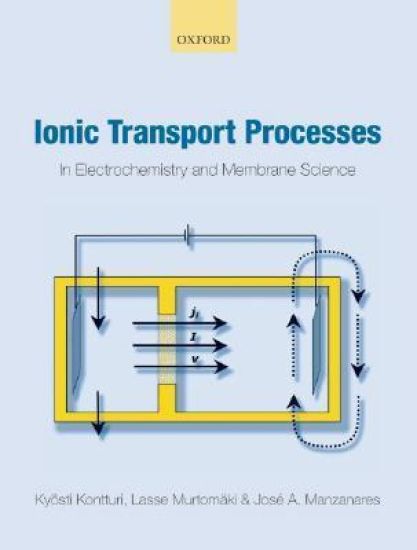
Ionic Transport Processes
Kyösti Kontturi; Lasse Murtomäki; José A. Manzanares
Oxford University Press
2014
nidottu
Modelling of heterogeneous processes, such as electrochemical reactions, extraction, or ion-exchange, usually requires solving the transport problem associated to the process. Since the processes at the phase boundary are described by scalar quantities and transport quantities are vectors or tensors, coupling them can take place only via conservation of mass, charge, or momentum. In this book, the transport of ionic species is addressed in a versatile manner, emphasizing the mutual coupling of fluxes in particular. Treatment is based on the formalism of irreversible thermodynamics, i.e. on linear (ionic) phenomenological equations, from which the most frequently used Nernst-Planck equation is derived. Limitations and assumptions made are thoroughly discussed. The Nernst-Planck equation is applied to selected problems at the electrodes and in membranes. Mathematical derivations are presented in detail so that the reader can learn the methodology of solving transport problems. Each chapter contains a large number of exercises, some of them more demanding than others.
Ionic Transport Processes
Kyösti Kontturi; Lasse Murtomäki; José A. Manzanares
Oxford University Press
2008
sidottu
Modelling of heterogeneous processes, such as electrochemical reactions, extraction or ion-exchange, usually requires solving the transport problem associated to the process. Since the processes at the phase boundary are described by scalar quantities and transport quantities are vectors or tensors, coupling of them can take place only via conservation of mass, charge or momentum. In this book, transport of ionic species is addressed in a versatile manner, emphasizing the mutual coupling of fluxes in particular. Treatment is based on the formalism of irreversible thermodynamics, i.e. on linear (ionic) phenomenological equations, from which the most frequently used Nernst-Planck equation is derived. Limitations and assumptions made are thoroughly discussed. The Nernst-Planck equation is applied to selected problems at the electrodes and in membranes. Mathematical derivations are presented in detail so that the reader can learn the methodology of solving transport problems. Each chapter contains a large number of exercises, some of them more demanding than others.

This title is part of UC Press's Voices Revived program, which commemorates University of California Press’s mission to seek out and cultivate the brightest minds and give them voice, reach, and impact. Drawing on a backlist dating to 1893, Voices Revived makes high-quality, peer-reviewed scholarship accessible once again using print-on-demand technology. This title was originally published in 1971.

This title is part of UC Press's Voices Revived program, which commemorates University of California Press’s mission to seek out and cultivate the brightest minds and give them voice, reach, and impact. Drawing on a backlist dating to 1893, Voices Revived makes high-quality, peer-reviewed scholarship accessible once again using print-on-demand technology. This title was originally published in 1971.

This book deals with biomimetic sensors that can quantify taste and smell - the electronic tongue and nose. Of all sensor technologies, these have been widely considered as the most difficult to realise and the development of these sensors significantly contributes to the understanding of the reception mechanisms in gustatory and olfactory systems. The author begins by dealing with the basic principles of measurement and multivariate analysis. Reception mechanisms in biological systems are briefly reviewed. Several types of biosensor, including enzyme-immobilized membranes, SPR, the quartz resonance oscillator and IC technologies are explained in detail. This book is the first to focus on artificial taste and smell sensors and also reviews conventional biosensors, such as enzyme sensors, in detail.

This book deals with biomimetic sensors that can quantify taste and smell - the electronic tongue and nose. Of all sensor technologies, these have been widely considered as the most difficult to realise and the development of these sensors significantly contributes to the understanding of the reception mechanisms in gustatory and olfactory systems. The author begins by dealing with the basic principles of measurement and multivariate analysis. Reception mechanisms in biological systems are briefly reviewed. Several types of biosensor, including enzyme-immobilized membranes, SPR, the quartz resonance oscillator and IC technologies are explained in detail. This book is the first to focus on artificial taste and smell sensors and also reviews conventional biosensors, such as enzyme sensors, in detail.


"Utterly charming . . . I would read a hundred of these stories." --Shelby Van Pelt, New York Times bestselling author of Remarkably Bright Creatures Seven struggling customers are given the unique opportunity to take home a "blanket cat" . . . but only for three days, the time it'll take to change their lives. A peculiar pet shop in Tokyo has been known to offer customers the unique opportunity to take home one of seven special cats, whose "magic" is never promised, but always received. But there are rules: these cats must be returned after three days. They must eat only the food supplied by the owner, and they must travel to their new homes with a distinctive blanket. In The Blanket Cats, we meet seven customers, each of whom is hoping a temporary feline companion will help them escape a certain reality, including a couple struggling with infertility, a middle-aged woman on the run from the police, and two families in very different circumstances simply seeking joy. But like all their kind, the "blanket cats" are mysterious creatures with unknowable agendas, who delight in confounding expectations. And perhaps what their hosts are looking for isn't really what they need. Three days may not be enough to change a life. But it might just change how you see it.

The book is devoted to the theory of topological higher Franz-Reidemeister torsion in $K$-theory. The author defines the higher Franz-Reidemeister torsion based on Volodin's $K$-theory and Borel's regulator map. He describes its properties and generalizations and studies the relation between the higher Franz-Reidemeister torsion and other torsions used in $K$-theory: Whitehead torsion and Ray-Singer torsion. He also presents methods of computing higher Franz-Reidemeister torsion, illustrates them with numerous examples, and describes various applications of higher Franz-Reidemeister torsion, particularly for the study of homology of mapping class groups. Packed with up-to-date information, the book provides a unique research and reference tool for specialists working in algebraic topology and $K$-theory.

An Introduction to Jodo Shinshu: Volume 1: The Salvation of Jodo Shinshu and its Structure
Kyoshin Asano
Kobozu the Little Priest Publishing
2013
nidottu
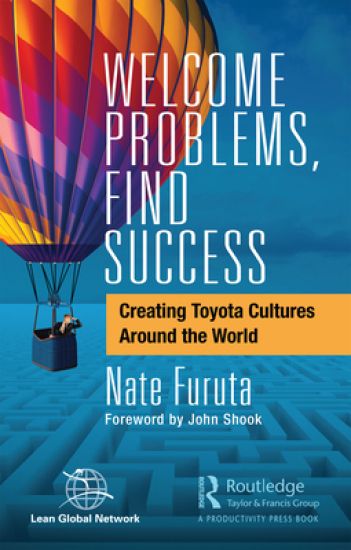
In this book, author Nate Furuta, former chair and CEO of Toyota Boshoku America Inc., shares the story of his decades of experience directly leading the establishment of Toyota cultures outside Japan. Furuta was the first Toyota employee on the ground at New United Motor Manufacturing Inc. (NUMMI), Toyota’s joint venture in California with General Motors, where he directly led the establishment of the most revolutionary labor-management agreement in the history of the US auto industry. In addition, Furuta was the first Toyota employee on the ground in Georgetown Kentucky at Toyota’s first full-scale, wholly owned manufacturing operation outside Japan, where he led (working directly with President Fujio Cho) the establishment of Toyota’s general management systems and culture there. This book tells the stories of establishing successful operations in those two iconic organizations as well as others. Furuta reveals details, both stories and process descriptions that only he can tell. He takes you along as he and others lead Toyota’s intense globalization from the early 1980s to recent days. He introduces you to the critical leaders in Toyota's history, such as Taiichi Ohno and Fujio Cho as well as Kenzo Tamai, the head of the company’s HRM function in the 1980s. This book is not about human-resource management (HRM) policies and procedures. It provides a deep dive into the way senior leaders embody deep awareness of HRM matters, developing and executing company strategy while at the same time developing organizational capability. The role of senior leaders isn’t just a matter of directing the company to achieve objectives; it is a matter of building the capability to achieve those objectives, consistently, and further developing capability as it executes. Key to this is to develop the awareness, attitude, capability, and practice of identifying problems as progress is made toward achieving objectives, which is, in fact, attained through steadily eliminating each problem as it arises. This becomes a self-reinforcing loop of the organization, tapping in to the essence of solving problems while simultaneously developing ever better problem-solving skills and better problem solvers. This loop propels an organization toward meeting its purpose while developing capability for capability development. Essentially, this book reveals Toyota’s general management systems from the firsthand experience of a Toyota Japanese senior manager and describes, with stories and process examples, the attitude, behaviors, and systems needed to successfully establish and lead in a true Lean business environment.
In this book, author Nate Furuta, former chair and CEO of Toyota Boshoku America Inc., shares the story of his decades of experience directly leading the establishment of Toyota cultures outside Japan. Furuta was the first Toyota employee on the ground at New United Motor Manufacturing Inc. (NUMMI), Toyota’s joint venture in California with General Motors, where he directly led the establishment of the most revolutionary labor-management agreement in the history of the US auto industry. In addition, Furuta was the first Toyota employee on the ground in Georgetown Kentucky at Toyota’s first full-scale, wholly owned manufacturing operation outside Japan, where he led (working directly with President Fujio Cho) the establishment of Toyota’s general management systems and culture there. This book tells the stories of establishing successful operations in those two iconic organizations as well as others. Furuta reveals details, both stories and process descriptions that only he can tell. He takes you along as he and others lead Toyota’s intense globalization from the early 1980s to recent days. He introduces you to the critical leaders in Toyota's history, such as Taiichi Ohno and Fujio Cho as well as Kenzo Tamai, the head of the company’s HRM function in the 1980s. This book is not about human-resource management (HRM) policies and procedures. It provides a deep dive into the way senior leaders embody deep awareness of HRM matters, developing and executing company strategy while at the same time developing organizational capability. The role of senior leaders isn’t just a matter of directing the company to achieve objectives; it is a matter of building the capability to achieve those objectives, consistently, and further developing capability as it executes. Key to this is to develop the awareness, attitude, capability, and practice of identifying problems as progress is made toward achieving objectives, which is, in fact, attained through steadily eliminating each problem as it arises. This becomes a self-reinforcing loop of the organization, tapping in to the essence of solving problems while simultaneously developing ever better problem-solving skills and better problem solvers. This loop propels an organization toward meeting its purpose while developing capability for capability development. Essentially, this book reveals Toyota’s general management systems from the firsthand experience of a Toyota Japanese senior manager and describes, with stories and process examples, the attitude, behaviors, and systems needed to successfully establish and lead in a true Lean business environment.

Britain and European Monetary Cooperation, 1964-1979
Kiyoshi Hirowatari
Palgrave Macmillan
2015
sidottu
The collapse of the Bretton Woods system in the early 1970s resulted in a transition to fluctuating rather than fixed currency system. This brought sterling into the turmoil of the world currency markets, and by the end of the 1970s, sterling had quietly ended its role as an international currency. Sterling-dollar diplomacy collapsed, bringing to an end what had hitherto been considered Britain's prime relationship. Britain and European Monetary Cooperation, 1964-1979 provides a unique perspective on these events, shedding light on the complexities of the historical context of British monetary diplomacy and exploring the country's attempt at a European approach to sterling in the 1960s and '70s. The book describes the political and economic approach Britain took at the turn of the 1970s, and explains how the country became restricted by the burden of the sterling balances. In this book, the author illustrates how these developments offered opportunity for both cooperation and conflict in the light of monetary diplomacy. He demonstrates how Britain's struggle to achieve exchange rate stability, twinned with controversy over European Economic Community membership, finally prompted serious reconsideration of economic policy-making. This book challenges the commonly-held perception of the decline of sterling, and explains that, although Britain's attempt at a European approach failed, the decline of the currency was more complicated than a 'managed decline'.


"Seven struggling customers are given the unique opportunity to take home a "blanket cat" ... but only for three days, the time it'll take to change their lives. A peculiar pet shop in Tokyo has been known to offer customers the unique opportunity to take home one of seven special cats, whose "magic" is never promised, but always received. But there are rules: these cats must be returned after three days. They must eat only the food supplied by the owner, and they must travel to their new homes with a distinctive blanket. In The Blanket Cats, we meet seven customers, each of whom is hoping a temporary feline companion will help them escape a certain reality, including a couple struggling with infertility, a middle-aged woman on the run from the police, and two families in very different circumstances simply seeking joy. But like all their kind, the "blanket cats" are mysterious creatures with unknowable agendas, who delight in confounding expectations. And perhaps what their hosts are looking for isn't really what they need. Three days may not be enough to change a life. But it might just change how you see it."
In this first comprehensive departure from the time-and-motion dictums of Frederick Taylor's Shop Management that have influenced management practices for most of this century, Kiyoshi Suzaki offers a framework for successfully conducting business at its most crucial point-the shop floor. Drawing on the principles of holistic management, where organizational boundaries are smashed and co-destiny is created, Suzaki demonstrates how modern shop floor management techniques -- focusing maximum energy on the front line -- can lead to dramatic improvements in productivity and valueadded-to-services.The role of management today, Suzaki argues, is to eliminate its own responsibilities by thinking of the organization from the genba, or shop floor, point of view. In this challenge, Suzaki claims, organizations need to collect the wisdom of people by practicing "Glass Wall Management," where organizations become transparent, enabling employees to contribute maximum creativity as opposed to blocking their potential with what he calls "Brick Wall Management." Further, to empower individuals to selfmanage their work and satisfy their customers, Suzaki asserts that they all should learn to manage their own "mini-company," where everybody is considered president of his or her area of responsibility.Front-line supervisors, Suzaki shows, must develop a mission and goals and share them both up and downstream. He cites examples of the "shop floor point of view" -- McDonald's Corporation's legal staff learning how to sell hamburgers and fix milkshake machines; Honda's human resource staff training on the assembly line -- that narrow the gap between top management and the shop floor. By upgrading people's skills, focusing on empowerment, and streamlining processes, Suzaki illustrates that an organization will realize concrete improvements in quality, cost, delivery, safety, morale, and ultimately, its competitive position.
As a consultant, Kiyoshi Suzaki has helped scores of Fortune 500 clients improve manufacturing operations and get the job done faster, cheaper, better, and safer. Now, in this detailed "operating manual" -- full of more step-by-step applications than any other book available -- Suzaki spells out new options in production and employee resources that can help American industry regain the cutting edge in price, quality, and delivery of products. A well-known expert in the field, Suzaki begins with the premise that "if it doesn't add value, it's waste" -- a concept devised by Henry Ford and later used by Toyota. He recaps what Toyota identifies as the seven most prominent forms of waste in factories. Most importantly, he meticulously details steps individuals can take to "simplify, combine, and eliminate operations" -- thereby reducing waste, improving quality, and saving money. Describing in detail the basic techniques culled from Japanese industrial philosophy and procedure, Suzaki shows how small, family-run businesses and billion-dollar American corporations from a wide range of industries -- automotive, electronics, cosmetics, and even defense contractors -- are meeting the manufacturing challenge today -- demolishing the widely held belief that most American manufacturers have become distribution organizations for products manufactured overseas. In addition, he links his methodology with several successful production systems, from Just-In-Time Production, Total Quality Control, Total Productive Maintenance to Computer Integrated Manufacturing. Throughout this practical handbook, he places emphasis squarely on the shop floor and grounds his approach in easy, yet powerful techniques everybody can understand and implement today. Illustrated with numerous charts and exhibits, The New Manufacturing Challenge shows how to integrate people and techniques to improve the workplace and, thus, strengthen any company's competitiveness in the global marketplace.