Kirjojen hintavertailu. Mukana 12 406 311 kirjaa ja 12 kauppaa.

Kirjahaku

Etsi kirjoja tekijän nimen, kirjan nimen tai ISBN:n perusteella.

1000 tulosta hakusanalla Lisa M. Connors

Our Lady of the Rock

Our Lady of the Rock

Lisa M. Bitel

Cornell University Press
2015
sidottu
For more than twenty years, Maria Paula Acuña has claimed to see the Virgin Mary, once a month, at a place called Our Lady of the Rock in the Mojave Desert of California. Hundreds of men, women, and children follow her into the desert to watch her see what they cannot. While she sees and speaks with the Virgin, onlookers search the skies for signs from heaven, snapping photographs of the sun and sky. Not all of them are convinced that Maria Paula can see the Virgin, yet at each vision event they watch for subtle clues to Mary's presence, such as the unexpected scent of roses or a cloud in the shape of an angel. The visionary depends on her audience to witness and authenticate her visions, while observers rely on Maria Paula and the Virgin to create a sacred space and moment where they, too, can experience firsthand one of the oldest and most fundamental promises of Christianity: direct contact with the divine. Together, visionary and witnesses negotiate and enact their monthly liturgy of revelations. Our Lady of the Rock, which features text by Lisa M. Bitel and more than sixty photographs by Matt Gainer, shows readers what happens in the Mojave Desert each month and tells us how two thousand years of Christian revelatory tradition prepared Maria Paula and her followers to meet in the desert. Based on six years of observation and interviews, chapters analyze the rituals, iconographies, and physical environment of Our Lady of the Rock. Bitel and Gainer also provide vivid portraits of the pilgrims—who they are, where they come from, and how they practice the traditional Christian discernment of spirits and visions. Our Lady of the Rock follows three pilgrims as they return home with relics and proofs of visions where, out of Maria Paula's sight, they too have learned to see the Virgin. The book also documents the public response from the Catholic Church and popular news media to Maria Paula and other contemporary visionaries. Throughout, Our Lady of the Rock locates Maria Paula and her followers in the context of recent demographic and cultural shifts in the American Southwest, the astonishing increase in reported apparitions and miracles from around the world, the latest developments in communications and visual technologies, and the never-ending debate among academics, faith leaders, scientists, and citizen observers about sight, perception, reason, and belief.

Our Lady of the Rock

Our Lady of the Rock

Lisa M. Bitel

Cornell University Press
2015
pokkari
For more than twenty years, Maria Paula Acuña has claimed to see the Virgin Mary, once a month, at a place called Our Lady of the Rock in the Mojave Desert of California. Hundreds of men, women, and children follow her into the desert to watch her see what they cannot. While she sees and speaks with the Virgin, onlookers search the skies for signs from heaven, snapping photographs of the sun and sky. Not all of them are convinced that Maria Paula can see the Virgin, yet at each vision event they watch for subtle clues to Mary's presence, such as the unexpected scent of roses or a cloud in the shape of an angel. The visionary depends on her audience to witness and authenticate her visions, while observers rely on Maria Paula and the Virgin to create a sacred space and moment where they, too, can experience firsthand one of the oldest and most fundamental promises of Christianity: direct contact with the divine. Together, visionary and witnesses negotiate and enact their monthly liturgy of revelations. Our Lady of the Rock, which features text by Lisa M. Bitel and more than sixty photographs by Matt Gainer, shows readers what happens in the Mojave Desert each month and tells us how two thousand years of Christian revelatory tradition prepared Maria Paula and her followers to meet in the desert. Based on six years of observation and interviews, chapters analyze the rituals, iconographies, and physical environment of Our Lady of the Rock. Bitel and Gainer also provide vivid portraits of the pilgrims—who they are, where they come from, and how they practice the traditional Christian discernment of spirits and visions. Our Lady of the Rock follows three pilgrims as they return home with relics and proofs of visions where, out of Maria Paula's sight, they too have learned to see the Virgin. The book also documents the public response from the Catholic Church and popular news media to Maria Paula and other contemporary visionaries. Throughout, Our Lady of the Rock locates Maria Paula and her followers in the context of recent demographic and cultural shifts in the American Southwest, the astonishing increase in reported apparitions and miracles from around the world, the latest developments in communications and visual technologies, and the never-ending debate among academics, faith leaders, scientists, and citizen observers about sight, perception, reason, and belief.

Isle of the Saints

Isle of the Saints

Lisa M. Bitel

Cornell University Press
1994
pokkari
Isle of the Saints recreates the harsh yet richly spiritual world of medieval Irish monks on the Christian frontier of barbarian Europe. Lisa Bitel draws on accounts of saints' lives written between 800 and 1200 to explain, from the monks' own perspective, the social networks that bound them to one another and to their secular neighbors.
Land of Women

Land of Women

Lisa M. Bitel

Cornell University Press
1998
pokkari
"This book disperses the shadows in an obscure but important landscape. Lisa Bitel addresses both the history of women in early Ireland and the history of myth, legend, and superstition which surrounded them. It is a powerful and exact book and an invaluable addition to our expanding sense of Ireland through the eyes of Irish women."—Eavan Boland, author of In a Time of Violence: Poems"It is refreshing to read in a book by a woman on medieval women that not all clerics hated women and that not all men were oversexed villains consciously bent on exploiting women. [Bitel] challenges not only the medieval Irish male construct of female behavior, but she is also courageous enough to question constructs of medieval women invented by modern Irish medieval historians."—Times Higher Education Supplement
Baby's First Picture

Baby's First Picture

Lisa M. Mitchell

University of Toronto Press
2001
pokkari
Appearing through developments in medicine, in volatile debates over abortion rights, in popular guides to pregnancy, and in advertisements for cars and long-distance telephone plans, the fetus has become an increasingly familiar part of our social landscape in Canada. Lisa Mitchell provides a critical anthropological perspective on the fetal subject, particularly as it emerges through the practice of ultrasound imaging. 'Seeing the baby,' is now a routine and expected part of pregnancy and prenatal care in Canada. Conventionally understood as a neutral and passive technology, ultrasound appears to be a 'window' through which to observe fetal sex, age, size, physical normality, and behaviour. However, Mitchell argues, what is seen through ultrasound is neither self-evident nor natural, but historically and culturally contingent and subject to a wide range of interpretation. Drawing upon fieldwork over the past ten years, the author includes observations at ultrasound clinics, interviews with pregnant women and their partners, and a discussion on how ultrasound's echoes become meaningful as 'baby's first picture' - a snapshot of the fetus in utero. Throughout, Mitchell probes our acceptance of this technology, our willingness to take fetal imaging for granted, and illuminates the links between this technologically mediated 'fetal reality' and the politics of gender and reproduction in Canada.
African American Readings of Paul: Reception, Resistance, and Transformation

African American Readings of Paul: Reception, Resistance, and Transformation

Lisa M. Bowens

William B. Eerdmans Publishing Company
2020
sidottu
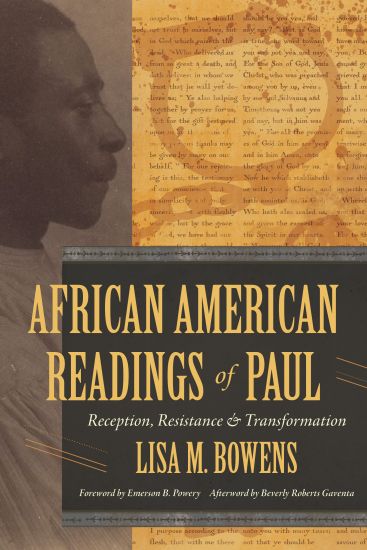
The letters of Paul--especially the verse in Ephesians directing slaves to obey their masters--played an enormous role in promoting slavery and justifying it as a Christian practice. Yet despite this reality African Americans throughout history still utilized Paul extensively in their own work to protest and resist oppression, responding to his theology and teachings in numerous--often starkly divergent and liberative--ways. In the first book of its kind, Lisa Bowens takes a historical, theological, and biblical approach to explore interpretations of Paul within African American communities over the past few centuries. She surveys a wealth of primary sources from the early 1700s to the mid-twentieth century, including sermons, conversion stories, slave petitions, and autobiographies of ex-slaves, many of which introduce readers to previously unknown names in the history of New Testament interpretation. Along with their hermeneutical value, these texts also provide fresh documentation of Black religious life through wide swaths of American history. African American Readings of Paul promises to change the landscape of Pauline studies and fill an important gap in the rising field of reception history.
Rape on Trial

Rape on Trial

Lisa M. Cuklanz

University of Pennsylvania Press
1995
pokkari
Why has so much of the public discussion of rape focused on a few specific cases, and to what extent has this discussion incorporated the feminist perspective on rape? Rape on Trial explores these questions and provides answers based on a detailed examination of the mainstream news coverage of the John and Greta Rideout marital rape case, the Big Dan's Tavern gang rape case, and the Webb-Dotson rape recantation case. Lisa M. Cuklanz traces where and how rape reform ideas were granted legitimacy in mainstream news coverage. She finds that while the subsequent fictionalized versions frequently adopted the themes foregrounded in the news coverage, they usually were more sympathetic toward-and indeed often took on-the rape victim's point of view.
Rape on Prime Time

Rape on Prime Time

Lisa M. Cuklanz

University of Pennsylvania Press
1999
pokkari
Depictions of rape on television have evolved dramatically, from hard-boiled stories about male detectives to more insightful shows focusing on rape victims. Rape on Prime Time is the first book to examine those changing depictions of rape. Lisa M. Cuklanz reveals that prime-time television programs during the 1970s-usually detective shows-reflected traditional ideas that "real" rape is perpetrated by brutal strangers upon passive victims. Beginning in 1980, depictions of rape began to include attacks by known assailants, and victims began to address their feelings. By 1990, scripts portrayed date and marital rape and paid greater attention to the trial process, reflecting legal reformers' concerns. While previous studies have examined one series or genre, Cuklanz examines programs as dissimilar as Barney Miller, Dallas, The Cosby Show, and Quincy. She outlines the "basic plot" for rape episodes, then traces the historical development of rape themes. In each chapter she includes close analyses of episodes that add depth to findings derived from scripts and taped episodes. Rape on Prime Time provides important insight into the social construction of rape in mainstream mass media since the inception of rape law reform in 1974.
Manic Minds

Manic Minds

Lisa M. Hermsen

Rutgers University Press
2011
sidottu
From its first depictions in ancient medical literature to contemporary depictions in brain imaging, mania has been largely associated with its Greek roots, "to rage." Prior to the nineteenth century, "mania" was used interchangeably with "madness." Although its meanings shifted over time, the word remained layered with the type of madness first-century writers described: rage, fury, frenzy. Even now, the mental illness we know as bipolar disorder describes conditions of extreme irritability, inflated grandiosity, and excessive impulsivity.Spanning several centuries, Manic Minds traces the multiple ways in which the word "mania" has been used by popular, medical, and academic writers. It reveals why the rhetorical history of the word is key to appreciating descriptions and meanings of the "manic" episode." Lisa M. Hermsen examines the way medical professionals analyzed the manic condition during the nineteenth and twentieth centuries and offers the first in-depth analysis of contemporary manic autobiographies: bipolar figures who have written from within the illness itself.
Manic Minds

Manic Minds

Lisa M. Hermsen

Rutgers University Press
2011
nidottu
From its first depictions in ancient medical literature to contemporary depictions in brain imaging, mania has been largely associated with its Greek roots, "to rage." Prior to the nineteenth century, "mania" was used interchangeably with "madness." Although its meanings shifted over time, the word remained layered with the type of madness first-century writers described: rage, fury, frenzy. Even now, the mental illness we know as bipolar disorder describes conditions of extreme irritability, inflated grandiosity, and excessive impulsivity.Spanning several centuries, Manic Minds traces the multiple ways in which the word "mania" has been used by popular, medical, and academic writers. It reveals why the rhetorical history of the word is key to appreciating descriptions and meanings of the "manic" episode." Lisa M. Hermsen examines the way medical professionals analyzed the manic condition during the nineteenth and twentieth centuries and offers the first in-depth analysis of contemporary manic autobiographies: bipolar figures who have written from within the illness itself.
Defining Student Success

Defining Student Success

Lisa M. Nunn

Rutgers University Press
2014
nidottu
2020 Scholarly Contributions to Teaching and Learning Award from the ASA The key to success, our culture tells us, is a combination of talent and hard work. Why then, do high schools that supposedly subscribe to this view send students to college at such dramatically different rates? Why do students from one school succeed while students from another struggle? To the usual answer—an imbalance in resources—this book adds a far more subtle and complicated explanation. Defining Student Success shows how different schools foster dissimilar and sometimes conflicting ideas about what it takes to succeed—ideas that do more to preserve the status quo than to promote upward mobility. Lisa Nunn’s study of three public high schools reveals how students’ beliefs about their own success are shaped by their particular school environment and reinforced by curriculum and teaching practices. While American culture broadly defines success as a product of hard work or talent (at school, intelligence is the talent that matters most), Nunn shows that each school refines and adapts this American cultural wisdom in its own distinct way—reflecting the sensibilities and concerns of the people who inhabit each school. While one school fosters the belief that effort is all it takes to succeed, another fosters the belief that hard work will only get you so far because you have to be smart enough to master course concepts. Ultimately, Nunn argues that these school-level adaptations of cultural ideas about success become invisible advantages and disadvantages for students’ college-going futures. Some schools’ definitions of success match seamlessly with elite college admissions’ definition of the ideal college applicant, while others more closely align with the expectations of middle or low-tier institutions of higher education. With its insights into the transmission of ideas of success from society to school to student, this provocative work should prompt a reevaluation of the culture of secondary education. Only with a thorough understanding of this process will we ever find more consistent means of inculcating success, by any measure.
Defining Student Success

Defining Student Success

Lisa M. Nunn

Rutgers University Press
2014
sidottu
2020 Scholarly Contributions to Teaching and Learning Award from the ASA The key to success, our culture tells us, is a combination of talent and hard work. Why then, do high schools that supposedly subscribe to this view send students to college at such dramatically different rates? Why do students from one school succeed while students from another struggle? To the usual answer—an imbalance in resources—this book adds a far more subtle and complicated explanation. Defining Student Success shows how different schools foster dissimilar and sometimes conflicting ideas about what it takes to succeed—ideas that do more to preserve the status quo than to promote upward mobility. Lisa Nunn’s study of three public high schools reveals how students’ beliefs about their own success are shaped by their particular school environment and reinforced by curriculum and teaching practices. While American culture broadly defines success as a product of hard work or talent (at school, intelligence is the talent that matters most), Nunn shows that each school refines and adapts this American cultural wisdom in its own distinct way—reflecting the sensibilities and concerns of the people who inhabit each school. While one school fosters the belief that effort is all it takes to succeed, another fosters the belief that hard work will only get you so far because you have to be smart enough to master course concepts. Ultimately, Nunn argues that these school-level adaptations of cultural ideas about success become invisible advantages and disadvantages for students’ college-going futures. Some schools’ definitions of success match seamlessly with elite college admissions’ definition of the ideal college applicant, while others more closely align with the expectations of middle or low-tier institutions of higher education. With its insights into the transmission of ideas of success from society to school to student, this provocative work should prompt a reevaluation of the culture of secondary education. Only with a thorough understanding of this process will we ever find more consistent means of inculcating success, by any measure.
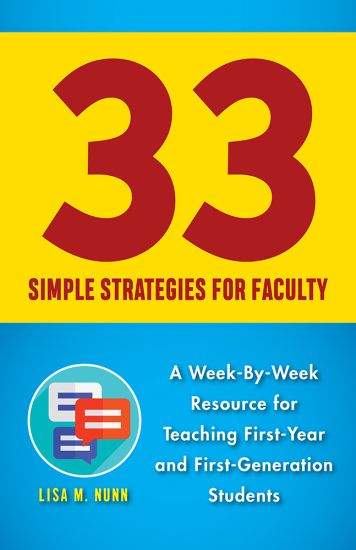
33 Simple Strategies for Faculty

33 Simple Strategies for Faculty

Lisa M. Nunn

Rutgers University Press
2018
nidottu
Winner of the 2020 Scholarly Contributions to Teaching and Learning Award from the American Sociological Association Many students struggle with the transition from high school to university life. This is especially true of first-generation college students, who are often unfamiliar with the norms and expectations of academia. College professors usually want to help, but many feel overwhelmed by the prospect of making extra time in their already hectic schedules to meet with these struggling students.33 Simple Strategies for Faculty is a guidebook filled with practical solutions to this problem. It gives college faculty concrete exercises and tools they can use both inside and outside of the classroom to effectively bolster the academic success and wellbeing of their students. To devise these strategies, educational sociologist Lisa M. Nunn talked with a variety of first-year college students, learning what they find baffling and frustrating about their classes, as well as what they love about their professors’ teaching. Combining student perspectives with the latest research on bridging the academic achievement gap, she shows how professors can make a difference by spending as little as fifteen minutes a week helping their students acculturate to college life. Whether you are a new faculty member or a tenured professor, you are sure to find 33 Simple Strategies for Faculty to be an invaluable resource.
33 Simple Strategies for Faculty

33 Simple Strategies for Faculty

Lisa M. Nunn

Rutgers University Press
2018
sidottu
Winner of the 2020 Scholarly Contributions to Teaching and Learning Award from the American Sociological Association Many students struggle with the transition from high school to university life. This is especially true of first-generation college students, who are often unfamiliar with the norms and expectations of academia. College professors usually want to help, but many feel overwhelmed by the prospect of making extra time in their already hectic schedules to meet with these struggling students.33 Simple Strategies for Faculty is a guidebook filled with practical solutions to this problem. It gives college faculty concrete exercises and tools they can use both inside and outside of the classroom to effectively bolster the academic success and wellbeing of their students. To devise these strategies, educational sociologist Lisa M. Nunn talked with a variety of first-year college students, learning what they find baffling and frustrating about their classes, as well as what they love about their professors’ teaching. Combining student perspectives with the latest research on bridging the academic achievement gap, she shows how professors can make a difference by spending as little as fifteen minutes a week helping their students acculturate to college life. Whether you are a new faculty member or a tenured professor, you are sure to find 33 Simple Strategies for Faculty to be an invaluable resource.
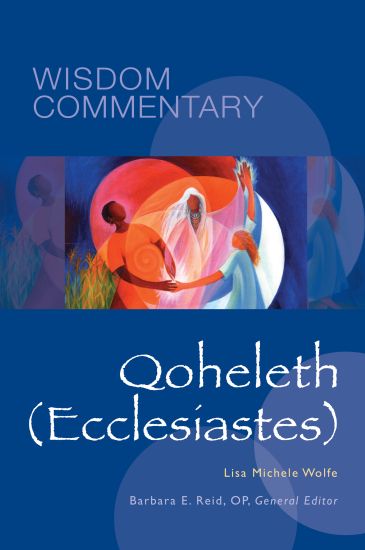
Qoheleth (Ecclesiastes)

Qoheleth (Ecclesiastes)

Lisa M. Wolfe

Liturgical Press
2020
sidottu
2021 Catholic Media Association Award third place award in academic studies Qoheleth, also called Ecclesiastes, has been bad news for women throughout history. In this commentary Lisa Wolfe offers intriguing new possibilities for feminist interpretation of the book's parts, including Qoheleth's most offensive passages, and as a whole. Throughout her interpretation, Wolfe explores multiple connections between this book and women of all times, from investigating how the verbs in the time poem in 3:1-8 may relate to biblical and contemporary women alike, to noting that if 11:1 indicates ancient beer making it thus reveals the women who made the beer itself. In the end, Wolfe argues that, by struggling with the perplexing text of Qoheleth, we may discover fruitful, against-the-grain reading strategies for our own time.
Bodies of War

Bodies of War

Lisa M. Budreau

New York University Press
2011
pokkari
Dissects the politics of commemoration of soldiers, veterans, and relatives from WWI The United States lost thousands of troops during World War I, and the government gave next-of-kin a choice about what to do with their fallen loved ones: ship them home for burial or leave them permanently in Europe, in makeshift graves that would be eventually transformed into cemeteries in France, Belgium, and England. World War I marked the first war in which the United States government and military took full responsibility for the identification, burial, and memorialization of those killed in battle, and as a result, the process of burying and remembering the dead became intensely political. The government and military attempted to create a patriotic consensus on the historical memory of World War I in which war dead were not only honored but used as a symbol to legitimize America's participation in a war not fully supported by all citizens. The saga of American soldiers killed in World War I and the efforts of the living to honor them is a neglected component of United States military history, and in this fascinating yet often macabre account, Lisa M. Budreau unpacks the politics and processes of the competing interest groups involved in the three core components of commemoration: repatriation, remembrance, and return. She also describes how relatives of the fallen made pilgrimages to French battlefields, attended largely by American Legionnaires and the Gold Star Mothers, a group formed by mothers of sons killed in World War I, which exists to this day. Throughout, and with sensitivity to issues of race and gender, Bodies of War emphasizes the inherent tensions in the politics of memorialization and explores how those interests often conflicted with the needs of veterans and relatives.
Boricua Literature

Boricua Literature

Lisa M. Sanchez Gonzalez

New York University Press
2001
sidottu
Since the invasion and colonization of Puerto Rico in 1898, all Puerto Ricans are both American citizens and colonial subjects by birth according to international law. Over a third of this population currently lives in the continental U.S. forming one of the nation's most significant "minority" communities. Yet no complete study of mainland Puerto Rican?or Boricua?literature has been written. Until now. Boricua Literature is the first literary history of the Puerto Rican colonial diaspora. The result of a decade of research in archives and special collections in the Caribbean and in the U.S., Lisa Sánchez González argues that the writing of the Puerto Rican diaspora should be considered an integral field of study. Covering 100 years of Boricua literary history, each chapter looks at the single writer or group of writers who are most emblematic of their respective generation, from William Carlos Williams and Arturo Schomburg, to latina feminism and salsa music. The story of an American community of color, Boricua Literature is also about contemporary critical race and gender studies. Unlike virtually all studies concerning mainland Puerto Rican writing, Lisa Sánchez González is less concerned with "cultural identity" than with unearthing a substantive cultural intellectual history. The first explicitly literary historical analysis of Boricua Literature, this definitive study proposes a new and discreet area of literary historical research in American studies.
Boricua Literature

Boricua Literature

Lisa M. Sanchez Gonzalez

New York University Press
2001
pokkari
Since the invasion and colonization of Puerto Rico in 1898, all Puerto Ricans are both American citizens and colonial subjects by birth according to international law. Over a third of this population currently lives in the continental U.S. forming one of the nation's most significant "minority" communities. Yet no complete study of mainland Puerto Rican?or Boricua?literature has been written. Until now. Boricua Literature is the first literary history of the Puerto Rican colonial diaspora. The result of a decade of research in archives and special collections in the Caribbean and in the U.S., Lisa Sánchez González argues that the writing of the Puerto Rican diaspora should be considered an integral field of study. Covering 100 years of Boricua literary history, each chapter looks at the single writer or group of writers who are most emblematic of their respective generation, from William Carlos Williams and Arturo Schomburg, to latina feminism and salsa music. The story of an American community of color, Boricua Literature is also about contemporary critical race and gender studies. Unlike virtually all studies concerning mainland Puerto Rican writing, Lisa Sánchez González is less concerned with "cultural identity" than with unearthing a substantive cultural intellectual history. The first explicitly literary historical analysis of Boricua Literature, this definitive study proposes a new and discreet area of literary historical research in American studies.
Bodies of War

Bodies of War

Lisa M. Budreau

New York University Press
2009
sidottu
Dissects the politics of commemoration of soldiers, veterans, and relatives from WWI The United States lost thousands of troops during World War I, and the government gave next-of-kin a choice about what to do with their fallen loved ones: ship them home for burial or leave them permanently in Europe, in makeshift graves that would be eventually transformed into cemeteries in France, Belgium, and England. World War I marked the first war in which the United States government and military took full responsibility for the identification, burial, and memorialization of those killed in battle, and as a result, the process of burying and remembering the dead became intensely political. The government and military attempted to create a patriotic consensus on the historical memory of World War I in which war dead were not only honored but used as a symbol to legitimize America's participation in a war not fully supported by all citizens. The saga of American soldiers killed in World War I and the efforts of the living to honor them is a neglected component of United States military history, and in this fascinating yet often macabre account, Lisa M. Budreau unpacks the politics and processes of the competing interest groups involved in the three core components of commemoration: repatriation, remembrance, and return. She also describes how relatives of the fallen made pilgrimages to French battlefields, attended largely by American Legionnaires and the Gold Star Mothers, a group formed by mothers of sons killed in World War I, which exists to this day. Throughout, and with sensitivity to issues of race and gender, Bodies of War emphasizes the inherent tensions in the politics of memorialization and explores how those interests often conflicted with the needs of veterans and relatives.
Families and Their Health Care after Homelessness
First published in 1999. This book focuses on the health and health care use of families after they have left the shelter system, with the first three chapters dedicated to a review of relevant literature. The research is based on self-reported data collected during a follow up study of 543 poor New York City mothers who were first interviewed in 1988.