Kirjojen hintavertailu. Mukana 12 419 756 kirjaa ja 12 kauppaa.

Kirjahaku

Etsi kirjoja tekijän nimen, kirjan nimen tai ISBN:n perusteella.

1000 tulosta hakusanalla Lucio Caio

Introduction to the Maths and Physics of the Solar System
This book provides readers with an understanding of the basic physics and mathematics that governs our solar system. It explores the mechanics of our Sun and planets; their orbits, tides, eclipses and many other fascinating phenomena. This book is a valuable resource for undergraduate students studying astronomy and should be used in conjunction with other introductory astronomy textbooks in the field to provide additional learning opportunities.Features: Written in an engaging and approachable manner, with fully explained mathematics and physics concepts Suitable as a companion to all introductory astronomy textbooksAccessible to a general audience
Introduction to the Maths and Physics of the Solar System
This book provides readers with an understanding of the basic physics and mathematics that governs our solar system. It explores the mechanics of our Sun and planets; their orbits, tides, eclipses and many other fascinating phenomena. This book is a valuable resource for undergraduate students studying astronomy and should be used in conjunction with other introductory astronomy textbooks in the field to provide additional learning opportunities.Features: Written in an engaging and approachable manner, with fully explained mathematics and physics concepts Suitable as a companion to all introductory astronomy textbooksAccessible to a general audience
Occupational Neurotoxicology

Occupational Neurotoxicology

Lucio G. Costa; Luigi Manzo

CRC PRESS
2019
sidottu
First published in 1988, many chemical compounds present in workplace settings can produce a number of impairments in the human nervous system. As the situations in which neurotoxic agents have been recognized in exposed workers has grown, so has the importance of occupational neurotoxicology as a specialty. Addressing some of the most vital concerns in the field, Occupational Neurotoxicology discusses: Neurotoxic agents commonly encountered in the workplace Signs and symptoms of neurotoxicity and of the factors affecting neurotoxic effects Biological monitoring and the use of biomarkers Epidemiological methods and clinical approaches to occupational neurotoxicology The analysis of behavioral, electrophysiological, and imaging techniques in the diagnosis of neurotoxicity Occupational neurotoxicity in developing countries The evaluation and management of occupational illnesses due to neurotoxicityOccupational Neurotoxicology concisely covers important facts on the adverse effects of chemical, biological, and physical agents that can impair or alter the structure of the nervous system. Professionals and researchers in the fields of occupational medicine, toxicology, epidemiology, neurology, industrial hygiene, and psychology will all find relevant information on the health problems that can occur from exposure to neurotoxicants.
Miniature Sorption Coolers

Miniature Sorption Coolers

Lucio Piccirillo; Gabriele Coppi; Andrew May

CRC Press
2020
nidottu
In recent years, there have been significant developments in detector technologies in the field of astrophysics, requiring lower temperatures with simple self-contained refrigerators. Temperatures in the range of 1K to 50mK are now achieved by using dedicated closed-cycle miniature sorption coolers.This book presents the theoretical and experimental knowledge necessary to design and build your own miniature refrigerators, including both single shot and continuous 1 K, 300 mK and 100 mK coolers, and details how to write the needed design software. This text will be of interest to students and researchers, already familiar with basic physics and thermodynamics, who want to understand how sorption coolers and miniature dilution refrigerators work. Features:The first book dedicated to miniature sorption coolersCovers the basic thermodynamic concepts needed to understand the behavior of liquid helium-3 and liquid helium-4Includes an appendix of Python example codes
Introduction to the Maths and Physics of Quantum Mechanics
Introduction to the Maths and Physics of Quantum Mechanics details the mathematics and physics that are needed to learn the principles of quantum mechanics. It provides an accessible treatment of how to use quantum mechanics and why it is so successful in explaining natural phenomena. This book clarifies various aspects of quantum physics such as ‘why quantum mechanics equations contain “I”, the imaginary number?’, ‘Is it possible to make a transition from classical mechanics to quantum physics without using postulates?’ and ‘What is the origin of the uncertainty principle?’. A significant proportion of discussion is dedicated to the issue of why the wave function must be complex to properly describe our “real” world. The book also addresses the different formulations of quantum mechanics. A relatively simple introductory treatment is given for the “standard” Heisenberg matrix formulation and Schrodinger wave-function formulation and Feynman path integrals and second quantization are then discussed. This book will appeal to first- and second-year university students in physics, mathematics, engineering and other sciences studying quantum mechanics who will find material and clarifications not easily found in other textbooks. It will also appeal to self-taught readers with a genuine interest in modern physics who are willing to examine the mathematics and physics in a simple but rigorous way. Key Features: Written in an engaging and approachable manner, with fully explained mathematics and physics concepts Suitable as a companion to all introductory quantum mechanics textbooks Accessible to a general audience
Introduction to the Maths and Physics of Quantum Mechanics
Introduction to the Maths and Physics of Quantum Mechanics details the mathematics and physics that are needed to learn the principles of quantum mechanics.It provides an accessible treatment of how to use quantum mechanics and why it is so successful in explaining natural phenomena. This book clarifies various aspects of quantum physics such as ‘why quantum mechanics equations contain “I”, the imaginary number?’, ‘Is it possible to make a transition from classical mechanics to quantum physics without using postulates?’ and ‘What is the origin of the uncertainty principle?’. A significant proportion of discussion is dedicated to the issue of why the wave function must be complex to properly describe our “real” world.The book also addresses the different formulations of quantum mechanics. A relatively simple introductory treatment is given for the “standard” Heisenberg matrix formulation and Schrodinger wave-function formulation and Feynman path integrals and second quantization are then discussed.This book will appeal to first- and second-year university students in physics, mathematics, engineering and other sciences studying quantum mechanics who will find material and clarifications not easily found in other textbooks. It will also appeal to self-taught readers with a genuine interest in modern physics who are willing to examine the mathematics and physics in a simple but rigorous way.Key Features:Written in an engaging and approachable manner, with fully explained mathematics and physics conceptsSuitable as a companion to all introductory quantum mechanics textbooksAccessible to a general audience
Modular Evolution

Modular Evolution

Lucio Vinicius

Cambridge University Press
2010
sidottu
Natural selection is more than the survival of the fittest: it is a force engendering higher biological complexity. Presenting a new explanation for the tendency of life to become more complex through evolution, this book offers an introduction to the key debates in evolutionary theory, including the role of genes and sex in evolution, the adaptive reasons for senescence and death and the origin of neural information. The author argues that biological complexity increased through the process of 'modularity transfer': modular phenotypes (proteins, somatic cells, learned behaviours) evolved into new modular information carriers (regulatory proteins, neural cells, words), giving rise to new information systems and higher levels of biological organisation. Modular Evolution makes sense of the unique place of humans in evolution, both as the pinnacle of biological complexity and inventors of non-biological evolution.
The Economics of Exchange Rates

The Economics of Exchange Rates

Lucio Sarno; Mark P. Taylor; Jeffery A. Frankel

Cambridge University Press
2003
pokkari
In the last few decades exchange rate economics has seen a number of developments, with substantial contributions to both the theory and empirics of exchange rate determination. Important developments in econometrics and the increasingly large availability of high-quality data have also been responsible for stimulating the large amount of empirical work on exchange rates in this period. Nonetheless, while our understanding of exchange rates has significantly improved, a number of challenges and open questions remain in the exchange rate debate, enhanced by events including the launch of the Euro and the large number of recent currency crises. This volume provides a selective coverage of the literature on exchange rates, focusing on developments from within the last fifteen years. Clear explanations of theories are offered, alongside an appraisal of the literature and suggestions for further research and analysis.
Modular Evolution

Modular Evolution

Lucio Vinicius

Cambridge University Press
2010
pokkari
Natural selection is more than the survival of the fittest: it is a force engendering higher biological complexity. Presenting a new explanation for the tendency of life to become more complex through evolution, this book offers an introduction to the key debates in evolutionary theory, including the role of genes and sex in evolution, the adaptive reasons for senescence and death and the origin of neural information. The author argues that biological complexity increased through the process of 'modularity transfer': modular phenotypes (proteins, somatic cells, learned behaviours) evolved into new modular information carriers (regulatory proteins, neural cells, words), giving rise to new information systems and higher levels of biological organisation. Modular Evolution makes sense of the unique place of humans in evolution, both as the pinnacle of biological complexity and inventors of non-biological evolution.
Programming 32-bit Microcontrollers in C

Programming 32-bit Microcontrollers in C

Lucio Di Jasio

Newnes (an imprint of Butterworth-Heinemann Ltd )
2008
nidottu
*Just months after the introduction of the new generation of 32-bit PIC microcontrollers, a Microchip insider and acclaimed author takes you by hand at the exploration of the PIC32 *Includes handy checklists to help readers perform the most common programming and debugging tasks The new 32-bit microcontrollers bring the promise of more speed and more performance while offering an unprecedented level of compatibility with existing 8 and 16-bit PIC microcontrollers. In sixteen engaging chapters, using a parallel track to his previous title dedicated to 16-bit programming, the author puts all these claims to test while offering a gradual introduction to the development and debugging of embedded control applications in C. Author Lucio Di Jasio, a PIC and embedded control expert, offers unique insight into the new 32-bit architecture while developing a number of projects of growing complexity. Experienced PIC users and newcomers to the field alike will benefit from the text’s many thorough examples which demonstrate how to nimbly side-step common obstacles, solve real-world design problems efficiently and optimize code using the new PIC32 features and peripheral set. You will learn about: *basic timing and I/O operation *debugging methods with the MPLAB SIM *simulator and ICD tools *multitasking using the PIC32 interrupts *all the new hardware peripherals *how to control LCD displays *experimenting with the Explorer16 board and *the PIC32 Starter Kit *accessing mass-storage media *generating audio and video signals *and more! TABLE OF CONTENTS Day 1 And the adventure begins Day 2 Walking in circles Day 3 Message in a Bottle Day 4 NUMB3RS Day 5 Interrupts Day 6 Memory Part 2 Experimenting Day 7 Running Day 8 Communication Day 9 Links Day 10 Glass = Bliss Day 11 It’s an analog world Part 3 Expansion Day 12 Capturing User Inputs Day 13 UTube Day 14 Mass Storage Day 15 File I/O Day 16 Musica Maestro!
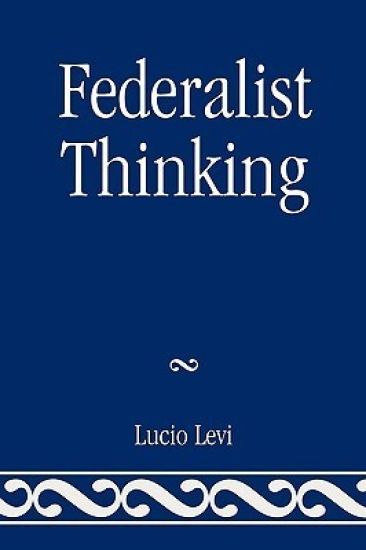
Federalist Thinking

Federalist Thinking

Lucio Levi

University Press of America
2008
nidottu
Federalist Thinking is an attempt to achieve a synthesis among several intellectual contributions in order to reassess the nature of federalism. Professor Lucio Levi points out unobserved relationships among classical thinkers belonging to distant, and generally unrelated, cultural areas. These areas include political and constitutional thinking (from The Federalist Papers to Kenneth Wheare), international relations, philosophy (Immanuel Kant), law, economics (Lionel Robbins and Luigi Einaudi), and history (John R. Seeley and John Fiske). The study also explores the federalist aspect of different political tendencies such as liberalism, democracy, socialism, communism and nationalism (Giuseppe Mazzini). The most recent development of federalism is the trend to become an independent political behavior, represented by towering personalities such as Altiero Spinelli and Albert Einstein, who were among the founders respectively of the movements for European and world unification. A concise and comprehensive account of the development of federalism from its starting point in history to present, this book focuses on disparaging theories and delves into that history.
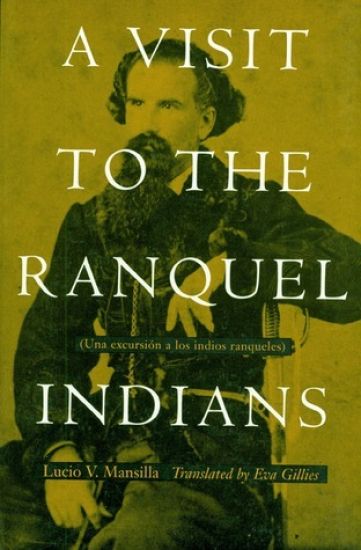
A Visit to the Ranquel Indians

A Visit to the Ranquel Indians

Lucio V. Mansilla

University of Nebraska Press
1997
sidottu
'One of the finest and subtlest books ever written on an American frontier...[A] many layered and ironical masterpiece' - Malcolm Deas, "Times Literary Supplement". 'I find Eva Gillies' translation of Mansilla's work simply superb...[It] provides an excellent reconstruction of Mansilla's momentous journey as well as of his times' - Saul Sosnowski, University of Maryland. Lucio V. Mansilla (1831-1913), the widely traveled and cultured scion of a famous family, was a colonel in the Argentine army when he undertook an 'excursion' to the Argentine interior in 1870 to visit natives in areas then largely unknown. Mansilla's uncle, dictator Juan Manuel de Rosas, dominated most of Argentina from 1829 to 1852 and had led successful military expeditions against the frontier Indians in 1852. Mansilla set out for a reconnaissance into the tense border region just after a peace treaty had been signed with the Indians. Over the course of this expedition, Mansilla sent to a friend in the capital a series of letters which were then serially published in a leading Buenos Aires newspaper. His careful observations offer valuable ethnographic data, as Argentina's Indians were almost totally extinguished or assimilated within a few generations of Mansilla's expedition. Furthermore, his account, which contains thoughtful perspectives on the 'Indian question' and the dichotomy of civilization and barbarism, stands as a lasting contribution to Argentine and Spanish-American literature. Mansilla's work both in this account and elsewhere made him a leading figure in the Argentina 'Generation of 1880', a group crucial in the development of Argentine literary and intellectual life. Translator Eva Gillies, who was born in Argentina, is retired from a lectureship at the University of London.
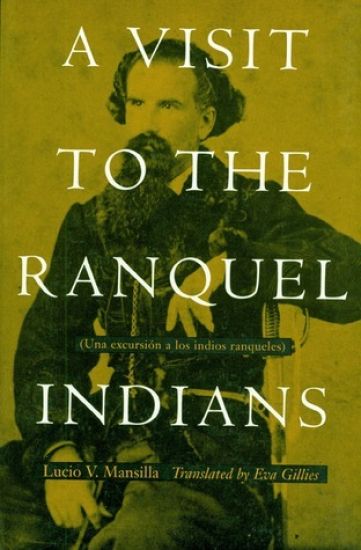
A Visit to the Ranquel Indians

A Visit to the Ranquel Indians

Lucio V. Mansilla

University of Nebraska Press
1997
pokkari
Lucio V. Mansilla (1831–1913), the widely traveled and cultured scion of a famous family, was a colonel in the Argentine army when he undertook an "excursion" to the Argentine interior in 1870 to visit natives in areas then largely unknown. Mansilla's uncle, dictator Juan Manuel de Rosas, dominated most of Argentina from 1829 to 1852 and had led successful military expeditions against the frontier Indians in 1852. Mansilla set out for a reconnaissance into the tense border region just after a peace treaty had been signed with the Indians. Over the course of this expedition, Mansilla sent to a friend in the capital a series of letters which were then serially published in a leading Buenos Aires newspaper. His careful observations offer valuable ethnographic data, as Argentina's Indians were almost totally extinguished or assimilated within a few generations of Mansilla's expedition. Furthermore, his account, which contains thoughtful perspectives on the "Indian question" and the dichotomy of civilization and barbarism, stands as a lasting contribution to Argentine and Spanish-American literature. Mansilla's work both in this account and elsewhere made him a leading figure in the Argentina "Generation of 1880," a group crucial in the development of Argentine literary and intellectual life.
The Interrupted Moment

The Interrupted Moment

Lucio Ruotolo

Stanford University Press
1988
nidottu
Throughout Virginia Woolf’s life and fiction, interruptions arouse inventive impulses, and such disorienting moments constitute, in the author’s view, a key aspect of Woolf’s experimental intention. To remain open to the shock of unmediated experience, what Woolf calls its “anarchy and newness,” is to recognize and celebrate the random diversity of modern life. Those of her characters who allow the chaotic intrusion of events or people to reshape expectations emerge as her most creative heroines. Those who voice distaste for interruption, and succumb to a protective impulse to close themselves off, invariably fall back into postures of self-supporting insularity. In widening perception, the impact of discontinuity occasions a more communal view of art and society-a shift from “I” to “we.” Woolf’s recurring impulse to break derived sequences of art and politics reveals a growing critique of something more fundamental than either patriarchal hierarchy or what Leonard Woolf described as “bourgeois Victorianism.” In the manner of anarchism, she comes to question those presumptions that underlie the theory of governance itself. Central to all her thinking is the revelation of interruption, heralding change, and the growing expectation that society is on the verge of radical transformation. The author studies each novel in turn, showing how the issues that motivated Woolf as a creative writer gradually developed in complexity-from The Voyage Out and its attempt to cultivate the art of doing nothing to Between the Acts and its vision of an egalitarian society where each new interruption emerges with a promise of renewal.
Reputation-Based Governance

Reputation-Based Governance

Lucio Picci

Stanford University Press
2011
sidottu
It would be easy to cheat someone on eBay. However, an essential characteristic of the site prevents this from happening: buyer and seller reviews form what amounts to an "index of reputation." The availability of such an index provides a strong incentive to be an honest trader. Reputation-Based Governance melds concepts from businesses like eBay with politics. Author Lucio Picci uses interdisciplinary tools to argue that the intelligent use of widely available Internet technologies can strengthen reputational mechanisms and significantly improve public governance. Based on this notion, the book proposes a governance model that leans on the concept of reputational incentives while discussing the pivotal role of reputation in politics today. Picci argues that a continuous, distributed process of assessing policy outcomes, enabled by an appropriate information system, would contribute to a governance model characterized by effectiveness, efficiency, and a minimum amount of rent-seeking activity. Moreover, if citizens were also allowed to express their views on prospective policies, then reputation-based governance would provide a platform on which to develop advanced forms of participative democracy.
Marxism and Hegel

Marxism and Hegel

Lucio Colletti

Verso Books
1973
nidottu
The interpretation of Hegel has been a focal point of philosophical controversy ever since the beginning of the twentieth century, both among Marxists and in the major European philosophical schools. Yet despite wide differences of emphasis most interpretations of Hegel share important similarities. They link his idea of Reason to the revolutionary and rationalist tradition which led to the French Revolution, and they interpret his dialectic as implying a latently atheist and even materialist world outlook.Lucio Colletti directly challenges this picture of Hegel. He argues that Hegel was an essentially Christian philosopher, and that his dialectic was explicitly anti-materialist in both intention and effect. In contrast to earlier views, Colletti maintains that there is no contradiction between Hegel's method and his system, once it is accepted that his thought is an exercise in Absolute Idealism stemming from a long Christian humanist tradition. He claims, on the contrary, that intellectual inconsistency is rather to be found in the works of Engels, Lenin, Lukás, Kojève and others, who have attempted to adapt Hegel to their own philosophical priorities.Colletti places his argument in the context of a broad re-examination of the whole relationship between Marxism and the Enlightenment, giving novel emphasis to the relationship between Marxism and Kant. He concludes by re-asserting the importance in Marxism of empirical science against the claim of "infinite reason," while at the same time showing how Marx did transform key ideas in Hegelian thought to construct a consistently materialist dialectic.