Kirjojen hintavertailu. Mukana 12 352 067 kirjaa ja 12 kauppaa.

Kirjahaku

Etsi kirjoja tekijän nimen, kirjan nimen tai ISBN:n perusteella.

676 tulosta hakusanalla Lucretius

Lucretius: Selections from the De Rerum Natura

Lucretius: Selections from the De Rerum Natura

Titus Lucretius Carus

Bristol Classical Press
2000
nidottu
Lucretius offers his readers a complete guide to happiness and a total tour of the universe. Even a few selections from his poetry reveal the radical freethinker at his very best. This book draws on the latest research into the text and interpretation of Lucretius. It is aimed at the sixth-former or undergraduate who seeks a helpful introduction to the poem; little background knowledge of Latin literature will be assumed. The commentary elucidates both the poetic artistry and philosophical content.
Lucretius and the Didactic Epic

Lucretius and the Didactic Epic

Monica R. Gale

Bristol Classical Press
2001
pokkari
The "De Rerum Natura" of Lucretius (?97-55 BC) is at first sight something of an oddity: a scientific treatise dealing with atomic physics, human biology and the nature of the cosmos, it is at the same time a poem of great power and intensity, one of the most important and influential literary works of its era. This book seeks to resolve the apparent contradiction by locating Lucretius' poem in the context of a very ancient tradition of didactic (or 'teaching') epic. It explores some of the ways in which Lucretius, in this attempt to convince the reader of the truth of his philosophical system, makes the traditional features of epic poetry work for him. And it discusses the poet's subtle interweaving of technical exposition with ethical precept, arguing that the poem offers the reader not just a scientific account of the workings of nature, but also a guide to happiness.
Lucretius: His Continuing Influence and Contemporary Relevance
Lucretius (c. 99 BCE-c. 55 BCE) is the author of De Rerum Natura, a work which tries to explain and expound the doctrines of the earlier Greek philosopher Epicurus. The Epicurean view of the world is that it is composed entirely of atoms moving about in infinite space. The implications of this view are profound: the proper study of the world is the province of natural philosophy (science); there are no supernatural gods who created the world or who direct its course or who can reward or punish us; death is simply annihilation, and so there is no next life and no torment in an underworld. Epicurus, and then his disciple Lucretius, advocated a simple life, free from mental turmoil and anguish. The essays in this collection deal with Lucretius's critique of religion, his critique of traditional attitudes about death, and his influences on later thinkers such as Isaac Newton and Alfred Tennyson. We see that Lucretius's philosophy is connected to contemporary philosophy such as existentialism and that aspects of his thought work against trying to separate the sciences and the humanities. Lucretius: His Continuing Influence and Contemporary Relevance is the title of a 2009 conference on Lucretius held at St. John Fisher College, when many of the ideas in these essays were first presented.
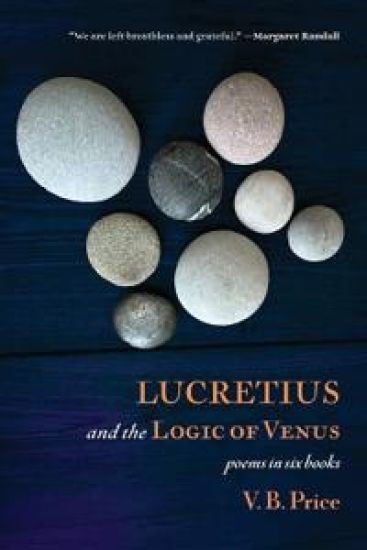
Lucretius and the Logic of Venus

Lucretius and the Logic of Venus

V B Price

Casa Urraca Press
2023
pokkari
Why did Lucretius begin his poem on physics and the philosophy of materialism with an invocation of the Goddess Venus? Is love a mere attraction, a kind of helpless gravity, or is there a holy logic to it, a divine sense to be made both in and beyond cosmic matter, a logic to not only feeling it, but to sustaining it, and meaning it?These questions are what V. B. Price sets out to explore in his response to the Roman poet Lucretius's classic On the Nature of Things. The result is timeless while reaching across time, a philosophical and heartfelt call for pleasure in a world too often reluctant to embrace it.
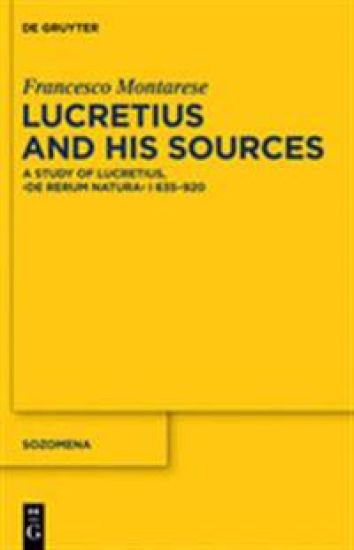
Lucretius and His Sources

Lucretius and His Sources

Francesco Montarese

De Gruyter
2012
sidottu
This book discusses Lucretius’ refutation of Heraclitus, Empedocles, Anaxagoras and other, unnamed thinkers in De Rerum Natura 1, 635-920. Chapter 1 argues that in DRN I 635-920 Lucretius was following an Epicurean source, which in turn depended on Theophrastean doxography. Chapter 2 shows that books 14 and 15 of Epicurus’ On Nature were not Lucretius’ source-text. Chapter 3 discusses how lines 635-920 fit in the structure of book 1 and whether Lucretius’ source is more likely to have been Epicurus himself or a neo-Epicurean. Chapter 4 focuses on Lucretius’ own additions to the material he derived from his sources and on his poetical and rhetorical contributions, which were extensive. Lucretius shows an understanding of philosophical points by adapting his poetical devices to the philosophical arguments. Chapter 4 also argues that Lucretius anticipates philosophical points in what have often been regarded as the ‘purple passages’ of his poem - e.g. the invocation of Venus in the proem, and the description of Sicily and Aetna - so that he could take them up later on in his narrative and provide an adequate explanation of reality.
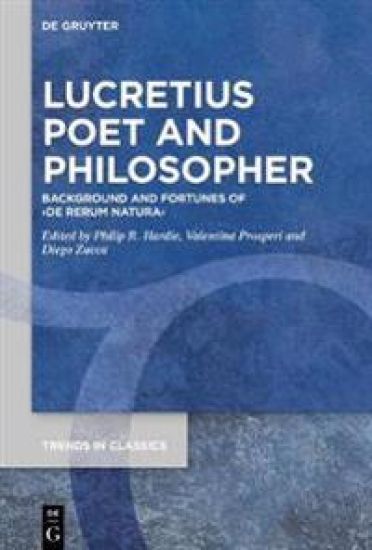
Lucretius Poet and Philosopher
Six hundred years after Poggio’s retrieval of the De rerum natura, and with the recent surge of interest in Lucretius and his influence, there has never been a better time to fully assess and recognize the shaping force of his thought and poetry over European culture from antiquity to modern times. This volume offers a multidisciplinary and updated overview of Lucretius as philosopher and as poet, with special attention to how these two aspects interact. The volume includes 18 contributions by established as well as early career scholars working on Lucretius’ philosophical and poetic work, and his reception both in ancient and early modern times. All the chapters present new and original research. Section I explores core issues of Epicurean-Lucretian epistemology and ethics. Section II expounds much new material on ancient response to and reception of Lucretius. Section III presents new material and analysis on the immediate, fraught early modern reception of the poem. Section IV offers a wide collection of new and original papers on Lucretius’ fortunes in the period from Machiavelli up to Victorian times. Section V explores little known aspects of the iconographical and biographical motifs related to the De rerum natura.
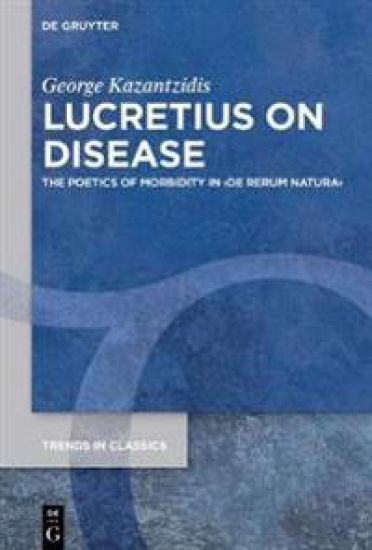
Lucretius on Disease

Lucretius on Disease

George Kazantzidis

De Gruyter
2021
sidottu
The standard view in scholarship is that disease in Lucretius' De rerum natura is mainly a problem to be solved and then dispensed with.However, a closer reading suggests that things are more layered and complex than they appear at first sight: just as morbus causes a radical rearrangement of atoms in the body and makes the patient engage with alternative and up to that point unknown dimensions of the sensible world, so does disease as a theme generate a multiplicity of meanings in the text. The present book argues for a reconsideration of morbus in De rerum natura along those lines: it invites the reader to revisit the topic of disease and reflect on the various, and often contrasting, discourses that unfold around it. More specifically, it illustrates how, apart from calling for therapy, disease, due to its dominant presence in the narrative, transforms at the same time into a concept that is integral both to the poem’s philosophical agenda but also to its wider aesthetic concerns as a literary product.The book thus sheds new light on De rerum natura's intense preoccupation with morbus by showing how disease is not exclusively conceived by Lucretius as a blind, obliterating force but is crucially linked to life and meaning—both inside and outside the text.
Lucretius on Disease

Lucretius on Disease

George Kazantzidis

De Gruyter
2022
isokokoinen pokkari
The standard view in scholarship is that disease in Lucretius' De rerum natura is mainly a problem to be solved and then dispensed with.However, a closer reading suggests that things are more layered and complex than they appear at first sight: just as morbus causes a radical rearrangement of atoms in the body and makes the patient engage with alternative and up to that point unknown dimensions of the sensible world, so does disease as a theme generate a multiplicity of meanings in the text. The present book argues for a reconsideration of morbus in De rerum natura along those lines: it invites the reader to revisit the topic of disease and reflect on the various, and often contrasting, discourses that unfold around it. More specifically, it illustrates how, apart from calling for therapy, disease, due to its dominant presence in the narrative, transforms at the same time into a concept that is integral both to the poem’s philosophical agenda but also to its wider aesthetic concerns as a literary product.The book thus sheds new light on De rerum natura's intense preoccupation with morbus by showing how disease is not exclusively conceived by Lucretius as a blind, obliterating force but is crucially linked to life and meaning—both inside and outside the text.
Lucretius on the Nature of Things

Lucretius on the Nature of Things

Charles Frederick Johnson

Anatiposi Verlag
2023
pokkari
Reprint of the original, first published in 1872. The publishing house Anatiposi publishes historical books as reprints. Due to their age, these books may have missing pages or inferior quality. Our aim is to preserve these books and make them available to the public so that they do not get lost.
Lucretius on the Nature of Things

Lucretius on the Nature of Things

Charles Frederick Johnson

Anatiposi Verlag
2023
sidottu
Reprint of the original, first published in 1872. The publishing house Anatiposi publishes historical books as reprints. Due to their age, these books may have missing pages or inferior quality. Our aim is to preserve these books and make them available to the public so that they do not get lost.
Lucretius On The Nature Of Things; A Philosophical Poem In Six Books
This book has been considered by academicians and scholars of great significance and value to literature. This forms a part of the knowledge base for future generations. So that the book is never forgotten we have represented this book in a print format as the same form as it was originally first published. Hence any marks or annotations seen are left intentionally to preserve its true nature.
Lucretius and the Late Republic
The crisis Rome experienced in the last decades of the Republic was intellectual as well as political, social and military. This crisis was marked by conflicts over values and a growing dichotomy between words and things, as a result of which the key words of the Roman tradition lost their anchor in the inherited, commonly-held percepetion of reality known as the mos maiorum. The crisis was therefore also one of the Latin language itself. The monograph explores this thesis in discussions of the background and character of Roman intellectual history, the nature of the mos maiorum, the relationship of the Late Republic to the Mediterranean world, the roles of Julius Caesar, Catullus, Cicero, and Lucretius in the crisis, and its Augustan and later consequences. The major portion of the discussion is devoted to Lucretius, because the De Rerum Natura is the clearest example of the extent and nature of the crisis, from which it took its origin and gained its form and purpose. A principal goal of the essay is to relate Lucretius to the structure of Roman literary and intellectual history. It finds the explanation for his work in the nature of that history and the characteristic Roman modes and categories of thought rather than in the general history fo Greek philosophy. It also offers a new explanation of the relationshiop of the authors of the Late Republic to each other. In so doing, it indicates the foundation for a new history of Roman literature and a new conception of the reality and importance of the intellectual history of Rome.